

Topics
-
The latest setback has fueled worries that Google was losing momentum just as OpenAI and Anthropic and a host of Chinese rivals have accelerated the pace of model releases. On the call on Wednesday, Pichai struck an unusually defensive tone as analysts pressed him on the state of Google's frontier models and whether they could still compete at the cutting edge of AI development. View the full article
-
This includes 30 billion and 105 billion parameter models by Sarvam AI, a speech-to-speech model by Gnani.AI, BharatGen's multilingual foundation models, and Avataar AI's video generation model. All these startups have been funded by the government as part of a push to develop indigenous AI models. Of the 20 models, five have been released so far. View the full article



Leaderboard
-
Anita Upadhyay
Members6Points14Posts -
R Rajesh
Members6Points160Posts -
Shailesh_Chavan
Members2Points3Posts -
Vastupal Vashisth
Members1Points130Posts





Popular Content
Showing content with the highest reputation on 09/06/2017 in all areas
-
6 pointsCause is a variable which affects the outcome by increasing its chances or making it happen. Problem is the outcome of the cause. Scenario Understanding Conclusion Action A cause (X) may be necessary but not sufficient for a problem (Y) to occur. Problem (Y) occurs ONLY when cause (X) is TRUE Problem (Y) may not occur even when the cause (X) is TRUE Causes other than X (A, B, …) must occur together with X for problem Y to occur Fix the cause (X) to remove one of the factors causing the problem (Y) however this will not fix it so look for other causes (A, B, ..) that result in this problem (Y) and address them too to fix the problem (Y). A cause (X) may be sufficient but not necessary for a problem (Y) to happen. Problem (Y) occurs whenever cause (X) is TRUE Problem (Y) can occur even when cause (X) is not TRUE Cause X is a definite cause for the problem (Y), however other causes (A, B, … ) can also result in this problem (Y) Fix the cause (X) to address some scenarios in which the problem (Y) occurs. However look for other causes (A, B, ..) which may also result in this problem to fix it for all scenarios. A cause (X) may be neither sufficient nor necessary for a problem (Y) to occur. Problem (Y) may not occur even when cause (X) is TRUE Problem (Y) can occur even when cause (X) is not TRUE Cause X is not established as a reason for the problem (Y) Fixing cause (X) may not fix the problem (Y). Look for other causes (A, B, ..) which are likely to be more relevant cause for this problem (Y) A cause may be both sufficient and necessary for a problem to occur. Problem (Y) occurs ONLY when cause (X) is TRUE Problem (Y) occurs whenever cause (X) is TRUE Cause X is a definite cause for problem Y Fixing cause (X) may fix Y completely.6 points
-
5 pointsGeneric Definition: Necessary means something needed. Sufficiency - an amount of something that is enough for a particular purpose 1). A cause may be necessary but not sufficient for a problem to occur: This means that the problem did/do not arise because of a single cause. There could be multiple causes which could lead to the problem Eg: An Application running in the system is responding very slowly. We could think that it could be due to less memory space in hard disk/RAM . But it may not be the only reason. It could be due to too many applications opened up thereby busying the CPU. It could also be because of some heavy processes running in the background or any other reasons. So our approach should be: a). To find out what other causes could be there which can make the problem to occur. b). Do try to drill down with 5-Why analysis or tree analysis of the problem or make Fishbone analysis and find out the other causes/category of causes. 2). A cause may be sufficient but not necessary for a problem to happen: This implies that a particular cause can be a potential source for the problem to occur but not necessarily be the primary one which will create the problem. Eg: If System "Welcome Screen" (logging in) taking time is a problem, then increasing the RAM size may be useful but it may not necessarily be increasing the speed as still the Processor CPU/Processor Speed(Frequency) could need to be addressed. There could be some more ways which can make this speed increased to Our approach should be : a). Find out the ways to have necessary conditions and satisfy sufficiency 3). A cause may be neither sufficient nor necessary for a problem to occur This portrays the fact that you are aware of the causes and have sufficient and needed information to resolve.But still there is a better workaround to ensure that problem does not occur Eg: You/Your organisation has technical challenge on Non Functional requirements and you think you know the causes and has sufficient and needed knowledge. However It will take 2 months of time for your team to complete this . But management outsources this to expedite this activity. So the approach should be a). To make effective use of the alternative method/approach that is being planned out for the problem. 4). A cause may be both sufficient and necessary for a problem to occur This means that initial assumptions are made on the necessity and sufficiency of causes, for a problem. Eg: If the problem is the smelling(bad odour) of Septic tank of the house, then immediately the assumption is made that the tank could be full and hence the smell is arising. So our approach would be : a). To validate as much as you can to ensure that the assumptions made are true. If not, then course correction needs to be done b). Depending on the assumptions , we need to proceed. If assumptions are false, then follow one of the approaches from the remaining 3 options/conditions5 points
-
2 pointsMeans Approach for problem solving Case 1 A cause may be necessary but not sufficient for a problem to occur. - This cause is must for problem to occur but cannot cause the problem alone. - There will be additional cause/s which are necessary & interaction of these causes becoming sufficient for problem to occur. - Find out other cause/s which are necessary for problem to occur. - Check which cause out of these is easy to eliminate & improvement made is easy to sustain. - Eliminate that cause to solve the problem. Case 2 A cause may be sufficient but not necessary for a problem to happen - This cause can alone cause the problem to occur - But there may be other cause/s also which can cause the problem to occur even in the absence of mentioned cause - Find out other cause/s which are sufficient for problem to occur. - Find out which cause is creating the problem most. - Start working on that cause. After eliminating the first one take next cause which causes the problem most & so on…. Case 3 A cause may be neither sufficient nor necessary for a problem to occur This cause is not the main cause for problem to occur - Find out the cause/s which are necessary for problem to occur. - If there is only one cause eliminating it will solve the problem. - If there are more than one necessary causes use approach mentioned for CASE 1. - If there is no necessary cause, find out significant cause/s & use approach mentioned for CASE 2 - If there is no significant cause also check interactions of probable causes & find out which interactions become significant. Then try to eliminate the easy to eliminate causes from each of these interactions to solve the problem. Case 4 A cause may be both sufficient and necessary for a problem to occur. - This is the main root cause for the problem. - There may be other root causes which are necessary for problem to occur but they will not able to cause the problem in the absence of this cause. - Eliminate this cause to solve the problem.2 points
-
1 pointNecessary - X is a must for Y to occur. Y cannot occur unless X is present. Sufficient - X is enough to cause Y. However, Z may also cause Y. Scenario 1 - Cause is necessary but not sufficient. X occured at some time for Y to have occured but alongside other factors. In this case, other causes that could have caused Y when combined X have to be found. E.g. there was a case of cars catching fire if hit from behind when the right indicator was on. Having the right indicator on was necessary but not sufficient for a car to catch fire. It had to be combined with the other factor of being hit from behind in order for it to catch fire. Hence, we are looking for critical combinations of other causes with this X. 2. Cause is sufficient but not necessary - means that X on it's own can cause Y. But this is not the only cause leading to Y. It is required in this case to make sure that other causes are also found out, else the problem may remain unresolved even when X is fixed. E.g. not having enough water in a day can cause headaches. But so can not eating on time. Even if you keep having water, but not having food could.still trigger the headaches. 3. Neither sufficient nor necessary - Even if X happens, Y will not occur. In this case this cannot.be deemed as a root cause. Solving for this X will be futile. Other causes ought to be explored in order for the problem to be solved. E.g. an executive assistant not having an app for calling a cab for her boss is neither a reason sufficient to not get a cab, nor is it necessary. A cab can still be called via a phone call, by asking someone else to order, or booked through a website, by hailing from the street. 4. Both sufficient and necessary - must be solved for as whenever X occurs Y will occur. If this is not solved, you have not resolved the problem1 point
-
1 pointRoot cause analysis - Root cause analysis is an approach for identifying the underlying causes of an incident so that the most effective solutions can be identified and implemented. It’s typically used when something goes badly, but can also be used when something goes well. Within an organization, problem solving, incident investigation, and root cause analysis are all fundamentally connected by three basic questions: What’s the problem? Why did it happen? What will be done to prevent it from happening again? ============================ A cause may be necessary but not sufficient for a problem to occur. A cause may be necessary but not sufficient for a problem to occur - It can be true as per the statement like to have a rain it needs to be cloudy which is necessary however are the clouds black enough to bring rain talks about sufficiency part. In such situation our focus should be on sufficiency part because untill it becomes sufficient the problem part will not occur.so if we can prevent the sufficiency it will save the problem occurence. ============================== A cause may be sufficient but not necessary for a problem to happen In this situation necessity does not play important role because being sufficient is more important.There could be more than one factor to make a thing sufficient.Hence we should work on all those reason to prevent from happening which can be sufficient for a problem to happen. ==================================== A cause may be both sufficient and necessary for a problem to occur. In this situation both being sufficient and necessary are equally important and they are very much linked to each other for a problem to occur.so to prevent a problem to occur we should work on both the aspects together. ============================================= A cause may be neither sufficient nor necessary for a problem to occur.1 point
-
1 point1. A cause may be necessary but not sufficient for a problem to occur. Meaning: Along with this there are more causes making this problem happen Action: Identify all other causes to satisfy "sufficient" condition. 2. A cause may be sufficient but not necessary for a problem to happen. Meaning: Apart from this there are other independent causes making this problem happen Action: Identify all causes to satisfy "necessary" condition 3. A cause may be neither sufficient nor necessary for a problem to occur. Meaning: Along with this there are both dependent and independent causes making the problem occur Action: Identify all causes to satisfy both "necessary" and "sufficient" condition 4. A cause may be both sufficient and necessary for a problem to occur. Meaning: This is all that is required to make the problem happen and nothing else Action: Straight away to analyze and measuring Xs1 point
-
1 point1. A cause may be necessary but not sufficient for a problem to occur This is a situation that crops up for most problems, where we quickly and certainly identify certain conditions, situations or factors that have been prevalent, without which the problem could never have happened. A popular example is when a change is implemented in a product and it fails after deployment, one of the obvious and necessary condition is that there has been an inadequacy in the testing / approval process, though that by itself could not have caused the problem. In short, any lapse in a failure containment system is always necessary but not sufficient reason for a failure. More examples are possible. In such situations, one of the immediate reaction is to fix the identified ""necessary" condition to help arrest or contain further occurrences, until we proceed and figure out the other causes. 2. A cause may be sufficient but not necessary for a problem to happen This represents a situation where multiple, possibly independent causes exist. For example, being absent is sufficient to fail in an examination, but not necessary. However, being present for the exam is a necessary condition to pass the exam, but not sufficient.The problem with dealing with causes that are sufficient for the failure, is our ability to pre-identify all such potential causes exhaustively. Ideally we should prevent all such causes, and the degree of exhaustiveness with which we do so, will result in the degree of non-failure. Goes without saying the if such a situation occurs, it has to be addressed and the learning used in strengthening the related FMEA. 3. A cause may be neither sufficient nor necessary for a problem to occur. Most of us will be familiar in the use of Brain storming and the Fish-Bone diagram. Once we list down a list of causes through brainstorming, we try to start narrowing down to potential ones and then the most probable ones. Those causes that are identified as "not necessary and sufficient" tend to get eliminated to help get closer to the actual cause. However, even if an individual cause may be insufficient to cause a problem, it has to be seen if it becomes a threat when combined with other cause(s). 4. A cause may be both sufficient and necessary for a problem to occur. Whenever we consider a cause to be necessary and sufficient for a problem, we tend to make several involuntary assumptions. For example, if a person has to get an electric shock upon touching a metal surface of an appliance, it is necessary that there must be a current leakage. However a combination of current leakage and earthing failure makes it sufficient for providing an electric shock. (We are assuming many things, for example, no lightning should have struck the appliance when the person touched it!) If we look at it the other way, it is sufficient to have a reliable earthing on the appliance to avoid getting an electric shock. It is often difficult to relate one cause as sufficient and necessary for a problem. It is more common to associate it with a set of causes.1 point
-
1 pointRoot Cause Analysis is for a problem solving. approach to be follow according to four possibilities: A cause may be necessary but not sufficient for a problem to occur. for example customer found a wrong Door assembled in a car because a wrong variant part has been assembled to another child part in welding jig. in this, wrong variant part supplied and welded with child part in welding jig is necessary cause for wrong assembly but not sufficient because system is not so effective that it can stop assembly of wrong variant parts to child parts and stop delivery of those wrong assembled door in car. we can do why why analysis/brainstorming and can do Poka-Yoke to error proof so that wrong variant will not be assemble with child part in welding jig so that it customer will not get wrong assembled door in the car. A cause may be sufficient but not necessary for a problem to happen. let me tell you this with a example, if a part is rejected then to have crack in part is sufficient to reject it but its not necessary to have only crack because there are other factors also due to which part can be rejected. So in this case we can use Why Why analysis to find out root cause. A cause may be neither sufficient nor necessary for a problem to occur. For example we have rejection of different parts due to different factors because one cause is neither sufficient nor necessary, so we should do initially brainstorming, affinity diagram followed by Pareto Analysis for prioritization and then do why why and fishbone analysis accordingly A cause may be both sufficient and necessary for a problem to occur. Parts not delivered to next customer because of non availability of parts due to non production that is sufficient and necessary condition. in this case we can for JDI( just do it), we can produce the parts and can deliver the parts to next customer because we know both cause and solution.1 point
-
1 pointRoot cause analysis: It is typically a very effective technique to identify the root causes for a problem or an issue. This technique uses the approach of right questioning such as WHYs. In order to do this analysis, it is also important to clearly identify the problems or issues for which we are going to identify the root causes. considering 4 possibilities: (as per the question) Example; Problem: campus placement did not happen, 1. A College could be the cause, but this is not sufficient. It can also be that the job market is also not good for being placed. 2. College could be sufficient cause, but not necessary. If the student would have put right efforts, he would have been still placed. 3. College may not be the reason at all, it could be the market and insufficient efforts by the students could be the main cause for no placement 4. The college could be the main cause as it doesn't call any companies to come for campus placements. In such cases and scenarios, Root cause analysis helps to find the right cause.1 point
-
Please see the answer from the Club 57.
 1 point
 -
Hi All Please find below comparison on the topic. Hope I can connect to the lot here. Business Excellence Process Excellence Operational Excellence Personal Excellence INQUIRY What am I supposed to do How am I supposed to do When am I supposed to do Who am I CRITERIA Vision Outcome Output Realization FOCUS AREA Market Competitiveness Continuous Improvement Quality Service Learning RELATIONSHIP Transforming Reframing Refining Acting ORDER You start with You design it into You execute it as You reinvent each time ABSENCE CAUSES Annihilation Variation Waste Insatiety APPROACH Balance Score Card Etc Value Stream Mapping Etc 7 QC, 7 MT, 7 Waste Selflessness and learning Regards Igniting Minds 95 ( Nagraj Bhat - On behalf of )1 point
-
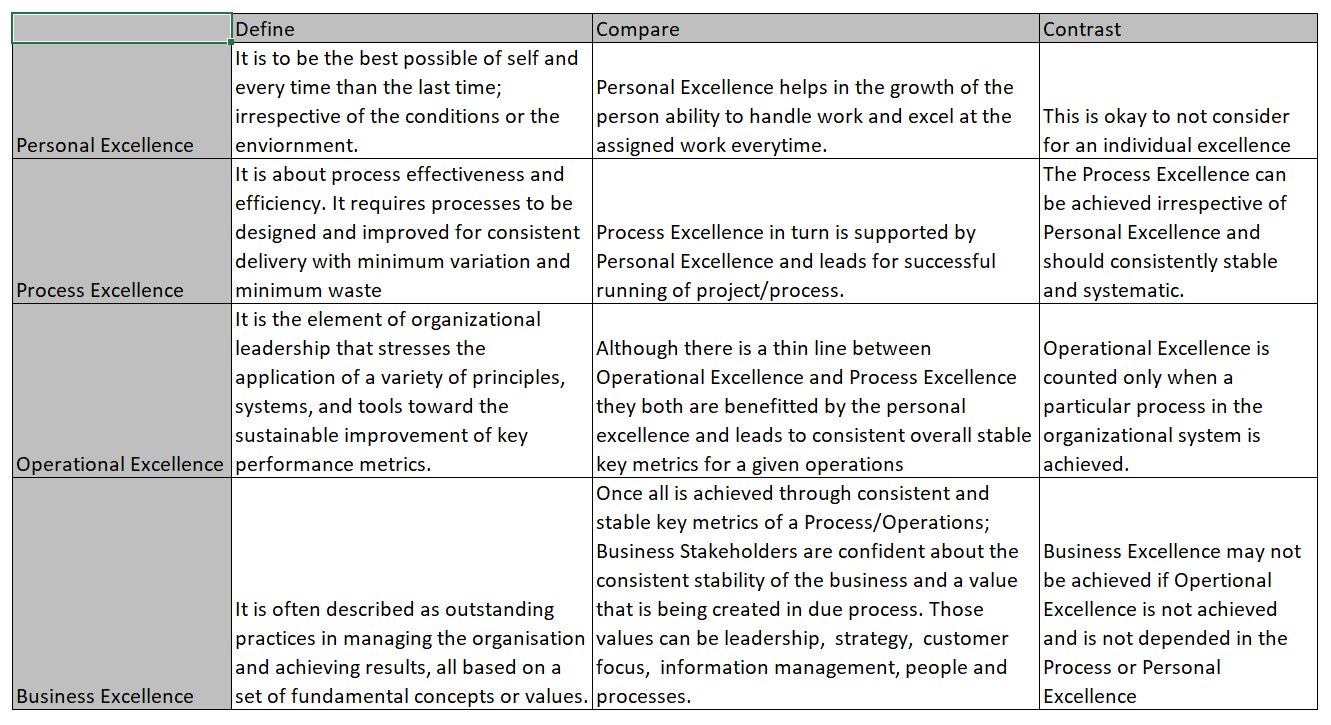
To define the above I will start with defining Business Excellence: Business excellence is often described as outstanding practices in managing the organization and achieving results, all based on a set of fundamental concepts or values. These practices have evolved into models for how a world class organization should operate studying each other's operational styles. The most common model include; Baldrige (MBNQA)- used in over 25 countries including US and NZ European Foundation for Quality Management- Used throughout Europe Japan Quality Award Model-used in Japan Singapore Quality Award Model- Singapore The most popular and influential model used in the western world is Malcolm Baldrige Award Model which consists of practices that are incorporated into six approach categories: Leadership Strategic Planning customer and market focus Measurement, Analysis and Knowledge Management workforce focus Process management Business results The model revolves around values like Visionary leadership where there is organizational and higher leadership commitment for achieving excellence, Customer driven Excellence where goals of the organization are made to satisfy ever changing customer demands, Organization and Personal learning to include People and its operations towards excellence, Valuing employees and Partners to have everlasting engagement for excellence, Focus on the future, Managing Innovation, Management by Fact, Social Responsibility, Focus on Results and Create Value and Systems perspective throughout. Now to define operational excellence the philosophy of the workplace is built around problem solving, team work and leadership results in the ongoing improvements of the Organization. the process involves focusing on the customer needs, keeping the employees positive and empowered and continually improving the current activities in the workplace. Several tools like applying Lean Six Sigma, TOC are used. Process excellence is about process effectiveness and efficiency of the operations handled by an organization. It requires processes to be designed and improved for consistent delivery with minimum variation (applying six sigma) and minimum waste (applying Lean). This will strengthen to meet the objectives of operational and business excellence. Personal excellence is being the excellent personal assets for the organization in which the people continuously evolving themselves with agility to bring about continual improvements in the processes they are involved helping meet the organizational goals. In nutshell the relationship is as below Personal Excellence leads to ---> Process Excellence leads to ---> Operational Excellence leads to ---> Business Excellence Business Excellence drives ------>Operational Excellence drives ------>Process Excellence drives ------>Personal Excellence1 point
-
Excellence : Excellence is defined as the quality of being extremely good So what is Personal excellence? In simple words, setting up the bar higher [benchmark] in whatever activities, the individual(who is compared with the rest) does. Process Excellence: Providing an environment where the processes are highly stable and controlled with a minimal or no variation and with minimum or no wastage(Muda). Focus is on continuous improvement to ensure processes are highly stablized Operational Excellence: It reflects the way how as a person, unit, you or your team/organisation excel at parameters such as Cost, Human Resources, scope, time, quality etc.,. By excelling at this, the provider of a service, can provide value to the customer with optimal/maximum efficiency. Business Excellence: It is through which you make your business, with effective strategies ,efficient business plans , best business practices so that optimal results are achieved at a sustained rate. How each one is related to the other one(s): Personal Excellence is directly tied to Process Excellence. If and only if the individual is interested to adhere to the processes laid out, then process excellence or for that matter any other activity can be successful . If the cultural shift/mindset is not there amongst the individual/team , then no change would work. This can be represented by the formula : Quality of the solution (Q) * Acceptance of the solution (A) = Effectiveness of the solution (E). Unless there is an acceptance to any thing (which is the human part) nothing can be done. So if the individual has the desire to excel at his/her work, then he/she would strive to make sure he/she/the organization achieve Process Excellence. Process Excellence provides a way for continuous improvement. Purpose of process excellence is to streamline all the processes , make them stable and in the process to achieve minimal degree of variation and minimal wastage. By having a process excellence system in place, grey areas in Operational excellence and Business excellence can be identified and improved/rectified upon. Practically it is difficult to achieve excellence in one when another one is absent. For instance, Business and Operational excellence would require process improvements. If streamlining does not happen there then there is no excellence in Business and in Operational aspects as well.Similarly without human intervention or the elevated mindset of the individual, it becomes difficult to successfully run the processes at a top-notch. From an organisation perspective, the organisation should Provide a conducive environment to work with wherein by individuals can be encouraged to share their ideas/thoughts and create a transparency, making them feel belonging to the organisational/unit's problems/constraints (Personal Excellence) Encourage individuals to showcase their creativity in designing/providing solutions to problems (Personal Excellence) Create Challenging contests and rewarding people on various categories such as best creativity,best solution, optimal solution,... (Personal Excellence) Setup process standards and metrics for each parameter(Define the expectation).Set the Upper & Lower limit & also customer specification limits (Process Excellence) Conduct awareness sessions on process expectations with reasoning and justifications. Provide details with SMART goals (Process Excellence) Ensure that individuals/teams adhere to the standards with constant monitoring through Audits/Inspections/reviews. (Process Excellence) Look out for scope for continuous improvements periodically and accordingly adjust the process baseline if required. (Process Excellence) Define the Operational parameters that requires excellence. (Operational Excellence) Conduct awareness sessions to key stakeholders on those operational parameters and provide the plan on when and how to achieve them (Operational Excellence) Ensure the status of operational excellence through Project Management Reviews/status reports and other similar artefacts and address the deviations (Operational Excellence). Preserve the best practices that were followed to achieve Operational Excellence (Operational Excellence) Define the strategies/plans needed for improving the business results (Business Excellence) Define the best practices in getting business-oriented goals/activities done (Business Excellence) Conduct Confidential meeting with key stakeholders and provide the envisaged plan to them and convey your expectation (Business Excellence) Conduct monthly/quarterly review meetings with respective units and look onto the 4-quarter dashboard. (Business Excellence) Get Business Mgmt section of Customer Satisfaction Survey from the customer to see if organisation is in target with its objective (Business Excellence) Document the outcome of the business results and the effective means to achieve them (Business Excellence)1 point




This leaderboard is set to Kolkata/GMT+05:30