


Vishwadeep Khatri
Administrators
-
Joined
-
Last visited
Everything posted by Vishwadeep Khatri
-
Here is a story followed by a multiple choice question for everyone to opine and discuss: You might have heard this story of a Washington Monument where erosion had reached worrisome levels. The erosion at this specific monument was much faster as compared to other similar monuments. Cause analysis showed that a strong chemical was needed to clean pigeon poops and there was no alternative. This cleaning chemical was leading to erosion. The reason for the presence of pigeons in large numbers was next analyzed. It was found that Pigeons like Spiders. Spiders were present in large numbers. As the focus shifted to spiders, it was found that spiders were around due to Gnats (a type of insect) as Spiders prey on Gnats. Gnats reached the monument daily as they are attracted to artificial light at the time of dusk. Lights at this monument were usually turned on before dusk. So, it was thought that in turning lights on only after dusk should work effectively, so that Gnats do not appear to attract Spiders, absence of whom shall keep Pigeons away, that leads to no Pigeon poops so that the chemical and therefore erosion is avoided. This solution of turning the lights on only after dusk was implemented. It was found that the Pigeon poops stopped appearing on the monument and the cleaning chemicals was no more required. Observations over a period of time showed that the Monument's erosion patterns now matched those of other similar monuments and the experts concluded that the problem is completely solved. QUESTION - When we do root cause analysis, the causes can be of two types: Necessary cause(s): In absence of such cause, the event cannot happen. Sufficient cause(s): If this cause is present, the event shall surely occur. In the above stated Monument's example of problem-solving, which set of the following causes do you think to meet both the criteria (of being necessary and sufficient), for the next event? Please refer to the figure above to answer this question. A, B, C, D, and E A, B, C, D, and F A, B, D, E, and F A, C, D, E, and F B, C, D, E, and F All A, B, C, D, E, and F ------------------------------------------------------------------------------------------------------------------------------------------------------------------------------------------------------ Please log in to reply to this post. Please note: login is easy. You can even use facebook or google account to login.
-
This aircraft landed short of the runway with tail touching down first. Most passengers survived. There were 307 on board, including 16 crew. Officials said 123 escaped without injury and 181 were hospitalized or treated for injuries. Among the injured, 49 are in serious condition and five at San Francisco General Hospital, including a child, remain in critical condition. Among the 47 others at San Francisco General, several were treated for minor injuries, including fractures and abrasions, and were released Saturday night. The first crash for a Boeing 777. We wait to understand why it happened as investigations are underway.
-
-
Hello Chandrasekar, One common thumb rule for quality improvement projects is to target 50% defect reduction. However, a realistic target must always make business sense. (The cost of doing the project must be far lesser than the benefits obtained from it). Target setting also depends on risk taking ability of the company. When a company is new to improvement journey, bigger goals are possible but (due to risk perception) commonly smaller goals are set. The goal setting also depends on the type of project. DMADV shall commonly allow bigger goals as compared to DMAIC. My advice would be to proceed with goal setting with any subjective method but to confirm it with business sense.
-
Fishbone Diagram or the Ishikawa Diagram is criticized for an inability to distinguish between necessary and sufficient conditions. The Ishikawa diagram merely shows causes of an event. Necessary conditions - A set of circumstance in absence of which, the event cannot occur. Sufficient set of conditions - A set of conditions which if present will ensure that the event will occur. Just to distinguish these, here is an example. Writing an exam is a necessary condition to pass the exam but is not a sufficient condition. If you are drawing a fishbone diagram for "only a few people pass an exam" - you may mention "many people do not write the exam" as one reason. This is not a sufficient condition - even if more people had written the exam, it may not have ensured that more would have cleared. In many cases, people who do not write are the people who lack confidence or knowledge. Well, this opens a room for debate. How would the necessary/sufficient distinction make our root cause analysis more useful? Please explain with an example.
-
-
A good project using Lean or six sigma skill set could be carried out in business or customer pain areas. I am mentioning a few examples here. -streamlining the booking and confirmation process -enhancing customer experience without increasing cost. -reducing missed pick ups -reducing operating costs without affecting quality of service. -improving availability of cars without increasing cost. Hope this helps.
-
Hi Uday, You may create a new section in your resume showing competence. This section can carry the skill sets that you are equipped with along with evidence. This section shall not be a part of your chronological sequence of job experience. If you search on LinkedIn, you can get some good examples for naming and highlighting such a section.
-
Hi Prashant, Please explain your objective of data collection and analysis.
-
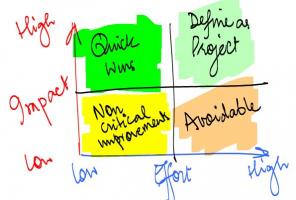
Good to see this detail. In a change project, it makes sense to tackle quick wins first. If you have completed the analyze phase, you may like to place your X's in appropriate regions of the effort impact matrix and chose immediate focus areas. If some of the elements under incorrect system activity, fall under quick win area, you may like to include them. Does it seem to address the challenge?
-
Hi Sandeep, You might find an interesting usage of Experimental Design while creating test cases. The objective is to create a combination of test cases that tests all functionalities of a module (with the aim of reducing testing time without losing comprehensiveness.)
-
A structured Lean Six Sigma deployment may not be needed here. However, experience with Lean Six Sigma tools like Concept FMEA for risk assessment, Decision Tools to choose the best option, Hoshin Kanri for policy deployment, VoC capturing methods for market study, CTQ focus for decision criteria shall be a big plus. This is exactly the reason why some of the world's largest banks want their VP - Strategy to have an MBB qualification.
-
Market Research is an integral part of many large Six Sigma projects. It is so because gathering Voice of Customer is a key requirement. A Market Research professional can contribute in large Lean Six Sigma projects by providing inputs for new product development (DMADV roadmap). Market research professionals can also take end to end marketing improvement projects using DMAIC methodology. Lean Six Sigma methods form an integral part of data driven decision making. Market research makes use of customer data for sense making, decision making and policy making. A Market Research professional can look forward to participation in cross functional projects (the kind of profile that product managers normally handle).
-
-
Correlation analysis is used to check how strongly one variable moves with another. For example, time spent in heating is directly related with temperature of an item. This can be understood by drawing a scatter plot taking one variable in X axis and the other on Y. Regression Analysis converts the relationship into a mathematical model. If the two variables have a cause and effect relationship, one can use such a model (equation) to predict the output if the value of input is known. As an example, one may be able to predict the height that a gas balloon shall achieve if the gas pressure is known. Hope this helps.
-
-
-
-
-
Companies who have reached zero defects in some process using trial and error have spent considerable time and effort reaching there. Dabbawalla is a 150 year old organization with small margins and limited competition. If you wish to achieve great performance levels in limited time, it is better you use the tried and tested Lean Six Sigma methods and be ahead of competition.
-
-
You may like to review the following How critical is the impact of a non conformance? If non conformance has serious impact, you can not afford to wait for non conformance to happen. Go ahead and collect continuous data to analyze trends and patterns in advance. What is the cost of data collection for each type? If continuous data has same cost and convenience as attribute, choose continuous data.
-
Hi Ajit, Good to see this question of yours. You surely have reached an important stage. Before I can respond to your question, I have a follow up query. Is it validated that "incorrect system activity" is one of the critical X? If yes, how was it found out? Regards, VK
-
For products that are repeat purchases, quality is likely to win. How about products that form a one time purchase? Do you have the same views for all types of products and services?
-

