


Vishwadeep Khatri
Administrators
-
Joined
-
Last visited
Everything posted by Vishwadeep Khatri
-
Hi Salil, You are on the right track. Once you find some focus areas, check which of them have the strongest business case and management support. Identify the CTQ for those specific issues and check if reliable data can be obtained for the CTQ (output variable metric) in a reasonable time. Keep discussing your progress. I am sure you will do well soon.
-
Hi Salil, Good to know that you have taken a new role. "How" should come after "What". Let us look at it this way. You need to follow DMAIC. D- Identify what to improve (error reduction OR turn around time reduction OR processing delays OR client acquisition OR Client retention OR Repeat Sales etc) M - Measure the current status A - Analyze the potential X's to find the critical X's I - Improve the critical X's by generating, comparing solutions, and choosing the best. C - Controlling the X's and monitoring the X,Y For Define phase, you should take a week's time to identify the biggest business pain areas or the biggest customer pain areas that can be attacked. Once you are through with this we can discuss more. Feel free to ask more questions. Best Wishes, VK
-
Yes, Pragya, you are right. Did you initiate this discussion with a purpose? Do you wish to engage people in a discussion?
-
What would you prefer in your process - a false alarm or a missed alert? I am assuming that you are collecting data from your process and viewing it to judge abnormal behaviour so that corrective action can be taken. I am also assuming that the data you are collecting is continuous data, each value is independent of others and the data is normally distributed. False Alarm - A false alarm occasionally may be okay or you may never want it. It depends. However, too many false alarms can lead to the assumption that something is wrong leading to an unwarranted change in a well behaving process. Missed Alert - A missed alert may never be acceptable or may be sometimes okay. It depends. The text in bold requires a discussion and convergence to a logical conclusion. What do you think are the factors on which "it depends".
-
Benchmark Six Sigma is a leading training/ consulting company for Lean Six Sigma and Project management - Kindly have a look at the office locations here - http://www.benchmarksixsigma.com/contact-us We provide regular public training in India - http://www.benchmarksixsigma.com/calendar We do corporate workshops in customized formats. - http://students.benchmarksixsigma.com/industry-application/
-
Some of the frequently used questions are - How do you identify good projects? What kind of project should not be taken up as a Six Sigma project? Why is MSA carried out? How do you do it? How would MSA be relevant for _________ process? What is meant by sigma level? Why is continuous data better than attribute data? Explain with examples. What is a hypothesis test? How would you use hypothesis testing in a Six Sigma project? Give some examples of effective control techniques? Why is control chart used? When would a control chart be most effective? How are control limits distinguished from specification limits? Provide some examples. What are the common tools you would use for decision making in ___________process? Others may like to contribute and make this list bigger.
-
Hi 5S can be implemented in services. It is a good idea to implement 5s in the mailing system of the company. It is likely to bring very good benefits. If you want to do a project on processing time reduction on mail based process (common mailbox), you may do a Lean Six Sigma Green Belt project on Lead time reduction. (Lead time is the average time it takes for an email to be responded). However, a project should be chosen from pain areas of the company or those of customers and not just because of a good idea.
-
Large number of professionals have found that the Industry they find themselves in, does not provide enough career opportunities to grow. How do they tackle this? Well, people who are in a General Management role think they can shift their sector more easily than others. HR and Marketing people can move widely within their domains if not across them. However, people with reasonable Lean Six Sigma Black Belt competence have moved across industries with relative ease. This happens because the desired Lean Six Sigma skill-set is very much the same across domains, and across functions. Here are six examples - Mr. Mohan PB - From Automotive Manufacturing to Services - Mr. Devendra - From Manufacturing to Airports Authority - http://forum.benchma...ndra-sharma-r42 Lt. Col Shalini Agrawal - From Armed forces to banking, and then to IT, and from IT to Cargo - during this video she was with banking - http://forum.benchma...ini-agarwal-r20 Amol Dixit - From Audits and Accounting to Six Sigma - http://forum.benchma.../amol-dixit-r72 Himadri Sarkar - From Hotel to Telecom and now in Management consulting in US During this video, he was with Telecom - http://forum.benchma...adri-sarkar-r26 Haresh Hiranandani - From BPO to Banking - His video link - http://forum.benchma...hindra-bank-r79
-
There was an overwhelming response to the elevator problem. The elevator problem can now be seen at the following link - https://www.benchmarksixsigma.com/blog/biggest-mistakes-people-make-solving-problem/
-
Minimum number for an Institutional program is fifty.
-
The answers are at the following link - https://www.benchmarksixsigma.com/student_participants/
-
Yes, please send us an email to us at [email protected] or call Murugappan at+917838547722
-
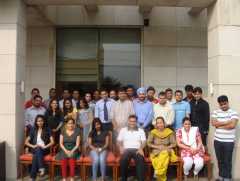
From the album: Jul-Sep 2012
Training completed at Hotel Crowne Plaza Okhla. -
Hi Virginie, Operational Excellence uses the same Lean Six Sigma techniques and is the name generally given to a long term continuous improvement philosophy. Many companies prefer to call their continual quest towards perfection as Operational Excellence. As Lean and Six Sigma cover the best in the world on continual improvement, you can confidently approach your interview with your skill set
-
Thanks Raghuram and Seena
-
Names from left - Parth Desai (PUMBA), Chinab Aggarwal (PUMBA), Vinay Singh (Somaiya), Murtuza Talib Kothari (Somaiya), VK, Pinakin Kamboj (SIMS), Varun Malhotra (NMIMS), Manas Madhu (SIBM), and Vijay Bhasker Reddy (IIT Bombay).
-
While B School students have good networking and learning opportunities on linkedin, their time is spent more on facebook and twitter. A small team at Mumbai and Pune is trying to change this. Is such a team likely to succeed?
-
Sorry, Muhammed Hamza, I missed your post earlier. You have an entirely valid and important query here. Logical validation of survey data - This would entail checking if the survey data is capturing information perfectly relevant to the identified project CTQ. For example, if the satisfaction measurement intends to judge customer feedback on a support service, but the question goes as "how do you rate us?", the customer may feel the question is related to his entire experience and not just the support service. Similarly, if the feedback information is gathered after a time gap (let us say a week later), the customer is unlikely to remember exact experience details and may provide inputs that relate to his brand perception rather than actual recent experience. Hope this helps.
-
Hi Anushri, Good that you asked this question here. As you are aware, the whole idea in Lean Six Sigma is about identifying projects that have a good business impact, are supported by senior management, finding the right team members to participate in the project, using the best techniques to succeed with challenges in each phase of the project. (D-M-A-I-C). I just noticed that you have been a high scorer in GB and have completed a GB project already. Graduating to Black Belt shall expose you to more details on measurement systems, more hypothesis tests, and above all exposure to the design of experiments. You might be aware that DOE was initiated in agriculture for the first time. In agri-operations, it is tough to confirm whether a specific combination of input variables in use is really the best for crop yield. The only option is to carry out well-designed experiments and use the inferences for large scale benefits. The use of experiments is important to try out new seeds, fertilizers, or new technological advancements. In addition, Black Belt shall equip you with change management concepts and approaches necessary for carrying out complex projects involving several stakeholders (internal or external). Hope this helps.
-
-
They say that if you put a frog into a pot of boiling water, it will leap out right away to escape the danger. But if you put a frog in a kettle that is filled with water that is cool and pleasant and then gradually start heating the kettle until the water starts boiling, the frog will not become aware of the threat until it is too late. The frog's survival instincts are geared towards detecting sudden changes. Don’t most of us suffer from this short-sightedness? Aren’t we always obsessing over short-term events and not taking cognizance of the bigger picture? This could be a major Six Sigma hindrance.
-
As Uday and I were in the final year of our graduation, everyone around us was sure of Uday's future. They said Uday could sell anything. Others spoke highly of his emotional intelligence. Sounds like an instant marketing hit, doesn’t he? Well, so he was! Filled with the indomitable energy of a sales newbie and exuding charm he sped his way to step into the shoes of a Area Sales Manager after 5 years of introductory sales engineer experience. Although he surmounted every problem that came his way, human errors made by subordinates served as regular bottle-necks. He’d ensure the avoidance of billing errors on his own but communication gaps would result in one. He would often suffer the embarrassment of differential pricing quotes for the same offering. And his team's efficiency was blotched with documentation errors, material dispatch errors, poor after-sales service etcetera all along the way. These debacles soon earned him the ire of his clients and he began to invest substantial time in resolving issues with them. What came to his rescue during such delicate times were his soft-skills. His juniors hero-worshiped him. They all said that Uday had his way with the clients and had to be seen tackling them to be believed. His success prevailed. The changing times soon saw him as GM Sales and in his stewardship saw the automation of many processes. Just when he was expecting technology to result in perfection, errors persisted due to a high rate of attrition amongst sales professionals. Uday sought help in sales counselling sessions but the organization was still infested by errors, reactive measures and rework. One hadn’t an option but to become complacent in the current situation of mediocrity. Majority of Uday’s energy was directed towards client conflicts and retaining business. Still exuded charm, our man, but perfection still eluded him. 15 years into the job and following a linear trend, Uday was now the Vice President of the sales department. Towering now over a fleet of GMs and reporting only to the CEO, he collaborated with the New Product Development Team and the Hiring/Training Team. Banking still on his insight into the customer psyche and high emotional intelligence and his reputation as the best Sales Workshop Facilitator, Uday now became the direct contact for strategic high value clients. But what sounds like a success story had a bitter glitch. With all he had accomplished in his 18 years long stint, Uday still couldn’t bask in the glory of his success without disturbance. He convinced himself that he had stuck to the same organization too long. It was now time for him to shift his allegiance. He flowed with the trend of his time and joined a multinational organization. This is where Uday had the greatest revelation of his life! The skill set he had acquired over the past prolific 18 years of his life seemed redundant now. The processes here were highly streamlined; devoid of quotation disputes, erroneous and delayed invoices, shipment delays and other organizational inefficiencies. It was there and then that the great truth had dawned on him; his coveted moment of corporate enlightenment; the great organizational consciousness that he had come in terms with: his new organization swore by and soared with Six Sigma- the ultimate organizational truth and saviour. Six Sigma had his creative juices flowing. He no longer felt contained or restricted. His approach was futuristic; prevention was the thumb-rule not mitigation. He soon collaborated with the Leadership Team and formulated a new sales model which heralded in astronomical revenues. Uday realized that he could never enjoy such potency of thought in his previous organization where he wasted much of his energy tackling trivialities. Much like Buddha, he attained the great consciousness the hard way. But it needn’t be so tough, does it? One can only imagine the greatness he and his organization could’ve scaled had he stumbled upon Six Sigma earlier.
-
Our Six Sigma Green Belt program is offered in two formats, Public training and Institutional workshops. Students can attend public training programs at a special fee. If an Institute signs an MoU with us to build Six Sigma competencies into their students, we offer special Institutional prices.
-
Yes, Benchmark Six Sigma offers students focused Lean Six Sigma Certification Programs at their Institutions to develop employable skills and competencies. We also conduct Faculty Development workshops at Engineering and Management Institutions which helps in streamlining the administration and education delivery. We do plan public training programs (in certain cities) that are specifically held for students and hence the coursework is customized and adapted to their needs.
-
Yes, we design and deliver objective specific workshops including programs on the following topics Statistical process control, Failure Mode and Effects Analysis, Process Mapping, Process Streamlining Workshops, Root Cause Analysis, Design of Experiments, Six Sigma for Project Managers, Value Stream Mapping workshop, Mistake Proofing workshop, Applying Hypothesis Testing, Business Problem Solving
