


rasheedin83
Members
-
Joined
-
Last visited
-
Data will always show variation. One of the key questions is whether the variation is normal for the process or is unexpected, indicating that something is common or out of the ordinary is happening. Thus variation is far more important to understand the process behavior. Variation will gives us meaningful insights about the process over a period. If common causes are producing too much variation in the system, then improvement is required. Since common causes create the normal everyday variation in the system, then improving them will involve systemic changes. However, if special causes are producing problems in the system, they will be specific events. In such scenarios, one needs to understand the underlying cause, optimize the current conditions of the process and put control to prevent it from recurring. Processes with more variation are more difficult to predict and are unstable. For example – let’s imagine you are part of old Indian Cricket selection board and you are left with a choice to either choose Rahul Dravid or Virendar Shewag. In this scenario – whom do you choose? (This is crucial match for India). It is quite obvious – one would have selected Rahul Dravid, because he is more predictable and stable when compared to Shewag. In the above example – when you closely look at the average scores of Dravid and Shewag, the scores will be of same or Shewag’s average would be better than Dravid’s. Measure of central tendency, the average score of Shewag does not qualify him to be part of the Indian squad because of unpredictability. Hence, it is not always measure of central tendency but variation that helps us bridge the gap in a process. Hence, understanding variation of a process is more important to decide on the next course action for a process
-
In today’s fascinating world any idea/tool that appears smart, efficient and technological driven will definitely have edge over the other. However, when it comes to Checksheet in the world of quality and process improvement – it still holds a good place but not in the original form. Almost all service industry has their own customized tracking sheet or a tool to capture the transactions / requests completed for the day. I see these trackers and tools as a modified form of Checksheet, which is simple to use and gives us the more benefit than a Checksheet. Hence, Checksheet exist and will exist in the future but in a more refined and modified form.
-
The second pillar of lean is JIDOKA, sometimes referred to as “autonomation” or automation with a “human touch”. The goal of Jidoka is Zero defects, which is to never pass a defective product downstream and to eliminate the risk that an undetected defect will end up in the hands of the customer. However, zero defects are not enough when it comes to Jidoka. Jidoka must be done in a way that promotes JIT and continuous flow. Jidoka’s purpose is to achieve zero defects within a JIT system. Every step and task of improvement using the Jidoka principle, accomplishes the goal. The three functions of Jidoka: Separate human work from machine work Develop defect prevention devices Apply Jidoka to assembly operations Jidoka is different than automation. It is accomplished slowly, systematically and inexpensively. It ensures that machine don’t just move parts and product. Instead, machines in a Jidoka system do only “Value added” work, reduce cycle time and prevent wastes such as waiting, moving things, inspection and defects. Further, Jidoka makes it easy to change any production process while automation is difficult and expensive to change.
-
What is False alarm and Missed Alert? False Alarm – refers to a system that triggers unexpected warning / remainders, which leads to unnecessary actions / response to be taken from our end. Missed Alert – when a system fails to trigger warning / remainders at the scheduled time or when required, so that necessary actions / response will be taken to mitigate or plan course of action Given a choice, I would prefer False Alarm over Missed Alert; because in such scenario my actions will go in vain whereas in case of a missed alert I would rather missed to act which leads to unnecessary risks or put me troublesome situation. Example: False alarm triggered from Fire bells will only lead to unnecessary evacuation being done. However, if the Fire bell does not trigger Alarm then it would to lead to unnecessary consequences.
-
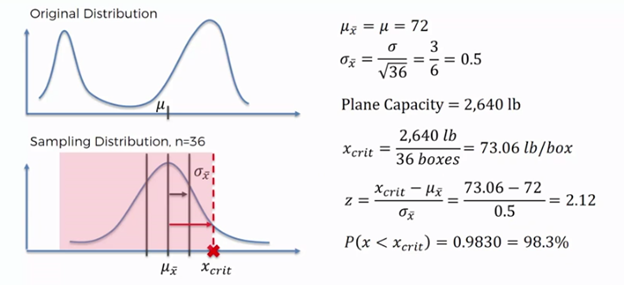
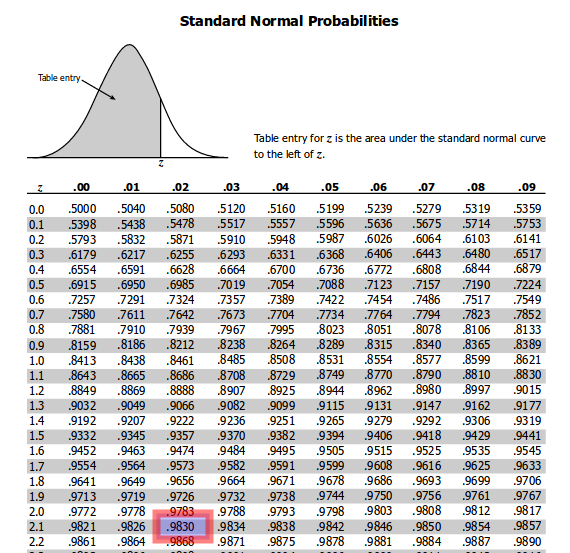
Central Limit Theorem The Central Limit Theorem, states that any data set that is randomly sampled from a population, regardless of distribution, will be approximately normal IF the sample size is large. This means that we can treat any data as normal, as long as we sample enough times from the population. But How Large is Large? Well, we say large enough, but what do we really mean by that? For most cases, any sample size of at least 30 will allow the CLT to be applied. Certain special cases exist, but this is a good rule to follow. Example: A business client of FedEx wants to deliver urgently a large freight from Denver to Salt Lake City. When asked about the weight of the cargo they could not supply the exact weight, however they have specified that there are total of 36 boxes. You are working as a Business analyst for FedEx. And you have been challenged to tell the executives quickly whether or not they can do certain delivery. Since, we have worked with them for so many years and have seen so many freights from them we can confidently say that the type of cargo they follow is a distribution with a mean of μ= 72 lb (32.66 kg) and a standard deviation of σ = 3 lb (1.36 kg). The plane you have can carry the max cargo weight upto 2640 lb (1193 kg). Based on this information what is the probability that all of the cargo can be safely loaded onto the planes and transported? Now, you can go to the manager and tell him that I have done the calculations and the probability that the plan can safely takeoff is 98.3% and 1.7 % chance it cannot takeoff. Law of Large Numbers: Have you ever seen a contest where there is a jar full of jelly beans along with a prize for the person who guesses how many jelly beans there are inside? If you try to guess, your answer may not come too close to the total number of jelly beans in the jar. The same may be true if you average the guesses of ten people who give it a try, but what happens if 1,000 people each take a guess and we average their guesses? Interestingly, that average will likely be a lot closer to the actual number of jelly beans in the jar. Taking it further, if 10,000 people take a guess and we average their guesses, that number will get even closer to the actual number of jelly beans in the jar. Which means the probability of guessing the correct amount of jelly beans is higher. As a matter of fact, as the number of guesses increases, the average of the guesses will come closer and closer to the actual number of jelly beans. This is the law of large numbers in action! Why are we not making use of CLT? Application of Central Limit Theorem is little tricky, why? Because of the size of the samples would keep on increases with the higher standard deviation and with the type of distribution. In such instances – it’s practically difficult for us to collect more data points as it consumes more time, eventually changes to the process would also be more. references: study.com medium.com
-
What is 5S? 5S is a philosophy and a way of organizing and managing the workspace workflow with the intent to improve efficiency by: 1. eliminating waste 2. improving flow 3. reducing process-unreasonableness Let’s see 5S – Sort (Seiri): Remove those items from the workplace that are not essential to enable the work activity to be carried out. ‘Decide what is needed (right now) and what is not’ Set in Order (Seiton): The orderly organization of those items that are necessary to complete the work activity, in a way that ensures safe and efficient operations, which can be repeated with minimal waste. ‘A Place for everything and everything in its place’ Shine (Seiso): Clean and check (or shine), is used to ensure that items are clean and ready to be used. Regular - ideally daily - ‘clean and check’ activities are carried out to maintain the 5S standards for cleanliness and workplace organization. ‘Keep things clean and in good working order’ Standardize (Seiketsu): Revisit the first three of the 5S’s on a regular and frequent basis and consolidate with Standard Procedures. ‘Make it Standard, make it easy’ Sustain (Shitsuke): Ensuring consistent adoption and use of 5S by all personnel who are either involved directly with the workplace or who interact with the workplace. ‘Consistent application, training and everyday routine’ Yes, definitely implementation of 5S would saves money outside manufacturing sector as well. As stated above – by carefully improving flow and eliminating waste from the process would save money if not directly but at least indirectly. Below examples are testimonies on the cost saved by implementation of 5S. Example: – collecting trashes from passenger couple of minutes before landing would actually eliminate or reduces parking charges. This eventually saves couple of thousands of dollars for the Airline operator. – maintaining files with proper folder structure and eliminating duplicate files maintained in multiple drives or folder will increase file transfer speed and reduces slowness of the system, which is indirect savings to the company.
-
Kaizen: ZEN (GOOD (FOR THE BETTER)) + KAI (CHANGE) = CONTINUAL IMPROVEMENT Kaizen – Change for Good / Better Kaizen are SMALL improvements carried out (IMPLEMENTED) by individuals on their day-to-day activities to make their life simpler and easier. Kaizen is typically continuous, incremental improvement of an activity to create more value with less waste. The process of making incremental, ongoing changes continually and not as a single event. Kaizen is about the changing of the method of work without hassles, without spending money and using the wisdom to make work easy, safe and fast. Kaizen usually focusses on reduction / elimination of waste and implementation of 5S. Kaikaku: KAI (CHANGE) + KAKU (REVOLUTIONARY) = TRANSFORMATION / BIG IMPROVEMENT Kaikaku is revolutionary, focused on breakthrough rapid and radical improvements. While both Kaizen and Kaikaku can be applied to production, Kaikaku goes beyond production to break the existing paradigm and create a breakthrough using a new system or model. Kaikaku was a discrete effort that had a definite time period with specific targets to be achieved at the end of the period. Therefore, Kaikaku was typically seen as a large project or an initiative. A Kaikaku initiative often contained smaller projects conducted at different points of time during the overall initiative. The time frames of the Kaikaku initiatives ranged from a few months to a few years. On the other hand, Kaizen is normally seen as a continuous effort, which indicates the embedded nature of the practice in a never-ending journey towards quality and efficiency. Kakushin: KAKU (REVOLUTIONARY) + SHIN (NEW) = INNOVATION / REFORM / RENEWAL Kakushin is all about innovation, transformation, reform and renewal. The idea here is that some change will form a complete transformation from the current scenario. An example of Kakushin is where the organization standardizes a process and supporting software across the entire organization where previously various groups had different processes and applications to achieve similar goals. How the above three does complement each other? Kaikaku is necessary to break paradigms and elevate the awareness of people to a higher level of understanding. When approaching a problem situation, it might require radical improvement to start with (Kaikaku), and then be continuously improved (kaizen). Whereas Kakushin is all about innovation complemented with revolutionary changes in the system. I perceive that all the three goes hand in hand in order to achieve their respective objectives.
-
"If you can't measure it, you can't manage it" - Peter Drucker. The above quote is absolutely true – in today’s fascinating and competitive world, it’s far more essential to measure organizational metrics (maintain & monitor) and publishing balance scorecard. Without measure - How will an organization knows they are competitive and had the edge over others? How will an individual know his/her strength & weakness? How will someone know pain area of their processes or business? Here is an example of “how important is to measure”: Imagine that you are a high school student and you appear for term / all other examinations. However, the class teacher had a tendency of not revealing (not measured) the examination scores. Since the student never knew their scores – they might not be focused (missing pain area) on the subject they are weak. On their final examination to their surprise, they failed in a subject that they believe it’s easier for them. That’s the power of measure. Similarly relate the above scenario to your business, processes etc. In an organization, it’s vital to measure, maintain and monitor relevant metrics without which it’s too difficult to manage your clients and eventually your business. "It is wrong to suppose that if you can't measure it, you can't manage it. The most important numbers are unknown and unknowable" - Dr. W. Edward Deming Thanks to the internet, there were lots of conflicting thoughts on the above the quote. When examine, I wonder how come a statistician like Deming says it’s wrong to suppose that if you can’t measure, you can’t manage it. I think this could be due to the fact that there are scenarios where it’s too difficult to measure at a granular level but can be measured at a high level and manage. The second sentence is little tricky when most important numbers are unknown and unknowable – to me, why should one worry about measuring and managing it when numbers are unknown. Rasheed Ahamed Igniting Minds 95
-
Personal Excellence – The innate ability to reflect on his/her core strength / weakness and challenge the status quo. And take appropriate action steps to continuously raise the bar and set them a new standard. Process Excellence – The effectiveness and efficiency of a process, which is designed to produce optimal results with minimal variation, reduce waste and increase revenue. An organization that practices Process Excellence uses Six Sigma, Lean methodologies to the core to retain the existing client base. Operational Excellence – This is one step ahead of Process Excellence approach and would envision end-to-end aspects of an organizational need. Such organization uses various methodologies to lead organization toward strategic and breakthrough operational objectives. Business Excellence – Organization with focused thought that set’s action in a more systematic approach with the implementation of international standards and frameworks. Such organization will easily win hearts of existing clients and generate new businesses. In my view any organization which pursues Personal and Business excellence has the edge over other organization. Individuals characterized with the personal excellence will have ownership and burning desire towards continuous improvement. When industry specific standards and frameworks implemented in an organization with personal excellence will definitely set standards for others.
-