


Rajesh Chakrabarty
Members
-
Joined
-
Last visited
Everything posted by Rajesh Chakrabarty
-
Rajesh Chakrabarty replied to Vishwadeep Khatri's topic in We ask and you answer! The best answer wins!SIPOC (Suppliers, Inputs, Process, Outputs, Customers) is a visual tool for documenting a business process from beginning to end. From the time since humankind started doing trade of any kind, it was evident that traders did procurement in some way or the other, held inventory, rocessed/packaged it to bring about a service/good for the customer in return of some remuneration. As time evolved, the necessity to plan & lay down processes became imminent. The idea of planning the process before starting the trade/ business became a practice and evolved to many tools – SIPOC is a diagrammatic tool to plan your Process. It can be used by a team to identify all relevant elements of a Process Initiation Project or a Process Improvement project before work begins. SIPOC draft leads to a planned sheet with information that allows the participants in a process to learn together and come to consensus not only about the make-up of the SIPOC itself, but also put in their experiences and learnings in each stage of the process. In an ongoing process, the SIPOC sheet helps the participants to define the process as is,“at a glance” and figure out the opportunities and challenges. It helps define a complex project that may not be well scoped. Thus, SIPOC is employed at the Define phase of the Six Sigma DMAIC or DMADV methodology. In modern times, part of the power of the SIPOC is that it is simple to do- it is easy to work out a SIPOC Diagram on excel also. During the creation of the SIPOC itself, places in the processes for potential improvement can be discussed and prioritized. By having the business units participate in the session and rank/prioritize opportunities together, they tend to be clearer and more descriptive in a shorter period of time. So the SIPOC acts as a dynamic tool to create dialogue and acceptance of a new process or a new approach for an existing process to change in addition to simply capturing the “as is” state. I use the SIPOC to explain any process to the sponsor/ investor of any project that I am doing. In a short time, it gives a macro perspective to all the stakeholders present during the presentation and acts as a tool that allows all the participants to see the process in relation to all needed inputs, outputs and Suppliers. The presentation session accentuates accommodation of many constructive inputs to the process, keeping the process boundaries in mind, which again is shown in the SIPOC. Since the key customers are also determined, most of the times, many advance decisions which will add value to the customer are easier to make during the presentation of the SIPOC itself. Detailing of the same is the next step towards DMADV or DMAIC. In Conclusion, the reason a Lean Six Sigma engagement many times begins with building a SIPOC diagram as a first step in the process mapping exercise is threefold in nature: A SIPOC diagram quickly and easily captures the current or “as is” state of the organization and processes in question. The SIPOC exercise brings participants together in a non-threatening way that builds teamwork and momentum to the cause around culture and learning about Six Sigma. The SIPOC exercise allows the team to review all the processes in a manner in which next steps can be identified, and limited resources assigned during the next phase of the roll-out to those processes with an objectively identified listing of the most critical project opportunities. I personally consider SIPOC as an important regular tool!!
-
Rajesh Chakrabarty replied to Vishwadeep Khatri's topic in We ask and you answer! The best answer wins!Automation can be defined as the technology by which a process or procedure is performed without human assistance- Automation most of the times provides a faster rate of production and the finished products are more or less of standardised quality standards, as compared to manual production. Whereas, Jidoka refers to an automated system, supplemented by human oversight and judgment, capable of detecting errors. A Jidoka solution would detect an error, halt production, alert a human worker to correct the problem and restart the system. The fundamental concept behind Jidoka is that machines don't solve problems, people solve problems. So when you design equipment, you design it to shut off when a bad product is made so that people can respond and solve that problem as soon as it is made. The original Jidoka implementation involved an automated loom that could detect a broken input strand and stop the loom until the strand was repaired. Hence Jidoka is also known as autonomation, meaning “automation with Human Intelligence” or “Intelligent Machines” In modern times when the focus is on Quality service to the customer, but with control of cost and wastage and enhancement of productivity Jidoka is the theory of designing Machines/ processes to run without people “Tied to the machine”, which means the attendant (resource) is able to do other tasks while the machine runs- greater productivity. Thus the work is being done with total “autonomy” as per design of plan- Good standardised Quality , till there is any deviation from expected results, and there is also a check/ warning- Control on wastage and arrangement for immediate human intervention to correct any undesired situation.- Control on cost of defectives and replacements and rework.
-
Rajesh Chakrabarty replied to Vishwadeep Khatri's topic in We ask and you answer! The best answer wins!In a production environment, when there are multiple products being simultaneously manufactured/ prepared/ assembled with different cycle times, to meet a defined Takt time and the individual processes are not linked – We are looking at a scope for piles of inventory scattered along the value stream. This adds to the wastage and other work flow inefficiencies. An apt example is the Kitchen or production area of a QSR that is into an assembly line production mode. Each product has it’s individual cycle time and the takt time by default is defined for an order. A single order can be with variable products or combination of multiple variable products… In this scenario , even with a takt time in place, there can still be some fluctuation in the actual performance of the sub processes, if they are not somehow linked together. This fluctuation gets even more complicated when scheduling is done at multiple places in a value stream. For this reason, a pacemaker is often established at a single point which is closest to the last service point- It is called a Transfer Bin , where the finished products are arranged in a supermarket system with kanbans (a signalling system between each process)’. The signal tells people when to produce products on every station. The signal is normally a card system or markings on the floor. Thus, a ‘production’ kanban triggers the production of parts. A ‘withdrawal’ kanban instructs the operator to refill it when it is empty and requires Replenishment to ensure that the immediate trend of product requirement is met . A proper schedule of production is controlled from here through the pull from upstream value system. Thus A pacemaker is the single point where a production process is scheduled. The upstream processes don’t produce without a Pull signal originating from the pacemaker. Thus it sets the pace for all the processes which are upstream in the Value system. An effective Pacemaker thus Facilitates or helps to: Meet customer demand immediately- adds to customer experience Create Flow- reduces inefficiencies in process Pull-based on real-time customer demand- Fresh food is provided to customer, thus customer experience is enhanced Keep a vigil on the final product quality as well as segregation of veg and non veg products, as the wrapping or packaging of the burgers / Sandwiches can be done at this point.- Thus reducing defects and replacements Simplifies production oversight.- The process is efficient and monitored Reduce the need for coordination as there is only one scheduling point- The benefit is amplified when there is a mixed- model production in a value stream, like in a QSR kitchen.- reduces waste of movement Determine the mix and pull signals based on actual demand to ensure that only the types and quantity of products that are needed are produced. Thus reducing wastage through replication or defects Thus an effective Pacemaker ensures that different types of wastage are controlled adding to value to customer as well as the profitability in business.
-
Rajesh Chakrabarty replied to Vishwadeep Khatri's topic in We ask and you answer! The best answer wins!Mistake proofing, or its Japanese equivalent poka-yoke, is the use of any automatic device or method that either, makes it impossible for an error to occur OR makes the error immediately obvious once it has occurred. Given by the above second scenario, it is obvious that there is a scope for the error to occur , but an it is made obvious immediately. Hence, the 2nd point is an apt interpretation – Human Error may continue to happen , but the defect will not happen. Given that most of the business activities can be considered to be a process. All processes have the potential for defects- Poka Yoke works on a thought that Operators and Machines will sometimes make mistakes(errors) in the flow of the process- Find ways to keeps errors from becoming defects. When it comes to human intervention in a process, we must recognize that it is natural for people to make mistakes. Ten Types of Human Mistakes 1) Forgetfulness 2) Misunderstanding 3) Wrong Identification 4) Lack of Experience 5) Willful (Ignoring Procedure/ Rule) 6) Inadvertent or sloppiness 7) Slowness 8) Lack of Standardisation 9) Surprise (Unexpected Machine Operation etc.) 10) Intentional (On purpose/ Sabotage) To curb all the above scope for human errors, Poka Yoke is a mistake proofing method that does not depend on operators catching mistakes and provides immediate feedback 100% times. The best way to eradicate the scope for defects is own the proactive approach and identifying the defect immediately (Point of origin inspection) Two Poka Yoke system approaches are utilized in production/ Manufacturing which lead to successful Zero Defect Quality (ZDQ): 1) Control Approach- Shuts down the process when error occurs Example:. Automatic Shutdown of the heater, with the help of multiple temperature sensors, when the temperature of the Heating/ Holding cabinet reaches the highest allowed temperature, thus ensuring that the products that are kept in the cabinet do not get overheated/ Overcooked , which is a defect 2) Warning Approach- Signals the operator to stop the process and correct the problem. Example: There is a red light alert and a sound of siren that reaches the main production area if the temperature of the storage freezer goes above a defined danger temperature zone. Thus a very obvious and "unmissable" warning is provided to a section where maximum number of people are present at all times , to check and correct the temperature of the freezer Thus as mentioned above, the 2nd point is an apt interpretation – Human Error may continue to happen , but the defect will not happen.
-
Rajesh Chakrabarty replied to Vishwadeep Khatri's topic in We ask and you answer! The best answer wins!On a lighter note, as is understood, False Alarm is a “Mistake in finding a Mistake”, i.e. A product/process is good/ correct but the alarm or check system has pointed it out as bad/ incorrect. The customer may not be able to know about this mistake, and hence unaffected, in most of the cases. Whereas, Missed Alert is when product / process is actually not good (NG)/ incorrect but passes through the check system and the Customer has experienced the impact of the bad product or incorrect Process.-Thus it is a “Mistake of not finding a Mistake” Though at first thought , it seems that A false alarm is no problem at all , as the customer seems to be unaffected, Too many or untimely false alarm can cause bad experience to the customer , whereas a Missed alert is definite cause for a bad customer experience. Hence, both the situation are lapses in the process and have their individual negative impact on the operations. To understand how a more “safe looking” False alarm can cause bad experience to the customer, Let us consider a Kitchen in a QSR, wherein , products to be cooked are pre frozen and stored in cartons. The Cartons are arranged by date of manufacture to ensure that a First in First Out (FIFO) process is followed, so that all products can be used within expiry and thus wastage is reduced. During Peak rush period- lunch time- If the person who is responsible to get the boxes from the Freezer to the production area, suddenly believes that he may have brought in a box that was out of the FIFO- It may be a false alarm- The time taken to sort out the confusion and then to get another box in the right FIFO order, can create delay in serving the customer. The extra effort to catch up with the lapse in Takt time could lead to further defects in the process (Food Production)- However, in this same situation, maybe an immediate call can be taken to use the box and then correct the arrangement of the box in the low rush time to ensure that the FIFO is followed in the future. This way ,the time delay is reduced and the damage can be mitigated. Thus, a false alarm, if happening occasionally, or if handled well tactically, will not cause much loss to company, most of the times ,and can be corrected or the damage can be mitigated.The chances of the same false alarm happening can be minimised by reinforcing the check points. Having said that, it is also very obvious that a false alarm can lead to process adjustments when none is required in an existing correct process and cause many NVA. However, if an alert is missed, it may affect the customer directly- For example in the Kitchen of a QSR, fried products are maintained in a Heated holding cabinet for a maximum Specified time (USL), beyond which the quality of the product deteriorates below the set standards of the product. The Holding cabinet has a timer that alerts once the time limit is over. If this alert is missed, a below standard product passes on to the customer, as there is no physical (Touch) check on the patty thereafter- very seasoned staff is required to visually detect a patty which is not in proper quality. This can lead to customer dissatisfaction and breach of expectation- Loss of reputation and eventually loss in business. Thus when asked a preference between the 2 errors, it is like choosing between the devil and the deep blue sea- However, with the above explanation and also given that Statistically for attribute measurement < 2% missed rate is considered as good and < 5% false alarm are considered in good category as general guideline, the space for false alarm acceptability is higher- I will “Prefer” the false alarm!!
-
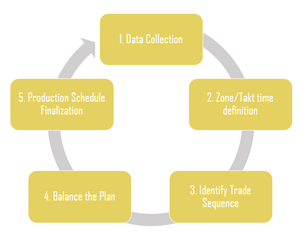
Rajesh Chakrabarty replied to Vishwadeep Khatri's topic in We ask and you answer! The best answer wins!Takt on it’s own as a word means “Beat” in German. It refers to beat, timing and regulation of speed. Definition: Takt is the desired time that it takes to make one unit of production otput. It is often confused as the cycle time which is different to Takt time- Cycle time is the actual time taken to to make one unit of production output. When Customer Driven it is Available operating Time/ Customer Demand Eg: 8 hours of daily operating time/4 units of daily demand= Takt tiem of 2 hours. When Operation Driven it is Available Operating Time/Units of Forecasted demand Eg: 8 hours of daily operating time/5.7 units of forecasted demand= Takt tiem of 1.4 hours. Nominally, this is an initial design variable that dictates the architecture of the manufacturing operations- Sets the pace of production/Manufacture to match the pace of sales How to Calculate Takt Time can be first determined by the formula T= Ta/ Td Where; T= Takt Time eg. Minutes of work/ Units produced Ta= Net Time available to work eg. Minutes of work/ Day Td= Time Demand (Customer Demand) eg Units required/ Day/ day part. Net Available time is the total time available for work to be done excluding any expected stoppage time like break time,Team Briefing, Scheduled maintenance etc. EXAMPLE: If there is a total of 8 hours(480 Minutes) in a shift (gross time),less 30 minutes Lunch and another 30 minutes for smoke breaks (2 X15).Then 10 Minutes for a Team Briefing Plus 10 Minutes for basic regular maintenance checks- Then the net time available to work is 480- 30 -15-15-10-10=400 Minutes. If the customers demand had to be 400 units a day in a single shift, then the line would be required to output at the rate of a minimum of one part per minute, in order to be able to keep up with customer demand. IMPLEMENTATION: Takt time is calculated virtually on every task in a business environment. It is used Mostly in a - Manufacturing(Casting of parts, drilling holes). - Control Tasks (testing of parts or adjusting Machinery) - Administration (Answering standard Enquiries, in call center operations) - It is used in production lines that move a product along a line of stations that each perform a set of predetermined tasks (Like the burger assembly in McD) MEASURES of Takt Time Implementation: - How well do the operational Takt times meet the customer demands? - Are the Takt time and Cycle times Synchronised? - What percentage of operations are controlled by Takt time? - Is there a System in Place to handle fluctuation in Customer Demands(Overtime,tpart time workers etc) - Does the plant conform to the takt time and not deviate from following it?? - In the QSR industry like in McDonalds, Takt time is considered very importand and is planned sequentially in all stations / product assembly points as the complete order delivery time is expected to be below 60 seconds. Technically it is the customer demand. So the Decisions is operationally driven and planned as a strategy- By following the 5 steps to Plan Takt time in each Station/ Zone of the assembly line : They aren’t worried about a shift. They are worried about smaller blocks of time. The operational processes must adjust sometime on an hourly basis driven by the planned and known changes in the customer demand rate (Trend charts based on dayparts are followed). The takt time is different from 11:30 – 3pm (Lunch rush) than it is from 3-6. This isn’t just variation in demand; it’s specific shifts in demand. There is an estimate PRODUCT BIN LEVEL CHART that is maintained and followed based on trends of consumption of the products . The stations and manned accordingly , along with storage optimization , to ensure the cycle time at each assembly station/ zone in the production line of the burger is met. It is thus that the Takt time is met, more often than not!!
-
Rajesh Chakrabarty replied to Vishwadeep Khatri's topic in We ask and you answer! The best answer wins!What is FTA?? Fault tree analysis (FTA) is a top down, deductive failure analysis in which an undesired state of a system is analyzed using Boolean logic to combine a series of lower-level events. Purpose?? Like Failure Mode and Effect Analysis (FMEA), FTA is a method used to predict the failure modes / events of failures of functional / Process Parts and assessing the impact of those modes/ events on a system/ product/process. Though FMEA and FTA have marked differences in approach, the purpose is same holistically. Fault tree analysis can be used to: - Understand the logic leading to the top event / undesired state.Basically, understand the cause of failure - To identify the effects of human errors - Show compliance with the (input) system safety / reliability requirements. - Prioritize the contributors leading to the top event - Creating the Critical Equipment/Parts/Events lists for different importance measures. - Monitor and control the safety performance of the complex system (e.g., is a particular aircraft safe to fly when fuel valve x malfunctions? For how long is it allowed to fly with the valve malfunction?). - Minimize and Optimize resources. - Assist in designing a system. The FTA can be used as a design tool that helps to create (output / lower level) requirements. - Function as a diagnostic tool to identify and correct causes of the top event. It can help with the creation of diagnostic manuals / processes. This analysis method is mainly used in the fields of safety engineering and reliability engineering to understand how systems can fail, to identify the best ways to reduce risk or to determine (or get a feeling for) event rates of a safety accident or a particular system level (functional) failure. FTA is used in the high hazard industries like aerospace, Pharmaceutical, petrochemical and fields as diverse as risk factor identification relating to social service system failure. FTA is also used in software engineering for debugging purposes and is closely related to cause-elimination technique used to detect bugs. Structure: Whereas FMEA is a “Bottom-Up” technique which examines the failure modes of the components within a system (i.e. the failure symptoms), and traces forward the potential effects of each component failure mode on system performance. As such it is a CAUSE => EFFECT model. FTA is the reverse of FMEA in that it is concerned with the identification and analysis of conditions (including component failures) that lead to the occurrence of a defined effect. In contrast with FMEA, FTA is therefore a “Top-Down” technique, and so is an EFFECT(Undesired Event) => CAUSE model. Both the above designs are, interchangeably, required for fault identification, correction and tolerance to improve design of process. FTA is the logical model of a relationship of the undesired event to more basic events. Obviously, the top event of the fault tree is the undesired event, the middle events are the intermediate events and the events at the bottom are the basic events. The logic relationships of events are shown by logic symbols or gates 5 Step Procedure 1) Define top event Define the undesired event 2) Define overall Structure Define the intermediate events and combination of failure that will lead to the top event Arrange them accordingly, using logical relationship 3) Explore each branch in successive level of detail Continue the Top down process until the root cause for each branch is identified and/ or until further decomposition is not required Thus, each branch will end with a basic event or an undeveloped event. Consider common cause failure and systematic failures in the process of decomposition. A good tip to stop decomposing is to go no further than physical or functional bounds set by the top event. 4) Solve the fault tree Assign probabilities of failure to the lowest level event in each branch of the tree From this data the intermediate event frequency and the top level event frequency can be determined using Boolean Algebra and minimal Cut Set Methods. 5) Perform Corrections if required and take decisions Application of Boolean algebra and minimal cut set method will help to identify the BASIC EVENTS (A) and combination of Basic Events (B.C.D) that have major influence on the top effect. This will give clear indication on what needs to be attended to and where resources need to be allocated for problem solving. Advantages of FTA Deals well with parallel, redundant or alternative fault paths Searches for possible causes of an end effect, which may not have been seen before. The cut sets derived in the FTA can give worthwhile insights into various ways top event occurs. Very useful tool for focused analysis where analysis is required for one or two major outcomes. Faults/ Disadvantages of FTA Time-consuming in constructing the graphs Requires a separate fault tree for each top event, hence making it difficult to analyse complex systems Many Systems may involve many dependencies. Difficult to detect inconsistencies Difficult to focus on the most critical parts of the design on high coupling systems Not always easy to spot when there many systems involved. Fault trees developed by different individuals are different in structure, producing different cut set elements and results. Sometimes the same event may appear in different parts of the tree , leading to confusion. Circumstances when FTA is not used When you suspect that a large number of distinct system conditions exist with a range of unacceptable consequences. FMEA will be more appropriate than FTA When there is a need to analyse systems that contain little or no redundancy and does not examine the effects of multiple failures at the system level (apart from common cause failures). FMEA is more suited for this When the system contains novel technology and the effects of failure of the components contained within the system need to be explored with insightful judgement, instead of FTA, consider using FMEA For any system FMEA is generally good for exhaustively identifying and recording the local effects within it that arise from component failures and then inferring the effects of those failures at system level. When there is a need (a) to establish appropriate levels of redundancy within the design of a system, (b) to ensure “fail safe” outputs, (c) to increase the derating of components, or (d) to otherwise enhance the design generally- we must consider using FMEA When you want to record the system effects of each failure cause in a tabular format as normally FTA enables the fault/failure logic within a system of a particular effect of interest to be represented in diagrammatic form In summary FTA will identify combinations of conditions and component failures which will lead to a single defined adverse effect FMEA, on the other hand, considers all single component failures in turn and identifies the range of their effects on the system. Either of the two methods of analyzing faults is required to enhance any process.

-
Rajesh Chakrabarty replied to Vishwadeep Khatri's topic in We ask and you answer! The best answer wins!I feel that one cannot use ONLY any one of the 3 given checkpoints or all of the 3, there are much more different checkpoints that will provide a different level of checks for activities. Each Activity will have its own set of checkpoints, which will give valid results. Depending on factors and variables like industry, business objectives, timelines, environment including physical and socioeconomic, one needs to devise suitable checkpoints to identify whether an activity id adding value or not. When looking at the value of the product or service, the goal is to have the value of the end-product or service exceed the cost of producing the product or providing the service. The cost of the product or service includes all resources used to produce it (e.g., raw materials, labor, storage, transportation, and overhead costs). We need to examine each activity within the process and determine the value-added assessment of the activity. The value added by an activity, in an accounting sense, is simply: (Value of the product after the activity) minus (Value of the product prior to the activity). The value added by an activity should be a positive value. Ideally, the value added by the activity is equal to or greater than the costs incurred during the activity. Value from the customer's point of view is independent of the cost to produce the product or provide the service. It is based on the customer's expectations, as identified by the effectiveness indicators for the process. So for me, the questions that I would need to ask, as checkpoints would deter the following categories of “Wastages” or Non value for all activities connected to processes: Waiting (idle) times Excess motion (transportation) Handling (moving things) Excess or useless inventory Overprocessing Overproduction Defects Broadly, the following questions cover the Checks on the above wastages: - Is the process documented? - Is there change management processes that ensure traceability of business process changes? - Is the process documentation up to date and relevant? - Are key decision points defined with the appropriate decision gates and levels of authority? - Is the process owner of the process clearly defined? - Does the process owner understand the process's role in the value network? - Is their information quality processes in place when a process captures or generates data? - Is there a continuous improvement program operational? - Does the process adhere to all the legal requirements? - Are there escalation procedures in place if process execution get delayed? - Are business continuity processes defined? - Is there disaster recovery processes in place? - Is the process outputs requirements clearly defined? - Does the process performance relate back to a somebody's performance assessment? - Are the process logistic in place to ensure all the process enablers are always available? - Is there process performance feedback in place that measures process performance? - Are there regular process reviews to ensure the process is executed according to its design? - Are there policies in place to regulate process execution? - Are process outputs aligned with strategic intent and customer expectations? - Are there processes to evaluate reasons for process failures and recommend corrective measures? - Is there a risk log that defines the degree of risk associated with process failure? All the checklist points might not be applicable to every business process. But I think this list will at be a good starting point to secure a good flight for the business. Even a short checklist used continuously to ensure consistency can make a big difference to the quality of processes in an organization. The aim for productivity improvement is to enhance the Real Value addActivity (RVA) which directly contributes to satisfying the customer's expectations/ perception of good product/ Service (e.g., taking customer orders, receiving materials, assembling materials, shipping) And reduce the Business Value add activities (BVA) activities which satisfy business requirements, but add no value from the customer's viewpoint (e.g., preparing financial reports, maintaining human resources records, and ordering business supplies) and to eliminate the Non Value Add activities(NVA)which do not enhance the customer's image of the product or service and do not support the business process and can be removed from the process with no effect on the end product / service When looking for ways to reduce BVA activities and to eliminate NVA activities, be creative and innovative. As an example In the QSR industry , all activities and decisions need to be customer-centric and hence, It is imminent to ask against all activities whether ; - Will the customer be 100% satisfied and perceive value for money?? The customer will be retained and will always add to new customers through word of mouth - Can the activity be scheduled and repetition can be eliminated- Eg, the Preventive maintenance schedule- It helps to ensure that there is no firefighting and customer experience is provided seamlessly on a continuous basis. - Can the activity be measured for timelines and impact- Most important- all activities need to be SMART, so that we can measure and improve on the same, thus committing to improve customer service at all times - Is the activity covering the scope for defects and defectives to reduce rejections. Eg in a QSR, the products have a defined time and temperature for cooking and equipment are automated for the same. Thus there is standardization and the customer’s expectation is met at all times - Is the activity using lesser movement of people- Eg. In the production area the tables and kitchen layout can be arrangeds in such a way that the staff need not move around too much and find things in “reach” and are able to produce faster. Thus saving time for the customer These are few examples that I could fit offhand- In conclusion- All the questions need to be answered in an affirmative towards customer satisfaction!!
-
Rajesh Chakrabarty replied to Vishwadeep Khatri's topic in We ask and you answer! The best answer wins!Though the concept of 5S was developed in Japan and was identified as one of the techniques that enabled “Just in Time” manufacturing, The application of the concept is relevant beyond manufacturing processes also. The image below helps to depicts the definition/Classification of the 5S, before we deliberate on further impacts of the 5 S. Definition/ Classification of 5S: < Please refer to attached png -5S at Workplace > In today’s competitive era, wherein the customer is the king in true sense, with all the options that he desires, It is a quest for all businesses / service providers to provide the customer with value for spend. One of the most impactful influencers of perception of value is the cost of the product / service. Keeping this in mind , the service industry is compelled to control internal cost , so that maximum value can be passed on to the customer and continue to kindle the customer’s interest in their services. How does the 5S Help to Save Money/ Costs in a Quick Service Restaurant: For most it is a known fact that for most operational activities,ONLY A SMALL PORTION of the total time and effort actually add value for the customer- about 90% of the time and effort withholds to elimination and reduction and the remaining odd 10% contributes to perceived Value addition.By clearly defining the value as perceived by the customer, All non value adding activities or resources can be targeted for removal through the 5S methodology. Hence the 5S methodology helps to save cost in the following way Sort (Seiri): Sorting helps to get rid of all unessential stuff we end up collecting over time, and holding for no purpose.- things which are rejected,or incomplete. It gives us the option to free space and use effectively, thus improving the productivity of real estate value. Things that are not required at all- can be used for other departments – Saves costs Certain unused material can be scrapped at WDV, thus bringing in revenue. Set in Order (Seiton): There is a dictum “A world class office is expected to locate any paper in less than a Minute” – An absolute hit on the value of saving time- TIME IS MONEY- for every stakeholder including the customer. Keeping required resources well aligned for usage, thus making it easy to find when required. Sanitation/ Shine (Seiso): It is all about keeping your machines, equipments. surroundings clean, infact, not only cleaning but also inspecting and simple repairs and preventive maintenance, which help to improve the life of the machines and thus save on repetitive or undue investments for machines / equipments. It also focuses on FIFO methodology in inventory control & reimplishment of stock effectively to cut down on wastage and thus save costs through wastage/expiration Standardise (Seiketsu) & Sustain (Shitsuke): To ensure that the efforts to sort > Set in order > Shine is standardised and sustained- We must encourage ,all involved , to measure the results regularly and update all, with focus on continuous improvement. Application in QSR Methodology Impact for Cost saving Sections of impact Value add to Customer Sort (Seiri) Optimisation of Real estate value- Warehousing/ Inventory control costs are reduced. Across the premise- All space is occupied to contribute to customer experience Gets an easier to use restaurant layout and maximum utilities Set in Order (Seiton) Optimization of time Production and Service is efficient and fast Quicker response and overall TAT- saves time Sanitation/ Shine (Seiso) Lesser defects, accidents,wastage,Rejections Service area and Seating/ Waiting area A feeling of safety and hygiene Standardise (Seiketsu) & Sustain (Shitsuke) Helps to replicate the processes across various sites and scale up the business with lesser cost Across the premise Confidence of expectations of Quality, Service & Cleanliness of being met each time- every time. In Conclusion- the following benefits are visible due to 5S, ; 1) Improve process and product quality (less defects) 2) Develop control through better visibility 3) Identify problems quickly as there is lesser arrangements to keep an eye on 4) Improve safety 5) Decrease downtimes and improve TAT 6) Establish convenient work place and work practices 7) Employee morale is high due to better performance and results. Thus, it is evident that there is a lot of cost saving through space saved, reduction of scrap/ wastage, reduction of breakdown of Equipments, reduction of cost for safety,cost , cost of rejections, improvement of productivity and most importantly, It keeps the cost of retaining customers down by enticing them for repeat business.

-
Rajesh Chakrabarty replied to Vishwadeep Khatri's topic in We ask and you answer! The best answer wins!Episode 4- 080917.pdf For organizations to stay competitive in today’s economy, given the era of start-up culture & globalization, it is essential for them be open to the concept of changing with the time. It is the agility and the openness for janusian thinking that will keep the organization boosted to make the best of the small gap between evolution and dissolution. It is but imminent to adopt and ingrain-in three important concepts of Kaizen (Change for Better), Kaikaku (Revolutionary Change), and Kakushin (Innovation). Organizations benefit from these through continual improvement of their processes, transformation of their organizational culture, and becoming an innovative entity. Though each of the Ks are the different faces of change in the organization, they collectively form the spectrum of change in the organisation. The representation below depicts how the spectrum of change can be progressively implemented in an organisation for improvement and growth when the 3Ks complement each other . In conclusion, effectively applying these three essential concepts of Kaizen, Kaikaku, and Kakushin is the right solution for any organization who wants to deliver a sustainable high quality product or service and to ensure a steady growth in the global market


-
Rajesh Chakrabarty replied to Vishwadeep Khatri's topic in We ask and you answer! The best answer wins!What is your view on this? Is measurement essential for good management? Why? Why Not? What did Edward W Deming mean by his statement? I personally feel , “if you cannot measure it, you cannot control/ Manage it” holds now , more than ever before. I am saying so as techniques to collect data and techniques to measure most processes through statistic and other experimental methods has evolved manifolds over time. Due to this, It is easier to manage processes and bring about enhancements and control it through the analysis of available data. We have become dependent on data to manage processes and bring about desired results – better than the current measured process matrices which can be attributed as “benchmarks” Having said that , I feel that the concept of measurement cannot be always limited to a sheet with notable calculations / formulae derived from data and definite yields from them. I am sure one would agree that millions of years of evolution has given us humans a built in information processing tool that takes signals from the environment and enables us to form decisions, so there’s “Neuro signalling data processor” buried somewhere in our heads. When one sees anything that has room for improvement, i.e. there is something in it, which is not quite right or satisfactory. That “something” itself is the “data” or data related. Thus, data in it's wide spectrum covers the information one does not necessarily have to measure physically or literally put on paper. The "Fact"is data. One observes > measures it against a reference / benchmark / level of satisfaction > Analyze it > work out a resolution/action = Decision which leads to improvement followed by control. “All done in your head”. It is a natural inbuilt flow It is understandable that ability to measure is not the only thing that’s important in and of itself. It’s also critical to understand the effect of measuring, and whether you are able to measure a system effectively and constructively. As I was researching on the net on the quote by Dr. Edward W Demings, There seems to be an ambiguity – John Hunter states in the W.Edwards Intitute Blog that the actual quote was- “It is wrong to suppose that if you can’t measure it, you can’t manage it – a costly myth.” His quote is saying the opposite of what most people think it means when they use the quote without the extra words he used. This is one of the dangers in using quotes without context. According to Hunter, Dr. Deming did very much believe in the value of using data to help improve the management of the organization,And several of the tools he recommended involved using data (Plan- Do- Study- Act Improvement Cycle, Control Charts) But he also knew that it wasn’t close to enough. There are many things that cannot be measured and still must be managed, And there are many things that cannot be measured and managers must still make decisions about, Hence; he is also quoted as saying “The most important numbers are unknown and unknowable" He probably was putting across that using data to aid in improvement efforts is extremely valuable. However, it is easy to be led astray while focusing on numbers without a solid understanding of concepts such as: variation, appreciation for a system, the proxy nature of data, theory of knowledge, etc.. Another, example that hits through and supports the above mentioned thought is, due to the time lapse in results you can’t measure the productivity of a team until a few years after a release of the software they were building. By teh time you put in the effort to measure the impact, the technology would have changed/ evolved and the software could be close to redundancy. But, the decision of building the software were probably taken, considering the need of the moment, based on factual requirements. As I have mentioned herein above, even that instance of taking a decision on facts that are observed is an intricate process of measuring and analyzing data within our head. It is overall a “measured” effort to bring about a desirable change , hence I strongly believe that the quote "If you can't measure it, you can't manage it" is valid at all time and covers it all, anytime...... every time!!
-
Rajesh Chakrabarty replied to Vishwadeep Khatri's topic in We ask and you answer! The best answer wins!How would you define, compare and contrast the following terms - Personal Excellence, Process Excellence, Operational Excellence and Business Excellence? Excellence is defined as "The quality of being outstanding or extremely good." To Compare the 4 basic levels of excellence in performance of tasks/work , we must first Define teh same. Personal Excellence: it is the effort or quest or will to become the best possible expression of who we are on a core or on the qualities that will help us to achieve the near or far goals that we set for ourselves. Pushing oneself that extra bit towards achieving improvement in our own individualities and aptitudes though practices and training will help us to attain personal excellence- The process cannot be timebound though as personal excellence can be sought in various spheres and the goal can be ever incrementing – the process needs to begin with Belief in self and the inner will to go beyond the comfort zones and always “sharpen your tools” to build upon skills to reach closer to goals that need to be a little stretched , over a period of time – higher goals than what is evidently near. It is very important to be connected and around or with people who are the best in the sphere that matches or seconds one’s objectives - This will bring in positivity and the fuel & mileage to attain personal Excellence. Personal Excellence is not tangible definitely and is associated with the results in tasks/ work. Process Excellence is about process effectiveness and efficiency. It requires processes to be designed and improved for consistent delivery with minimum variation and minimum waste. Notwithstanding that it is the domain of Six Sigma and Lean, Process Excellence creates a framework for continuous improvement in performance of task/ work. It sets benchmarks and standards and helps us to deliver tangible results in tasks/ work and translates our vision and strategies into tangible matrix on which further “excellence” can be derived. Operational Excellence: Though Process Excellence and Operational Excellence is deemed the same by many, in practicality, operational excellence is broader . It builds on the concept of end-to-end process flows in core and support processes, including organisation’s culture (and with it HR) in its domain. Operations is basically the action/ work that is done regularly as design to produce the deliverables of a process. The excellence in operations is attained when a regular task by design is completed within the allocated time with allocated resources within defined specifications of produce. Business Excellence: This is the broadest concept - It encompasses the whole organization, including strategy, communication with all stakeholders, and – critically – the organization’s Mission, vision and “scorecard”. Many would want to consider it as the integrated collection of all the above mentioned levels of excellence to attain closest to 100% satisfaction for all stakeholders .An organization can have excellent processes and products but if its strategy is wrong or if its results are poor, it still has a long way to go to achieve Business Excellence. Business excellence can be measured though multiple Scorecards covering all segments of business. From the above we can ascertain that Business Excellence is the Journey while Personal, Process and Operational excellence are the stepping stones for the same. Compare: Personal Excellence Process Excellence Operational Excellence Business Excellence Aspire and attain Define and attain Do and attain Ultimate objective Depends on individual will Depends on science and learning Depends on action and checkpoints and evaluation Depends on results and a combination all other levels of excellence Cannot be measured as it can be ever proliferating Can be measured and improved with analysis and experimentations & Research Can be measured and corrected/ improved on immediate basis , thus providing matter for process Excellence Can be measured and enhanced In summary: Personal Excellence- Voluntary improvement in individual efficiency Process Excellence – effective, efficient processes to provide effective operational conditions Operational Excellence – process excellence seconded and supplemented with keen attention to HR, culture and systems thinking Business Excellence – The rational quest and delivery of outstanding results for all stakeholders
