


Nagraj Bhat
Members
-
Joined
-
Last visited
Everything posted by Nagraj Bhat
-
Assuming the 7 wastes that creep into production of goods/service are controlled within customer and business specifications, here are the three examples. Appointments at various set ups (colleges, offices and businesses)where in restricting the exchange to an agreed upon time frame. This helps in effective time management and avoided queuing typically found in the open to all/first in and first out format. Separate allocation in the IVRs/webspace for various categories of businesses and channels of communications. Hence avoiding wait time and improved handle time based on criticality of the cases. Emphasis on one on one meetings rather than skip level meetings is another area where each individual is “listened and not heard”. This drive of ‘one at a time’ helps the sum of the parts to build up the synergy of the whole. Also taking care of the eight waste of poor employee skill management.
-
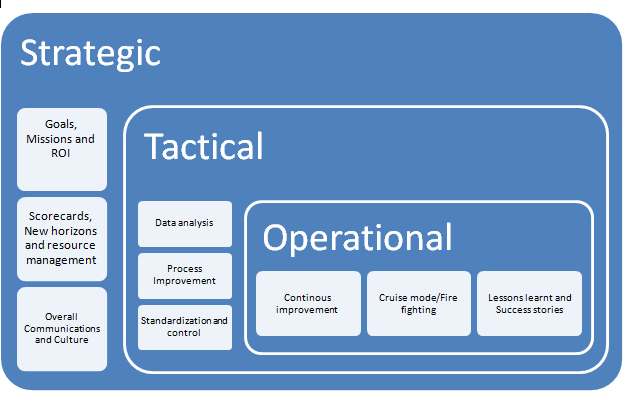
An organization ideally can be split into three major groups with respective responsibilities A STRATEGIC (senior Leadership) head for driving the goals, mission and culture. A TACTICAL (excellence) team for analysis, change and sustenance An OPERATIONAL (Production, Technical and Quality) team for meeting the volume of work, handle deviations and learning. Misplaced Values and corresponding propositions are the reasons for neglected VOB and VOC. So, when the Strategists are content with the ROI, status quo and have pride being risk averse, along with the Operations with no time for change management, adaptations and controlling penalties – Tacticians turn out be a cost. As a Tactician; in order to create a value in the process, through the service, to the product, for the customer and on self – he/she has to Make the organization realize who the customer is and why is he important Develop systems thinking Map Value stream processes Drive triple loop learning Promote stronger communications Encourage transparency Awareness of the industry best practices
-
Two stages are to be attained for a process to be in a statistically controlled state of certainty and quality. Being stable and capable are the requirements for a setup to maintain consistency and conformance to the customers’ requirement. STABILITY – is an ability of a process to perform in a predictable manner over a period of time. The process in this state will be aware of the common cause inherent in the dynamics. Random causes noticed during Stability drive will be analyzed for the root cause and mistake proofed. The goal during stability period is to contain the output within control limits (set by the manufacturer/provider). Control charts provide an insight to the voice of the process. CAPABILITY – is an ability of a process to realize the characteristic that will fulfill the customer requirement. The process in this state will have to be contained within the specification limits (decreed by consumer) agreed with the customer. Assignable causes are made remote if not banished in the process. Capability indices are calculated using the specification width divided by process spread. Indices which determine the spread, the location and long term capabilities are helpful to assess the performance of the process. Ideally a process spread with the output has to be close to the mean of the controls and centered to the specifics. Capability is effectively conceived only if the process is religiously stable. Below are the situation an organization/process can be in. Is Stability achieved Is Capability achieved Status Risk Solution Examples NO NO Both control limits and specification limits are breached. Type I error of considering common cause as special cause is possible as the reviewer would try to tweak the system for reduction in variability. Taming special causes, acknowledging common causes and deriving control limits New employee’s yield/QC score to the company. Stage of assignable causes fed back as a learning. The production from the employee has to be at par with the department’s variation with the output. YES NO Control limits are honored yet overshooting by the specification limits The customer not happy with the output Specification limits are checked for business compatibility. Consistently adhering within the control limits is another option. New application launched for an android. Bugs autocorrected yet not meeting customer expectations with frequent crashes of the system. NO YES All of the output is within the specification limits but out of control. Type II error of special causes treated as common cause. Mean shift has to be addressed. The process needs to be controlled. Special causes out of the control limits should be analyzed. Process to be reviewed. Wait time due to the poor categorization of the IVR. Customers waiting for equal time for resolution irrespective of the severity of the issue. Missed callers are reached out by email. CSAT varies as stability is missing. YES YES The outputs are within the control and specifics Complacency and latency with the processes. Stability to be under check. Continuous improvement. Process reengineering Aircrafts landing and takeoff instances at an airport. Timelines, communications and SOPs are deployed for error free service.
-
Correlation projects the statistical relationship between two variables whereas Causality prompts towards the cause of an event. Correlation does not imply causation and it only provides a possible lead for an analysis. If a plot of two variables in a manufacturing setup is looked at, defects produced against month of the year. They could be a positive correlation (directly proportional), negative correlation (indirectly proportional) or no relationship between the two variables. However if one has to arrive at a causation of one variable on the other, here are the possible investigation patterns Defects have cause and effect exchange with the month of the year Months of the year should have an exchange with the defects caused (reverse causation) Defects in a particular month might influence other months delivery( reinforcing) Defects and month of an year might not be related directly but an unaccounted factor ( e.g leadership) could be causing both. For an investigation be it in problem solving(DMAIC) or problem avoiding(DFSS), Correlation could be the only data available to tell the story between two variables. The study mode is less reliable but indicate a pattern ( Employee satisfaction measured against companies offering cars when compared to companies offering incentives) Correlation among variables offers good start for basic trees and allows to break presumptions in an investigation ( Black cars plotted against road accidents) Sometimes it might not be practical to collect causal information such as data from the clinical trials of a drug. The correlation between the factors( blinded, groups, sites) and the environment ( phases, diseases, medication)should be validated with certain significance level and power( conforming regulatory bodies and pharma companies). Causal data is expensive and time consuming to compile. (Call audits of the entire lot in a center to determine customer satisfaction) In order to bark up at the right tree, a researcher has to recognize the assumptions, evaluate arguments and draw conclusions.
-
In any successful business which believes in building strong customer base, continued innovations and quality delivered the first time shall try to abide by the following equation. (PRICE+VALUE) __ (COST+RISK) = PROFIT Customer’s receivable Manufacturer’s deliverable Business gain(revenue and loyalty) The Price a consumer is willing to pay and the value expected out of it should be higher than the cost for creating a product/service and the risk involved in innovations/improvements. In order to attain good revenue and thereby make profits, an organization will ensure that the cost of quality, service and maintenance are lean in approach. In turn, the price for the product and the value received are seamless. So how does an organization reach the economies of scale of increased production and decreased operational cost. It should identify the need and want of the customer. These requirements are to be weighed against the organizations capability of meeting the stakeholder’s interests, benchmark report, voice of employees and revenue model of the setup. Voice of the Customer can be reactive( Sales report, Audits, Customer complaints) or proactive ( Surveys, Focus groups, Interviews). House of Quality, Affinity diagrams and Pugh matrix are the popular ones used to convert these “voices” to “scope”. Critical to Quality is then realized though metrics for control and improvement of the deliverable. VOC is significant when the organization identified its problems and wanted to check it against the customer’s response ( Sales drop and CSAT feedbacks) wanted to adopt DMAIC roadmap in improving the processes by identifying the problem area. Benchmark report on potential scope in a market for certain product /service. ( Faster laptops for gaming or better treatment of a condition) try using Kano's model and exceed expectation/improvise the need. VOC can be ineffective when the organisation Jumps in for the market share without analysis of the risk for both short and long term sustenance( two wheeler's manufacturer's risk venturing in four wheeler segment) emphasizes more on the revenue and ignores voice of employee, voice of business and voice of process ( seeking more business from offshore client without training of the staff, value streaming the process and ignored profit sharing ) takes up the pressure from the market for discoveries and innovation contributing compromised product/service ( Pharma companies pushing the drugs through the phases with incomplete and inconclusive clinical trials.) has poor leadership, structure and standardization with fundamental flaws in managing business and data collection ( poll results and elected representatives of a bad government).
-
The balance score card advises as to how the customers, the organisation's finances, the up skilling of the staff and internal process should align to create a value add to the service/product. Mapping is the tool which encourages the way a score card is maintained, worked upon and designed. Hierarchy of work in an organization is the layout which explains as to how a work moves from the time an order is placed till its delivery. Tasks -> Activity -> Process -> Value Chain is the flow realized. Basis on the level of work, level of understanding needed, level of involvement, value addition and timelines in an organisation, the below table sheds some light. TASK ACTIVITY PROCESS VALUE CHAIN WHAT A specific unit of work required to create an output A group of tasks required to conceptualize an output Activities aligning to create a flow intending to deliver an confirmed output A series of processes strategically looped in to create a value addition to the product /service DETAILING Required to carry out work FUNCTIONAL Required enough to Quality check the work COMMON Required enough to guide the output DETAILED Required enough to validate and verify the outcome HIGH LEVEL SUCCESS CRITERIA Efficiency, utilization Quality, Customer satisfaction Process improvement measures Revenue and Profits PEOPLE involved are Operational Functional Functional Leadership and Functional TOOLS Flow chart, RACI table, SOP-JD Matrix Process Map, Swimlane, Gantt chart VSM, Process Map, FMEA, Spaghetti diagrams SIPOC, Readiness review, Criteria quadrants, Risk assessment, Org chart
-
Data, the source and need of all investigations in an analysis has been classified based on the attributes and values it describes. Qualitative data are the ones which focus on description, observation and attribution. Its aesthetic and difficult to measure. NOMINAL( names, labels, not ordered) and ORDINAL(ordered, attitudes) are the data levels categorized in this type. Quantitative data are the ones which are measurable or countable. Discrete and Continuous are the classifications in it and supports all the four data levels of being NOMINAL(names, labels, not ordered), ORDINAL(ordered,attitudes), INTERVAL(ordered, no natural zero) and RATIO(ordered, with natural zero). After establishing the measurement to gauge the data and disclose a pattern, one opts for DISCRETE or CONTINOUS form of sampling. Discrete data has values that are distinct, countable, and separate. Bar Graphs are used in this case to represent the data. Number of employees in an organisation Number of defects identified Customer surveys scores Continuous data has values of a continuous range that can be measured, counted and ordered. Histogram and line graph are used to represent the data. Log in times of an employee Length of road laid up per day Amount of milk filled in the packets during packing For instance when a manufacturing set up is to determine the efficiency of the process, the major factors to be measured are the Quality (conformance% or defect count), Productivity( utilization) and Availability (on/off time). Quality can be QC score (continuous) or DPMO(Discrete), Productivity measured through login times(continuous) and Availability gauged through login days (discrete). Continuous data has a distinctive edge over discrete data and if the measurement allows, one can wish for the continuum with the data. Continuous data provides better "see through" for comparatively smaller sizes of sample and is highly sensitive(probability of detection). The prediction from the data is relatively better than with discrete inputs.
-
In a stable process, Variation from the mean is treated based on the severity and the magnitude of the data point. Three major modes/activities used to contain/control the deviation within the process. Correction is deployed when the error has occurred and it has to be contained immediately. The “patch” that is used should fix the error. For instance, 1) A call center agent missing on asking the name of the customer over the call. He corrects himself immediately and the customer wouldn’t bother. 2) The confectionery manufacturer correcting the design of the product to enhance the experience of the customer. The error otherwise is unnoticed by the buyer. Corrective action is the elimination of the root cause to avoid recurrence of the event. The action will help to ensure that the error is not repeated within the process. Thorough RCA should identify the interactions of the system and make the corrective action more effective. For instance, 1) A project deviating from a task. Assuming the business impact being moderate, the corrective action should involve proper situation appraisal, IS/IS NOT analysis and identify the environment causing the fault. 2) On a typical busy day at a hotel reception, the delay in responding to the customer’s query needs a look into. Assuming the dissatisfaction was handled well, manager’s role is to ensure that the situation is not repeated. Hence, the day, the time, the type and other critical factors are to be investigated. Preventive action is the elimination or mitigation of the potential problem identified from a learning elsewhere or within. Replacement, Detection, Facilitation and Prevention are the other principles to be considered depending on the change intended. For instance, 1) Cars recalled for the fault identified during one of the correction. Based on the corrective action implemented for the batch which has this release, the preventive actions are thought over for future potential failures. 2) Medical negligence encountered at a hospital are usually quite critical. The failures are to be prevented with proper standards and controls. Regular monitoring of the records and understanding of the variations should prompt one to undertake mistake proofing. Corrections are made when the variation is within the control limits and the customer is un-fluttered as its inherent in the product. Common causes should be the reason for the error resulting as minor to nil business impact. Issue tracker and Change management should help most of the corrections. Corrective Action and Preventive Action (CAPA) on the other hand is considered to be initiated when the impact is of larger scale to customer satisfaction, the risk factor with business, suppliers and clients and to the process which needs continuous improvement and is deprived of it. Special causes which are a threat to the control and specification limits are to be avoided with changes in design and the processes.
-
Checksheet is a simple, primitive and an effective tool used to record and analyze the data. It primarily captures either distribution or locations of the factors under deliberation. Checksheet precedes the other QC tools used in continuous improvement such as Pareto analysis, Cost analysis, Histograms and Fishbone analysis. Before the advent of automation, checksheet were used in readiness reviews, time stamps, location plots, measurement and calibrations. Its usage has been incorporated into powerful tools deployed in enterprises and industries. These tools transform the data into appropriate information and prompt solutions for strategic decision making. Here is the contrast of the tool’s feasibility - A Store manager using basic hard checksheet on the flow of the products in the rack when compared to the chain of stores monitoring the trend of a product across the region, group and time substantiates the adaptation of the tool. Checksheets are here to stay and oblige the user’s need depending on the environment of information, skill set of the individual, resources available, accuracy/swiftness intended and effectiveness realized of the output.
-
In any business model, the primary aim of the seller is to ensure that the profits made are post the costs incurred in running the setup. For the buyer, the lookout will be the quality of the service/product against the price and time invested. In a push process, the traditional way of “make to stock” is carried out where the resources, materials and energies are aligned to create a flow and send it down stream. The push happens based on the demand forecast and believes in piling up the inventories. In a pull process, the lean way of “make to order” thrives with the customer demand initiating the flow. The pull triggers the stages in process to get the input/output at the stipulated time, delays are managed and no choking between the stages. From order till delivery of a product/service three major areas needs a control. Cost structure – With the onset of Lean thinking in business, organizations have focused more on savings and utilization. A pull strategy believes in reducing the cost with (7) waste management. Mergers and acquisitions are cases when companies push each other resources to deliver better options to the customers. Create a new market of hidden consumer base. The other aspect is of economies of scale - cost advantage due to increased output. A business can capitalize the benefit of the same by creating a demand in the market through value proposition. Work in process – In a pull process, WIP tries to align with the takt time demand. Cycle time is the key area to be dealt with for efficient throughput. Push mode will encourage teams working for R&D and in creative fields to pursuit their ideas/thoughts relentlessly with no rush. Assuming SMART is used to derive the goal. The workforce up skilled and ready for the anticipated work scheduled is another push concept. Load leveling can be used to address the variation in the demand. Value proposition- Quality is another by product of disciplined pulling of the flow. When the demand is understood and inspection is built in at stages of a process, customer gets what he is willing to buy. Pushing will help with many choices to the customer and can also bump customer off-guard when he/she is delighted with something not asked for. Well, it all depends on the FLOW. You can still opt for a hybrid version of the tug(push and pull) with dynamic interface of the system to quickly adapt to the changing demand and the cost to keep up. Having said that, value offered to the customer is more important than the price he/she pays for the service/product.
-
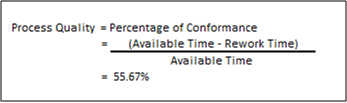
Cost of Quality assessment benefits the organizations translate efforts into profits. It draws the attention of the management towards the overall work accomplished while delivering quality the first time and to the hidden factory ignored which is notoriously run under the pretext of “business as usual”. COQ aligns quality with goals and promotes effective use of resources. Delivering Quality is relatively cheaper when compared to the expenses incurred lack of it. The costs of conformance will be relatively higher at the start however once the quality is built in the product/service, the profits are well managed. Below is the breakup of the components. CONFORMANCE – Cost of Quality NON CONFORMANCE - Cost of Poor Quality Prevention includes Quality planning and assurance, process definition, process capability assessment Internal Failures includes substandard service, rework, downtimes, unused resources, scrap and abandoned projects. Appraisal includes tests, inspections, Quality audits, surveys, reviews and skill assessment External Failures includes recalls, complaints, lawsuits, DSATs and servicing 50% +20% = PREVENTION + INSPECTION 20%+10% = REWORKS + DAMAGES In order to look into what is happening to the voices heard from the market and the criticality identified thereafter, the organization should Determine the processes and their interaction with the system. The functions and the roles of each process. For instance - Quality ( Analyst, Level II etc ), SME and the Operations( TL, Level III). The activities and tasks in the process which are identified as value add for the vision. Effective value stream mapping is the key. These activities are categorized and sorted into the four components. Their occurrences in a month and the time spent on each instance is captured. Later, the manhours invested into these activities in a given month are calculated. Activity based costing helps us to understand the hours put in and billable for the role. Finally one would have the COQ efforts of the organisation as the cost of carrying out the activity in a month will be segregated based on the table above. Modifications and redirecting the approach towards attaining 10-20% of non conformance costs will drive reduced variation and delivery within the specification limits. A snapshot of activities (corresponding hourly dollar value is missed) and proportions in regards to the COQ components. This is for a Quality Analyst.

-
Scope for variations is designed along with the process boundaries and system structure. So when a system adopts a stream, it blends the respective chance and assignable deviations across the functions and will be reporting the non conformance in isolation or in combination. When the process is statistically controlled, it will have common cause variations. These are random in nature and are inherent. These are accepted as are well within the control limits of the process. Process reengineering and continuous improvement are the popular practices deployed to ensure that the efficiency is better than the current state. On the other hand, if the process is out of control it will have special cause variations. These are systematic and are to be analyzed. A failure which was not detected at the error state and not contained when at fault makes us regret. Lean principles (mistake proofing, VSM etc) and 7 QC tools should assist the preventive stage as it’s a flaw in the design of the process that has to be fixed. Tools and practices like FMEA, TRIPLE LOOP LEARNING and QFD does give an insight of the potential risks, the impact of the process gaps, the VOC/CTQ needed for the VSM and thoughts over KAIZEN efforts. These are to be acknowledged and reconstructed for effective designing. Outliers in the control charts should insist us on investigating the root cause and point at process entropy which is otherwise unavoidable. Trains arriving/leaving with variations can be still controlled with standardization, however accidents are to be sorted and prevented.
-
A SIPOC diagram is a visual representation of the high level process map. It captures SUPPLIERs and INPUTs which get into the process and OUTPUTs and CUSTOMERs out from the process. It also determines or rather should be defining the information of the stakeholders involved and the scope boundaries of the stream. This is how we conceptualize it One begins with a high level process mapped. Specific to the stream under investigation. Outputs from this process are listed next. Possible ones are services, products, reports and data etc. Customers are identified and jotted down. Can be categorized as Internal, external, vendors, management and users. Then all the Inputs to the process are captured. Such as data, applications, raw materials etc Finally, Suppliers are put up on the table. Similar to Customers, they can be Internal and external, vendors and others. Post the draft one can look at a table which is well laid out providing a quick snapshot of the process and its extent. The SIPOC layout benefits All the stake holders to have their expectations match the result. Scope is clarified with acknowledged gap analysis. The SIPOC activity benefits during the DEFINE phase of a project. The outcome is of a high level AS IS process explained with the stakeholders and deliverables made explicit. The VOCs and the corresponding CTQs will also provide necessary outlook for the exercise.
-
WHAT Jidoka/Autonomation is one of the pillars of Toyota Production System. The other one being Just - in-time. So, Jidoka is about “Automation with Human touch”. While Automation (replacement of humans) focuses on improving utilization whereas, Autonomation(enhancing value addition of a human) addresses quality of the products/deliverable. HOW When a Jidoka is deployed or employed (if built in), it stops the process from abnormality, corrects the errors, prevents repetition, alerts the controls and restarts the process. It is accomplished by human intervention. An alert and its significance makes whole of Jidoka to be non invasive and efficient. WHY Jidoka is against traditional thinking of inspection towards the end of the process and rework thereafter to recover from damages. Autonomation ensures quality built in the process and only confirmed service/product is delivered. It provides us with tremendous benefit of identifying the hidden factory, reducing rework, external failures and controlled operational costs. Better standardization helps problem detection and quality the first time. WHERE Inspired by the functioning of human body of find, diagnosis and repair below are few applications of Jidoka. Needless to say that the manufacturing setups have discovered this approach of process efficiency and have displayed substantial merit over the years. Talking about smart phones with space cleaner and antivirus Applications. They help user identify the space usage and unwarranted intrusion of malware. User will decide on the alert and approve the automation. The application will repair, advise over RCA and prompt preventive measures. This entire exercise can be automated with status update shared to the user. Fitness watches tracking the movement of the bearer, identifying misses with the course, suggesting remedies, upon confirmation of correction, prompts preventive measures. Project management for minor or major undertakings where in the stages of defining, initiation, Planning, execution, monitoring, control and closure have standardized approach. Each phase will alert deviations, identify the problem, stop the proceedings to reduce the bleeding and get back on track post approvals and conformance to the measurements. Both automation and autonomation have scope to assist the cause. Health care industry implementing Jidoka through evaluation of each assessment to determine the treatment needed for a patient. Each stage is reviewed for the variations from the desired state and corresponding outcome is recommended. Can run entirely by machines or involve humans at critical points.
-
Pacemaker helps the process to set the pace to meet the customer’s demand. Takt Time helps greatly to determine the speed and control of the process. The goal is to match the cycle time to the Takt time. Two major stages - Upstream is the point of origin for the process where it gets the input. Downstream is the point where it is closer to the end/to the customer. The pace maker schedules the process and sends out the signal to upstream as to what the inventory has been and the subsequent demand therefore. When the pacemaker is set closer towards the end of the process, it causes continuous flow resulting cycle time matching lead time. The other pre requisites for pacemaker implementation are and not limited to PULL (released when needed) FLOW (movement with reduced waste) VALUE (Customer’s willing to get) MAP( Designing the process ) PERFECTION (Seeking continuous improvement) Load leveling (Spike in Customer demand) Let’s consider a simple stream of seeking a loan and the getting it approved. PROCESS Applying online Customer reached out Documents received Verification Approval Cycle time( Biz hrs) 0.25 0.25 0.25 0.25 0.10 Lead time(Biz hrs) 8 8 16 16 8 Lead time 7 biz days TAKT time 5 biz days Upstream XXXXXXXXXXXXXXXXXXXXXXXXXXXXXXXXXXXXXXXXX Down stream XXXXXXXXXXX Pacemaker XXXXXXXXXXXX
-
Hypothesis testing is an objective method of making decisions or inferences from sample data. Typically carried out by comparing what we have observed to what we have expected and if one of the statements was true. These are the requirements for the test: Null statement or Ho is an assumption about the population from the sample data used to decide whether it is true or otherwise. Also known as skeptic’s hypothesis it is sticking to the status quo of the case. Alternative hypothesis on the other hand is a researcher’s question to the claim. Since we are inferring the population from a sample one needs to also asses the risk involved of being wrong. Significance level is the probability of rejecting the null hypothesis when it is true. Also known as type I error. This is normally set at 5% (0.05). Test statistic is the value calculated from a sample to decide whether to accept or reject null hypothesis. p Value is the probability of obtaining a test statistics. If p is less than alpha=5%, the null hypothesis is rejected at 5% significance level and the test result is called “statistically significant”. If p is less than alpha=1%, the null hypothesis is rejected at 1% significance level and the test result is called “highly significant”. Test statistic = [Relevant Statistics - Hypothesized Parameter]/Standard Error of Relevant Statistic. = [Observed-Expected]/Standard Error Based on the awareness of Standard deviation one needs to use either z test or t test. And the table below shows the relationship of the choice made based on the statistical result. DECISION Ho TRUE Ho FALSE Do not Reject Ho No Error ( 1-alpha) Type II Error (beta) Reject Ho Type I Error (alpha) No Error (1-beta) Predominantly used during the analyse phase of the DMAIC roadmap. Below are the criteria one needs to be familiar with to have a successful test and subsequent effective prediction. It would be wonderful if we could force both alpha and beta to equal zero. Unfortunately, these quantities have an inverse relationship. As alpha increases, beta decreases and vice versa. alpha is the producer’s risk in an experiment with a new drug or the skeptics leeway to the status quo and beta, the consumer’s risk to the new drug or declined researcher’s claim. Both are to assessed and determined based on the potential loss and the severity of a decision. The only way to decrease both alpha and beta is to increase the sample size. To make both quantities equal zero, the sample size would have to be infinite—you would have to sample the entire population. Power of the test (1– beta) is the probability of correctly rejecting the false null hypothesis. This can be enhanced when the variation in the sample is reduced, increase in the sample size and an increase in alpha. For parametric tests, the statistical power is higher and it helps one to significantly detect an effect.
-
Mistake proofing is intended in building up a system/process which eliminates, replaces, prevents, facilitates, detects and mitigates errors leading to failures. One can deploy few or all of these characteristics to make the setup error free. Since 94% of the time the problems are system driven rather than human misses, it becomes imperative to have an acknowledgement of the common causes, prevention of special causes in the systems and promotion of continuous improvement onto people and processes. Let us discuss the cases below The human error will not happen at all – Never is really harsh to use. If we measure from six sigma stand point, then it is possible provided the environment is controlled and standardized. Bomb squad, Pit stop for F1 cars and critical surgeries are a few examples. Human error may continue to happen but the defect will not happen - This is possible when the specification limits and control limits are way too accommodating. The voices are not heard and corresponding measurements are not fixed. Neither designing issues are worked upon nor the customer is expecting any change with the status quo. Human error may happen, the defect is less likely to happen - Possible again. User making a wrong entry and the systems identifying, prompting and ensuring correction. Defect is alerted and failure is averted. Human error may happen, the defect will also happen but will be detected and corrected automatically - Human and system interface at its best. Human error while flying a plane is detected and the change is mitigated by the system correcting the deviation and confirming back to the standard. Below are the common human mistakes been mapped to the mistake proofing principles. The matrix is subjected to severity, occurrence and detection specific to the environment and objectives. HUMAN MISTAKES and PROOFING Elimination (remove to improve) Replacement (deploy a reliable substitute ) Prevention ( modify to avoid) Facilitation ( Visuals and tools ) Detection (identify & rectify) Mitigation ( cushioning the impact) Forgetfulness X X X X Misunderstanding X X X Wrong identification X X X Lack of experience X X X X Willful (ignoring rules or procedure) X X X X Inadvertent or sloppiness X X X Slowness X X X Lack of standardization X X X X Surprise (unexpected machine operation, etc.) X X Intentional (sabotage) X X X
-
Quite tricky though. Here is what I interpret – A false alarm is a situation when the system has the right conditions to prompt us to a fault, yet recovers itself without a failure. It raises an alarm, however the proceedings are still under control. The measuring system and its resolution are to be checked for the same to ensure that accuracy and precision of the deliverable are effective. For instance, consider the weather forecast, earthquakes, Global warming reports, stock market and other highly unpredictable human undertakings. The false alarms are quite regular as the profound knowledge of system dynamics, variations and sensitivity turns out to be quite huge. With the advent of stronger statistical tools we are able to avert dangers and learn. Another case is when the customer raises an alarm of bad treatment despite the operator following the protocol of acceptable customer service and satisfaction measures. The numbers might indicate a DSAT score, nevertheless it could be one odd instance and should have special treatments in place for the future. Missed alert is a situation when there was a fault shaping into a failure and the relevant mistake proofing/preventive measure has missed identifying the same. Constant review of the control chart, mistake proofing principles, training the staff and optimizing the process should give us considerable certainty. For instance, catastrophe to the Challenger shuttle in 1986, where the alerts of low temperature at the launch pad, the gas leak and the worn out rings were alerting the mission control and yet been ignored. Employee dissatisfaction and not taking up the cause of creating an effective working environment. It is the most common indication of poor team formation and neglected by the leadership at times as they are focused on the business gains and the SLAs. One can still wake up by a false alarm but shouldn't sleep off with a missed alert.
-
It all starts with the need to understand the customer’s requirement and operations’ effort to meet those. Takt time is the average unit time needed to meet customer demand and is the pulse of the business. WORK TIME / CUSTOMER DEMAND. The operations must be aware of the CYCLE TIME –as to how much time does it take to finish a task and the corresponding LEAD TIME – as to how soon can the entire work be finished from order till delivery. For instance if the reception at a hotel is supposed to resolve a query/ accept a booking in 5 minutes as let’s assume it to be the benchmark of the industry ( based on CSAT surveys). Where in the reception works 10 hrs shift comprising 600 minutes a day and on an average the hotel gets 100 customers. Currently the Cycle time is at 600/100=6 min. Also let us assume that the customer is made to wait for at least a minute before his request is considered. This will add to our lead time which determines the time taken since the customer enters the hotel and till is “satisfied “by the response received. The hotel needs to match the takt time of 5 minutes. How will it accomplish. If I say that is has be strategic, I will be looking into the business delivery and its improvement. That is possible by looking into the resources, the profits the business has to make and the cost the customer is willing to pay for the 5 star service. If I focus on being tactical, it has to around the operations, their efficiency, data collection, customer experience and employee satisfaction. Tactical decisions will guide the priorities, solutions with lean thinking and continuous improvement. TAKT time should drive both. Its about the vision of the business, which prompts my strategic decisions and in turn will drive my tactical performance.
-
Central Limit Theorem - The means of randomly selected independent samples from a population distributes themselves normally. This holds true even when the population doesn’t align as a bell curve. Another element of the theory suggests that as the size of the samples increases, the distribution of the means becomes less spread out. Skewed populations require larger samples when compared to normally distributed ones. A thumb rule of 30 samples should make one comfortable with the distribution. Law of Large numbers - A rule where in when the experiment is carried out enough times one does end up with the average/expected probability. The coin when tossed, the recorded outcome post many trails will lead to the expected probability of 50% each side. Both complement each other. The Central Limit theorem closes in on Law of large numbers. CLT advises about the rate while LLN provides the parameters of the sample means that converge to population means when the sampling increases. Normal and Non Normal Data – Spread of the data points in an investigating can shape into a symmetrical inverted bell or skewed to either side of the graph. The former is considered to be normal and the latter is non normal. For normal data, parametric tests are used and they have higher power (used in hypothesis testing for inference) when compared to the non parametric tests carried out on the non normal distribution of similar sample size. Non parametric test are more robust (insensitivity to the violations of assumptions) and the corresponding conclusions are more accurate when compared to the same test through parametric tests. Both the tests hold good depending on the sample size availability, the power needed to infer about the population and the risk with assumptions and groups. Before “transforming” skewed to normal and then using parameter testing – one has to study the data and the underlying message of the sample. For instance, if the sample has outliers, its quite naive to resort to truncation/transformation rather than analyzing the special cause of the extreme data point. When the sample is inherently non normal, one has to administer caution by considering sample size and trade offs with power and flexibility.
-
Fault is what a system has in it inherent. It’s a flaw in the design. One does realize it( at times not – which is bad). Error, on the other hand is something where in an act deviates from the course. Actual needed against measured ones. The Failure, is inability to perform to the requirements. Not conforming to what it set out to be. Hence, when the system has a fault, it has every possibility of contributing an error which makes it a failure. All failures can be caused by faults ( since designed ), yet all faults do not result in a failure (cannot be lucky always !!!). That’s for the background. When we talk about Fault Tree Analysis, we will be using a fault in the system and try to dissect/analyze it by putting the same at top and graphically modeling all the way down. Consider it as a tree with a flow determined to arrive at a CAUSE from the EFFECT. It is deductive in approach. FTA uses the conditions for the effect and establishes whether they are immediate, necessary and sufficient. Its more logical in approach and depicts an algorithm which is ruled by the clause - if yes, then true. It can be explained as a path of base events and intermediate events at the bottom leading to the fault to expose and subsequent failure thereafter. FTA suggests the states where the system is least reliable or otherwise. Example : The unfortunate explosion of Challenger shuttle in 1986 and then the FTA on the mishap. The cause apparently was human error of neglecting the temperature that day near the launch pad and the punctured O rings leaking the gases. Primarily used to those system conditions which are a threat and relatively lesser in number to handle. It helps one to understand the sensitivity to the violation of assumptions from the systems standpoint to the faults inherent. Systems which are complex and with well acknowledged faults can prompt one to use FTA. It might not serve the individual when all the undesirable events are not foreseen. Each cause should have two modes and are to be independent. The other tools at disposal are FMEA, Event tree Analysis, What-If Analysis, Checklist etc. Depending on the principle of mistake proofing (Elimination, Replacement, Prevention, Detection, Facilitation and Mitigation) one deploys, the corresponding tool should assist the purpose.
-
I believe we have all the three major factors required to arrive at the true value add activity in our processes. It is applicable to all setups. The “to be” process recommended will have the thorough usage of lean tools. Therefore when we say… A value adding activity is one that customer is willing to pay for – It’s the activity which determines the price customer is ready to pay. This helps us to establish the cost involved running the process and the profits we are targeting to rake in, since Price – Cost = Profit. Exceptions could be the cases when the manufacturer/provider wanted to adopt KANO model and try to DELIGHT the customer. The risk here could be manufacturer’s market competitiveness and customer acceptance. A value adding activity is transformational by nature - the activity in a process has to help the product /service reach to the next phase of realization. The time invested in the effort should assist the product/service attain its entirety. Exceptions are based on the assumptions and the knowledge on the transformation/stages. Continuous learning will rock the boat and force us to consider a detour in the journey. A value adding activity is done first time right – the activity of the process should be carried out with utmost quality. The service/product should be free from failures otherwise it will lead to rework. Exceptions are limited here if we assume that the manufacturer/provider has got the right VOC/CTQ. If the requirements are sorted, quality management should be effortless. I think, in the sequences of new-product-design/ innovative product creation/ unique offerings/ one time projects, we need to modify our understanding of VA/ NVA. In an established process/ repetitive sequences, the original three questions seem to work well.
-
One of the most simple and effective tools in the world of Lean framework is the 5S mode of functioning. If we focus on the English version of these five attitudes, they will be labeled as SORT, SET IN ORDER, SHINE, STANDARDIZE and SUSTAIN. When we channel our energies on Quality service ( planning, control and improvement) and Time management ( SMED, VSM …), Costs of activities and managing a process gets more efficient. If we consider the banking sector and the possible advantages that these setups have if adopted 5S - well, here they are What Personal Virtual Sort Better counters for various needs of the customer and categories defined by the bank Better web space for various offering by the bank, categorization and customization Set in Order Define the necessary proceedings for each counter, keeping the customer in loop on the time taken for each activity May be a simulator , a tour explaining the functioning of each page. User friendly Apps for better cust experience. Shine Better bank premises and faces. Look and feel to match the bank’s culture. Better responsiveness of the site. Standardize Guidelines to the employees. Customer made aware of the change management. Guidelines to the customer on the timelines, on certain security compliance. Sustain Feedback portals to challenge the status quo. Regular meet and greet of the bank with its customer for continuous improvement. Maintain the customer experience by reaching out for feedback, calls made to the customer as to assess the scope of improvement. Below is how we can expect 5S to help us out away from the manufacturing floor. What How Cost Quality Time Sort Distinguishing the necessary, the needed and the important Helps to know the priority before investing Conformance to the goal set in mind Helps in determining - Important against Urgent factors Set in Order Assigned responsibilities for humans and locations for things Job descriptions to define roles and error management. Quality the first time as things and people maintain an order Place for everything and everything in its place saves time Shine Cleaning the mind and the surroundings. Cleaning helps you to get free from latency and savings from accidents Better accessibility and presentation fetches customer satisfaction. Time spent on presentation is far lesser than spent on clarification Standardize Guidelines and accountabilities to drive the above three Replicating the best practices across functions hence reducing costs Better corrective and preventive actions. Variations in time are monitored. Deviations are analyzed. Sustain Follow the standard and promote awareness Sustaining the best practices and challenging the status quo for improved savings Identifying the common causes and the special causes in the process for Quality improvement Identify roles which are underutilized and increase the man hours (Skill enhancement).
-
Innovations happen when proceedings are simple. It can be simple and effective if we remove waste and get lean. Processes do not hinder creativity they promote it. The main criterion that ensures that you think outside the box is discipline. Discipline as a competency can be explained as maintaining right amount of scope, time, quality and cost needed for attaining the goal. LSS has its tools, methods, frameworks and other thoughts exploiting the concept of reducing variation and removing waste. Thomas Edison managed to find the right element which burns longer only after recording his failures( measurement ) and exploring the options( CTQ). Forcefield Analysis, Brainstorming, Value Stream mapping, TRIZ, COQ, CTQ, VOC, Kano Model are few of the ways and means to create a magic.
-
In an organization consisting of systems, the interchange of information and feedback are crucial. To attain a better state from current state, the systems need to question the status quo and try reducing/eradicating the inherent common cause variations. These are possible with constant change leading to radical breakthrough and finally discovering a new horizon. All three are cyclic and follow a sequence. A learning organization needs all the three, identifying the potential area where the scope is vast and goal is aggressive. Kaizen - Continuous Improvement - Regular activity improved each day, evolutionary – Eg. Exploring automation in the organization. Kaikaku – Radical change initiative – Process reengineering , revolutionary – Eg. Robotics interface to human’s activity, as a part of bomb disposal squad, in manufacturing. Kakushin – Innovation – Eg. Devices inserted into the human body ( for assessing the health of the host), New modes of transport ( hyperloop) Regards Nagraj Bhat On behalf of Igniting Minds 95