

Topics
-
AI News from ET - AMD to invest up to $5 billion in Anthropic; AI startup to buy up to 2 GW of chips
AMD has been seeking to expand its foothold in the fast-growing AI chip market as developers look to diversify beyond Nvidia, while Anthropic has been racing to secure computing capacity to meet growing demand for its AI services. View the full article -
A Meta Platforms lawsuit claims AI tools unfairly targeted employees for layoffs. Workers face difficulties proving AI discrimination due to limited access to internal processes. Arbitration agreements often prevent collective legal action and public scrutiny of workplace disputes. These hurdles explain the scarcity of high-profile AI employment lawsuits. Meta denies using AI for layoff decisions, stating humans made all choices. View the full article



Leaderboard
-
Jpiyush
Members1Points14Posts -
Rahul.Arora2
Members1Points44Posts -
Rakesh Chandra
Members1Points12Posts -
Ashish Kumar Sharma
Members1Points10Posts


Popular Content
Showing content with the highest reputation on 09/16/2022 in all areas
-
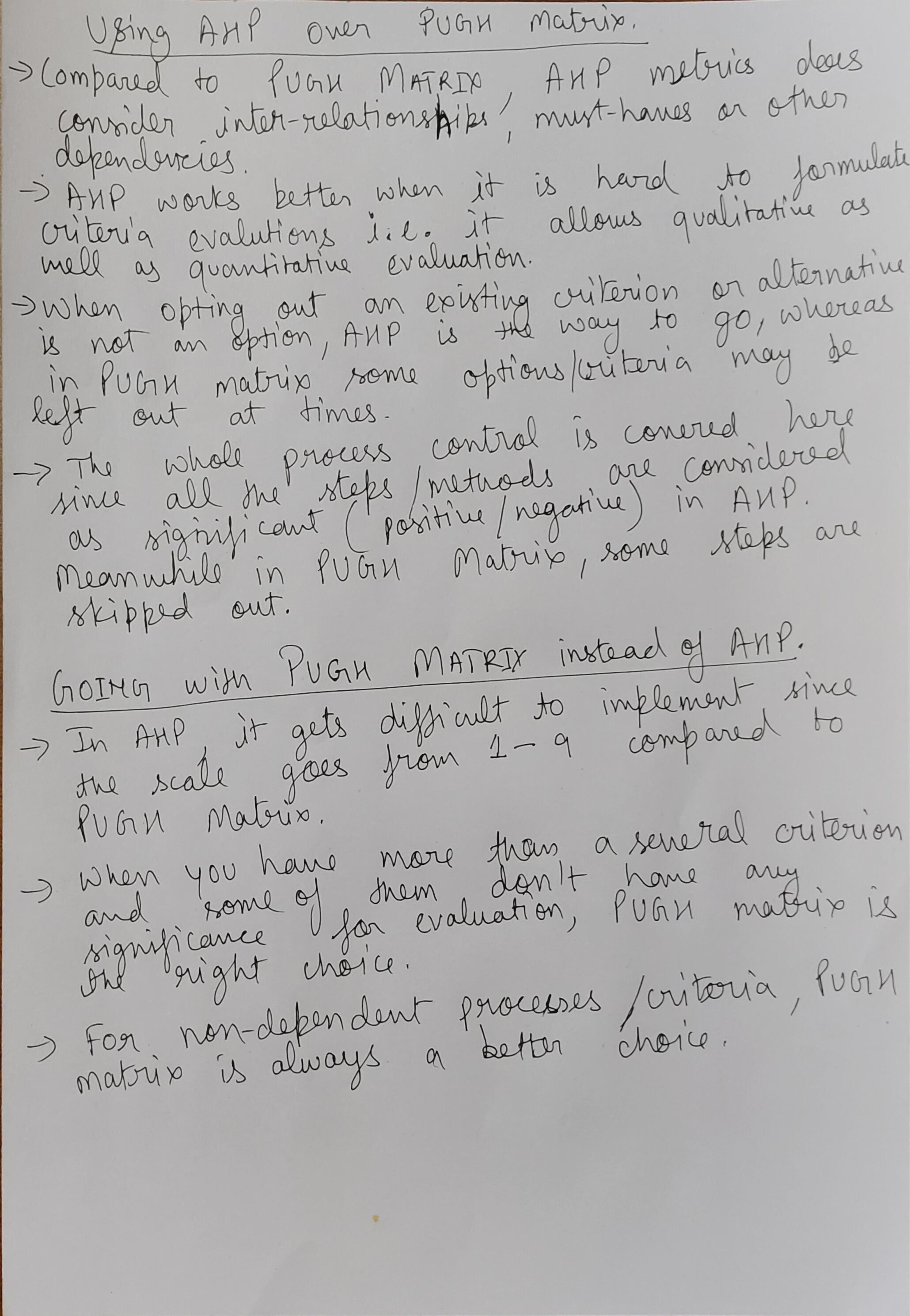
1 pointAnalytic Hierarchy Process (AHP) is an organized decision-making method that enables analysis around a problem, needed for making a choice between available alternatives by determining the criteria basis which selection or prioritization will be done. It is a process of quantifying criteria and alternatives and relating each element to the desired outcome. Pugh Matrix is most popular decision making six sigma tool that uses scores awarded to criteria and scoring them for each alternative. It is a qualitative technique which allows stakeholders to make a choice between alternatives basis scores. While both are used for the same purpose but preference and usage are largely driven by the stakeholder approach, problem in hand and proof of concept needed. Let’s look at some of the differences. AHP PUGH Matrix 1. Pair wised Matching – compare two criteria at a time and amongst alternatives 1. Each alternative is independently awarded a score and compared with DATUM and against the weightage decided for each criteria 2. Quantitative method used for evaluation 2. Qualitative method by awarding scores 3. Complex Statistical Method 3. Simple Method based of Ranking 4. Enables a direct comparison between alternatives and via defined criteria 4. Each Alternative is not compared with each other 5. Consistency Index (<10%) aids validation of the comparison outcome. Improving a decision is possible 5. No such validation and standard are possible 6. Based on Continuous Data – Ratio 6. Based on Discrete Data – Ordinal Data Type 7. Is not LEAN SIX SIGMA QUALITY Tool 7. Is integral part of the LEAN SIX SIGMA QUALITY Playbook 8. Very difficult and time-consuming process especially with more criteria 8. Preferred tool to handle several criteria’s 9. Based on stimulus – response, a mathematical numeric relationship is established 9. Based on Logical thinking, experience and willingness of stakeholders. 10. Individual and Group decisions can be combined. Everyone has a strong reason to believe in the outcome 10. Stays Subjective to a great extent, enables understanding of each alternative compared to existing one The complexity involved and the ability to run AHP, differentiates the choice to be made in comparison with Pugh. AHP is more time consuming and requires complex calculations to reach towards conclusion, ability to handle data and using the method is the key. Hence, AHP is less preferred compared to Pugh and mostly due to simplicity factor. Example scoring movies to judge the most preferred for annual reward compared to a preference of IT Software involving investments. In first case Experience and Knowledge of stakeholders in reference to the problem in hand, governs the success and accuracy of Pugh Matrix outcome. Hence Pugh Matrix can handle sensitive analysis better and where quantitative data is available in abundant. Where as the client would want to have more statistical proof concept for deciding which Software to install and WHY, AHP will be the preference.1 point
-
1 pointThe Pugh Matrix is a criteria- grounded decision matrix which uses criteria scoring to determine which of several implicit results or options should be named. The fashion gets its name from Stuart Pugh and has come a standard part of Six Sigma methodology. It's generally used after the development of the VOC( Voice of the client) and after the creation of a QFD( Quality Function Design). The Pugh Matrix has some of other names as well, including Decision matrix/ grid Selection matrix/ grid Problem matrix occasion analysis Criteria standing form Criteria- grounded matrix The Pugh Matrix Allows the critic to organize colorful criteria( or features) of a result in a structured way for easy comparison Facilitates a team- based process for chastened conception generation and selection Allows the critic to develop a optimal result which is a mongrel of other strong results Sample Pugh Matrix The way for creating a Pugh Matrix are as follows · Identify applicable user demand or criteria. The illustration shows veritably general criteria. · Develop weights for each of the conditions. This is voluntary for weighting the scores. colorful weighting strategies can be used. · Induce several feasible options for a result. · Elect one of the options as a base. This is frequently a current state result. · Estimate each volition against the baseline scoring it as positive, negative or equal in meeting the criteria. · Total the values from each volition, multiplying each value by its weight if the voluntary scoring medium was used. · Combine the best candidates of each volition to produce an optimal hybrid result. Analytic Hierarchy Process The multi- criteria programming made through the use of the logical scale process is a fashion for decision making in complex surroundings in which numerous variables or criteria are considered in the prioritization and selection of preferences or systems. AHP was chased in the 1970s by T. Saaty and has been Extensively studied and is presently used in decision making for complex scripts, where people work together to make opinions when mortal comprehensions, judgments, and consequences have long- term impacts. The operation of AHP begins with a problem being perished into a scale of criteria to be more fluently anatomized and compared in an independent manner. After this logical scale is constructed, the decision makers can fully assess the preferences by making quintet comparisons for each of the chosen conditions. This comparison may use concrete data from the options or mortal judgments to input subjacent information (Saaty, 2008). Illustration of a Hierarchy of Criteria/ objects exhibition 2 – illustration of a Hierarchy of Criteria/ objects AHP transforms the comparisons, which are most constantly empirical, into numerical values that are farther reused and compared. The weight of each factor allows the assessment of each one of the principles inside the defined scale. This capability of converting empirical data into fine models is the main distinctive donation of the AHP fashion when varied with other comparing ways. After all the comparisons have been made, and the relative weights between each of the criteria to be estimated have been established, the numerical probability of each volition is calculated. This probability determines the liability that the volition must fulfill the awaited thing. The more advanced the probability, the better the chances the volition must satisfy the final thing of the portfolio. The fine computation involved in the AHP process may at first feel simple, but when dealing with further complex cases, the analyses and computations become deeper and more total.


 1 point
 -
1 pointAnalytic Hierarchy Process (AHP) & Pugh Matrix are two common methods that are leveraged for decision making in situations having multiple alternatives to be compared basis the multiple criteria. Both these methods incorporate quantifiable comparisons amongst alternatives & rely on establishment of a criteria based on subjective comparison. While Pugh Matrix is good at optimizing & eliminating low quality alternatives, AHP gets an edge as it performs better when it comes to forcing a decision in cases where there is lot of uncertainty & disagreement. Below are some limitations of Pugh Matrix which can be mitigated through AHP:- The only comparison that is happening is with the datum or the base alternative, however there is no pairwise comparison happening between different criteria which is being done in AHP where we performing a pairwise comparison amongst the criteria. Also when evaluating alternatives we are only using a 3 point scale i.e. +, -, s which provides limited granularity as it is leveraging attribute data while AHP leverages ratio scale data i.e. 1,2,3,4,5,6,7,8,9,1/2,1/3,1/4,1/5,1/6,1/7,1/8,1/9 which provides a much granular pairwise comparison amongst the criteria. There is an element of bias when it comes to assigning the importance ratings (usually on a scale of 1-5) as these tend to change basis how the people feel on a particular day while AHP enforces a consistency ratio (CR) threshold which ensures optimum degree of consistency in terms of agreement amongst the people involved in decision making. Now the choice between using AHP & Pugh Matrix depends on situations. Let us try to understand some of these situations:- For organizations who are mature in terms of adopting best practices such as lean six sigma can leverage Pugh matrix for their decision making as the decision makers are not aligned in terms of thought process thus less probability of disagreements. For organizations that have a higher leverage (i.e. organizations that thrive on external investments rather than equity) have to take into considerations the relative importance of different criteria that are being leveraged for decision making, thus they tend to use AHP for making decisions, however for less leveraged organizations since investment is coming through equity they have much more flexibility in terms of investing for future, thus they can use Pugh Matrix for making decisions. Thus using AHP or Pugh Matrix depends on the organizational maturity & complexity of the situation. I hope you all agree with this..!!1 point
-
1 pointAHP Pugh Matrix AHP enables decision makers to represent simultaneous interaction of many factors in complex unstructured situations. Pugh matrix is a decision matrix for the comparison of alternatives.. It is multi-criteria decision making tool with wide range of applications. It compares alternative solutions against the Datum (the current situation) as per the defined criteria. It is used to rank multi-dimensional options of an option set. The basic steps of the AHP Concept Selection Process are: The basic steps of the Pugh matrix Concept Selection Process are: 1. Brainstorm criteria that is important to the customer. List them down rows of sheet along with their weightages. 1. Brainstorm criteria that is important to the customer. List them down rows of sheet along with their weightages. 2. List the alternatives across columns of sheet Identify the Datum or status quo choice. 2. List the alternatives across columns of sheet Identify the Datum or status quo choice. 3. Begin filling in 1 or 0 or ‘or 1 or ratings in the main area of sheet, based on whether that alternative is better, equivalent, or worse than the datum for that criteria. 3. Begin filling in 1 or 0 or ‘or 1 or ratings in the main area of sheet, based on whether that alternative is better, equivalent, or worse than the datum for that criteria. 4. Prepare the prioritization matrix for each attribute. 4. Look at what the spreadsheet tells is the best choice. We need to do our and the group feel good about that decision? If ok means done and if not then need to look again to verify that something has missed from the set of criteria. 5. Calculate and check the CR, if the CR is equal to or less than it is 10% is ok, CR closer to the zero means better the result. 6. Create the summary table and choose the best alternative. Pugh matrix may not a long term strategic decision making like AHP as it selects baseline from the alternatives. AHP is a long term strategic decision making and gives the best result as per the consistency Ratio. AHP works on the basis of quantitative and qualitative data (Nominal, Ordinal, Interval and Ratio) and Ratio data is the best for AHP. Pugh matrix gives alternatives only because it uses discrete data not continuous data so unable to give the logical output as compare to AHP AHP develops a hierarchy of decision criteria and define the alternative courses of actions. AHP gives the logical output because it uses continuous data, It also uses discrete data. As we must use continuous data for critical matrix and continuous data is always preferred for best decision making. AHP algorithm is basically having two steps: 1. Determine the relative weights of the decision criteria. 2. Determine the relative rankings (priorities) of alternatives. AHP is used in complex decision making and group decision making also. We can check the best alternative by using a single chart (RADAR chart) *Finally AHP is the better than Pugh matrix for comparison and choosing the best alternatives. Pugh matrix can be preferred over AHP in small projects where there is no use of continuous data and discrete data is enough for choosing the alternatives.1 point


This leaderboard is set to Kolkata/GMT+05:30