

Topics
-
The latest setback has fueled worries that Google was losing momentum just as OpenAI and Anthropic and a host of Chinese rivals have accelerated the pace of model releases. On the call on Wednesday, Pichai struck an unusually defensive tone as analysts pressed him on the state of Google's frontier models and whether they could still compete at the cutting edge of AI development. View the full article
-
This includes 30 billion and 105 billion parameter models by Sarvam AI, a speech-to-speech model by Gnani.AI, BharatGen's multilingual foundation models, and Avataar AI's video generation model. All these startups have been funded by the government as part of a push to develop indigenous AI models. Of the 20 models, five have been released so far. View the full article



Leaderboard
-
Mohamed Asif Abdul Hameed
Fraternity Members2Points78Posts -
Rahul.Arora2
Members1Points44Posts -
rohit chaudhary
Members1Points11Posts


Popular Content
Showing content with the highest reputation on 07/16/2022 in all areas
-
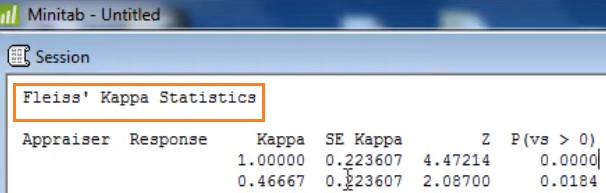
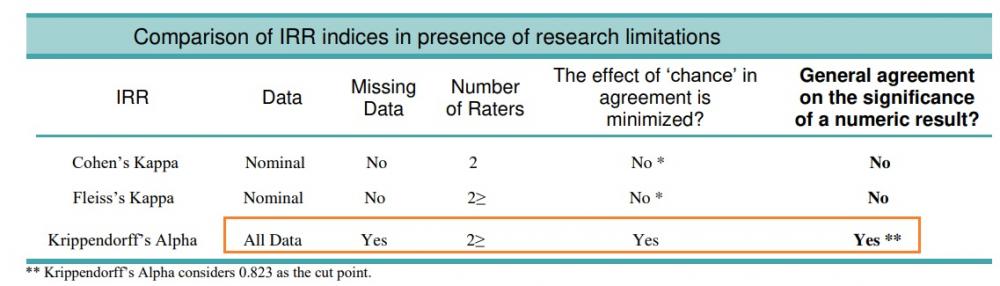
Kappa is defined as the ratio of proportion of times that the appraisers agree to max proportion of times that the appraisers could agree. Kappa ranges from -1 to 1 The larger the kappa, the more agreement in that category For instance, Kappa value of 1 represents Absolute agreement Below table represents commonly accepted values for reliability measures: Cohen’s kappa Value Interpretation: 0.91 - 1.00 - Almost perfect 0.80 - 0.90 - Strong 0.60 - 0.79 - Moderate 0.40 - 0.59 - Weak 0.21 - 0.39 - Minimal 0.00 - 0.20 - None Krippendorff’s alpha Value Interpretation: 0.80 - 1.00 - Reliable value 0.67 - 0.79 - Acceptable for tentative conclusions 0.00 - 0.66 - Not acceptable Take Away: With caution, Stat practitioners should primarily examine the marginal distribution and not uncritically interpret the kappa value whether it is high or low. As prevalence, odds, raters independence, and the impact on diagnosis and other additional factors can have significant influence on the kappa statistics. Kappa statistics represents the degree of absolute agreement amongst ratings and popular statistics includes that of, Cohen’s kappa – Measures assessment agreement between two raters Fleiss’s kappa – Generalization of Cohen’s kappa (>2 raters) In most of the statistical tools, such as Minitab, by default Fleiss’s kappa is calculated for AAA (Attribute Agreement Analysis) As we could note here, Fleiss’s kappa is based on the theory that the observed agreement is corrected for the agreement expected by chance. However, on the contrary, Krippendorff’s alpha is based on the observed disagreement corrected for disagreement expected by chance. Key Differences: Fleiss’s kappa: Cannot handle missing values Expected agreement sample size is infinite Best suited for Nominal data Krippendorff’s alpha: Can handle missing values Actual sample size is considered Can handle all data types Both Fleiss’s kappa and Krippendorff’s alpha can be likewise recommended in the circumstance when the data is nominal and when there are no missing values. However, Krippendorff’s alpha statistics is preferred in below situations, viz., Whenever the data is missing Higher than nominal order (ordinal, interval, ratio) When there is bias in the distribution of disagreements (even strong bias will not have any distorting effect) When different participants have different number of raters (usually when the number of raters is more than 2 and can be applied to any scale level) When there is incompatibility in obtaining observation ratios by pair counting in the small samples Summary Table: Final Take Away: Before deep diving into the reliability data, it is recommended that based on the context, practitioners should select the index of Inter Coder Reliability based on data properties and assumptions, including the level of measurement of each variable to calculate the agreement and the number of coders. Most of the times, it is difficult and complex to compute Krippendorff’s alpha statistics compared to Fleiss’s kappa, however Krippendorff’s alpha provides higher reliability, particularly when there are no perfect conditions for research.
 1 point
 -
The basic premise of conducting Attribute Agreement Analysis is to assess whether there is consistency amongst the appraisers in terms of assessing an attribute which is non-measurable in nature (i.e. Nominal, Ordinal, Binary etc) in terms of three aspects:- Agreement of appraisers within themselves i.e. Repeatability Agreement of appraisers between themselves i.e. Reproducibility Agreement of appraisers with the standard i.e. Accuracy There are two popular measures of appraiser consistency / reliability i.e. Fleiss Kappa & Krippendorff’s Alpha values. However both are equally consistent measures when it comes to assessing the reliability of your measurement system, there are slight differences in these two measures. These differences are as mentioned below:- Fleiss Kappa is based on the concept of the ratio calculated between observed agreement(Pa) & agreement expected by chance(Pe) whereas Krippendorff's Alpha is based on the concept of ratio calculated between observed disagreement(Pa) & disagreement expected by chance(Pe). Mathematically both are calculated by the below formula:- Ranges for both the measures is from -1 to 1 with 1 indicating perfect agreement, 0 indicating no agreement & -1 denoting inverse agreement in case of Fleiss Kappa with an acceptable threshold value of 0.75 resembling significant agreement. However in the case of Krippendorff's Alpha an alpha value of 1 denoting perfect disagreement, 0 being no disagreement with an acceptable threshold value of 0.80 for significant disagreement. Fleiss Kappa is most suitable in case of nominal data while Krippendorff's Alpha has high flexibility as it can work with nominal, ordinal as well as metric data. In case of missing data Krippendorff's Alpha is the preferred option rather than Fleiss Kappa which cannot handle missing values & these missing values must be excluded from the data. Krippendorff's Alpha is said to be much more robust even if we have 50% of the values missing in our data & provides unbiased results. Based on the above facts it would be preferable to use Krippendorff's Alpha as the preferred statistic for measuring inter-appraiser reliability in situations where we have data other than nominal data, have multiple appraisers choosen randomly & the attribute agreement data is having missing values.1 point
-
1 pointCobots are similar but smaller when compared to that of industrial robots. It is also comparatively cheaper in price and much user friendly. For a large-scale mass production, industrial robots can provide best efficiency. However, for small and medium scale businesses, cobots can be much more effective when it comes to automation on the shop floor. Cobots are Collaborative Robots. It is more of a collaboration between Human and Robot in a shared space and can optimize human work in various aspects. International Federation of Robotics (IFR) defines multi-level of collaboration viz., Coexistence, Sequential, Cooperation and Responsive Collaboration. Traditional Robots are best fit for: Large batches, small variability Complex deployment Consistent environment Human monitoring Focus on Robot Automation Big Investments Longer ROI Alternatively, Cobots could be a best alternative for: Low-volume, high-mix Fast and Easy deployment Agile and adapts to environment Collaborative Focus on End-Of-Arm-Tooling (EOAT) Lower upfront cost Faster ROI Cobots in Service Industry: It is often referred as RaaS (Robots-as-a-Service) and few of the utilities includes that of, Robotic-Assisted Knee Surgery (robotic arm assistance) Food Robots - Packaging (Wrapper, Vacuum sealer) Food Robots - Other Applications (Palletizing, Pick-and-place, Logistical automation) Product Quality Inspection (Cobot arms for visual inspection using 3d Cameras) Aviation (Cobot co-pilot mainly for Military UCAV (Unmanned combat aerial vehicles)) Agriculture (Farming - Once Cobot identifies flowers, fan gets activated for effective pollination (Smart Farming)) Diary (Robotic Milking) Restaurant Cobot These cobots are identified and selected based on critical factors such as, Reach (500 - 900 mm) Payload (2kg - 16kg) Footprint (Ø 128 - 200 mm) Weight (10kg - 35kg) Technology Advancements like IoT features with loaded capabilities such as heat sensors and thermal cameras help the cobots to perform more accurate tasks based on their use cases. Anticipating the rise of 5G, could lead Cobots to get fully automated and to perform tasks with greater accuracy.

 1 point
 -
1 pointThe underlying definition of a Robot is that, it is a programmable machine that is capable of taking a number of undertaking complex series of actions, either assisted by Humans or unassisted. Robots, could be classified into two categories (as per IFR, International Federation of Robotics) on the basis of application and way of us as below: 1. Industrial Robots: These are traditional robots that are programmed to work in isolation from human contact, largely in Industrial settings. Industrial robots are majorly used for Assembly operations, Heavy material movements and Machine feeding. 2. Cobots: Also known as Collaborative Robots, are robots designed to work with direct human interactions, either in close proximities or within a shared space. These are closely related to what is called as Service Bots, and the main uses are in domestic & professional settings including below Applications: a. Pick & place objects (e.g. Moving documents within office space) b. Quality inspection (eg. Alicona uses its 3D metrology inspection cameras) c. Machine tending, like tool changes or raw material replacement d. Packaging & Palletizing, where tasks are repetitive and involve small payloads e. Process tasks, situations that requires a tool to interact with a workpiece (eg. da Vinci System, built with robot arms and high-tech cameras to assist surgeons during operations.) f. Finish tasks, such as polishing and grinding The key differences between Cobot and Traditional robots are as below: 1. A Cobot can act as an assistant to a human operator and is typically used in applications working alongside human operators. Traditional robots are programmed to complete an automated task with very little or no human interaction. 2. Traditional robots are designed to do industrial tasks and Cobots are used in domestic & professional settings. 3. Cobots are built with safety for humans, these are built generally as rounded and lightweight materials, whereas Traditional robots are not built for humans to work next to them and could be highly unsafe as these are built as heavy machineries.1 point


This leaderboard is set to Kolkata/GMT+05:30