

Topics
-
A significant chipmaking tool from ASML has arrived in New York. This advanced equipment will drive research into future chip designs and manufacturing. The Albany NanoTech Complex is North America's sole facility of its kind. This transformative technology development places the US at the forefront of innovation. The tool is expected to be fully operational by the year's end. View the full article
-
As part of the agreement, Microsoft Azure customers will be able to develop software using Mistral's data centers in France, giving Microsoft more capacity in Europe and regulated industries an alternative to U.S.-controlled infrastructure. View the full article



Leaderboard
-
Kaviraj
Members1Points10Posts -
Rahul.Arora2
Members1Points44Posts -
Soji Sam
Members1Points10Posts -
Manish Manjhi
Members1Points10Posts


Popular Content
Showing content with the highest reputation on 06/24/2022 in all areas
-
1 pointWhat is Thematic Analysis Thematic analysis is commonly stated as the study of patterns of meaning. In other words, If you want to analyze the themes within your data set to identify meaning. It is the most common forms of analysis within qualitative research - to identify, analyze and interpreting patterns of meaning or themes within quality data. What is Qualitative Data It is the data on which participants write descriptively and it can be obtained from questionnaires, interviews, focus groups, case studies, social media profiles, survey responses etc. - these data are generally non-numerical. And qualitative research methods have been used in various areas like, sociology, political science, psychology, educational research etc. Some samples of qualitative data The hair was smooth and silky The girls have brown, black, blonde, and red hair The room was very airy and bright with white curtains Different Approaches · Inductive Approach: No pre-conceptions about themes, instead we generating themes. · Deductive Approach: Already have a set of themes that we expect to generate from the data. · Semantic Approach: No need to understand the subjective meaning of the data. · Latent Approach: Need to dive into the data and understand its meaning. Steps To Do Thematic Analysis This is an iterative process which helps to go from messy data to the most important themes in the data. There are commonly used six steps developed by Braun and Clarke which can follow - · Data familiarization : reading, re-reading, taking notes · Initial codes generation: coding interesting feature across the entire data set · Searching themes: collecting codes related to potential themes · Reviewing themes : review and compare themes against data set · Defining Themes: generating clear definitions and names for each theme · Writing Up: the final analysis of selected extracts and producing a report of the analysis Advantages and Disadvantages Advantages - - It has a lot of flexibility in interpreting the data - It helps to approach large data sets easily into broad themes by sorting them. Disadvantages - - it involves the risk of missing nuances in the data - It is often quite subjective - Need to carefully reflect on your interpretations1 point
-
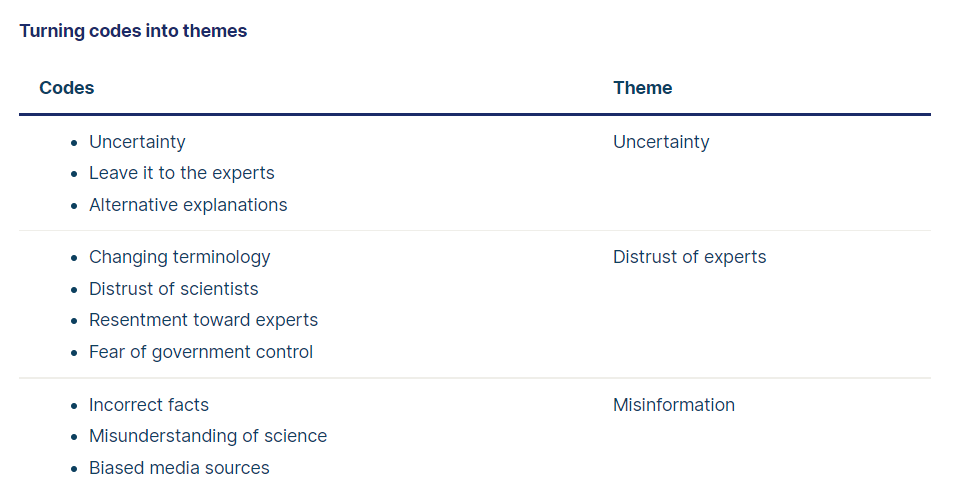
1 pointIn qualitative research, we can use thematic analysis to determine something about people's views, opinions, knowledge, experiences, or values from a set of qualitative data, such as interview transcripts, social media profiles, or survey responses. We can use thematic analysis to answer the following types of research questions: In a hospital setting, how do patients perceive doctors? In terms of climate change, what do non-experts think? What is the role of gender in high school history? The six steps Braun and Clarke develop can help us decide if the thematic analysis is right for you and how you will analyse our data. Step 1: Familiarization Familiarizing ourselves with our data is the first step. Getting an overview of all the data we collected is essential before we analyse individual items. Step 2: Coding Once the data is analysed, it needs to be coded. It is, in essence, the process of highlighting sections of a text, usually a phrase or a sentence, and creating shorthand labels for it. We can quickly gain an overview of the main points and common meanings that recur across the data by using these codes. Step 3: Generating themes Next, we review the codes we've created, identify patterns among them, and begin generating themes. Themes are more general than codes. In most cases, you'll combine several codes into one theme. As an example, we might combine the codes as follows: Again, what we decide will depend on what we are trying to discover. We are looking for themes that tell us something useful about the data for our purposes. Step 4: Reviewing themes We need to make sure our themes are useful and accurate representations of the data. In this step, we compare our themes with the actual data set. For eg, we might decide upon looking through the data that “changing terminology” fits better under the “uncertainty” theme than under “distrust of experts,” since the data labelled with this code involves confusion. Step 5: Defining and naming themes Now that we have the final list of themes, it’s time to label and describe each of them. Defining themes will involve formulating precisely what we mean by each theme and figuring out how it helps us understand the data. Naming themes will involve coming up with a succinct and easily understandable name for each theme. Step 6: Writing up At last, we’ll write up our analysis of the data. A thematic analysis needs to begin with an introduction that establishes our research question, aims, and approach. We should also include a methodology section, describing how we collected the data and explaining how we conducted the analysis itself. The results or findings usually address each theme in turn. We describe how often the themes come up and what they mean, including examples from the data as evidence. Finally, our conclusion explains the main takeaways and shows how the analysis has answered our research question.
 1 point
 -
1 pointWhat is Thematic Analysis, Thematic analysis is a study of patterns, a methodology used to analyse qualitative data (i.e. non-numerical data’s like audio or video, or audio) for understanding the opinions, experiences, or concepts. This analysis will be used to gather in-depth insights into a problem or to generate new ideas for research. There are 3 approaches/ways to do this analysis, they are, 1. Inductive approach – This approach derives meaning and creating themes from data without any preconceptions. (Will do the analysis without any idea of what themes will emerge, hence the themes will be determined by the data) 2. Deductive approach – In this approach, we start the analysis with a set of themes that we already expect to find from the data. (Will do this analysis after getting the knowledge from research or existing theory about the data) 3. Semantic approach – In this approach, we ignore the underlying meaning of data, but will identify the themes based on what is openly stated or written. (This approach is taken when investigating opinions and viewpoints, as these tend to be understandable) 4. Latent approach - This approach focuses on underlying meanings and relatively looks at the reasons for semantic content, which involves an element of interpretation, where data is not just engaged because of face value, but meanings are also theorized. Note – I personally prefer the Latent approach though we have the option of choosing any of these four as per the analysis requirement. Application, This analysis is useful during an interview or transcripts or during psychological research to examine the data to identify the patterns of meaning that come up repeatedly. How to do this analysis, There are different approaches to conducting thematic analysis, the most familiar type is the six-step process, Step 1 - Familiarization, In this step the analyser makes himself familiar with the data that needs to be analysed. This may include reading and re-reading the whole data thus having an overview of its context and taking notes of it. Step 2 - Coding, In step 2, the analyser highlights or labels the keywords or group of keywords, or even the entire phrases in the data that indicate some meaning. This meaning will come in handy when the analyser trying to clutch the essence of the data. In this example - The survey questing is “How has social media changed over the years?”, and we are interviewing a person who is 40+ years old and working in a middle school. And receiving the opinion, “I think these social media platforms such as YOUTUBE/FACEBOOK and LINKEDIN are not for the oldies anymore. Because the current trends are rapidly changing and evolving every day. Hence it becomes difficult for people like me to keep up with them. This difficulty makes us feel disconnected.” Further, we need to derive codes for the key phrases like – Quickly changing/ Uninterested/ Discomfort, etc., Step 3 - Generating themes, For the above-mentioned example, we can have a theme called “NOT SATISFIED” for the codes we derived from the interview mentioned. This step will give the analyser a brief idea about how many codes are being used repeatedly and which ones of them will be useful and which need to be discarded. Step 4 - Reviewing themes, In this step, the analyser compares the themes with the original data and looks for any missing points or irrelevant results, and may modify the themes by checking on how they satisfy and/or justify the data intended. Step 5 – Defining and naming themes, Next step, the analyser will do the naming for the themes depending on what they indicate and what we will understand from the data. Step 6 - Writing up, in the last step, using all the results we may conclude that social media has evolved so much that the elder generations find it difficult to understand and interact with which results in their dissatisfaction. This is the method I prefer and practice to regulate a perfect Thematic Analysis. Thanks1 point
-
1 pointThematic Analysis is a method of analyzing qualitative data. It is generally applied to a set of text such as verbatim or transcripts where it is closely examined in order to identify common themes. It is a good approach to leverage whenever you are trying to find something meaningful(eg: people’s views, opinions etc) from a set of qualitative data. It is basically a data analysis process which involves deep diving through a dataset, create coding, identifying patterns, , deriving themes & then finally create a narrative. Following are the steps to perform Thematic Analysis:- First step is to familiarise yourself with the data i.e. performing an initial exploratory analysis of the data in order to identify meanings & patterns in the data. After familiarising with the data, create the initial codes that represent the meanings & patterns identified in the data. Decide the code, go through the data again & identify the excerpts, then apply the appropriate codes to them. Also add new codes as deemed fit. Bring together all the excerpts associated with a code & collate them under that appropriate code, repeat the same for other codes as well. Group the collated codes containing the excerpts into suitable themes . Evaluate & revise the themes, also ensure that each theme has data to support it & each theme must be unique. Once themes are finalised the final step is to create the narrative in order to share your findings to the audience. Based on the above understanding one of the common applications of thematic analysis in lean six sigma is VOC analysis. The objective here is to identify major recurring themes that reflect the concerns or problems raised by the customer & eventually this will help to identify the key needs of the customer basis which we can focus our improvement efforts accordingly. Let us take the example of a bank having rolled out a survey to its customers in order to get their valuable feedback on the overall performance of the services thy are delivering. Now once we have received the responses from the bank’s customers the bank decides to use Thematic Analysis in order to analyze those responses & post the analysis it was found that there were two major themes identified from the data points one towards the accuracy & other towards the timeliness of the Bank’s wire transfer process. Thus by leveraging this analysis they identified two major improvement areas i.e. To improve the accuracy of the wire transfer process & to reduce the overall time to completion of the wire transfer process.1 point
This leaderboard is set to Kolkata/GMT+05:30