NiketKumarPhuria
Lean Six Sigma Green Belt
-
Joined
-
Last visited
Everything posted by NiketKumarPhuria
-
NiketKumarPhuria replied to Vishwadeep Khatri's topic in We ask and you answer! The best answer wins!Jidoka means intelligent automation. When translated to the factory floor, Jidoka is a quality control method, which ensures that all the quality checks and balances are carried out. Jidoka enables machinery to be intelligent enough to: Identify process malfunctions or product defects. Stop itself Alert the operator

-
NiketKumarPhuria replied to Vishwadeep Khatri's topic in We ask and you answer! The best answer wins!The steps of a process that are dedicated to a particular family of products or services that responds directly to orders from external customers. A well run pacemaker sends smooth demand signals upstream to the pull loops of the remaining processes, which respond to requirements from internal customers (not directly from external customers). Lean activity should begin at the pacemaker process (usually shipping or final assembly), as it is most vulnerable with direct impacts on the customer. The pacemaker simplifies production oversight. Having only one scheduling point greatly reduces the need for coordination. The benefit is amplified when there is mixed-model production in a value stream. The actual demand determines the mix, and the pull signals generated by the pacemaker ensure that only the types of products that are needed are produced. The Pacemaker Process: The production schedule is planned according to takt time, and is sent to the pacemaker process. It pulls from the upstream processes. Upstream processes ONLY produce when the pacemaker sends its signal. If there are multiple products, supermarkets are used. Continuous flow is used downstream from the pacemaker to manage production. There are several things to consider when selecting a pacemaker. The pacemaker should be reliable. If it is frequently down for maintenance, it wreaks havoc on the rest of the value stream. It should have minimal setup times to prevent surges. The closer it is to the end of production, the more linked it is to the customer. The downside is that it might drive more inventory into supermarkets on the upstream processes. Branches in production processes need to be upstream of the pacemaker, or have a supermarket.
-
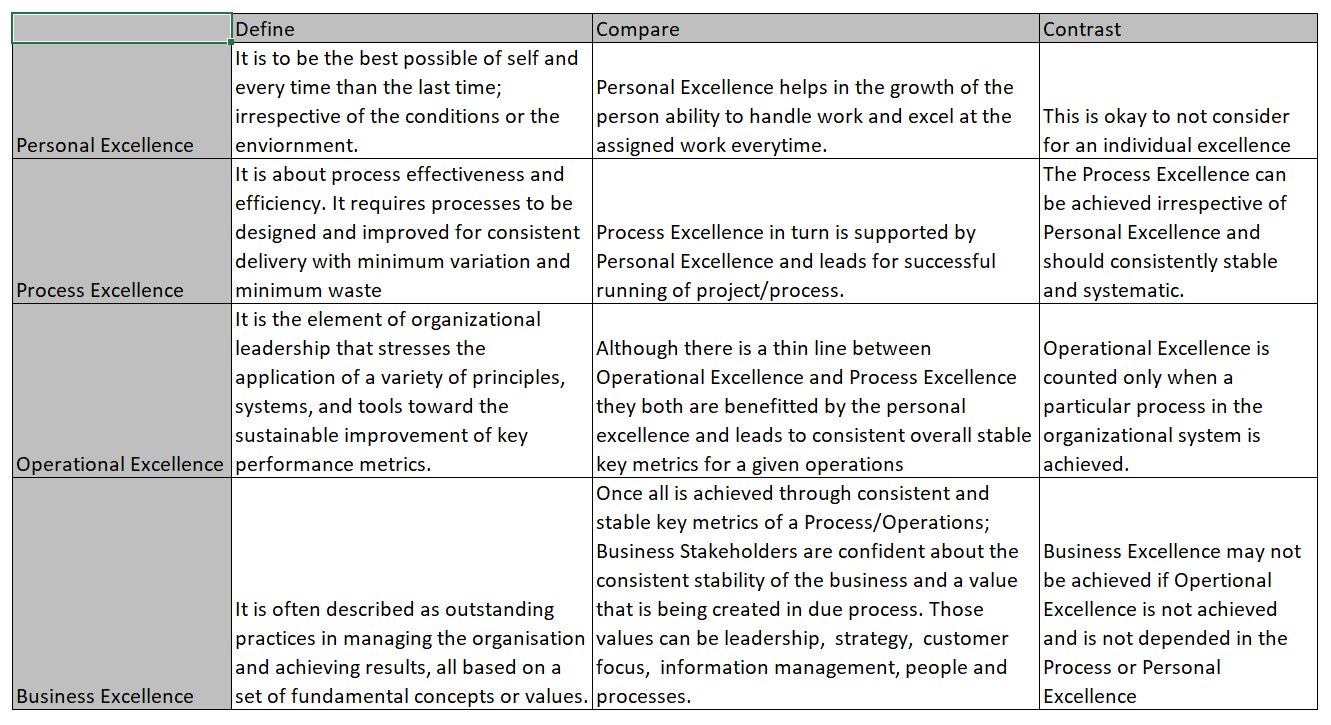
NiketKumarPhuria replied to Vishwadeep Khatri's topic in We ask and you answer! The best answer wins!Alarms: These are to notify the user that there is something wrong with the process and needs attention. They could be manual or automatic. These both could result into a 'False Alarm' or 'Missed Alarm'. Now, both false and missed alarms are based on specific criteria. False alarms can help users to make sure that they are attentive and are able to respond in time in case of any actual "Alarm". While, Missed alarm may led to notify the user's authorities that there was an alarm and an important one that was missed by the user and could turn fatal. In both the cases a missed alarm could result in losing the business and too many false alarm may also result in losing the business. However, one should always define the criteria of how a false alarm will be triggered and what needs to be done if an alarm is missed. What is the criteria that is "Ok" for an Alarm to be Missed and recurrence for a False Alarm. This will be defined only when there is sufficient data and continuous monitoring of data that is received in the process. This will also define the Business Excellence as well.
-
NiketKumarPhuria replied to Vishwadeep Khatri's topic in We ask and you answer! The best answer wins!In Lean, takt time is the rate at which a finished product needs to be completed in order to meet customer demand. Described mathematically, takt time is: Available time for production / required units of production Takt time drives all decisions related to meeting Customer demands and it is strategic when the delivery time is small for a larger no. of goods that needs manufactured and there are many competitors who are ready to deliver the same product. It would be tactical when you want to be ready before the customer makes his demand and being prepared for the market competition. For example, a factory operates 1,000 minutes per day. Customer demand is 500 widgets units per day. The takt time, then, is: 1,000 / 500 = 2 minutes
-
NiketKumarPhuria replied to Vishwadeep Khatri's topic in We ask and you answer! The best answer wins!The Central Limit Theorem tell us that as the sample size tends to infinity, the of the distribution of sample means approaches the normal distribution. This is a statement about the SHAPE of the distribution. A normal distribution is bell shaped so the shape of the distribution of sample means begins to look bell shaped as the sample size increases. The Law of Large Numbers tells us where the centre (maximum point) of the bell is located. Again, as the sample size approaches infinity the centre of the distribution of the sample means becomes very close to the population mean. I will take this to mean that it is the belief that for i.i.d. random variables Xi with mean μ and standard deviation σ, the cumulative distribution function FZn(a) of Zn=1n∑i=1nXi converges to the cumulative distribution function of N(μ,σ), a normal random variable with mean μ and standard deviation σ. Or, the minor re-arrangements of this formula, e.g. the distribution of Zn−μ converges to the distribution of N(0,σ), or the distribution of (Zn−μ)/σ converges to the distribution of N(0,1), the standard normal random variable. Note as an example that these statements imply that P{|Zn−μ|>σ}=1−FZn(μ+σ)+FZn((μ+σ)−)→1−Φ(1)+Φ(−1)≈0.32 as n→∞. The weak law of large numbers says that for i.i.d. random variables Xi with finite mean μ, given any ϵ>0, P{|Zn−μ|>ϵ}→0 as n→∞. Note that it is not necessary to assume that the standard deviation is finite. So, to answer the question, The central limit theorem does not imply the weak law of large numbers. As n→∞, the other version of the central limit theorem says that P{|Zn−μ|>σ}→0.317⋯ while the weak law says that P{|Zn−μ|>σ}→0 From a correct statement of the central limit theorem, one can at best deduce only a restricted form of the weak law of large numbers applying to random variables with finite mean and standard deviation. But the weak law of large numbers also holds for random variables such as Pareto random variables with finite means but infinite standard deviation. I think it is safe to say that the sample mean converges to a normal random variable with nonzero standard deviation is a stronger statement than saying that the sample mean converges to the population mean, which is a constant (or a random variable with zero standard deviation if you like). Isn’t it?
-
NiketKumarPhuria replied to Vishwadeep Khatri's topic in We ask and you answer! The best answer wins!The fault tree analysis (FTA) was first introduced by Bell Laboratories and is one of the most widely used methods in system reliability, maintainability and safety analysis. It is a deductive procedure used to determine the various combinations of hardware and software failures and human errors that could cause undesired events (referred to as top events) at the system level. The deductive analysis begins with a general conclusion, then attempts to determine the specific causes of the conclusion by constructing a logic diagram called a fault tree. This is also known as taking a top-down approach. The main purpose of the fault tree analysis is to help identify potential causes of system failures before the failures actually occur. It can also be used to evaluate the probability of the top event using analytical or statistical methods. These calculations involve system quantitative reliability and maintainability information, such as failure probability, failure rate and repair rate. After completing an FTA, you can focus your efforts on improving system safety and reliability. This analysis method is mainly used in the fields of safety engineering and reliability engineering to understand how systems can fail, to identify the best ways to reduce risk or to determine (or get a feeling for) event rates of a safety accident or a particular system level (functional) failure. FTA is used in the aerospace,nuclear power, chemical and process,pharmaceutical, petrochemical and other high-hazard industries; but is also used in fields as diverse as risk factor identification relating to social service system failure. FTA is also used in software engineering for debugging purposes and is closely related to cause-elimination technique used to detect bugs. I don't think that FTA is less likely to be used in any process or projects. The unlikely use will only if the project is small and there is very minimum error/failures.
-
NiketKumarPhuria replied to Vishwadeep Khatri's topic in We ask and you answer! The best answer wins!Q4 - Explain the meaning of Kaizen, Kaikaku and Kakushin. How are the three different from each other? How do they complement each other? What would a company lose if one of these as a concept was not utilised? Answer: 1. Definition, Difference & Complement: a. Kaizen It is the Japanese word for continuous improvement using small incremental changes. It translates as change for the better. Kai means change, Zen means for the better. Lean IT Kaizen is an approach for solving problems and forms the basis of incremental continual improvement in organizations. A problem is a difficulty that should be resolved or dealt with. When applied to the workplace, Kaizen means continuous improvement involving everyone, managers and workers alike, every day and everywhere, providing structure to process improvement. Kaizen is about continuously improving: everyday, everyone and everywhere. Many small improvements implemented with Kaizen produce faster results with less risk. In IT terms, we can equate this to a minor update to a piece of software. b. Kaikaku Lean also recognizes that there are moments that more radical, step change is necessary. This type of change is known as Kaikaku. This refers to a revolutionary change to the existing situation. Following the software example, Kaikaku would be the upgrade of an application currently in use from a release level to a new release level. Software providers will often substantially change both the technical basis of the software and its functionality. For both IT and the user community, this means a large step change. c. Kakushin A third type of improvement known within Lean is Kakushin. The idea here is that some change will form a complete departure from the current situation. It is about innovation, transformation, reform and renewal. Again, in our software example, this may mean replacing a complete application with a different application that supports the process in a completely different way, for example a web-based application that fully automates the registration of orders, the submission of invoices and the generation of a picking order at order fulfilment. This kind of change will entail the disappearance of many roles and functions within a business. Both from technological and business process perspectives, this example represents a complete departure from the current way of working. Another example of Kakushin is where the organization standardizes a process and supporting software across the entire organization where previously various groups had different processes and applications to achieve similar goals. 2. What would a company lose if one of these as a concept was not utilised? Organizations do benefit from these through continual improvement of their processes, transformation of their organizational culture, and becoming an innovative entity. When it comes to adopting these concepts in a company; it really deppends on what problem are we solving. These concepts are elimination of non-value-added work (7+1 types of waste) in the work processes, companies will become more efficient and as a result be more profitable and competitive. This great philosophy of Kaizen that encourages incremental continuous improvement, in the last decade, has spread out among other service oriented industries, i.e. Healthcare, IT, Retail, …, where the need for a more rapid and agile methodology was felt. It was realized as a necessity to be able to deliver products and services to the customer quicker, while maintaining the high quality and lower cost. The companies will lose the chance to improve, innovate and eliminate waste through either of these concepts and the process will not efficient for delivery of a project. Kaizen bring immediate changes in the process and if you need more radical changes then the concept of Kaikaku was born. Kaikaku is Radical Change, where emphasis is on revolutionary change and big improvements. It allows organizations to reform and transform their culture and work habits into greatness via implementation of fundamental changes in the existing production systems. It is a large-scale and wide-ranging activity that is initiated and invested in by the executives and top management. To clarify this more, let’s look at different scenarios in an automotive manufacturing plant. When we perform projects to reduce the production time, implement 5S, or redesign the assembly line, we are implementing Kaizen. On the other hand, when we introduce a new lighter material to be used for the vehicle’s body or install robots to weld, press, or paint the vehicle, we are applying Kaikaku. So far you have explored making either small incremental improvement changes to better the production processes (Kaizen) or big revolutionary changes to reform existing production systems (Kaikaku). However, there are times that new revolutionary and breakthrough ideas, products, or services are desired and needed and thus we must renew our way of thinking and doing and become innovative. This innovation and renewal is called Kakushin. The concept of Kakushin was mentioned by former President of Toyota, Mr. Katsuaki Watanabe; during interviews with Wall Street Journal and Harvard Business Review in 2007 as a Radical Innovation. He elaborated this concept by saying that if we could make simplified cars by cutting the number of parts in half and design more flexible production lines to manufacture many different car models rapidly, then we had made a new revolutionary reform in our production system and that is Kakushin. In conclusion, effectively applying these three essential concepts of Kaizen, Kaikaku, and Kakushin is the right solution for any organization who wants to deliver a sustainable high-quality product or service and to ensure a steady growth in the global market. 3. References: https://www.pinkelephantasia.com/kaizen-kaikaku-kakushin/ https://www.linkedin.com/pulse/3-essential-ks-organizational-success-kaizen-kaikaku-mogharei-pmp https://en.wikipedia.org/wiki/Kaizen https://en.wikipedia.org/wiki/Kaikaku http://www.1000ventures.com/business_guide/mgmt_kaizen_vs_kaikaku_10c.html
-
NiketKumarPhuria replied to Vishwadeep Khatri's topic in We ask and you answer! The best answer wins!Q. What is your view on this? Is measurement essential for good management? Why? Why Not? A. I believe it is important to define a measurement for any product/process/operations which leads to definition of the CTQs/Metrics/Dashboards/Numbers. These numbers define the performance standards/specification limits and also helps in staying up in the competition. Any level of measurement for a product/process/operations is good management. The reason being as follows: These numbers become Voice of Customer and say that this is a level of quality that can be expected from a product/process/operations. The "Customer" here can be anyone inter-outer stakeholders, Customers, etc. Their numbers define the Characteristics of product/process/operations. Eg. Mobile/Phone charging time These numbers help to define Operational definitions and measurement of how and what needs to be quantified. Eg. Unit to measure the time from the start of charge and full charge capacity of the battery. The target value of he product/process/operations and if there is no variance in the product or process that will be the value to be delivered. Eg. Mobile phone charges to 100% capacity in 20mins. The numbers will also tell what is the defect rate that will be produced by a particular process Eg. 2.4 defects per million opportunities. What did Edward W Deming mean by his statement? I think what he is trying to say "The most important numbers are unknown and unknowable" is that choosing the right metrics for Practitioners is very challenging because the incorrect definition of measurement and the incorrect unit of measurement may lead to variation in the product and may create extra costs, rework, low productivity; drive the “wrong” decisions (because of outdated data); and prompt a sense of frustration or lack of trust. From a project perspective, it could result in project delays and impairment of testing. Project teams need to assure that data associated with their designs is both accurate and complete. Hence, his statement: "It is wrong to suppose that if you can't measure it, you can't manage it. The most important numbers are unknown and unknowable"
-
NiketKumarPhuria replied to Vishwadeep Khatri's topic in We ask and you answer! The best answer wins!Please see the answer from the Club 57 as follows: I think the answer should be option 1: because the Root Cause Analysis is done to understand what, why and how to solve the problem occurred. Hence, A cause may be necessary but not sufficient for a problem to occur. Root cause can help and detect issues in the current problem and at the same time it will also help in identifying actions for preventing reoccurrence .
-
NiketKumarPhuria replied to Vishwadeep Khatri's topic in We ask and you answer! The best answer wins!Please see the answer from the Club 57.