

Topics
-
OpenAI, which is expected to need about 3,200 megawatts (MW) of power for its new facility, has agreed to provide up to 1,000 MW to the Southern Co subsidiary Georgia Power's systems in times of high demand. View the full article
-
The affected startup, Hugging Face, said it had turned to Zhipu AI's open-source GLM-5.2 model last week to analyze data from the hack after leading US AI models declined the task, unable to distinguish between a defender and an attacker. View the full article


Leaderboard
-
Adil Khan18
Members1Points56Posts -
Keerthi vasan
Members1Points12Posts -
Asangi
Members1Points10Posts -
Saurabh N.
Members1Points11Posts




Popular Content
Showing content with the highest reputation on 11/17/2023 in all areas
-
1 pointThe actual requirement of the FMEA is to create a very useful document used for making strategic decisions based on risk involved in process. FMEA can be characterized in the relative risk contribution of potential failure areas associated with the process in terms of a risk priority number (RPN). This RPN can be obtained as a product of three phase of framework representing below. · Severity of Occurrence · Frequency of Occurrence · Chance of Detection RPN Scales usually range from 1 to 10, with the higher number representing the higher seriousness or risk. considering ten-point Occurrence scale, 10 indicates that the failure is very likely to be occurred and is worst compared to 1 which indicates that the failure is very rare to be occurred. Severity- Which indicates that the occurrence of severity of the potential effect of the failure is high when rated as 10 and low when rated as 1. Occurrence- Which indicates that the frequency of occurrence of the potential effect of the failure is high when rated as 10 and low when rated as 1. Detection - Which indicates that the chance of detection of the potential effect of the failure is high when rated as 10 and low when rated as 1. For each potential cause, the individual factors occurrence (O), severity (S), and detection (D)are rated and multiplied together. PRN= Severity (S) X Occurrence (O) X Detection(D) In order to improve the rating of PRN suitable actions cab be taken and risk can be reduced However, the specific rating criteria for the ranking of occurrence (O), severity (S), and detection (D) are defined by the individual organization based on process and priorities. · Reduce the severity. · Reduce the probability. · Improve the design to improve the control over detection Example:- Potential failure areas with risk priority number (RPN) improvement in bottling plant. Sr No Process Potential Failure mode Potential effect of Failure Severity (S) Potential Cause/ Mechanism of Failure Occurrence (O) Current Process control Detection (D) Risk Priority No (S*O*D) 1 Bottling plant Less quantity Customer complain 5 Filler 2 Weight gauge 3 30 2 Bottling plant Insufficient seal Mixing with other substance 3 Heat Sealer 5 Seal Test 4 60 3 Bottling plant Wrong marking Expiry period 1 Manual Labeler 5 Random In Process check 3 15 For above example below Corrective Actions can be implemented such as: Installing automatic labeler can help improving mechanism by removing potential cause for frequency of occurrence. Installing sensor based continuous automatic Checking system to reduce chance of detection. Sr No Process Potential Failure mode Potential effect of Failure Severity Potential Cause/ Mechanism of Failure Occurrence Current Process control Detection Risk Priority No 1 Bottling plant Less quantity Customer complain 5 Filler 2 Weight gauge 3 30 2 Bottling plant Insufficient seal Mixing with other substance 3 Heat Sealer 5 Seal Test 4 60 3 Bottling plant Wrong marking Expiry period 1 Automatic Labeler 1 Continuous Sensor based Automatic Checking 1 11 point
-
1 pointIn FMEA, Risk Priority Number helps us assess the risk in the process. While potentially RPN can range from 1 to 1000, could there be a process step, where the RPN is 1? Provide examples to support your answer. Risk priority number helps us to prioritized the potential failure modes. RPN is the product of severity, occurrence and Detection . (RPN = Severity * Occurrence* Detection.) In some situations it can be 1 when severity = 1 , occurrence =1 and detection 1.This is the minimum level that RPN can be. RPN =1= 1 (Sev)*1(Occ)*1(Detection) Severity number 1 shows low severity that are unnoticeable or can be reworked areas. Occurrence ranking 1 implies the failure cause is very unlikely to occur, Detection rank 1 implies if process automatically detect the failure and the controls will almost certainly detect the existence of a failure Please refer below Example for more understanding , low battery level of car key In some Auto car’s if battery level is low in car key we won’t be able to start the car automatically but it is detecting by the vehicle and advised to keep the key at a designated area near steering wheel to start the car.
 1 point
 -
1 pointRPN = severity * occurrence * detection Wherein severity 1 - low impact, 10 - high impact Occurrence 1 - rare, 10 - frequent Detection 1 - easy to detect, 10 - tedious to detect A value of 1 is possible when all three parameters are minimal - minimum impact, extremely rare occurrence and highly effective detection system. Examples 1 - running out of stock on office supplies (pen, paper etc.). Since inconvenience is minor, rare case wherein admin is out of stock and easily detectable, RPN for this example is 1. 2 - slot machines underpaying a player (from Casino management perspective). Since financial impact is marginal, Slot machines rarely have technical glitch and Casino's outlier management system are highly effective, this scenario has a RPN value of 11 point
-
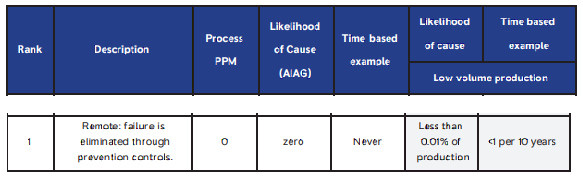
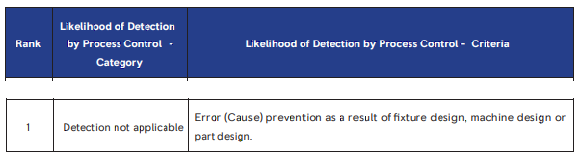
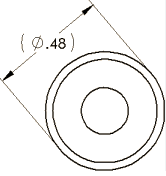
1 pointCan there be a process step where RPN = 1? Let us first understand how RPN is calucated. RPN = Risk Priority Number can be calculated by Formulae, Severity (S) X Occurrence (O) X Detection (D). Inorder for RPN to be 1 all Severity, Occurence & Detection must be one. Let us take a example to see if this is possible. Example Severity For Severity to be 1 there should not be any discernible effect, I have worked with Aircraft cabin structural drawings, there will not be any dimension which will not have a impact on the Fit, Form, Functions (rating 5-8) or actetic aspect(Rating 2-4) of the part, so having a severity of 1 which is no effect at all, its pretty rare. However theoratically speaking any reference dimension in drawing can have a severity of 1, So Severity = 1 [Reference Dimension example As per ASME Y14.5] Severity = 1 Occurrence For Occurrence to be 1 it should be 0 PPM, You may think of introducing Poke Yoke to get this, Firstly it is not possible to have Poke Yoke in all the cases, Secondly Poke yoke implementation is costly. Thirdly it makes no sense in introdusing Poke Yoke for every non critical dimension. Occurence can have 1 if you have Poke Yoke. Example :- Manual Tig Welding fixture can have poke yoke to prevent end fitting incorrect orienatation. Occurence = 1 Detection For Detection to be 1 you can have Poke Yoke in inspection fixture, again poke yoke is not always possible. For non critical items any visual or dimensional inspection will be adequate. Yes Detection can be one if Poke Yoke can be introduced. Example :- Inspection fixture can have poke yoke blocks / Pins to prevent part seating if end fitting incorrect orienated. Detection = 1 Summary Theoratically speaking yes its possible, if you have met criteria provided above RPN can be 1. Pratically RPN cannot be 1 as there will always be a impact for any dimension non conformance, introduction of Poke Yoke is not always feasible for Occurence and Detection, even is possible this may not make a business case to do something like that when simple dimentional inspection can suffice (Over processing).

 1 point

This leaderboard is set to Kolkata/GMT+05:30