

Topics
-
The latest setback has fueled worries that Google was losing momentum just as OpenAI and Anthropic and a host of Chinese rivals have accelerated the pace of model releases. On the call on Wednesday, Pichai struck an unusually defensive tone as analysts pressed him on the state of Google's frontier models and whether they could still compete at the cutting edge of AI development. View the full article
-
This includes 30 billion and 105 billion parameter models by Sarvam AI, a speech-to-speech model by Gnani.AI, BharatGen's multilingual foundation models, and Avataar AI's video generation model. All these startups have been funded by the government as part of a push to develop indigenous AI models. Of the 20 models, five have been released so far. View the full article



Leaderboard
-
Vishwadeep Khatri
Administrators1Points6,717Posts -
Mokshesh
Members1Points10Posts -
VVK
Members1Points15Posts -
Meenakshi Balaji Iyer
Members1Points11Posts


Popular Content
Showing content with the highest reputation on 10/19/2021 in all areas
-
1 pointQ 410. What is an Issue Tree? What are the different types and uses of an Issue Tree in Problem Solving? Note for website visitors - Two questions are asked every week on this platform. One on Tuesday and the other on Friday. All questions so far can be seen here - https://www.benchmarksixsigma.com/forum/lean-six-sigma-business-excellence-questions/ Please visit the forum home page at https://www.benchmarksixsigma.com/forum/ to respond to the latest question open till the next Tuesday/ Friday evening 5 PM as per Indian Standard Time. Questions launched on Tuesdays are open till Friday and questions launched on Friday are open till Tuesday. When you respond to this question, your answer will not be visible till it is reviewed. Only non-plagiarised (plagiarism below 5-10%) responses will be approved. If you have doubts about plagiarism, please check your answer with a plagiarism checker tool like https://smallseotools.com/plagiarism-checker/ before submitting. The best answer is always shown at the top among responses and the author finds honorable mention in our Business Excellence dictionary at https://www.benchmarksixsigma.com/forum/business-excellence-dictionary-glossary/ along with the related term1 point
-
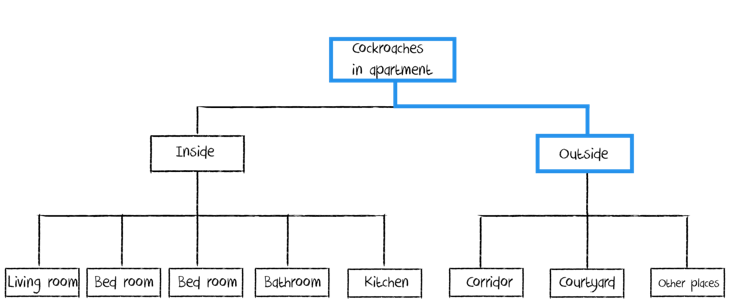
1 pointIssue tree, also called as logic tree or hypothesis tree is used for systematic problem solving. It is a visual representation of breaking down the larger problems into several questions. Issue tree indicates the relationship between the larger question and the derivation questions hence it becomes clear and structured way to resolve a problem. While constructing issue tree there is an opportunity to explore all possible area which require focus during solving a problem Reference: https://www.myconsultingoffer.org/case-study-interview-prep/issue-tree/ Following steps to be followed in issue tree: Benefits of issue tree a) All possible area & scenarios can be explored b) Structured approach and thought process initiated c) Surfacing various components of the issue, view the entire picture d) Understand how various components are inter-related e) Reach to the probable root cause questions to be answered f) Move from larger and complex questions to the small and simple question through breakdown approach g) Issue tree provides roadmap to solve key questions Different types of issue tree: A) Diagnostic (Breakdown “Why” question)- It is also called Hypothesis tree which identifies all potential root causes of the problem Solution (Breakdown “How” question)- It is also called as Fact tree or Data tree which identifies all potential solutions to the problem How Issue tree is used in problem solving? Ø Through breakdown of questions the Issue tree helps in identifying the root cause of the problem. It also helps in identifying the key potential solutions of the problem Ø Visually it jots down the anatomy of cause and effect for the issue to be resolved Ø It is the most powerful tool to be used in consulting, interview cases to reach to the real issue of the problem Ø It is data driven hence useful in analyzing the facts in detail Ø It follows the approach as follows: define, analyze, describe problem, identify root cause, identify solution, implement solution and measure result hence it is an effective way to problem solving Example: Steps for Issue tree 1. Problem-Cockroaches in house 2. Objective- Drive cockroaches away 3. Issue tree approach- Break down the problem into branches and further subbranches to reach the isolated root cause 4. A principle of “Mutually exclusive and collectively Exhaustive”(MECE) can be used to avoid overlapping questions between 2 branches 5. Testing through hypothesis with data 6. Identify solution Resource: https://mconsultingprep.com/issue-tree/ Some more examples of issue tree https://www.myconsultingoffer.org/case-study-interview-prep/issue-tree/



 1 point
 -
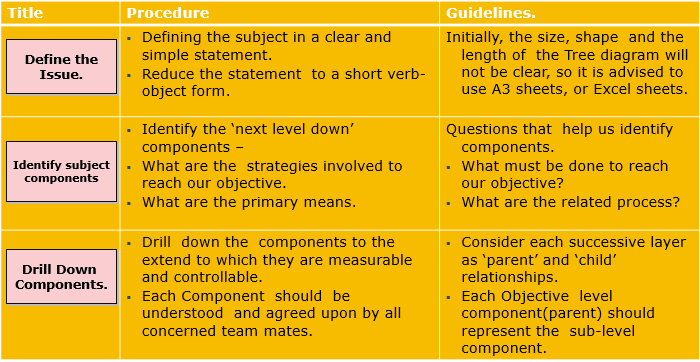
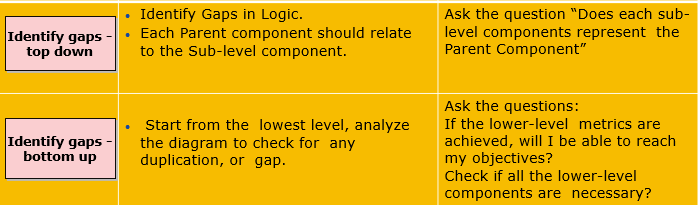
1 point"Issue Tree" which is also known as "Logic Tree" is the graphical breakdown of a complex problem into smaller manageable multiple levels of subsets called "Branches". This can be represented Vertically (Top to Bottom) or Horizontally (Left to Right). The use of an Issue tree systematically identifies and isolates the root causes and gives high impact solution for the problem. Most of the Consulting firms like Mckinsey, Boston and Bain frequently use this methodology for solving their Client's problem. It is also having many significant contributions in Manufacturing firms as well. Typical Flow Syntax Of Issue Tree looks like this: Source:https://igotanoffer.com/blogs/mckinsey-case-interview-blog/issue-tree There are two variants of an Issue tree. 1)A Problem based tree- Can be used to find out the "Root Cause" of the problem and to understand "why" the problem occurred. 2)A Solution based tree-Used to determine the recommended solution and also to understand "how" to solve the problem. Rules to Follow while creating Issue Tree Rule-1: The branches should be MECE (Mutually Exclusive, Collectively Exhaustive). Mutually Exclusive means there should not be any overlap between the sub issues identified. Example: In the Financial Framework there should not be any overlap between the revenues and costs by definition. Collectively Exhaustive means sub causes of the problem should cover all the possible root causes of the problem. Rule-2: Another rule is that Issue Trees follow the 80:20 principle means they focus on most important issues. For Example: While considering the losses in production, it's ok to omit the causes which are having less or negligible impact on the overall net losses. Source:https://www.craftingcases.com/issue-tree-guide/ Rule-3 : The Issue Tree should be linked together by a Logical linkage. If the issue components are random and non related to each other there are chances of getting more confused rather than getting the solution. How to Create a Tree Diagram: Example with Steps defined: Issue Diagram to increase the revenue of a company: Source: Self Drafted Slide Example 2: Electrostatic oiler used in Rolling Mill Electrostatic oiler is used in Rolling Mills for spraying uniform thin layer of oil on both sides of sheet. The objective of using oiler is to prevent coils from getting rusted till the coils reach customer. When the oiler fails to perform, or when the oiler is not working, it leads to stoppage of line & thus leads to enormous delays and financial loss. Source: Business case study from a manufacturing plant Uses of Issue Tree: It makes the problem easier to solve: Since major problem gets divided into smaller many, it's easier to handle and solve the problem. It provides a roadmap on how to solve the problem: Since it helps in focusing and prioritization of the solves it explains about the sequence of problem solve. It helps us to divide the work: Since Complex problem has been broken into smaller many, it helps to divide the problem and parallel action implementation resulting in early completion of the project. It helps to Prioritize: Based on the criticality of solve. It helps in identifying more number of solutions since the problem is being divided into many sub levels. These act as good Visual Communication tools for the stakeholders. Conclusion: Thus Issue Trees are one among the powerful tool used by the consultants on a regular basis. One can use them in their own case interviews by following all the 3 rules explained above for the effective problem solving.




 1 point
 -
1 pointIssue Tree Issue tree is a management tool used to solve complex business problems. Issue tree diagram approach helps in breaking complex problems into smaller manageable problems. This helps in tackling a large problem by effectively managing the smaller problems. This approach gets its name as ‘Issue Tree’ from the fact that it helps in breaking large problem into branches of smaller problems like a tree structure shown below: Benefits of Using Issue Tree 1. It makes it easier to solve complex problems by decomposing them into mutually exclusive and collectively exhaustive smaller problems 2. It provides a systematic roadmap to solve all the problems and effectively perform causal analysis to understand which few smaller problems when solved are yielding maximum beneficial results (80/20 principle) 3. It helps in prioritizing the problem solving process by focusing on critical smaller problems first and non-critical ones to be picked up later 4. It helps in dividing the problem solving work by grouping the logically related problems into one bucket and assigning it to relevant team for solving it Different Types and Uses of Issue Trees in Problem Solving Issue trees are of primarily two types, viz. diagnostic issue tree and solution issue tree. Diagnostic issue tree tries to answer the “Why” part of complex problem and Solution issue tree tries to answer the “How” part of a complex problem. An example of Solution Issue Tree trying to solve a complex problem of “How to Increase the profits of a lemonade business?” can be illustrated as below: References https://hackingthecaseinterview.thinkific.com/pages/issue-trees https://en.wikipedia.org/wiki/Issue_tree

 1 point
This leaderboard is set to Kolkata/GMT+05:30