

Topics
-
The latest setback has fueled worries that Google was losing momentum just as OpenAI and Anthropic and a host of Chinese rivals have accelerated the pace of model releases. On the call on Wednesday, Pichai struck an unusually defensive tone as analysts pressed him on the state of Google's frontier models and whether they could still compete at the cutting edge of AI development. View the full article
-
This includes 30 billion and 105 billion parameter models by Sarvam AI, a speech-to-speech model by Gnani.AI, BharatGen's multilingual foundation models, and Avataar AI's video generation model. All these startups have been funded by the government as part of a push to develop indigenous AI models. Of the 20 models, five have been released so far. View the full article



Leaderboard
-
mohanpb0
Members1Points63Posts -
Kavitha Sundar
Members1Points69Posts -
Sumanta Das
Members1Points48Posts -
Venugopal R
Members1Points238Posts


Popular Content
Showing content with the highest reputation on 11/30/2017 in all areas
-
1 pointThe Coefficient of Variation (CV) that is also known as the Relative Standard Deviation (RSD) is the ratio of the Standard Deviation of a Dataset to its Mean, popularly expressed as a percentage. The CV is a useful metric to compare variations of two datasets with different means. This metric has the advantage of all ratio coefficients in that it acts as a “common denominator” when comparing diverse data sets. Some of the relevant features of the CV are that it is independent of the order of values in the dataset and that it is relevant with only positive values of the dataset. The applications of the CV are many and include: 1. Evaluation of risk of investments vis-à-vis the return – Lower the CV, better the risk – return match 2. Assess the homogeneity of solid powder mixtures – Closer the CV to the defined norm, more homogeneous is the mixture 3. Measuring specific properties of chemicals or proportions of specific materials in mixtures 4. Calculation of economic disparity of a community or a group 5. Comparison of performance of two batches in a batch processing industry The CV can used to test hypotheses through Levene’s test. The general interpretation of the CV is that lower the CV lesser the variation relative to the mean and therefore a lower value of CV is preferable. While the advantages of CV are many, one of its disadvantages is that it is usable with only parameters on a ratio scale but not on an ordinal, value or categorical scales. Further if the dataset consists of both positive and negative values, the mean tends to zero and CV tends to infinity. If the two datasets being compared, contain values or on a scale related to one another, then the CV would be different for both the datasets in spite of the data sets being related. (E.g. The CVs of two data sets measuring the temperature of the same substances but expressed as Celsius in one data set and as Fahrenheit in another).1 point
-
1 pointQ52. Explain the use of Coefficient of Variation with examples. Coefficient of variation is the ratio of standard deviation to the mean. The higher the CV, the more is the spread of the data around its mean and the team or process is very unstable or ununiformed. In simple, it is % variation in mean, where SD is total variation in mean. It is a measure of relative variability. This is used to compare variations of two or more data sets. For Eg. If I have to compare results of two groups lets say Group A & Group B. Group A has CV of 25% and Group B has CV of 18%. This says that the Group A has more variability to its mean. Formula for CV = SD / mean It can be expressed as in percentage %. Hence the formula for CV can be multiplied by 100. Benefits of CV – 1. Measure of Precision – It is used to describe the level of variations existing within the population independently from the absolute values of the individual observations. If the population is same, where you have to find out the variation, then use Standard deviation. If the population is different, use this CV to estimate the spread or variability from its relative mean. Eg. If Male and female elephant group is compared, then use SD to find out the variation. If you have to compare the male elephant population with male mice population, then use CV. In simple, when the two groups differ significantly, use CV as a measure. It is to assess the precision of the measurement technique. 2. Measure of Repeatability - CV is used to measure the repeatability within the group and not the validity / reproducibility. It is used in a way to tell you the degree of association but not agreement. Measuring repeatability with out validity is a useful analysis. When assessing the measurement error, CV value depends on both the variability between sampling units and variability between repeated readings from the same user. If we have to select the variable group of sampling units, then the repeatability CV would be higher than taking up for a homogenous group. The aim is to be maximize the repeatability within the given situation. Eg. Used by Microbiologists and pharmacist to evaluate the intra assay and inter assay CV, in order to bring down the CV value to make it acceptable. 3. Consistency of data – CV is used to understand and confirm the consistency of data. Consistency means uniformity in the values of the data set. How consistent the values are from the mean of the data set is measured. As small as the CV means the data is uniform or consistent. Eg. If the temperature of an adult is to be compared to the same of a newborn, certain values are recorded In the real time for some time. Hence CV for adult is 10% and CV for newborn is of 2%. As for Newborn the CV is smaller, the variation in the data is very minimal. Means the data for Newborn is consistent than adult. 4. Indicator for Risk Assessment – It is a better indicator for all levels of risk assessment. In any type of situation, if we were to assess the risk, this would be the right tool. Eg. If Bank A gives a rate of interest at 20% and Bank B gives u at 10%, with a standard deviation of 10% and 5% respectively. Which bank is better to take a loan? As Bank B has SD of 5%, the Rate of interest is minimal for a longer run to balance his needs by the customer. Hence customer would prefer Bank B. 5. Decision making: If the team has to downsize due to high cost, the decision is to eliminate some of the team members. CV Is a useful tool where it tells us in which team ,there is more of variability, which team receives higher cost , etc to make strategic decisions. Eg. Organization has two functions – coding and billing with 40 and 65 employees in it. They earn around $450 and $350 respectively with SD as 7 and 9. Q – A) which section has a higher salary package? Which function has highest variability? Answer – a) Salary for Coding = 40 *450 = 18000 Salary for billing = 65 * 350 = 22750 So, Salary for billing is higher. CV for Coding =( 7/450) *100 = 1.6% CV for billing =( 9/350) *100 = 2.6% Billing is more of variability since it has more CV. The Zero disadvantage: CV is useful only for the calculations, when the mean of sample population is not zero. Lets assume, if the sample mean is equal to zero, then the denominator would become zero. Hence the CV gets nullified. Yes. CV is useful if all the data points or atmost of the data points share the same value as of plus or minus sign. Conclusion: CV has its own use and limitations. Hence it should used to carefully in 1. Estimating the variation 2 different populations 2. Estimating the 2 set of categories variations. 3. Risk assessment indicator 4. Decision making Thanks Kavitha1 point
-
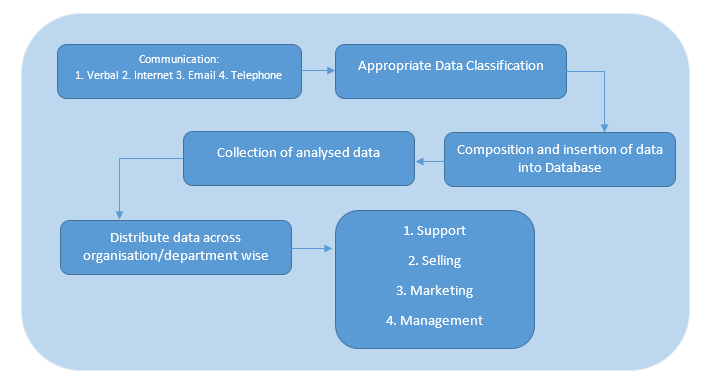
1 point'CRM' is sand for ‘Customer Relationship Management’ While interacting with its customers, CRM is all about – · principles, · practices and · guidelines Organization's view: It includes direct interactions with customers, example: sales & service. Customer's overall experience actually enhanced by CRM. A. Strategic: Customer Centric B. Operational: Integration & automation of Sales/Support/Marketing. C. Analytical: Collect customer’s data & present it to management to take decision. D. Collaborative: include external stakeholders and share customer information throughout organisation. Components: CRM includes 1. Data Warehouse - Centralize customer information 2. Opportunity Management - Track sales opportunities 3. Track & measure of marketing campaigns ) - Track sales opportunities 4. SaaS- Automate marketing interactions 5. PaaS - Provide business intelligence 6. Contact manager system integrating emails, documents, tasks, schedules, faxes etc.- Facilitate communications 7. CCRM (Customer Centric Relationship Management etc. Customer Satisfaction: It helps customer a lot by increasing loyalty and usage behaviour and by reducing customer complaints. Organisation can distinguished profitable customer, integrated across channel assistance, salesforce effectiveness & efficiency, competitive pricing, customised offers/products/services, improved customer service, individualised campaign, single channel association with customer. In practice: a. Call centres, b. Contact centre automation, c. Social media, d. Location-based services, e. Business-to-business transactions CRM market a. Salesforce.com b. SAP c. Oracle d. Microsoft Dynamics (Axapta). Break Down Of CRM: 1. Software 2. Cloud Solutions 3. Management



 1 point
 -
1 pointIf we look back one and a half decades ago, we had marketing, sales and customer service activities, in an organization, each area managed by the respective functions. The term ‘Customer Relations Management’ evolved subsequently and it continued to evolve with varying dimensions and scope. While we can find various definitions for CRM, one common intent that emerges is that it is an approach to get the customers and company connected better. Considering the challenge in getting a universal definition, I would put down the below points that relate to the intent of CRM, furnished with no order or sequence in mind. 1. Provide better responsiveness and service 2. Provide single point of contact from company 3. Long term customer retention 4. Obtain feedback on customer satisfaction and loyalty 5. Examine customer behavior patterns 6. Wooing customers to buy more / additional products / services. CRM is sometimes looked upon as a function (department) in an organization. One of the most popular development that we saw during early 2000s is the growth of call centers. So much so, that the Call Centers became an outsourced activity surmounting geographical barriers. The advent of Information Technology has also transformed the outlook of CRM. Various CRM softwares have emerged. Good or bad, it is a fact that CRM has become highly depended on IT. In fact in one of the definitions, CRM is understood as a software. In most Websites, if you click the “contact us”, you can no longer expect to obtain telephone number by which you can call and talk to someone. You may see a page that will ask you several details, or present you with several options to choose from and you will end up getting answered by the machine! Even if there is a telephone number, it will lead you to an automated voice response, which will keep on guiding you to select various options depending upon what you are seeking. Getting a person to interact would be a final option, if at all it happens! While the above methods may have some advantages in terms of standardized and sometimes quicker response, it could also be very frustrating for a customer who may not get the answer to any specific problem for which a solution is being sought. The CRM practices are bound to undergo more transformation in the days to come and have already been seen as an important factor for competitiveness. With the above said, in today’s world, any organized business is not complete without a CRM in place.1 point
This leaderboard is set to Kolkata/GMT+05:30