

Topics
-
OpenAI, which is expected to need about 3,200 megawatts (MW) of power for its new facility, has agreed to provide up to 1,000 MW to the Southern Co subsidiary Georgia Power's systems in times of high demand. View the full article
-
The affected startup, Hugging Face, said it had turned to Zhipu AI's open-source GLM-5.2 model last week to analyze data from the hack after leading US AI models declined the task, unable to distinguish between a defender and an attacker. View the full article

Leaderboard
-
Vishwadeep Khatri
Administrators1Points6,714Posts -
Mayank Gupta
Members1Points679Posts -
Swapnil Madhav Chaukar
Members1Points10Posts -
Sunny Prithviraj
Members1Points11Posts


Popular Content
Showing content with the highest reputation on 08/31/2025 in all areas
-
Q 800. Managers and leaders often face tough decisions where data is incomplete, options are conflicting, and time is limited. AI can analyze large amounts of information and surface recommendations — but leaders still need to trust and interpret those insights. Imagine an AI agent designed to support decision-making for managers in your domain. What kind of decisions should it assist with, and what checks would you build in to ensure its advice is both reliable and aligned with organizational goals? The best answer will be selected on the basis of: Relevance of the leadership decision scenario Practicality of the AI support mechanism Insight into balancing AI advice with human judgment Note for website visitors - This platform hosts two weekly questions, one on Monday and the other on Thursday. All previous questions can be found here: https://www.benchmarksixsigma.com/forum/lean-six-sigma-business-excellence-questions/. To participate in the current question, please visit the forum homepage at https://www.benchmarksixsigma.com/forum/. The question will be open until Monday or Thursday at 5 PM Indian Standard Time, depending on the launch day. Responses will not be visible until they are reviewed, and only non-plagiarised answers with less than 5-10% plagiarism will be considered for winner selection. If you are unsure about plagiarism, please check your answer using a plagiarism checker tool such as https://smallseotools.com/plagiarism-checker/ before submitting. All correct answers shall be published, and the top-rated answer will be displayed first. The author will receive an honourable mention in our Business Excellence dictionary at https://www.benchmarksixsigma.com/forum/business-excellence-dictionary-glossary/ along with the related term. Some people seem to be using AI platforms to find forum answers. This is a risky approach as AI responses are error-prone because our questions are application-oriented (they are never straightforward). Have a look at this funny example - https://www.benchmarksixsigma.com/forum/topic/39458-using-ai-to-respond-to-forum-questions/ We also use an AI content detector at https://quillbot.com/ai-content-detector. Only answers with less than 45-50% AI-generated content will be considered for winner selection.1 point
-
It is good to see the varied areas where AI can become a trusted partner for leaders. The best answer is from Ayomide. Well done!1 point
-
For leaders to trust AI, we need to consider the following concerns : * Can we build an AI agent with not enough data about the case to make tough and timely critical decisions by AI? We expect with limited data to make biased and inappropriate decisions; however, we might be able to build an AI model that mitigates the data shortage issue, but this will be risky. Therefore, it is rather advised to build a selective automated system by keeping the critical decision to the leader, considering the output of the AI agent * What are the possibilities when data is incomplete, or options are conflicting to overlapping, to get a trusted critical decision by an AI agent? There is an opportunity to build an AI agent that works on different techniques to eliminate data shortage and conflicting data, probabilistic reasoning, uncertainty quantification, or contextual analysis. Bases on the nature of the business and criticality of decision; leaders can work on segmenting the decision making approach into three different categories, level one we trust to AI agent to take decision where options are limited and the risk of which is controlled and supervised, level 2 where leaders can delegate the final decision making based on AI agents to reporting managers, and level 3 which is concerned with the real costly decision where tolerance toward errors is almost zero; in this category leader should avoid trust AI agent decisions but still they can consult it * What are the working environment constraints that might limit the correct decision by the AI agent? The level of working environments' complexity plays a critical role in AI agents’ rational decisions, and it is important to consider that there are deterministic and dynamic environments where transparency, social context, and ethical context need to be addressed when we deploy AI agents * How far can the decision taken by AI be in favour of the business goals? Any decision taken by an AI agent should be for sure in favour of the business goals, as this is part of the context and data set the AI agent is using to make decisions; however, “How far" is based on the robustness of the system setup in the business, the Business AI strategy, and proper ethical governance * How long does AI need to be part of the working environment to get the correct sentiment for any required decision? Sentiment is probably the next of AI machine learning, as it requires a bit of complex AI setup, the competencies of data AI is learning from, therefore, in our case, where the data dataset is incomplete and there are conflicting parameters, the sentiment will be biased even if we tried to enhance the dataset's integrity level * Can we build a tailored AI agent to be able to detect the leader's tone in decisions? Technically, it is possible, and this turns out to be an AI digital assistant. This would require sentiment analysis, NLP dedicated to the leader's personal data set. Now, how far will this agent be trusted for a critical decision? It all depends on a healthy relationship between the leader and the agent itself, in which, over time, the leader will be able to decide when to delegate the decision to the agent and when to keep it for himself Conclusion: An AI agent can be considered as an advisor in the case of a critical decision for a leader; however, we need to consider the problems and effects of having incomplete data or conflicting data, and based on that, we shall fine-tune our own ability to trust the AI Agent to make critical decisions1 point
-
In 2W Automotive domain , AI can assist the managers on key decision areas: 1.Production and Inventory planning Challenge: Fluctuating demand, JIT systems, raw material shortages. AI Support: Forecast demand shifts at model or region level, suggest inventory distribution, flag supply chain risks early. 2.Model portfolio strategy Challenge: Balancing ICE vs. EV investments, deciding when to sunset legacy models. AI Support: Simulate long-term performance of model lineups, compare regulatory impacts, analyze regional readiness for EV adoption. 3. Supplier and Vendor selection Challenge: Cost vs. reliability, geopolitical risks, ESG concerns. AI Support: Evaluate vendor performance over time, assess financial health, and flag risk indicators (e.g. political exposure, labor issues). 4.Aftermarket and service operations Challenge: Maximizing lifetime value of vehicles and customer retention. AI Support: Forecast part demand, optimize service schedules, and personalize post-sale engagement strategies. To ensure it is both reliable and aligned with organizational goals 1. Built in Human 0verride-even with strong algorithms, AI should act as a co-pilot, not an autopilot. Managers must retain authority and be encouraged to challenge the AI—especially when it presents a "high-confidence" recommendation that contradicts lived experience. 2.Feedback and learning loop- Managers’ decisions and their outcomes should be fed back into the system: Did the manager accept or reject the advice? What actually happened? Was the AI accurate or off the mark? This loop helps the AI grow more accurate over time—and helps managers become better users of it. 3. Transparent logic and traceability - the system should clearly outline: What inputs were used How the conclusion was reached Where uncertainty or data gaps exist This helps managers understand the "why" behind every recommendation—not just the "what." In the automotive domain,Quality, speed and precision are everything—but so is judgment. An AI assistant should not replace human reasoning; it should amplify it. By combining fast analysis with organizational context and strategic alignment, it becomes not just a machine that calculates—but a partner that collaborates.1 point
-
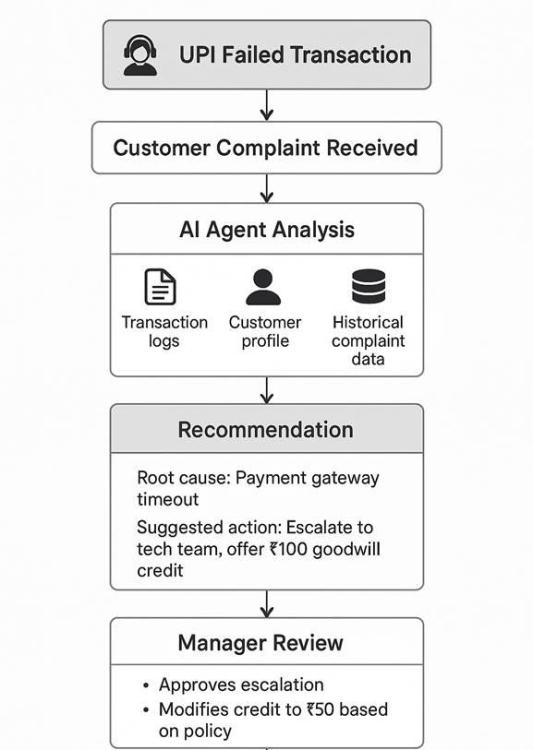
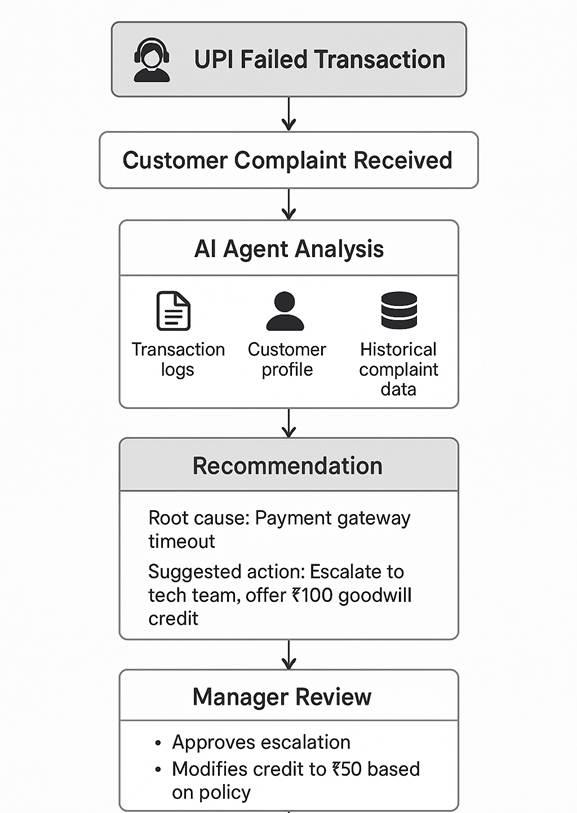
Decision making by leaders is traditionally a competency that comes with years of experience and analytical thinking. Now, in today’s world can the leaders make use of AI in decision making. There are different type of decisions, executive decisions, decisions to add or not add HC, should we invest more in labour or technology or data security, usually all this is based on need of the hour, business goals, budget, urgency and risks. This is also beneficial in day to day manager decision making in operations. For example in a banking customer service environment, especially one dealing with queries like UPI failed transactions, balance inquiries, or standing instructions not honored, an AI agent can be a powerful decision-support tool for managers. Here's how it can assist and what checks should be built in to ensure reliability and alignment with organizational goals. What decisions the AI can assist 1. Prioritization of Customer Queries E.g: A UPI transaction failed for a high-value customer vs. a routine balance inquiry. AI Role: Use customer segmentation, transaction history, and sentiment analysis to prioritize cases. Manager Decision: Approve escalation or fast-track resolution. 2. Root Cause Analysis E.g.: A customer complaining that a standing instruction was not honored, maybe a customer lost an investment opportunity in an IPO — is it due to insufficient funds, system error, or third-party failure? AI Role: Aggregate logs, transaction data, and system alerts to suggest probable causes. Manager Decision: Decide whether to initiate a technical fix, customer compensation, or policy review. 3. Reversal or credit recommendations E.g.: UPI failure caused a missed payment for a premium customer. AI Role: Analyze customer value, historical issues, and policy thresholds to recommend goodwill credits or fee waivers. Manager Decision: Approve or modify compensation. 4. Process Optimization Example: Frequent failures in standing instructions from a specific bank. AI Role: Detect patterns across customer complaints and suggest process or partner bank reviews. Manager Decision: Initiate cross-functional investigation or vendor engagement. What checks can be inculcated to ensure reliability and alignment to business objectives 1. Transparency and Explanation Soln.: AI must provide a clear rationale for its recommendations (e.g., “Customer has 3 prior complaints and is in the top 5% revenue bracket”). Benefit: Builds trust and helps managers make informed decisions. 2. Human involvement Soln: AI suggestions should be reviewed and approved by managers, especially for financial or reputational decisions. Apply HITL Benefit: Ensures accountability and prevents blind reliance on automation. 3. Policy Alignment Engine Solution: Embed business goals, organizational policies and ethics into the AI’s decision logic (e.g., compensation caps, escalation rules). Benefit: Keeps AI recommendations compliant with internal standards. 4. VOC Solution: check success and failures of AI assisted decisions, track outcomes and feed them back into the model to improve accuracy. Benefit: Continuous learning and refinement of decision quality. 5. Biasness audits Solution: Regularly audit AI outputs for bias (e.g., favoring certain customer segments unfairly). Benefit: Promotes ethical decision-making and regulatory compliance. In a banking customer service process workflow: UPI Failed Transaction Customer Complaint Received AI Agent Analysis: Transaction logs Customer profile Historical complaint data Recommendation: Root cause: Payment gateway timeout Suggested action: Escalate to tech team, offer ₹100 goodwill credit Manager Review: Approves escalation Modifies credit to ₹50 based on policy Outcome Logged for Learning Customer Query Intake – UPI failure, balance inquiry, etc. AI Analysis – Transaction logs, customer profile, sentiment. Decision Support – customer credit rating, prior history, Prioritization, root cause, compensation suggestion. Manager Review – Human validation based on pre-decided bank criteria Action & Feedback – Resolution, learning feedback loop for AI. Policy Alignment Matrix for Banking Customer Service AI Query Type AI Recommendation Scope Policy Constraints Escalation Criteria UPI Failed Transaction Root cause analysis, retry suggestion, goodwill credit Credit limit ₹50 per incident; max 3 credits/month High-value customer, repeated failures Balance Inquiry Provide latest balance, detect anomalies Must verify customer identity; no financial advice Suspicious activity or mismatch in balances Standing Instruction Not Honored Identify failure reason, suggest manual payment, notify customer No auto-compensation; notify customer within 24 hrs Recurring failures, regulatory breach Card Block/Unblock Request Confirm identity, initiate block/unblock Must follow 2FA; no override without customer confirmation Fraud suspicion, system error
 1 point
 -
The decision making by leaders has always needed data and insights as back up on which the causes and action points hinges upon. The leaders have always wanted to make their decision making faster but not without data and facts. But often they have hit the roadblock because of the inefficiency crept in the systems by virtue of process and technology deficiencies in the system. Usual approach by the leaders have been to focus on ways to improve the process and system through process improvement steps like Lean Six sigma approach and Business process reengineering. These improvement steps have most of the time benefited the process and technology enablement for the leaders to arrive at improvement projects and subsequent steps to improve. The only concern which leaders have around the time it takes to deliver the projects which ranges from months to sometimes years depending on the complexity of the problem statement. Leaders have always been on lookout for tools or methods through which they can work on the decision making tools which will help in the quicker decision making and increase in the Profit in P&L statements of the Company. E.g. in one of the manufacturing assembly line I worked with the COO knew that the quality parameters are in pretty much bad conditions and needed immediate drastic improvement steps but whenever he was chairing HoDs meeting, he used to come across different localized set of data which was being presented and thus leading to contradictory claims and counter claims resulting in no action points of significant impact. The problem statement was overcome by asking all the team members to work on the data cleansing and having a master data sheet by working together so that the data sanctity is not in question. COO was able to take some drastic steps in the quality improvement like implementation of lean and TOC concepts for further improvements which was able to help being down considerably. Now how I see AI as opportunity and how we could have done things differently back then or facing a similar situation, how differently could have approached the problem statement. Now with the agentic AI there could have been three different types of agentic AI which could have been developed and deployed viz. the agentic AI for the data cleansing and standardization, second agentic AI with analyzing the data and bringing in the insights for the subsequent analysis and decision making and third one which could have collaborated with other data tools and would have generated a lot of insights in collaboration with other ERP tools. The insights would have been generated much faster and would have lesser time as compared to conventional approach and would also have had the flexibility to provide details as per the change in requirement by COO or management/HoDs. Now is the question is how to ensure that the insights would have been correct and not wayward. So, by collaborating with the quality team would have set the mean and median in the numbers of say non conformance per unit and other parameters for us to arrive for any deviation in the insights which is being generated. Also, regular analysis of the data and insights should have been carried out by the AI data engineer entrusted with this work. Agentic AI would have been such an enabler for us to move ahead in the lean implementation journey and could have delivered more Profit in the P&L statements of the company at faster pace. 582 Words1 point


This leaderboard is set to Kolkata/GMT+05:30