

Topics
-
OpenAI, which is expected to need about 3,200 megawatts (MW) of power for its new facility, has agreed to provide up to 1,000 MW to the Southern Co subsidiary Georgia Power's systems in times of high demand. View the full article
-
The affected startup, Hugging Face, said it had turned to Zhipu AI's open-source GLM-5.2 model last week to analyze data from the hack after leading US AI models declined the task, unable to distinguish between a defender and an attacker. View the full article



Leaderboard
-
R Rajesh
Members1Points160Posts -
Venugopal R
Members1Points238Posts -
Delnaz Irani
Lean Six Sigma Black Belt1Points12Posts -
RD RD
Members1Points9Posts



Popular Content
Showing content with the highest reputation on 02/11/2025 in all areas
-
1 pointHow ISO 31000 and FMEA Make a Great Team for Managing Risks Let’s keep it simple: think of ISO 31000 as your bird’s-eye view of risk management—it gives you a big-picture strategy for identifying and handling risks across your entire business. FMEA, on the other hand, gets down to the nuts and bolts—it digs deep into specific processes or products to figure out what could go wrong and how serious the impact might be. Here’s what’s great: combining these two approaches not only helps you identify risks but also gives you the tools to handle them in a smarter and more strategic way. How They Work Better Together - Zoom Out vs. Zoom In: ISO 31000 helps you step back and look at broad risks that can affect your whole business—like supply chain disruptions or changes in regulations. FMEA, meanwhile, gets up close and personal with the nuts and bolts of your operations, helping you identify specific failure points in processes or products. FMEA zooms in on specific processes (say, a production line) to pinpoint potential failures. When you connect the two, you get both perspectives—strategy and detail. Context Matters: One of ISO 31000’s strengths is making sure you assess risks in the right context (what’s important to your business and goals). FMEA doesn’t naturally do this—it’s more about the mechanics of failure. Integrating them makes sure your risk evaluations align with business priorities. Keeping Risks Top of Mind: ISO 31000 encourages continuous risk monitoring. This works well with FMEA's need for updates as processes evolve, ensuring you stay proactive rather than reactive. Imagine this: you're a car manufacturer, and your main goal is to make sure every driver can trust the braking system to keep them safe. Seems pretty straightforward, right? But with all the potential issues that could arise, it can get a bit overwhelming trying to figure out where to begin. That’s where combining ISO 31000 and FMEA comes in. By using these two tools together, you can approach risks in a more organized and thoughtful way. It helps you spot potential problems before they even have a chance to occur, so you can ensure drivers stay safe on the road. Step 1: Get the Big Picture (ISO 31000) The first thing you need to do is step back and take in the bigger picture. What are your main goals when it comes to risk? Of course, the main one is ensuring customer safety and meeting all the safety regulations. But there’s more to consider—like what if there are disruptions in your supply chain or if new regulations come along that require a redesign of your product? By looking at these bigger risks, you’re setting yourself up for smarter, more proactive decisions in the long run. Step 2: Dive Into the Details (FMEA) Alright, now we’re getting into the nitty-gritty. This is where FMEA (Failure Modes and Effects Analysis) comes in. You take a closer look at the braking system, breaking it down into smaller parts to pinpoint where things could go wrong: Hydraulic leaks Sensor malfunctions Component wear and tear By doing this, you can start tackling those little details that play a big role in keeping everyone safe. For each possible issue, you’ll look at three main factors: Severity: How bad would it be if this problem happened? Occurrence: How likely is this to actually happen? Detection: How easy is it to spot the issue before it causes any damage? Once you’ve evaluated these factors, you’ll come up with something called the Risk Priority Number (RPN). This helps you figure out which issues are the most urgent and need your attention first. Here’s why this combination works so well: When you bring together the big-picture strategy of ISO 31000 with the detail-oriented focus of FMEA, you get a complete and clear picture of the risks you're dealing with. It’s like having the ability to see potential issues before they catch you off guard. Catching problems early really makes a difference—it lets you tackle them before they turn into bigger issues. Whether it's a big risk in the industry or just a small hiccup in your system, being proactive can totally change the game. It helps you create safer products and make smarter, more confident decisions all around. Use Both to Prioritize Risks: FMEA might flag a hydraulic leak as a top issue because of its high RPN. But integrating ISO 31000 can reveal additional priorities. For example, a sensor miscalibration might not seem critical based on RPN alone but could pose a big reputational or compliance risk. Better Mitigation: ISO 31000 encourages broader, strategic solutions. Instead of just redesigning the sensor, you might implement a supplier audit program and a quality assurance process across multiple product lines. Continuous Improvement: It’s important to regularly review things to stay on track, especially as new risks—like cybersecurity threats to electronic brakes—start to pop up. Why It’s Worth It: By combining ISO 31000 and FMEA, you’re not just reacting to risks; you're staying one step ahead. ISO 31000 gives you a strategic view of what’s coming, while FMEA offers clear, practical steps to address those risks. Together, they help you manage risk smarter, align better with business goals, and ultimately, be more effective.1 point
-
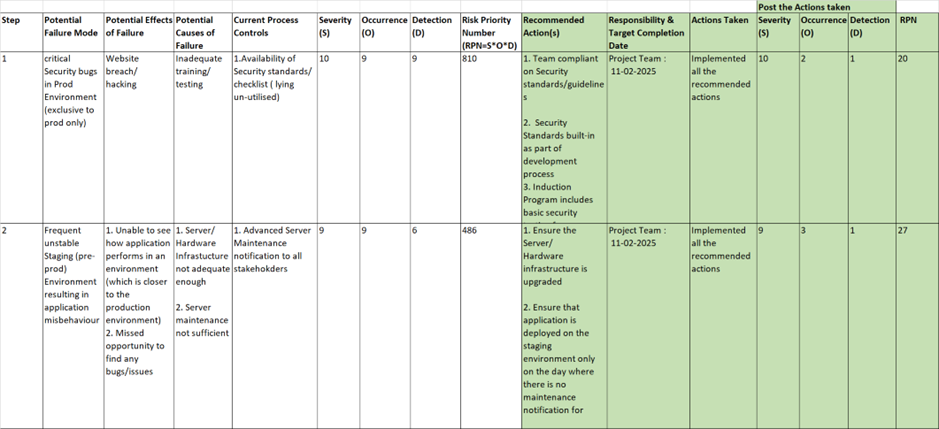
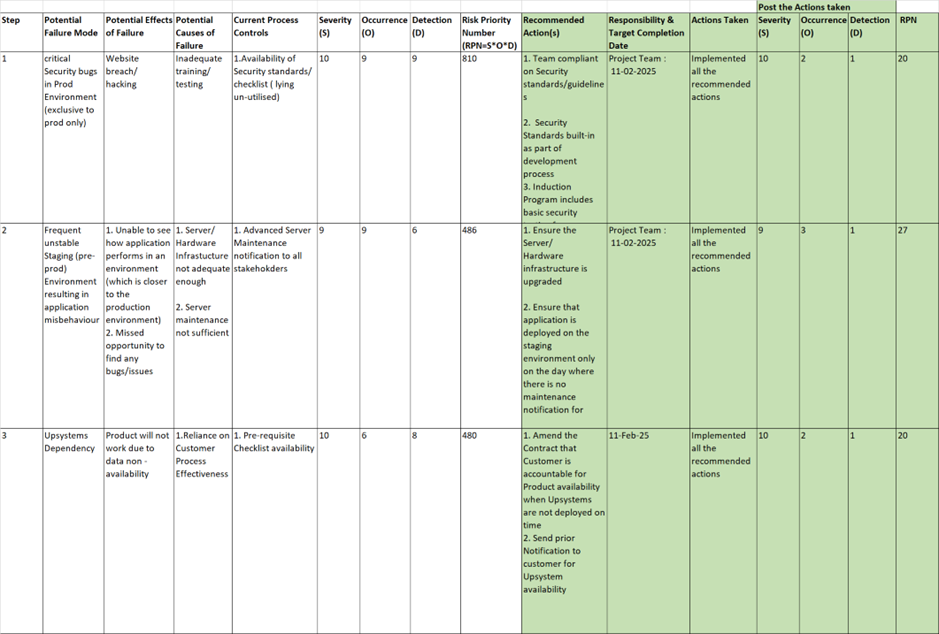
1 pointBefore going to the problem statement, let us understand the concept/definition of ISO 31000 and FMEA to have a better grip of the context As ISO org’s definition of ISO 31000 : It is an international standard that provides principles and guidelines for risk management. It outlines a comprehensive approach to identifying, analyzing, evaluating, treating, monitoring and communicating risks across an organization Benefits of ISO 31000: - Helps in Risk Identification - Helps in Governance & Structure - Helps in Reporting - Helps in Risk Strategy An ASQ definition of FMEA states it as a “A step-by-step approach for identifying all possible failures in a design, a manufacturing or assembly process, or a product or service; studying the consequences, or effects, of those failures; and eliminating or reducing failures, starting with the highest-priority ones” Benefits of FMEA: - Helps in identifying possible failure/risk - Provides a simple and a logical way to calculate the priority, when there are more items to be prioritized - Helps in finding the highest priority and provide an evidence-based approach to the stakeholders (as how you arrive at that) - Helps in decision-making as what items to be addressed/worked upon Let us see how integrating the two can improve risk prioritization and mitigation with an example: Let us see an example from a small sized IT Service company. For a banking and financial services customer, the IT service provider created a product for Wealth Management system that can interface with FinTech companies. The Service Provider, with the help of FMEA tool, they were able to identify few potential failures/risks and also came up with some recommended actions and implementations As we see here, before the recommendations were given, the highest priority one was #1 (critical security bugs) . But post the recommendations, #2 became the highest priority. This shows how effective FMEA can be for effective calculation of priority based on severity, occurrence and detection and how much it provides transparency by just looking at the table and finding the priority (highest RPN is the first priority and the lowest RPN is the least priority item) Now, the IT service providing organization realized that it had got in-direct dependency with multiple other vendors in terms of getting the up-systems’ readiness (customer needed to have that up-system readiness but those systems impacted the product which the IT service provider was developing & was accountable for its timely delivery). Till date, it had got this dependency issues covered well because customer had put lot of due diligence on this upsystems ‘ readiness . But the IT service providing company had not thought about this. There was one instance recently that created a noise for few hours on a given day. It was closed well before it became big. The (IT) company felt that it should treat this as a potential risk.. While it (IT service providing company) decided to put this as part of the FMEA list, it also understood that having a holistic approach to the risk can help it address all such issues efficiently. This was where the company felt that having ISO 31000 standard could help them to have a more rounded view on risk management and help them to navigate through uncertainties in a smoother manner. So the IT service providing company, came up with the holistic approach by incorporating ISO 31000. This helped to find out as what were the areas in the organization that could be potential risks, how best can those risks be tackled, were there any standards/guidelines to address those risks, how could planning happen , what strategy could be made and how the governance should happen.. This perspective (view) of thinking holistically across each aspect of the product development cycle within the organisation triggered the thought process for them to decide to go ahead with this incorporation of ISO 31000 and the triggering point was the dependency issue for up-systems. The project team identified the dependency on up-systems. and added that as a new risk and did the FMEA calculation in the existing FMEA sheet it had, as seen in the below table Thus, using the IS0 31000 and FMEA tool, the IT organization was able to plugin the potential pitfalls such as contract management with the customer (where earlier it was written as supplier responsibility even when there was dependency with 3rd party vendors which customer had control; but post this ISO 31000 framework usage , the amended contract ensured that the customer was taking responsibility in such cases). This also ensured that a clear cut view of the product roadmap showcasing the danger zones in each of the milestones, thereby giving the stakeholders a true picture of where the product was at any point of time, which also helped them in understanding the threats and opportunities that they had.. Based on the risk strategy , proper and timely decisions were taken. All the relevant potential risks were evaluated with FMEA and suitable recommendations were given and actions were taken accordingly. Thus the IT service providing company effectively leveraged ISO31000 and FMEA Conclusion: FMEA is a wonderful tool for identifying potential risks(/failures) and works excellent at a project-level. When we want to have a holistic level approach for handling risks at an enterprise level which can serve as a beacon, then ISO 31000 helps in achieving that. Having ISO31000 and FMEA together can bring lot of benefits: 1. ISO31000 can help you to identify, analyze, evaluate, treat, monitor and communicate risks Which provides transparency of potential risks within the organization at every aspect/department 2. ISO31000 helps in setting up the standards/guidelines 3. ISO31000 gives confidence to the Stakeholders as we saw above 4. ISO31000 helps in better decision making as you have a structured risk strategy 5. ISO31000 helps you to shape your fix your current flaws or missing pieces (AS-IS) in handling risks. Sometimes we may think our process is good unless you benchmark it against a very good approach 6. As ISO31000 is being applied, it can shakeup your current risk handling ecosystem (like the Contract example we earlier saw), opening up potential traps(risks), which can be addressed well by the usage of FMEA 7. Serves as an input to a Risk Log which can be used by FMEA 8. FMEA helps in bringing transparency to the stakeholders with recommendations and proper actions 9. FMEA helps in building collaboration amongst the team members and encourages collective decision-making 10. FMEA helps in continuous thinking and continuous improvement as the RPN could vary depending on the prevailing situations at a given point of time (for some risks) Thus, IMHO, having a combo of ISO 31000 and FMEA is akin to the “Delighters” category in a Kano Model. Every Organization that prides itself in Risk Management might try to have this together!!
 1 point
 -
1 pointBenchmark Six Sigma Expert View by Venugopal R As mentioned as per the scope of ISO 31000, it is a generic standard on risk guidelines meant to be applied to cater a wide range of activities including strategies and decisions, operations, processes, product, processes, services and assets. The standard is not prescribing any specific risk management methodology. However, it refers to 'risk' as 'an effect on uncertainty of objectives'. It also indicates that risk is a 'combination of the consequences of an event and associated with a 'likelihood'. FMEA is a more of a specific tool or methodology whose origins can be traced to the US Aerospace industry. This method focuses on harnessing the tacit knowledge of team members within an organization in a structured manner. There are different types of FMEA, though the most popular ones are the 'Design FMEA and 'Process FMEA'. Anticipating and preventing the potential failures associated with Design and Process activities pertaining to a Product design and Process of producing and delivering were the key purpose for which this tool got evolved. However, it has become a versatile tool to address the potential failure modes for any process, be it manufacturing, transactional, services etc. While ISO 31000 does not prescribe any specific tool or method for Risk Management, many of the generic guidelines provided by the standard could be fulfilled by FMEA method for selected activities. Below are few examples, though not exhaustive. 1. In clause 2.13, it mentions the stakeholder as one who may be impacted by a decison or activity. This will relate to the "Effect" as in FMEA. 2. It mentions 'Risk identification involves Risk Sources, Events, their caues and potential consequences. In process FMEA, we move from the Potential failure mode, Effects and Causes, for each and every process step. 3. Event with / without consequences are considered as 'near miss'. It relates to FMEA, where we are considering 'Potential failure modes'. Sometimes adverse consequences may be avoided by timely controls, yet they could be 'near miss'. 4. Consequences are expressed quantitatively. This is done in FMEA by using the severity ratings. 5. The 'Level of Risk' as mentioned in the standard relates to the quantification using RPN values. 6. The standard mentions about the combination the risk levels using consequences and likely hood. The RPN in FMEA is a composite risk level that considers the Severity of the Effect, the Probability of occurrence and the likely hood of detection and control 7. Section 2.26 makes a broad mention about 'Control', whereas in FMEA, the expectation for current controls and detection methods are clearly defined and also quantified using the Detection rating. 8. The standard expects 'monitoring'. One of the main outcomes of the FMEA evolves action plans aiming to reduce the RPN numbers. FMEA should be a live document and is continuously worked upon to keep reducing the RPN numbers as well as to address new failure modes that may be identified. It gives adequate scope for monitoring. 9. The standard expects accountability. The same is the expectation in FMEA process where there will be process owner, responsibilities for individual actions identified and targets for improvement. 10. The reference to people skills and training programs connects well with the intent of FMEA, which is always performed as a teamwork. This harnesses the scattered process knowledge and skills and connects them into the various aspects of the risk prioritization. As I mentioned, the above discussion is not exhaustive and has not dwelled into all the clauses of the ISO 31000 standard. However, these examples could be adequate to understand how the risk management tool 'FMEA' can become part of implementing this standard. It may also be noted that FMEA is considered as a 'Process Map' based method and gets generated for each process steps. While implementing ISO 31000, other risk management methods may also be considered as appropriate apart from FMEA.1 point
-
1 pointRisk management is a vital part of any organization’s success, and two popular methods in this field are ISO 31000 and FMEA (Failure Modes and Effects Analysis). While ISO 31000 takes a broad look at potential threats facing the entire business—like financial, operational, or compliance risks—FMEA digs into specific processes to find weaknesses before they become major problems. When these two approaches are used together, they form a more comprehensive and practical system for keeping risks in check. ISO 31000 lays out a structured way to identify and handle all sorts of risks, ensuring that important decisions line up with the company’s overall objectives. In contrast, FMEA zeroes in on particular points of failure, ranking them by severity, likelihood, and how easily they can be detected. This ranking helps teams tackle the most critical issues first and fix them quickly. To see how this works in real life, consider an automotive manufacturer. Using ISO 31000, the company keeps an eye on large-scale risks, such as product recalls or quality-control failures. At the same time, by applying FMEA, it spots a problem in the engine’s cooling system early on—well before it leads to costly recalls or damage to the brand. In a banking scenario, ISO 31000 might guide the bank’s overall strategies for managing credit risk, while FMEA focuses on catching errors in loan approvals, like incorrect data entry or incomplete documentation. By fixing those errors upfront, the bank reduces both financial losses and customer dissatisfaction. Ultimately, ISO 31000 and FMEA work best hand-in-hand. ISO 31000 provides the high-level structure that keeps an organization aware of its major threats, and FMEA gives a detailed roadmap for preventing smaller issues from ballooning into significant setbacks. Using both methods together allows a business to prioritize, plan, and act more effectively, resulting in stronger overall risk management.1 point
-
1 pointISO 31000 has set international standards for managing risks, it was developed in 2009 by International Organization for Standardization. ISO 31000 is tailor-made for any organization seeking clear guidance on risk management. FMEA is also a risk management process that helps the organization to identify all the possible risks and come up with a mitigation plan. So, integrating ISO 31000 and FMEA would provide a structured and comprehensive approach to risk management process. ISO 31000 FMEA ISO 31000 provides a broad, principle-based framework to identify risks, do the assessments and provide mitigation plan FMEA is a detailed, bottom-up approach which systematically identifies potential failure modes within a system. FMEA focuses on the occurrence, severity and detection of the failures. ISO 31000 encourages enterprise-wide risk assessment. This will ensure that risks from different sources such as technical, operational, security, compliance etc. are considered. FMEA will quantify the risks using a method called Risk Priority Number (RPN). This method helps us to prioritize mitigation efforts based on numerical values. Higher the RPN number (more than 120), means the risks are more. ISO 31000 will emphasize on a continuous risk management process. This will include communication, monitoring, and improvement. FMEA will focus on failure prediction and prevention. This will make it an effective tool for designing robust systems and processes. ISO 31000 identifies risks beyond technical failures, including regulatory, financial, and reputational risks. FMEA offers a structured way to analyze potential failures in software platforms, ensuring that critical risks are mitigated at an early stage. To explain the synergies between the two methodologies, I have considered an example from Software and Platform industry – Content platforms such as Amazon, Netflix, Spotify etc. use AI-based recommended engine, because it personalizes the user experience by analyzing the historical data of the customers, their preferences, and behavioral patterns to suggest relevant products, movies, or songs. However, there can be failures in the recommendation engine which would lead to poor user experience, revenue loss, and reputational damage. Let us see how by applying ISO 31000 we can identify and assess these risks. 1. First risk can be fairness risk or Algorithmic Bias risk - for an AI based recommended engine its observed that the model may over-recommend certain content, which can lead to a lack of diversity and user dissatisfaction. 2. Another risk can be performance degradation. As and when the users evolve, and their preferences change the AI model will degrade over time. 3. There can be an operational risk involved wherein if the response time is slow then it will lead to a poor user experience and increased churn rate. 4. If the data privacy laws such as GDPR, CCPA are not followed then it will lead to legal penalties for the organization. 5. Hackers can manipulate the recommended AI results by injecting fake information. By integrating FMEA here we can start analyzing and prioritizing these risks. Failure mode Effect Severity (S) Occurrence (O) Detection (D) RPN = S*O*D Mitigation plan fairness risk or Algorithmic Bias risk Users may move to another platform 8 6 7 336 Audits, ML based algorithms Performance degradation Outdated information will be provided 7 8 6 336 Real-time monitoring, automated retraining Operational risk Increase in the churn rate 9 5 5 225 Optimize algorithms Data privacy Legal penalties, loss of user trust 10 3 5 150 Data anonymization, consent management Cyber security Data manipulation or bot attacks 9 4 6 216 Fraud detection, anomaly detection Based on the ISO 31000 framework and FMEA analysis, mitigation strategies will get prioritized. Algorithm bias risk and Performance degradation have the highest RPN hence they are critical to get addressed. However, the severity of Data Privacy and Cyber security is highest, which makes them equally critical if they occur. By aligning ISO 31000’s continuous risk assessment cycle with FMEA’s structured failure analysis, the recommendation engine’s risks would get regularly monitored, reassessed, and mitigated. Hence this hybrid approach will ensure higher accuracy, fairness, security and compliance, improved user experience, engagement, and trust.1 point

This leaderboard is set to Kolkata/GMT+05:30