

Topics
-
OpenAI, which is expected to need about 3,200 megawatts (MW) of power for its new facility, has agreed to provide up to 1,000 MW to the Southern Co subsidiary Georgia Power's systems in times of high demand. View the full article
-
The affected startup, Hugging Face, said it had turned to Zhipu AI's open-source GLM-5.2 model last week to analyze data from the hack after leading US AI models declined the task, unable to distinguish between a defender and an attacker. View the full article


Leaderboard
-
Mayank Gupta
Members1Points679Posts -
PriyankaBose
Members1Points10Posts


Popular Content
Showing content with the highest reputation on 05/29/2024 in all areas
-
1 pointAll the published answers are correct and are a must read. The winning answer has been provided by Sachin Tanwar. Well done!1 point
-
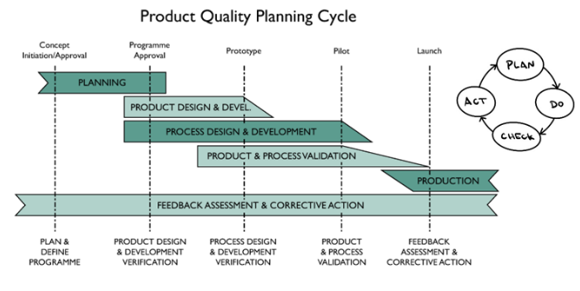
1 pointIf you’re not from the automotive industry, then you’ve most certainly not heard of the APQP before, and perhaps, you’re curious to delve into the answer to the question. Brief History APQP: Developed by the Ford Motor Company, that published the first Advanced Quality Planning handbook for suppliers in the 1980’s. DFSS: Developed in the 1980’s by Motorola and became popular worldwide from there. APQP is a quality framework for developing new products, evolved from and typically utilized in the automotive industry. Having said that, APQP can be applied to any industry and is similar to DFSS in many ways. However, let’s understand how they’re different. DFSS APQP PRIMARY GOAL To reduce defects and deliver high quality products that fulfil customer needs. PRIMARY GOAL To mitigating possibilities of risks or failure during the entire life cycle, while delivering high quality and competitive products that fulfil customer needs. APPLICATIONS Largely used across industries (basic engineering, process industries, waste management, and electronics) and functions (finance, marketing). o Designing or re-designing a New Process, Product or Service from the scratch. o Replacement of a current product/ process that needs complete re-design or has reached redundancy APPLICATIONS Typically utilized in the automotive industry can be applied to any industry. o Designing or re-designing New Process or Product o Change/ replace a current in Product or Process o Continuous Improvement of Product /Processes FRAMEWORK o Utilizes the DMADV cycle to determine the needs of customers and then design a solution to meet those needs. Picture source: https://www.pwc.com/ FRAMEWORK o Utilises the PDCA cycle across 5 NPD phases, also referred to as the Product Quality Planning Cycle. Picture source: https://www.vhancevalencia.com/posts/six-sigma-frameworks TOOLS & TECHNIQUES o Requires tools such as QFD, FMEA, TRIZ, Design for X, DOE, Taguchi methods, etc. TOOLS & TECHNIQUES o Requires the use of quality tools, such as FMEA, MSA, SPC, PPAP. SCOPE o Largely a design scope and internal to an organisation. o Limited to a single organisation with cross functional collaboration o Highly focused on customer needs and specifications to deliver high value product/ services. SCOPE o Largely a scope across the entire product lifecycle viz. design conceptualisation to production and development of comprehensive control plans. o Intended to aggregate goals and planning activities of suppliers across the product development value chain into a single process and program. o An end-to end scope essentially scaled across functions, the entire value chain (viz. the company and its suppliers) o Implementation is not regulatory requirement, the expected process Sigma level for a product or service should be no less than 4.5 (can even be 6 or higher depending the product) Mandatory implementation requirement for Tier I automotive suppliers (APQP process standards are published, controlled and maintained by the AIAG) As mentioned above, while DFSS is has laser focus on designing, APQP is a much larger scope and scale; hence the application of DFSS methodology in APQP makes it more aligned to overall product planning and goals that are measurable and robust.
 1 point
This leaderboard is set to Kolkata/GMT+05:30