Topics
-
OpenAI, which is expected to need about 3,200 megawatts (MW) of power for its new facility, has agreed to provide up to 1,000 MW to the Southern Co subsidiary Georgia Power's systems in times of high demand. View the full article
-
The affected startup, Hugging Face, said it had turned to Zhipu AI's open-source GLM-5.2 model last week to analyze data from the hack after leading US AI models declined the task, unable to distinguish between a defender and an attacker. View the full article



Leaderboard
-
Aarti T
Members1Points17Posts -
Shubham Chamoli
Members1Points14Posts -
Nikita Chordia
Members1Points10Posts -
Muth Abraham
Members1Points10Posts


Popular Content
Showing content with the highest reputation on 01/19/2024 in all areas
-
1 pointCriteria Risk Register FMEA Purpose Tracking and management of project risks. Analysis and prioritization of failure modes. Risk Scoring - Qualitative scoring often using scales like low, medium, high. Systematic scoring for Severity, Occurrence, and Detection. Prioritization - Based on qualitative risk scores. - May lack a standardized prioritization mechanism. - Based on Severity, Occurrence, and Detection (RPN) - Provides clear prioritization of failure modes. Advantages - Holistic view of all identified risks. - Inclusive of positive and negative risks. - Helps in project planning and management -Proactive risk identification. - Systematic analysis and prioritization of risks via RPN -It can serve as tool for process improvement Disadvantages - May lack depth of analysis for specific failure modes. - Subjectivity in risk scoring. - Can be time-consuming mainly for complex systems. - Subjectivity in assigning severity, occurrence, and detection scores. Use Cases - Project management in various industries. - Business risk analysis. - Manufacturing and engineering processes. - Product development.1 point
-
1 pointRisk Register and FMEA are different tools used for managing risk. Risk Register is comparatively broader, covering all identified risks across an organization, project or activity. On the other hand, FMEA focuses on specific failures within a system, process or the product. The advantages and disadvantages of Risk register are listed below: Advantages: 1) Facilitates communication and collaboration on risk management. 2) It is adaptable to various contexts and industries. 3) The risk register provides a comprehensive overview of all potential risks. Disadvantage: 1) At times, risk Register lack detail and actionable insights. 2) This requires ongoing maintenance and updates. 3) This can be subjective and prone to bias. The advantages and Disadvantages of FMEA listed below: Advantages 1. FMEA is well-established methodology with standardized guidelines. 2.This method have quantified risk assessment enables data-driven decision-making. 3. It is a Proactive approach to identifying and mitigating potential failures before they occur. Disadvantages: 1. This is a time-consuming process. 2. Resource intensive process. 3. It relies on accurate system understanding and may overlook external factors. 4. This can be overly focused on technical failures and neglect broader risks. Use Cases: Risk Register: 1. Strategic planning and decision-making. 2. Project management and risk mitigation. 3. Compliance with regulations and standards. FMEA: 1. Product design and development. 2. Manufacturing and process improvement. 3. Safety and reliability engineering.1 point
-
1 pointThe Risk Register and FMEA (Failure Mode and Effects Analysis) are both risk management tools for different purposes. Risk Register The risk register takes a holistic or broader view, listing each risk, its potential impact, and mitigation strategies. Advantages of Risk Register: It helps to identify and document a wide range of risks. This documentation is often saved as a project artifact during project or organization reviews. Communication of risks: It allows all stakeholders to have the same understanding of the risk, thus reducing subjectivity. Living document: Risks are constantly tracked and adjusted as the drivers change or evolve. Disadvantages of Risk Register: Prioritization is challenging: Because of the broad nature of the tool, it does not provide information on specific issues. This can make it difficult to focus on the critical Xs. It takes a qualitative approach that provides inadequate information for detailed analysis. Maintaining the risk register: If there are many risks to track, it can be challenging to keep the document current. Use Cases of Risk Register: Project management: Monitoring risks and keeping projects on track. Business continuity planning: Preparing for a variety of potential disruptions e.g. cyclones in areas where this is likelihood. Regulatory compliance: Ensure that all necessary compliance meets the requirements e.g. GDPR compliance. FMEA This dives deeper into issues in the process to identify specific system, product, or process failures. It dissects failure modes, their consequences, and the likelihood of their occurrence, calculating a risk priority number (RPN). Advantages of FMEA: Quantification of risks: A risk priority number (RPN) score helps prioritize the most critical failures for mitigation. Mitigation planning: Targeted solutions can be tailored to address specific failure modes and root causes. Prevention-oriented: Proactive approach to minimizing failure impact. Disadvantages of FMEA: Narrow scope: Limited to specific systems and may miss broader risks, especially those outside the process or outside the team's knowledge. Resource-intensive: Requires detailed knowledge of how to use the tool and effort to complete. Complexity: FMEA can produce a lot of information for the team to sift through and it can be difficult to assign “mutually exclusive” causes in the exercise because systems can be affected by multiple factors simultaneously. Use Cases for FMEA: Service improvement: Identifying and mitigating potential service failures e.g. long call times resulting in customers leaving a service. Complex systems: Ensuring safety and reliability in aerospace or medical equipment. Design FMEAs are a powerful tool in anticipating potential failure modes at the design stage. Conclusion: One can consider using both tools i.e. use a risk register to find broadly understood risks and then apply FMEA to do a more targeted analysis.1 point
-
1 pointWhat is a Risk Register: It is a mandatory tool that a Project Manager should have or maintain. A risk register is also known as Risk Log. It is a tool and central repository that Project Managers create and use to track and monitor any risks that might impact their project. A risk register is used both before and during a project. It allows a Project manager to plan and strategize on any potential problems or setbacks that arise on a project and help plan an effective risk management strategy. Purpose of Risk Register: The purpose is to identify, log and track any project risks. A risk is anything unexpected that could happen, that would positively or negatively impact a project. Logging risks help to understand the severity, make stakeholders aware and ensure prioritization is in place for such risks. Why do we need a Risk Register: We need a risk register because, as projects get larger, longer, and more complex, it becomes increasingly difficult to manage. If risks are not tracked in a central repository and reviewed regularly, risks can develop, get worse or cause a larger impact. Some risks may seem negligible or unlikely to occur but have the potential to impact a project and have a knock on effect. Effective risk management is about identifying possible problems sufficiently early to plan the response and approach. It also allows a project manager to monitor risks over time and see how they progress. Risks are categorized into 2 types: Qualitative Analysis: In this, we prioritize the risks based on the probability and impact of the risks. Quantitative Analysis: In this, we analyze the effect of risks on the project. Examples of risks: Data breach Catastrophic event. Service outreach. Supplier goods go into liquidation or cease trading. What does a risk register look like? A risk register is essentially a document that lists all the risks and provides key information again each one. Risk registers are usually populated in spreadsheets. Columns in the risk register: Unique risk identifier - is the number to quickly refer to each risk. Risk Name – Name of the risk. Description - Enter the description of the risk. Risk category: It explains the type of Risk (social risk, economic risk, technological risk, environmental risk, security risk etc.) Probability – it explains occurrence of risks. Impact –analyze the potential impact of risk in this column. Risk Mitigation – Enter risk response plan. Priority – Level of risk compared to others (Low, medium, high) Responsibility owner – Person responsible for risk management and overseeing the solution. Status – Progress of the risk mitigation plan (Open, In progress, closed) An effective risk register is: One that is routinely updated, reviewed and easily accessible by project stakeholders. Can be filtered easily, to allow certain risks to be more easily monitored and understood. Where probability and impact can be realized and prioritized.
 1 point
 -
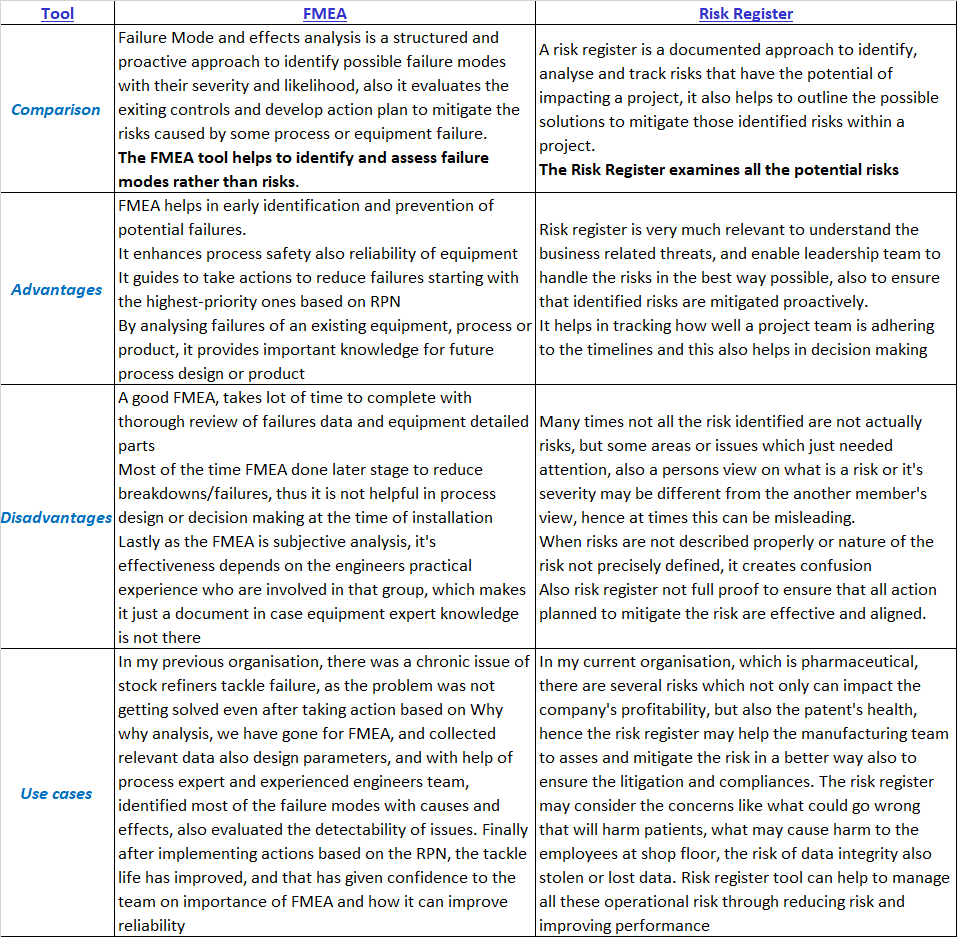
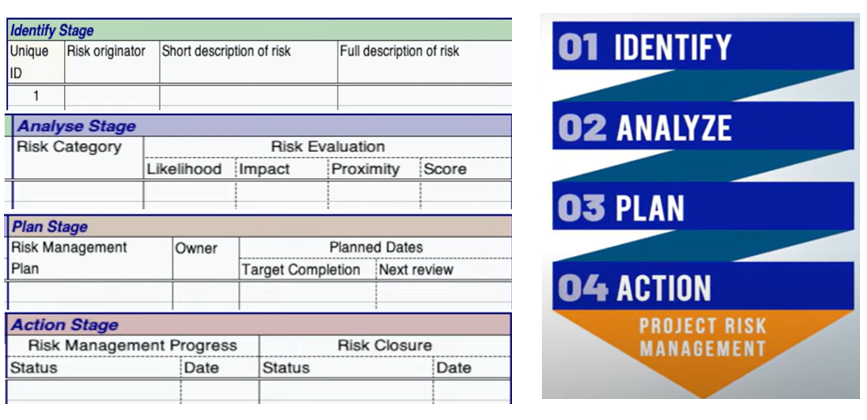
1 point1 point1 pointBoth Risk Register and FMEA are Risk Management Tool that are used by many organisations worldwide to mitigate the risk, but surely they have got their own different purpose, advantages and disadvantages. Risk Register In this methodology, we try to identify and capture the potential risks involved in a project or in an organisation. These potential risk are updated in Risk register and are followed and tracked to keep a basic overview of the condition or status. Basically Risk Register has got 4 parts: Identify, Analyse, Plan and Action. Also Components of each stage can be understood from the pic attached below. Identity: This involves Risk Identification and its description along with potential causes. Analyse: Analysis of Risk in terms of Likelihood, Impact and Proximity. Plan: Defining risk management plan along with fixed ownership. Action: In this we monitor and update the status of Risk over time. Failure Mode Effect Analysis FMEA is a tool used by organizations for evaluation of failure modes in a product, process, system using a very systematic approach of focusing and prioritising on the identified failure modes by identifying the severity, likelihood/occurrence and detection of the mode. By analysing above we calculate Risk Priority Number(RPN) and define action plan for elimination of failure mode. Higher the RPN number higher is the priority for elimination of failure mode. FMEA has got 7 parts: Failure mode identification, Failure mode effect, Severity, Occurrence, Detection, RPN Calculation and Action. These can be understood properly by the pics below: Advantages / Disadvantages /Use Cases 1. Risk Register has a Broader Scope and deals with the risk involved in a project or organization. FMEA is more Specific and Systematic in analysis of Failure Modes in a product, process, design, etc. 2. Risk Register is all about identifying and managing risk and its impact on project objectives. FMEA focuses on identification of failure modes and its impact of the performance and deliverables of a system. 3. Risk Register is used in Project Management centrally controlled and helps in taking predefined decisions. FMEA on the other hand is mostly deployed in engineering, designing, manufacturing in detailed failure mode analysis. 4. Risk Register is for risk which may occur in future and has got action plan to be taken in future to mitigate the risk. While FMEA is identification of failure mode which may occur in future and taking action in present to eliminate such cases in future. Use Case Example: Risk Register: We will use risk register when we are planning to setup a new plant. We will identify potential risk involved like Land Allocation, Certification, Pollution NOC, Local Demography, chances of flooding in rains, Seismic zone, local politicians, etc. We will make a well-defined action plan along with concerned owner for mitigation of the risk. FMEA: We will use FMEA whenever we are designing a new product or defining a new process. In this we will define the failure modes like lower specs, non-functional part, Early Failure, not meeting customer requirements, imbalanced process, breakdown of machine, etc. Actions will be taken immediately to eliminate these cases and chances of occurrence in future. Conclusion: Risk Register and FMEA are both great tools for Risk Management but both have different applicability, advantages and disadvantages. Risk Register being more broader and general towards complete organization while FMEA focusses on analysis and elimination of failure modes in a particular product or process.

 1 pointThis leaderboard is set to Kolkata/GMT+05:30