Niloy M
Members
-
Joined
-
Last visited
-
Triple Bottom Line (TBL) : It is a business concept which emphasizes that companies should be committed to focus as much on social and environmental concerns also as they do on profitability of the organization. The TBL consists of three critical dimensions and they are profit, people & the planet. Companies should work simultaneously on these three bottom lines and also can use these three elements to conceptualize their environmental and social responsibility along with making profit. Re-aligning business excellence objectives to TBL with examples: The Tripple Bottom Line framework includes integrating social, environmental and economic impacts that might affect the business, instead of using profit and financial terms only as the company driving force. To implement TBL theory through business excellence initiative, need to take the framework of People, Planet, Profit and examine each one to identify actions to achieve goals of all these dimensions. First is 'Profit', where the company must ensure the earnings or incomes are in ethical, fair manners. Business excellence drivers need to develop strategies or financial operating plan carefully to maximize profits while reducing costs and mitigating risk. Like it is company's responsibility to pay its lenders, stakeholders and employees what is due to them and to have a sense of responsibility for obligations like fair share of local, state govt. or income taxes on a timely basis. Next is 'People', here company to determine how it manages its employees and how its operations affect people. People includes all employees, vendors and customers as well. At times company prioritize investors, but TBL guides to shift the focus to all individuals who are involved in the business operation. It's all about ensuring well-being of society and its people. For ex. doing CSR activities like promoting education and skill development, promoting healthcare etc. 'Planet', In this dimension business excellence objectives must include implementing a lower-cost option or a more environment-friendly alternative for all the business needs. All actions should be making a positive impact on the planet, for examples redesigning its distribution channels or logistics to reduce its energy usage, which will result saving a certain amount of greenhouse gas emissions. Also, organization may take goals like more Recyling and pollution reduction initiatives. So, the TBL is about a company's contribution to society, environment, and the economy. An organization that focuses on bettering its surroundings including its people, has a long way to go. At the same time sustainable business gains loyal customers, which is critical in the competitive business world.
-
Methodology Vertical Integration Concept: Vertical integration approach is taken by companies to integrate one or two production processes or steps into their own business, instead of relying on external suppliers for those particular requirements. A business can achieve this by acquiring or taking direct control for some of their own suppliers, distributors, or retail locations rather than outsourcing them as external service providers, also it can be done by merging two or more companies which are serving different function in same supply chain. Types: Mainly there are two types of vertical integration, one is Forward Integration, when a company takes ownership of downstream process or further along the supply chain like sales or distribution of finished goods. And another is Backward integration, it is when a company acquires an upstream process which is prior to it along the supply chain, for example a fast-food restaurant takes control to some of the agricultural production that supplies ingredients for cooking foods. Purpose / Advantages 1. To have greater control on supply chain thus fewer disruptions and lower lead time 2. Company can identify possible disruptions in advance also can have more visibility 3. To lower the manufacturing costs by optimizing operations in all verticals based on need 4. Direct control on processes ensured better quality control in each stage as per requirement 5. Lower transportation costs, less turnaround times if the entire process is managed in-house. Example In my earlier organization of paper and paperboards manufacturing, brown Kraft paper core pipe was one of the major raw materials, there were few suppliers for core pipes, one local & two from other states. We were facing issues like size variation, moisture content and also on higher lead time for core pipes. Hence it was decided to develop the local supplier with training and guidance in terms of variation reduction, later company acquired that core pipe cutting facility, also upgraded the machines, and deputed 2 resources. Which has lead to eliminate size variation issue also stock out scenarios. This was one backward integration. It was also planned to relocate that facility inside the main plant to reduce the fixed cost further also making logistics and transportation simpler & more cost effective. Impact on Business Excellence strategy A successful vertical integration means company the one acquiring, must manage multiple challenges, some of them for which company resources may not be expert as it was not in original core competencies. Also, it increases business complexity as some new processes gets added in existing operations. To deal with these challenges, business excellence strategy must be aligned to get the full potential benefit and the new process must be thoroughly investigated to integrate those operations with existing processes and ongoing systems, it will also help to get upstream or downstream profits. On the other hand, the business, one getting acquired, may raise good capital if the assets were not getting utilized fully or not making profitable business. Also, the business will get more exposure with the modern tools and techniques used in parent organization, and expertise to make the processes more effective like improving quality considering actual customer requirement.
-
Standard Operating Procedures (SOP) are very important process document that specify job steps, which helps to standardize products and consequently quality. It describes in detail how an operator should perform a given operation or run a process. The purpose of SOPs is to ensure that all persons are performing the defined tasks in the same way, which is a needed to get the expected output from the process, thus person to person variation or chances of error reduces. Hence the SOPs plays a crucial role to standardize the processes across organization. At the same time to sustain profitable business in this competitive scenario, innovation with continuous improvement is essential. Any new business opportunities will create new problems and that needs new solutions, so any organization must be equipped with the new tools and have the freedom to innovate. But organizations may face challenges between competing needs for standardization through SOPs and innovation. At the crucial time of organizational change, achieving correct balance between these needs can be essential to an organization's success. Going for too much of either can lead to decline in productivity and morale issue as well among the team members. Team must understand that freedom to innovate doesn't mean freedom to do whatever we are thinking. The trick is to be able to encourage and drive innovation, but at the same time to keep innovation efforts focused towards organization's goals and to address the problems business is currently facing. The standardization gives a solid foundation on which innovation and improvement culture can build. Because until process is standardized, we don't have the base to work on and find improvement opportunities. To complement innovation with standardization, there must be flexibility to update the SOPs as and when required based on the improvement done through innovation. That will give the team apply creativity at the same time achieving organization goals through following standards.
-
Methodology TOC Lean Concept Theory of Constraint is a methodology to identify the bottleneck that limits achieving the goal of the business, like output or throughput. This is a process improvement approach, focusing mainly on improving profitability and business performance by identifying and eliminating the constraint or limiting factor. Lean methodology is aimed for continuous improvement and waste reduction. It focuses to fulfil the customer demand by matching the throughput. Lean thinking helps to identify seven types of waste, by eliminating those, organization can improve the current efficiencies also can reduce the operating cost. Differences on concept & process 1. TOC focuses to continuously increase the business throughput. 2. TOC approach is production lead, it increases throughput parallelly helps in reducing inventory and operating expenses. 3. Key measurements in TOC method are Throughput, Inventory & Operational expense 4. Method used in TOC are the Five focusing steps, followed by the Thinking process and then throughput accounting 5. Types of constraint that can be identified and eliminated are capacity constraint, cash constraint, Demand constraint, Regulatory constraints, Market constraint, supply constraint etc. 1. Lean focuses on matching the throughput with the takt time, 2. Lean is Customer lead approach, it helps organisation in fulfilling the exact customer need by matching the takt time 3. Key measurements in Lean system are the seven types of losses in the business processes 4. Tools used in Lean manufacturing are like Value stream mapping, Just-In-Time, OEE, Kaizen, Kanban, SMED etc. 5. Types of Wastes that can be identified and eliminated are Overproduction, Over processing, Transportation, Waiting, Motion, Defects, inventory. Examples TOC helps management to focus on what’s important by identifying individual constraints which is limiting organization for achieving goal. The work that I've done on implementing TOC, was to improve the machine capacity, as it was an old machine, team was unable to achieve the desired production due to the bottleneck of speed. After following the TOC approach, found that the constrain was the drives capacity and roller conditions, after investing on drives upgradation and changing old rollers, we could able reach the desired speed of 480 from level of 454 rpm, which has helped to improve the throughput of the plant. In my earlier organization Lean methodology implemented eight years back and followed which has resulted in increasing efficiencies, reducing losses, changing the mindset towards continuous improvement, and ultimately making the unit more profitable. Introducing lean and it's successful implementation takes a lot of time as it requires involvement of all stakeholders from top to bottom, also to bring the cultural shift to see the losses in each step and take action to reduce the waste by continuous improvement. After 3 years lean journey, witnessed the overall OEE improvement by 7%, thus productivity improved, also the product quality improved
-
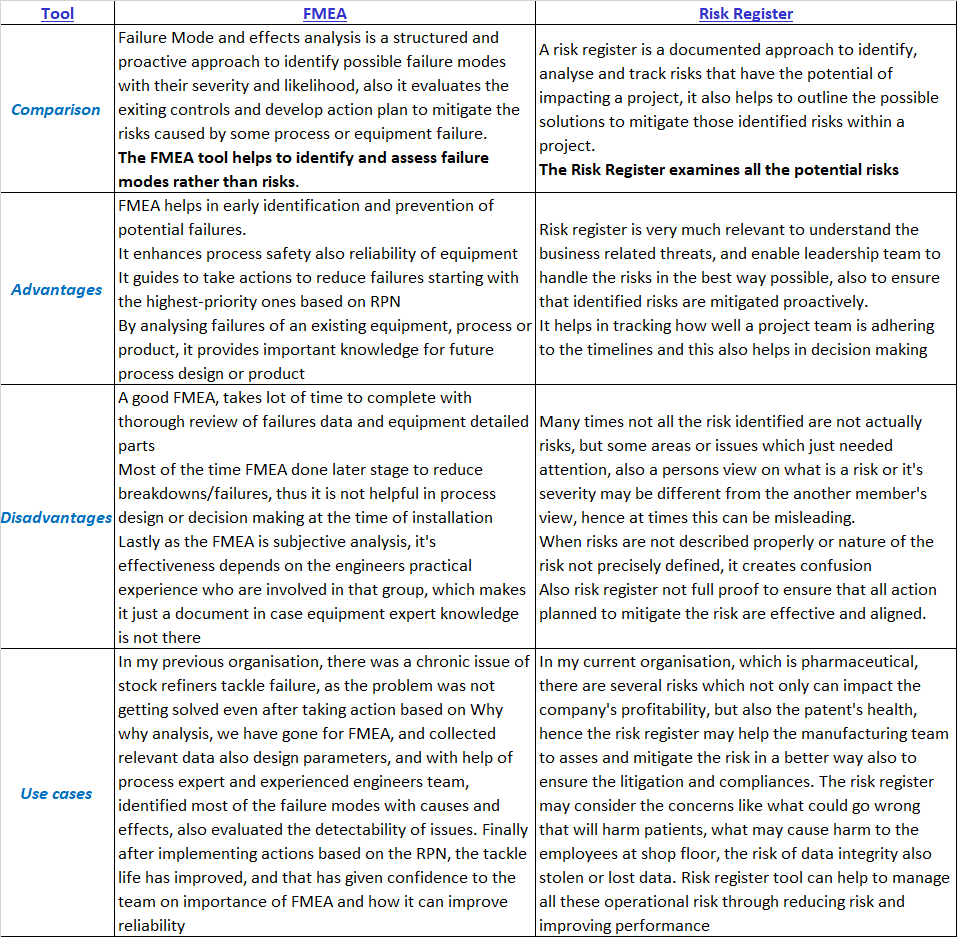
Process Benchmarking : Process benchmarking is the exercise to measure the quality and performance of a business processes and then comparing or analyzing those measured parameters with other business processes which are considered as best practices in the similar industry. Process benchmarking can be internal, external or competitive. Purpose : The main purpose of process benchmarking is to improve the current business performances like process efficiency, productivity or quality by learning from other best practices and by implementing strategies to minimize the identified gaps. Benefits : It helps to understand where the existing business processes stands compared to others or competitors, which gives us the awareness on scope of improvement also guides to set clear goals, thus drives the continuous improvement to gin competitive advantage. Project identification in Business Excellence through Process Benchmarking : Business excellence is the initiative which many of the organization follows to evolve best practices and managing business processes in effective manner to achieve more sustainable results. It helps to drive productivity improvement, sustainability and competitiveness also. To achieve those outstanding results, it is very important to understand how and on what parameters other organizations are achieving higher performance than our company. There comes the importance of process benchmarking, which helps us to know how much better we can perform and improve the exiting processes by selecting right projects on the identified gaps and implementing the learnings. Right project selection is very important so that company resources will be rightly utilized to ensure good returns and achieve goals. To identify the right projects there can be several types of benchmarking, like Internal, which helps to evaluate and compare internal processes, thus establishing same standard company wide. Next is External benchmarking, which is the method of collecting and evaluating metrices from external sources like other similar industries, those are performing better than us in some manner, and we can take projects to improve on those deliverables by establishing industry standard. There can be also Competitive Process benchmarking, which helps in identifying right projects to achieve the parameters on those our business process lagging from competitors, thus organization will get the competitive advantage by improving performances, products and services. So to make the business excellence journey successful, benchmarking is vey important in terms of right project selection.A risk register is a documented approach to identify and track risks that have the potential of impacting a project, it also helps to outline the possible solutions to mitigate those identified risks. Risk register is very much relevant to understand the business related threats and also to ensure those risks are mitigated proactively. Criteria to enter or remove a particular risk item from it : To create a risk register, clear criteria's need to define, which includes risk category, then to asses the risk need to identify it's probability and impact, accordingly rating to be given based on the qualitative or quantitative risk assessment method. Through this assessment only we can decide what are the risk to enter also what the vital few risk to focus first. If some identified risks that are already managed or avoided through some existing control, or that risk is no longer relevant based on the assessment, that particular risk can be removed from the risk register. Can risk register be used for process management : Yes, the risk register can be used in Process management in terms of process improvement, as this tool helps not only for a better risk assessment by identifying business risk and taking appropriate control, but also it helps in process improvements with sustainable action plan which gives impactful solutions to run the processes in a reduced risk environment. Example : For example in my current organisation, which is pharmaceutical, there are several risks which not only can impact the company's profitability, but also the patent's health, hence the risk register may help the manufacturing team to asses and mitigate the risk in a better way also to ensure the litigation and compliances. The risk register may consider the concerns like what could go wrong that will harm patients, what may cause harm to the employees at shop floor, the risk of data integrity also stolen or lost data. Risk register tool can help to manage all these operational risk through reducing risk and improving performanceTest Name 2 Variance Test Purpose Two variances test helps us to determine whether the variances of two populations are the same. It uses in case variance of a process is of more important to compare than the process mean Test shows that 2 data sets have different variances : inferences In Two variances test the hypothesis are Null hypothesis is Ho: s1² = s2² means two populations have equal variances Alternate Hypothesis Ha : s1² ≠ s2² or s1² < s2² or s1² > s2² , means two populations variance not equal If the test shows that 2 data sets have different variances, means the test statistic F which is the ratio s1²/s2² is deviates from 1, which shows the stronger evidence for unequal population variances. Means Null hypothesis that the two variances are same is rejected. Example : We need to find out whether there is difference between the mathematics exam grades as per the way the exams are conducted. Suppose each got the grade based on the same set of 20 exams, one of the teacher grades has the variance of 40 and another teacher got 25. Means this test will show that the first teacher’s variance is higher compared to 2nd teacher. Which is not expected for such exams.Test Name Kruskal Wallis Test Mood's Median Test Method The Kruskal-Wallis is a nonparametric test for comparing two or more sample medians, Statistic is based on comparing mean ranks for each group versus the mean rank for all observations. It is one of the nonparametric test which is used to compare medians of two independent samples. It can also be used to estimate whether the median of any two independent samples is equal. Differences Samples are random samples The two samples are mutually independent The variable is continuous The observations are independent both within and between samples. The observations come from a population with a continuous distribution The samples have drawn from the same population with equal medians Benefits It is used for comparing two or more independent samples of equal or different sample sizes. Mood’s Median Test is suitable when the dependent variable is continuous or discrete count, and the independent variables are discrete with two or more attributes. Limitations The Kruskal- Wallis test is not as powerful as other parametric tests like ANOVA, henec may need a larger sample size to get an adequate power level when using this test. This test just takes into account whether a data element is larger or smaller than the median. It is more useful for smaller sample sizes when the data contains few outliers as this test only focuses on median value instead of ranking Usage This is used as a test of equality of medians or even means It is used for determining whether the medians of two or more sample data sets come from the same population or notJohnson transformation is one of the type of mathematical transformation technique, which is used to transform non-normal data to follow a normal distribution through Johnson distribution system. When the Box cox transformation is not adequate to use, and the data contains any values including negative as well, in such scenarios Johnson Transformation is preferred. Johnson Transformation technique can be useful in the conditions like : When the original data set is following non normal distributions When the data set having negative values, also extreme outliers When the data has skewness or asymmetry distribution and kurtosis When it is required to preserve most of the features of original distribution When it is required to manage a wide range of shapes of distribution in data Statistical analysis like normal probability test can be performed on Johnson transformed data along with Anderson Darling Test statistic, which can be compared with the original data and it’s probability to visualize the improvement or to understand whether the transformation is effective. Also Histogram plot can be done with the Johnson transformed data and it can be plotted to I-MR chart to check if the process is in control.