

Topics
-
The latest setback has fueled worries that Google was losing momentum just as OpenAI and Anthropic and a host of Chinese rivals have accelerated the pace of model releases. On the call on Wednesday, Pichai struck an unusually defensive tone as analysts pressed him on the state of Google's frontier models and whether they could still compete at the cutting edge of AI development. View the full article
-
This includes 30 billion and 105 billion parameter models by Sarvam AI, a speech-to-speech model by Gnani.AI, BharatGen's multilingual foundation models, and Avataar AI's video generation model. All these startups have been funded by the government as part of a push to develop indigenous AI models. Of the 20 models, five have been released so far. View the full article



Leaderboard
-
Johanan Collins
Members1Points72Posts -
Prashant Philip Vargis
Members1Points10Posts -
kiran Kumar R
Members1Points10Posts -
prvnt
Members1Points10Posts


Popular Content
Showing content with the highest reputation on 11/16/2021 in all areas
-
1 pointMcClelland theory of needs advocates that every person is driven by 3 needs which are Achievement, Power and Affiliation. This is not inherent but shaped over time through culture and experiences in life. This was put forward by Psychologist David McClelland and he suggests this is useful to understand from a managerial context. Need for Achievement : This is the urge to achieve certain things in whatever you do. Such people avoid both low risk and high risk situations. These people are generally individual contributors and do not value financial gains much as compared to the achievement they look for. Need for Power: This is the desire to have control and authority over another person to influence their decision in accordance with his/her need or desire. Most strong leaders fall into this category Need for Affiliation: This is the desire to build interpersonal relations/socializing with others. They want to maintain a healthy relationship with anyone who they interact with and always want to be loved and accepted everywhere. Now lets see how this can be used by a project leader for team management. Based on the personal traits, the leader can assign people accordingly who can encourage and urge people, take charge of deliverables etc. This could be a person who is driven by the need of power. As per who has the need for affiliation can be entrusted to maintain harmony and resolved conflicts within a team. This can be analysed from past actions of the team members. It is important to keep the resources motivated so as a manager its important to know that so that resources can be offered the tasks/responsibilities based on their needs. These analysis could be considered while setting up goals, targets for the individual, designing the learning plan etc1 point
-
1 pointWe all go through different experience and culture during our lifetime. Do we derive any dominant behavior within us from these experiences, which is regardless of our age ,gender and culture? The American phycologist “ David McClelland” ,studied the ways in which people satisfy their needs and the drivers which motivates them. According to him these drivers are directly linked to their needs and classified them into the below 3 categories in his “Need Theory “ Need for achievement Need for Affiliation Need for Power The theory is a research based approach, identifying the factors that motivates an employee at work. Let us understand in detail, the general behavior and the mode of motivation for the people group. Use of “McClelland Theory of Needs” in team management :- As the research proves that, any of the above 3 factor is dominant in around 86% of population, the theory could be applied in team management as mode of right motivation for the right person /group. We can be selective in assigning tasks and responsibility to keep the employee motivated and extract the best out of everyone. To apply this theory on team management ,we need to identify the motivation drivers in each employee to ensure the best fit. Initiating open conversations individually with each employee will be a crucial step in identifying the factors motivating them. A team manager can assign a group activity and identify these behavioral patterns. The leadership style towards each employee/ group need to be structured based on your findings.
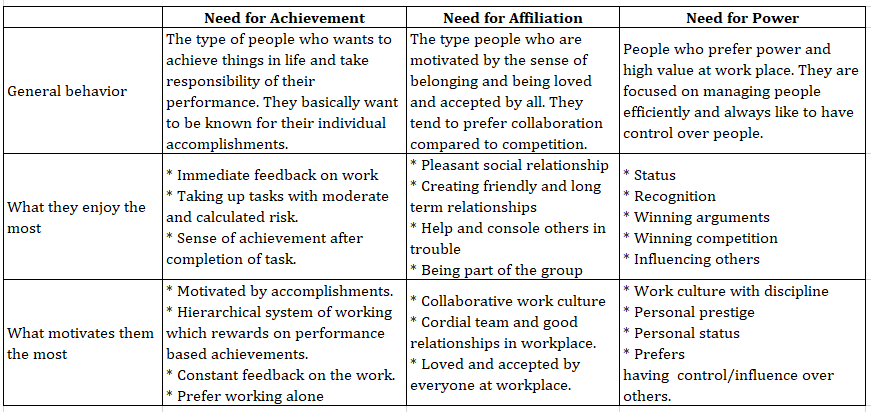 1 point
 -
1 pointDavid McClelland’s motivation theory or Expectancy Value Theory of Motivation states that every person is motivated by one of the three below needs: a) Achievement - need to get things done, b) Power - need to have influence over others & c) Affiliation - need to have good relationships. Person with the need of Achievement will always try to drive to excel, try to perform above set standards, and will always strive to succeed. Such individuals with a high need for achievement usually will take moderate risks in order to be always successful. Person with the need of Power is concerned with making an impact on other, the desire to influence other. Such individuals tend to take highest risks in order to achieve their goals. Person with the need of Affiliation will desire to maintain friendly relations with other individuals. They have a strong desire for acceptance and approval from others. Individuals with a high need for affiliation tend to be low risk takers. Though everyone has a blend of all the three, usually only one is dominant. This dominant need of that individual shapes their behaviors and motivations. The three different needs bring different strengths, weaknesses, preferred ways of working and behavioral risks into their respective workplace. Management & project leader leverage the respective team members dominant needs to in order to get the most out of them and to succeed as a team.1 point
-
1 pointMcClelland Theory of Needs was developed by David McClelland in 1960, about two decades after Maslow’s hierarchy of needs. It is also called Need Theory. It was put forward as a motivational model. McClelland hypothesized that an individual's needs are acquired over a period of time and are shaped by their unique experiences. The theory explains three needs viz. achievement, affiliation, and power. The theory states that all humans irrespective of their gender, age, or race have these needs for achievement, affiliation, and power. The Thematic Appreciation Test is used to measure these needs. The score on the TAT can be used to suggest the type of work that will be suitable for that individual. Need for Achievement. People who have a dominant need for achievement, are most likely to take on moderate tasks which are not too easy and not too difficult so that they fail. They like to continuously receive feedback on their work further reinforcing and motivating their need to achieve. Such people are motivated by rewards such as promotions, bonuses, etc. Need for Affiliation. Such people look forward to social relationships and have a desire to be part of a group and be loved and accepted by the group. Such people out of fear of rejection, adhere to the norms of the group. People with a need for affiliation prefer collaboration over competition and detest situations with high risk and uncertainty. They work best in areas where social interactions are called for such as customer service or directly dealing with clients. Need for Power. The need for power can either be personal or institutional. People with institutional power desire to organize the entire efforts of the group to further the overall goals of the organization whereas people with personal power want to direct others and be in control. People with a need for institutional power are generally more effective than people with personal power. People with a need for power are likely to see everything as a Zero-sum game. They are meticulous and disciplined. They look for competition, winning the argument, influencing others rather than being influenced, and desire recognition and status. Implications for a Project Leaders 1. About 7/8th of the population is dominant in 1,2 or all 3 of these needs. Project leaders need to attempt to identify these needs in each of their Project Team members. 2. Project leaders need to interact with Top Management keeping in mind that Top Management generally has a low need for affiliation and a high need for power. 3. Project leaders need to identify people with a high need for institutional power and be cautious with people with a high need for personal power. They should give people with a high need for institutional power every opportunity to take on leadership. 4. Project Leaders should remember that people with high need for affiliation do not make good top managers and are more suited for non-leadership roles. Project leaders should put them in a collaborative environment that requires high personal interaction and harmonious relationships. Such people should not be put in a highly creative and flexible environment since these people generally conform to the group norms and would feel threatened in such an environment. 5. People with a strong need for achievement generally do not rise to top management. Understanding that they seek to excel and prefer to take on projects where they can be successful through their own efforts, Project leaders should either group them with other high achievers or give then independent tasks. Understanding that they avoid both high-risk and high uncertainty situations, Project leaders should generally give them challenging tasks with reachable goals and give them regular feedback either in the form of verbal appreciation or some reward. References https://en.wikipedia.org/wiki/Need_theory http://www.netmba.com/mgmt/ob/motivation/mcclelland/#:~:text=McClelland's Theory of Needs. In his acquired-needs theory%2C,be classed as either achievement%2C affiliation%2C or power.1 point
-
1 pointNeed theory was proposed by David McClelland and is also known as Three needs theory. The Mc Clelland Theory provides a great motivational model that helps to understand personal drivers within a Team into main 3 means – Achievement drive, Affiliation, and effect of power. The theory evaluated the impact of how the needs for achievement, affiliation, power affect the actions of people from a managerial standpoint. Thus, theory is very helpful models for discovering the key drives for your team members and to help manage the team effectively. For a project/ program manager, it's essential to know what motivates your tea, and McClelland's Human Motivation Theory allows to identify people's motivational drivers which can help to manage the team either by appreciating or through effective feedbacks and in suitable task allocation. The theory is hence a very effective model to help keep the team motivated basis their individual motivators and not team behavior.1 point
-
1 pointThe McClelland theory is a hypothesis for analyzing and evaluating human motivation as well as how employees of a company are driven based on the three needs listed below. 1. Need for Achievement (N-Ach) an unspoken desire to improve in order to achieve a higher standard of excellence. People who have a strong Need for Achievement set clear goals for themselves. They accept moderate risks, individualistic activities, recreational activities that require a score and occupations that require individual performance data. 2. Need for Power (N-Affil) People with high N Pow frequently assert themselves by holding positions of power. They preferred employment in which they could aid or have an impact on others and very much like to lead, liked to gather items that signified prestige to others. 3. Need for Affiliation (N-Pow) to be a part of warm, personal relationships, such as friendships. People with high N Affil love to spend time with close friends or significant others, used to send letters or call friends or family, prefer to work in groups, and are sensitive to the reactions of others. They love collaborative activities and jobs that require close collaboration with others. One of the reason we also called it “theory of needs” as we assess the human motivation on these three needs. E.g. Successful entrepreneurs all across the world have high N Ach, low N Affil, and moderate N Pow. Effective leaders, middle-level, and executive managers have high N Pow, moderate to low N Affil, moderate N Ach, and high Activity Inhibition (a measure of self-control). Project leaders use the “theory of needs” in team management through DISC (Drive-Influence-Steadiness-Compliance) assessments, in which team members are assessed based on their personalities, and the leader improves/directs/changes how the team members think and act in order to achieve project results. Individuals with “D” personalities are ego and put a priority on achieving bottom-line results. Individuals with “I” personalities are much more open and appreciate relationships as well as influencing or encouraging others. Individuals with “S” personalities are dependable & appreciate cooperation and sincerity above anything else. Individual with “C” personalities Quality, accuracy, expertise, and competency is important to the people.1 point
-
1 pointMcClelland Theory of Needs says that regardless of gender, age or culture, everyone has three motivating drivers such as Achievement, Affiliation and Power, with one dominant motivating driver. This dominating motivator is largely influenced by the cultural background and experiences. Characteristics of the person with each of the dominating motivating drivers are as follows- Achievement - 1. Need challenging goals 2. Ready to take calculated risks. 3. Needs regular feedback on progress and achievements. Affiliation 1. Likes to be in a group. 2. Not risk takers. 3. More interested in collaboration than competition. 4. Wants to be liked and goes along with the group. Power 1. Interested in control and influence over others 2. Likes competition and winning. 3. Likes status and recognition. The knowledge of the dominating motivating factors of the team members helps the project managers in the following ways- 1. Setting goals and providing the right feedback. 2. To provide the right reward and recognition. 3. To distribute the right work to the team members and thereby providing best fit jobs. 4. To provide the right motivation to the team members to help do the job better.1 point
-
1 pointProject is an activity with purpose or end results achieved in definite period with start and end time with budgeted resources (money, manpower, material). Project Leader role is to ensure above objectives are met by leading diverse team having direct control, external teams, stake holders with little or no control over them. Managing and motivating the internal team having direct control is extremely important as they can influence the project outcome significantly. In many organizations project team composition is diverse in nature, some are fixed in nature of doing such repeat projects. Some are picked-up from different functions, with in or out side organization. Some are even engaged for temporary period of time. Hence to ensure that team delivers the results, project leader need to play important role in constantly engaging and motivating the team. Motivation is large subject and there are many theories around it. However, for corporate, professional setting McClelland theory of Needs is apt one to relate and practice. There are 3 needs as per McClelland theory as below. Need for achievement – motivated by results Need for Affiliation – motivated by inclusiveness, engagement Need for power – motivated by delegation, control over Project can be broadly divided into 3 buckets. Planning (design) Execution Control (monitoring) Based on background of project team members and their motivational needs, they can be assigned appropriate role in above phases of project. For example, team members having Need of achievement as motivation can be given task of project execution role. Project Controllers who monitor end-to-end project in resource allocation, driving collective performance. These get motivated by Need of power and above job would be suitable to them. Finally there are many team members either in back office, planning , design departments, who get motivated by constant engagement, appreciating them for impact they make to the project. There could be transitions in the motivational needs yet times. One , especially Project Leader in above case, need to recognize this and make course correction in dealing with team.1 point
-
1 pointMcClelland's Theory is about a person's explicit needs picked and formed over their life experience may it be professional or personal. These experiences are categorized as Achievements, Power and Affiliation. A person's performance quality is exactly determined by any of the categories mentioned. A Project Leader can use these 3 needs as motivation for his/her project team members. As it plays a vital role in an individual and/or organization's productivity and the overall employee's satifactions towards work.1 point


This leaderboard is set to Kolkata/GMT+05:30