

Topics
-
Fifty-five women engineering students completed an AI bootcamp focused on rural Karnataka. Participants developed AI-based solutions after visiting villages and conducting field interviews. The She Innovates bootcamp partnered with several organizations to achieve its goals. This initiative aims to boost women's participation in AI and entrepreneurship. It encourages AI applications for rural development and community-focused sectors. View the full article
-
Besi's quarterly orders more than doubled, fueled by AI and hybrid bonding technology. The company saw increased customer adoption of its advanced chip packaging solutions. Demand for AI applications continues to drive growth in data centers. Besi anticipates revenue growth between ten and fifteen percent. This strong performance aligns with other semiconductor sector reports. View the full article



Leaderboard
-
Vishwadeep Khatri
Administrators1Points6,722Posts -
AmitKumar
Lean Six Sigma Black Belt1Points11Posts -
Johanan Collins
Members1Points72Posts -
Saravanan MR
Members1Points11Posts



Popular Content
Showing content with the highest reputation on 10/08/2021 in all areas
-
Q 408. OTED is closely related to SMED however it is much tougher to implement. What is OTED? Provide an example where it has been achieved. Note for website visitors - Two questions are asked every week on this platform. One on Tuesday and the other on Friday. All questions so far can be seen here - https://www.benchmarksixsigma.com/forum/lean-six-sigma-business-excellence-questions/ Please visit the forum home page at https://www.benchmarksixsigma.com/forum/ to respond to the latest question open till the next Tuesday/ Friday evening 5 PM as per Indian Standard Time. Questions launched on Tuesdays are open till Friday and questions launched on Friday are open till Tuesday. When you respond to this question, your answer will not be visible till it is reviewed. Only non-plagiarised (plagiarism below 5-10%) responses will be approved. If you have doubts about plagiarism, please check your answer with a plagiarism checker tool like https://smallseotools.com/plagiarism-checker/ before submitting. The best answer is always shown at the top among responses and the author finds honorable mention in our Business Excellence dictionary at https://www.benchmarksixsigma.com/forum/business-excellence-dictionary-glossary/ along with the related term1 point
-
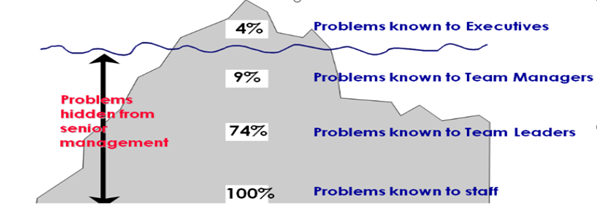
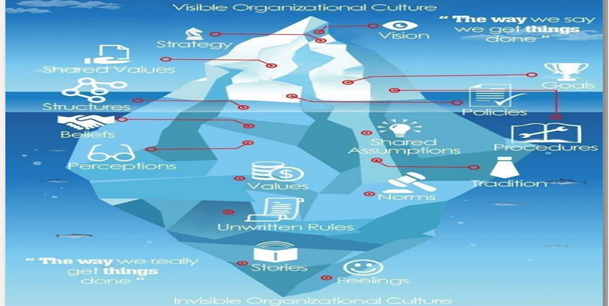
1 pointThe Iceberg Model The Iceberg Model of culture & leadership can drive organizational success. The fundamental pillars are Strategy, leadership, and culture that define the success of any organization. Organizational culture should align with the growth strategy defined by the leadership to achieve the desired business outcome. And the leadership should uphold organizational values and beliefs through their daily activities and decisions that aids the execution of the organizational strategy. What is Iceberg Theory: Edward T Hall developed the "Iceberg Model of Culture” In 1976, where he explains that organizational culture is like an iceberg found in polar seas, around 10% of the iceberg is visible above the water surface, while most of the iceberg is hidden and below the water surface. Similar approach is applied to every organizational Culture that has the characteristic of being highly disproportionate in its actual visibility. Image credit to Internet Source: pdfproof.com Surface Culture: These are some common observation formed by people based on what they see, hear, or feel and easily visible from the outside, about organizational culture and leadership. We often called the “surface culture,” for example, vision, strategy, goals workplace ambiance, dress code, systems, policies, processes, etc., are visible on the surface. Deeper Culture: The aspects of a deeper culture are built on beliefs and values, bias and coercion, authority and competition, health and wellbeing and these factors cannot be easily perceived or evaluated as external factors. These elements are very crucial for the organization that can make or break the organization and very difficult to handle. The organizational leadership has a significant impact on changing the culture and disseminating the deeper culture through their proper actions, decisions, beliefs, and behavior. Organizational Culture: The Organization DNA is sometimes used as a shorthand for an organizations culture and strategy. Organizations DNA is the organization’s “smells” and behaves with visible and invisible elements. Organizational culture is a set of beliefs and values that drive what people do and how they do it. Culture is implicit norm that identifies the type of employee’s behavior that are accepted, rejected, encouraged, or discouraged within the entire organization. Culture influences in decision making, behavior and the motivation of employees, hence individual and company performance. Iceberg of Ignorance theory by Sidney Yoshida: Iceberg of ignorance trigger employees’ disengagement and frustration at the front line and subsequently generates high attrition and poor business performance. • “The iceberg of ignorance” by Sidney Yoshida, observed that senior level management is often removed from day-to-day business operations. For that reason, they fail to understand about the running systems and processes that affect both employees and customers. Fig: The iceberg of ignorance” by Sidney Yoshida • The study concluded in a way that only 4% of the day-to-day problems are aware of executive level, only 9% of the problems were aware of department managers, employee supervisors know of 74% of problems whereas the frontline employees know almost 100% of problems that significantly affects the quality of products or services that were being delivered to customers. Iceberg Model: Using Motivation to enhance organization performance There are many factors that determine that employees are motivated or not. To start with from the recruitment and get trained for a particular position that drives employees motivated to do his job perfectly that also triggers the highest performance of the organizations. Picture credit to 6seconds.org about Iceberg Model of Motivation To examine an employee’s highest commitment and performance to the organization both Extrinsic and intrinsic motivators are identified. Extrinsic motivators are as “above the surface of the iceberg” such as status, money & perks, praise that engaged employees checking into work, maintains and followed procedures and completing work duties in time. On other side, intrinsic motivators are resided at below the surface of the iceberg where employees are acknowledged, develop relationships, have feelings of belonging, purpose, and resulting in employees maintaining trust, innovation, commitment, and loyalty& satisfaction within the organization. The challenge persists in engaging employees with intrinsic motivators. Extrinsic motivators are tangible, measurable and always supportive to leadership in the organization. Three Keys to develop Intrinsic Motivation Employee involvement, Build relationships, Work with purpose. Iceberg Model: Organization Culture Change Organizational culture is the shadow of the leadership. Leader shape their organization culture through their behaviors. The behavior of the senior team has a direct impact of the performance and productivity of the entire organizations. Therefore, it is important for leadership to address on cultivating a great culture. Once culture developed it is very hard to change. Leaders are working as the change agent to change the organization. Image credit to TORBEN RICK – Organization culture Change Organization cannot change itself at their own. Top performance leadership teams could realize that their collective and individual behavior have a positive or negative shadow across the entire organization. The leader should perform the desired behavior as a role model and let others see & follow the desired values in action. The most difficult leadership challenges that faces are the changing the culture of the organization. Because an organization’s culture is consisting of many interlocking set of goals, processes, roles, feelings, values, communications practices, attitudes and assumptions. At the end, by understanding and practicing the iceberg theory, we can find out the root causes of the problems in the organizations and transform human behavior at a large extend by motivating, training & development. Organizational culture has an enormous impact on employee engagement, performance, productivity, overall experiences and success. Right leadership behavior, belief and actions can play a significant role in influencing culture within the organization and driving the organizational strategies to become successful organization.


 1 point
 -
1 pointQ 407. Iceberg Theory is a literary theory that focuses more on surface elements rather than underlying themes. What are some of the business excellence applications of this theory? Provide examples. Answer: American writer Ernest Hemingway conceptualized the theory of omission which is also called as Iceberg Theory. In Iceberg only the tip of the iceberg is visible above the surface of water, the huge part of iceberg remains underneath the water, this resembles that at the surface only symptoms, actions or events are seen on the tip of iceberg, the real issue, task, or vision will be seen once we penetrate deep inside and understand the situation better. It is the key tool for system thinking Generally, the events seen at the tip of the iceberg is analyzed and solution is provided for the issues observed, but the issue gets repeated, when deep dive, the main problem/cause is identified. While deep dive we reach 5 phases of analysis a) Events- (What has happened): Events are the actions which occur, and we analyze and resolve the event at its face-value but that doesn’t indicate resolution, the event could occur again b) Patterns- (How frequently the event occurs): We see different patterns, trends, sequences over the period leading to the event/symptoms occurring multiple times c) Structures- (What influences the pattern): We see difference influencing factors which occur the patterns. We can establish a clear connection between the structure and pattern such that the structure would influence the pattern to occur multiple times d) Mental Models- (Any transformational model impacted the structure): This is the culture of the organization highly influenced by values, beliefs, morals, attitude which impacts the structure Hence, the reaction of the events is largely depending upon the anticipated patterns or trends appeared due to the design of the structure influenced by the mentor model which is transformed. Which means it starts with evaluating the behavior of the event, moving towards understanding the psychology why the event occurred and lead towards changing the philosophy of how things are managed. Resource: https://untools.co/iceberg-model Iceberg theory is applied widely and are proven effective. Some of the examples are Hence, the deeper meaning of any event should not be at the surface, we should dive deep to understand more before concluding. Business excellence application of this theory can be at all the levels ( Operations, Mid-level management and leadership level) changing the approach of how the event need to be looked at and decision can be made accordingly


 1 point
 -
1 pointIceberg Theory The Iceberg Theory is also called the theory of Omission. It is a writing theory that was made popular by journalist and writer Ernest Hemingway. He used his style of writing as a journalist in the writing of his short stories. In doing so, he focused more on the immediate events which were evident on the surface and less on their context. His writing style caused the reader to understand the context of the story in an implicit manner. His minimalistic style of writing caused each reader to contextualize the story within the readers' framework. Quoting from Oliver, Charles M “If a writer of prose knows enough of what he is writing about he may omit things that he knows and the reader, if the writer is writing truly enough, will have a feeling of those things as strongly as though the writer had stated them. The dignity of movement of an iceberg is due to only one-eighth of it being above water. A writer who omits things because he does not know them only makes hollow places in his writing.” The key to the quote by Oliver Charles M is that when the writer omits what he knows the reader is likely to strongly pick up the things omitted by the writer. This adds to the authenticity of the writer. However, when a writer omits things that he does not know, the reader is naturally unable to pick up the things omitted by the writer and it leads to a hollowness and in his writing. Application of the Iceberg Theory Leadership/Management. Questions such as “Are leaders born or made” or “Is Management an art or science” have been asked through the ages. Advancement of knowledge and technology has shown that through training, patience, and discipline leaders are made and management is more of a science than an art. Leadership qualities span a vast array of attributes such as professional knowledge, integrity, empathy, etc. This inward focus of character and knowledge and an outward focus on people takes time and effort to build making a leader authentic. Consultants. Successful consultants are those who have a wide range of knowledge and experience spanning various fields including understanding human behavior. With processes crossing numerous functions, consultants who are experts in a very specific area are unable to optimize solutions. Actors. Great Actors spend months or years researching their part. Good examples of this are Tom Hanks who plays the life of a physically disabled and low intelligence man in the movie “Forrest Gump”, Freddie Highmore who plays the part of a young autistic savant surgical resident in the series and Darsheel Safary who plays the part of a dyslexic child in “Taare Jameen Par”. Teachers, Professors. Similarly, teachers and professors with a deep knowledge of not only their subject but related subjects are generally more successful and popular. Doctors. With the human body being a diverse spectrum of various systems that interact with each other and with the external environment, a doctor with a deeper knowledge of not only the human body but other external factors is more likely to be successful. Conclusion. The Iceberg Theory brings out the fact that when a person with in-depth knowledge over a wide array of subjects speaks, the information appears to be authentic. On the contrary, when a person with superficial knowledge speaks, his lack of in-depth knowledge, of confidence, of authenticity, etc. will betray him and he will be easily found out. References https://en.wikipedia.org/wiki/Iceberg_theory Oliver, Charles M. (1999). Ernest Hemingway A to Z: The Essential Reference to the Life and Work. New York: Checkmark. ISBN 0-8160-3467-2.1 point
-
1 pointThis termed Iceberg was coined by American writer Ernest Hemingway. The Iceberg Theory suggests that most of the time, people cannot see or find situations’ s data & existing conditions. The theory is also called as 'Theory of Omission'. It is applicable to most of daily or professional scenarios. It says that most of the reasons are hidden like as Iceberg in the ocean. The major portion of the Iceberg remains below the surface & slight portion stays above the surface. Most of the Iceberg is not visible & hence we see only Tip of the Iceberg. It may be very small information available at the tip of Iceberg. In some scenarios, Iceberg relates to culture, Music, Food for a particular reason as well. We have to dig dipper to understand the real problem & reasons to solve the issue from the grass root level. It will help to eradicate the problem completely from the system & process will become more effective too.1 point
-
1 pointWe know that 90% of Ice Berg is under the water and has been said that Ice Berg has a 30% more width inside the water than what it appears outside. The 90% Ice Berg that exists inside the water is what creates the behavior is what seen by 10% Ice Berg which is above the surface. We can apply this same logic to the problem solving. We are often exposed to a problem by a surface level event or experience. Solutioning for such type of problem may give a temporary solve but it may repeat once again! Ice berg model is a 4 step approach for solving such type of problems. Ultimate goal is to identify the root causes for the underlying portion and mental models that create problematic events. Step-1: Events: Observe here what has happened/happening. We may get the better results, if we recreate the event that has been lead to the discovery of problem. Step-2: Patterns and Trends: Make the historical data analysis/ observation of trends and also observe if there is any particular point where the problem has occurred or triggered. Step-3:Structures and Systems: Then identify the things or behaviors that has contributed to this problem and make the why-why analysis. Step-4:Mental Model: List down what are beliefs or assumptions that has created and shaped the system/trigger that has caused the problem. Example: Poor Working Index of an equipment (in which it is not possible to identify the internal material flow manually) in a manufacturing industry. Step-1: Observe what is happening/happened in that machine which has resulted in poor working index of it. Step-2: Identify the historical data/trends of the temperature distribution pattern inside the equipment say for min 6 months by observing the Level-2/3 automation output trends. Step-3: Observe the peak and low trends in the distribution pattern and make why-why analysis for it's triggering. Step-4: Based on your thought or mental model establish a relation between the parameters and proceed with the model building or further analysis on the assumptions.
 1 point
 -
1 pointWhat is Iceberg theory: The Iceberg theory was written by American journalist Hemingway, This theory is widely used in many industries / sectors as a problem solving technique or methodology. It talks about what is visible and what is not visible in the iceberg, Very little portion (15%) of the iceberg (The Tip) is visible and the remaining (85%) portion of the iceberg is invisible and immersed in the water. This model enhances the team to think beyond the immediate causes / events visible to everyone. It shall provide complete insight into any difficult problems. The model emphasize 15% are visible and remaining 85% are below the water level. Source: Marketbusiness.com We generally use the phrase “you know the tip of the iceberg.” It means that we know only the visible portion of the iceberg and so many things are hidden just below the tip of the iceberg. When we talk about some problem or event we have to dive deeper to see from top of the iceberg to bottom of the iceberg to understand the complete picture of the event or problem / situation. While consider any problem, Most of the cases we can see only the highly visible causes and invisible causes are not noticed at all during the problem solving process. So, This model emphasizes looking at the invisible portion where more causes / information are located. Also the quantum of the invisible portion contributes more than the tip of the iceberg. In industrial scenarios we often use this model to resolve problems like to reduce the number of LTA (lost time accidents) and to reduce COPQ (Cost of poor quality). Here we will see how it is used in COPQ. COPQ: The activities and processes that do not deliver the agreed performance / specification and / or expected outcomes. Most of the the traditional organization the COPQ identified between 4 - 5% of the sale whereas in six sigma organizations identify between 15 to 25% of sale, the reason behind that is the six sigma organization go below the tip of the iceberg whereas in traditional organization looks only on the tip of the iceberg. Hidden COPQ: This cost will deal with hidden chronic issues in the process COPQ ranges from 15-25% of Sales The actual cost of poor quality is difficult to arrive, On tip of the iceberg is the visible cost and the hidden cost is just below the water line which are the real chronic problems. In the visible part, we can see rework, rejection, waste, inspection cost, goods return etc. whereas in the invisible part sales lost due to poor product quality, excess inventory, unused capacity, premium freight cost and overdue receivable etc. This tool is used in many areas notably in Quality, Problem solving, understanding of market, Cultural analysis etc. The theory clearly taught us to not see the situational data, dive deeper and look for chronic events, This model is also called omission theory or model. Example in safety topic: Source: Research gate.net1 point


This leaderboard is set to Kolkata/GMT+05:30