

Topics
-
Fifty-five women engineering students completed an AI bootcamp focused on rural Karnataka. Participants developed AI-based solutions after visiting villages and conducting field interviews. The She Innovates bootcamp partnered with several organizations to achieve its goals. This initiative aims to boost women's participation in AI and entrepreneurship. It encourages AI applications for rural development and community-focused sectors. View the full article
-
Besi's quarterly orders more than doubled, fueled by AI and hybrid bonding technology. The company saw increased customer adoption of its advanced chip packaging solutions. Demand for AI applications continues to drive growth in data centers. Besi anticipates revenue growth between ten and fifteen percent. This strong performance aligns with other semiconductor sector reports. View the full article



Leaderboard
-
Mayank Gupta
Members1Points679Posts -
Mokshesh
Members1Points10Posts -
AmitKumar
Lean Six Sigma Black Belt1Points11Posts -
Swarandeep Kaur Juneja
Lean Six Sigma Black Belt1Points21Posts




Popular Content
Showing content with the highest reputation on 09/10/2021 in Posts
-
1 pointMeenakshi Iyer has provided a very detailed answer to the question and highlighted the responsibilities and method to validate successful implementation of Jishu Hozen. Therefore it is selected as the best answer. Answers from Swarandeep and Johanan are also a must read.1 point
-
1 pointJishu-Hozen means autonomous maintenance in Japanese. Jishu is translated into ‘independence or autonomy’ and Hozen is translated into ‘integrity, conversation or preservation’. It removes the concept of division of labor between the operator and maintainer. It may however require some multi-skilling and more skilled operators. Jishu-Hozen and TPM. It is one amongst the eight pillars of TPM, the others being Planned Maintenance, Quality Maintenance, Early Management, Safety, Health & Environment, Focussed Improvement, Training & Education, TPM in the Office. Objectives. The main objective is to train the employee to maintain the performance of his equipment. It is based on the operator-maintainer concept and prevents the operator from passing the buck for poor quality onto the maintainer. Jishu-Hozen takes advantage of the fact that generally the operator knows more about his equipment than the maintainer and can do the basic, daily and routine maintenance tasks such as tuning, inspection, cleaning, lubrication, etc. Benefits. This daily maintenance not only increases the machine life but also improves its performance thereby reducing variability in the process and defects. Jishu-Hozen could thus help in improving quality, improving profitability, reducing defects, reducing Mean Time to Repair, Increasing Mean Time Between Failures, increase ownership and skill level among operators, check for deterioration of the equipment, keep machines in optimal working condition, reduction of minor stoppages, eliminates failures, and develop personnel. TPM and Indian Navy. The Indian Navy uses the system of Planned Preventive Maintenance. This maintenance is either done by the operator on a periodic basis. This is followed by some maintenance schedules being carried out by the onboard technical staff. These tasks are generally carried out when the ship is at sea. After a certain period of time, the ship is given a Self-Maintenance Period. During this time the ship staff consisting of the operator and maintainer do maintenance of the equipment. Every third Self-Maintenance Period is an Assisted-Maintenance Period wherein the ship staff and the Fleet Maintenance Unit Staff carry our more major maintenance routines. Modular Design. The modular design of weapons and sensors on the ships enables ease in the implementation of the operator-maintainer concept. This is similar to the Design for Six Sigma.1 point
-
1 pointJishu Hozen is one of the eight pillars under Total Productive Maintenance. Traditionally each employee was expected to do their part of the job assigned to them and in case anything goes wrong with the machinery, maintenance team would be called to address those issues. This methodology had a lot of shortcomings such as delays, bottlenecks in the work flow, high maintenance cost etc. In order to avoid such circumstances, regular operators were cross-skilled to look after daily maintenance of the machinery, e.g. cleaning, lubrication, tightening etc. This is known as Jishu Hozen. Jishu Hozen is a Japanese term which means “autonomation (automation with human intervention)”. Steps to be followed for successful implementation of Jishu Hozen – 1. Upskilling Operators - There are two types of machine deterioration – Natural and Forced. By upskilling employees to manage daily maintenance of machinery forced deterioration is eliminated to some extent and natural deterioration is delayed. 2. Standard Process – Standard maintenance process should be defined to manage and maintain daily machine maintenance. Defining each step in detail along with clear roles and responsibilities. 3. General Inspection – Regular inspection in order to identify deterioration of machinery and keep machines/equipment working at their optimal performance. This prevents unprecedented machine failure. 4. Root Cause Analysis and Corrective Actions – In order to prevent quality defects and improve profitability timely analysis of defects/defectives, incidents etc. is mandatory to find out the root cause of the problem and implement corrective actions accordingly. 5. Standardization and Self-Management – Post identification of root causes and implementing corrective actions, standardize the best practices to avoid future incidents. Learn from all the past practices to self-manage machine maintenance and include all such findings in the knowledge repository. Jishu Hozen in service industry – It would be quite intriguing to see Jishu Hozen’s application in service industry. In service industries quality department is generally responsible to identify root cause of the problem and implement corrective actions. Implementing Jishu Hozen here would mean making employees skilled enough to identify hiccups in their own processes, learn from their past experience or best practices across and immediately restore their process by taking the right actions. Knowledge repository would come in handy in such a scenario where FAQs are maintained and answered. This would in turn enhance quality of deliveries, reduce cost and enhance employee’s confidence in managing their own day to day processes. This methodology would also help in reducing time spent on Essential Non Value Add activities such as Reviews.1 point
-
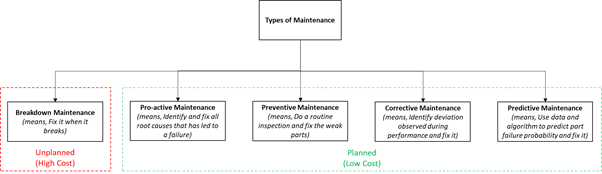
1 pointLet us understand the concept of Jishu Hozen systematically and also understand the key levers for its successful implementation. Maintenance can be defined as series of efforts taken to restore the condition of any mechanical object (or a machine) in order to get the desired productivity from it. To achieve the desired productivity, a machine must: a. Be available (no stop time) for operations as per planned time b. Perform (as fast as possible) as per expected cycle time, and c. Produce quality (only good parts) output as per the standards defined The above criteria gives rise to the concept of overall equipment effectiveness (OEE). An OEE of 100% indicates that a machine is producing only good parts as fast as possible without any stop time. Thus, it becomes clear that, maintenance of a machine is important to achieve a 100% or near to 100% OEE. Let’s take a quick look into the below diagram on types of maintenance to understand what a productive maintenance means. In the primitive days of industrialization, there used to be a separate maintenance department for performing the ‘breakdown maintenance’ upon failure of the machine. The production team was focused only on achieving the production targets. With the increasing complexity of the machines and increasing competitiveness (cost pressures), the industries could no longer cope with breakdown maintenance strategy. Industries gradually matured and moved towards planned maintenance strategies. A careful observation at various planned maintenance strategies in above chart confirms one thing for sure – that “a planned maintenance cannot be a job of an isolated maintenance department personnel, but has to be a jointly achieved by involving production department personnel as well.” Therefore the responsibility for maintenance tasks was partially transferred to production employees. This is how the term “Productive Maintenance” evolved. With rapidly changing technologies and practices, the element of continuous improvement in productive maintenance led to emergence of “Total Productive Maintenance” (TPM) One can now self-define the objective of TPM as “A continuous effort towards maintaining and improving overall equipment effectiveness by engaging those that use and impact the equipment.” Jishu (自主, autonomous) Hozen (保全, maintenance) is a Japanese term that translates into “Autonomous Maintenance”. Since TPM depends on involvement of production team to maintain OEE, it becomes evidently clear of having Jishu Hozen as one of the pillars of TPM. The main goal of Jishu Hozen is to empower and enable the employee to make a daily conscious efforts to maintain the performance of equipment. In order to enable the employee to do so, Jishu Hozen can be effectively implemented by implementing below key levers: 1. Improve knowledge of operator: Operators are masters of running their equipment. In order to get an optimal output from machines, they must know in and out of it. Therefore constantly training them on equipment anatomy and improving their problem solving skills will help. 2. Implement machine cleaning & inspection practices: Train operators to clean the machine and restore it to original state after use. Also operators must be empowered to perform daily inspection and do corrective maintenance. 3. Improve accessibility: Operators should be able to access the machine and its components easily in order to perform the inspection and maintenance while working on it. Therefore improving the layout to aid the accessibility must be done. 4. Eliminate cause of contamination: Operators must be encouraged to identify the source of contamination which soils/damages the equipment. Necessary steps must be taken to eliminate the cause of contamination. This will ensure that their daily maintenance and inspection task becomes easy. 5. Promote visual maintenance: Visual technique is an important element in implementing autonomous maintenance. Visual techniques makes it easy for operators at all level to understand messages without speaking in a loud operating environment. 6. Develop and implement standards: Create standards for training operator and inspection procedures based on type of equipment. Implementing the standards will ensure a systematic approach in long run. 7. Implement continuous improvement: A period practice to dissect the standard processes and check for room for improvement is important for sustaining autonomous maintenance. This practice can help in designing new machines and making new designs even easier to access and maintain. 8. Reward and Recognition: Congratulating operators and rewarding them suitably for doing a good job will help in promoting and sustaining Jishu Hozen in a healthy way.
 1 point
 -
1 pointJishu Hozen Majorly talks about the activities that eliminate Machine/equipment failures, minor issues in machines or defects in machines by maintaining, improving and restoring equipment to expected / desirable forms. The activities in Jishu Hozen will prevent deterioration of Machines / equipment, which will result in increased/improved production output/ efficiency. It helps in reducing the Oil Consumption & reducing the overall Process type of the process as well. It helps in Speedy notification/Proactive alert of failures & malfunctions which may occur in machine in future to plan the production in proper manner & avoid any losses due to issues with Machines.1 point
-
1 pointJishu Hozen is one among the important pillars of TPM, where the operators themselves do the maintenance without waiting for any maintenance team or dedicated service men from maintenance department. For it's successful implementation following things need to be followed on a regular basis. 1)Initial Cleaning and Inspection of the equipment. 2)Providing proper access to the areas and avoiding the sources of contamination 3)Making of cleaning and lubrication standards. 4)Conducting general inspections as per schedule (Daily/Weekly/Monthly) based on criticality of the equipment. 5)By scheduling Autonomous Inspection for the critical equipment as per the schedule 6)Visualization of the established standards. 7)And Implement the autonomous equipment management.1 point
-
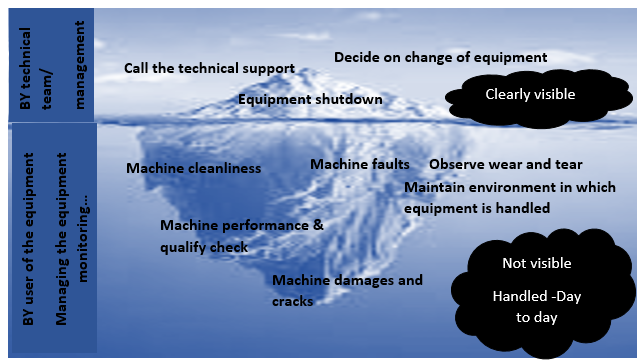
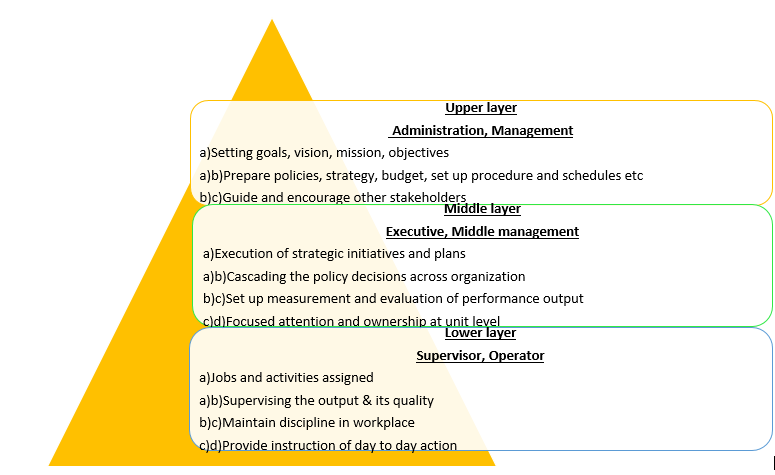
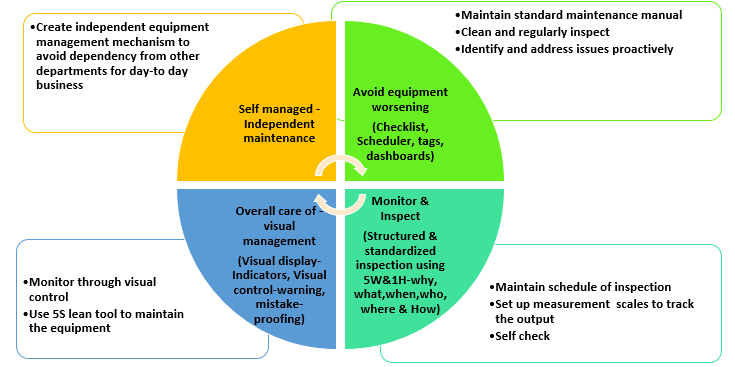
1 pointTotal productivity maintenance drives the thought of participation by every stakeholder in the production facilities i.e., it drives the idea that not only the team who manages or maintains the production, other teams or facilities should also participate in the maintenance activity (E.g., participation from leadership till operators) The total productivity maintenance work on goals like zero-defects/error, zero-accident/incident, zero-shut down/outage To manage each goals there are 8 strong and effective pillars on which the concept of total productivity maintenance is established. The pillars are: 1. Continuous improvement 2. Autonomous maintenance 3. Preventive maintenance 4. Training and education 5. Startup monitoring 6. Quality management 7. Administration 8. Health & safety management All these 8 pillars of TPM works on the lean tool of 5 S (Sort, Shine, set in order, standardize & Sustain) One of the key pillars of TPM is Autonomous maintenance also known as Jishu Hozen in Japanese where basically it means independent (Jishu) maintenance through management, protection & veracity (Hozen) by all the stakeholders from top layer management to the workers on the field Jishu Hozen in manufacturing is usually used to upscale the operator to make a daily effort to maintain the performance of equipment and processes during the issues identified in the equipment/tool/machine without waiting for the expert or technical support to resolve. In normal practice if there is a layer of hierarchy or many departments with scope of work defined, one department would wait for the other interlinking department to bring the solution, however the user of the equipment would know in and out about the equipment and should take charge to maintain them instead of waiting for action from other department i.e., operator should be empowered to maintain the equipment taking responsibility of the equipment. The frequent user of the equipment can generally inspect and identify if there is any functional issue, maintain the equipment through cleanups and frequent oiling or lubrication due to which the performance of the equipment can be enhanced & capacity improved. JH shifts the attitude from I, to WE leading to improvement in equipment productivity, efficiency and enhances the skills of the user/operator leading to cultural shift •Manage equipments: •a) Cleaning, b) Identifying flaws/errors,c) Optimizing efficiency,d) Restore to old status •Understand equipments: •a) Functionality,b) Monitor-frequent checkups,c) Optimizing efficiency The ownership and accountability need to jointly be handled by all layers of the organization.Largely there are 3 layers of management: Upper layer, Middle layer and Lower layer How JH works? The equipment when purchased has a life span as per the tested laboratory outcome. Beyond the available lifespan the performance of the equipment deteriorates if it is not maintained properly. Such weakened performance could be due to improper handling of the machine. Both these scenario are interlinked as : a) If the equipment is not maintained properly (by Lower layer of management) the machine would have to be replaced with new leading to huge cost of capital and such decision need to be taken by the middle and top layer of management b) If the equipment needs to be managed well by lower layer of management it would involve additional cost of maintenance like more cleaning, lubrication, minute repair from inspection etc. which should be budgeted by top and middle layer management Performing both the action would lead to improvement in the life span of the equipment. Preventive maintenance is essential part of JH where equipment is inspected regularly to see if there are abnormalities observed and address them on priority to avoid equipment to be a scrap if such issues remain un-actioned leading to increase in cost and dip in the quality/perforance of outcome from the equipment. In order to perform the inspection , checklist is the key document to be maintained at operator’s level and to be managed day to day. If AM(JH) is properly management by the operators, the need of technical staff is restricted to the annual maintenance of the equipment and/or during the complete shutdown/break of the equipment. Such scenario is not only observed in the manufacturing industry but also in areas like a) Domestic equipment’s (Fridge, washing machine, TV, Mobile phones & other gadgets are maintained by user and user seek technical help only during extreme stoppage conditions or annual maintenance) b) Infrastructure support & service (VPN connectivity, Network support, application & password management etc. are managed by the user following the self-help user manual and the technical support is consulted during complete shut down or update/upgradation/renewal) To ensure the successful implementation of JH we need to ensure: Audit can be conducted to check if the JH is implemented successfully at multiple layers of management e.g Self inspection, Audit at function/department level, Audit at the leadership head level Following checkpoints for implementing the successful JH On implementation of JH we can ensure a) A team is identified to perform JH -Training imparted, Expectations set, Plan etc. b) Cleaning- Precautions taken to clean, use kit, Prioritization etc. c) Address issues in equipment-Understand impact, identify source, define frequency of identification d) Establish standard of JH- Preparation of inspection, visually control and monitor, checklist e) Conduct general inspection-Draft schedule, inspection manual/process, identify abnormalities f) Autonomous inspection-Monitor quality/time take/output, Correct abnormalities, follow inspection training and standard module g) Standardize-eliminate waste, check proper flow managed h) Complete independent autonomous management-Streamline routine, enhance operator problem solving skills, perform continuous improvement through company goal alignment, The successful implementation of JH can be measured using the calculation of overall equipment effectiveness (OEE) parameter. The operational metric of OEE is as follows: OEE = Availability rating X Performance rating X Quality rating A)Availability rating is calculated in %, indicating the % of time the equipment was available for usage and calculated as: Availability rating =( (Available time – Shut down or Break time)/Available time)*100 E.g if a machine is available for 1000 hrs and there was breakdown for 100 hrs then availability rating will be ((1000-100)/1000)*100= 90% Availability rating Performance rating is calculated in %, indicating what is the performance or outcome of the equipment vs what was planned Performance rating = (Actual production/Planned production) *100 E.g if the planned or target for production was 1000units and actual production is 900 units then performance rating will be (900/1000)*100=90% performance rating C) Quality rating also measured in% indicates the level of quality of the output i.e Accuracy % Quality rating = (Number of defect free part of output/Total produced output or production)*100 E.g if the total production is 900 units of which defect free are 890 units then quality rating will be (890/900)*100 = 98.88% So, Overall equipment effectiveness = Availability rate X Performance rate X Quality rate = (0.9*0.9*0.98)*100 = 79.83% Such OEE is tracked and measured in a set frequency like weekly, fortnightly, monthly, quarterly etc and expectation is that OEE should have gradual increase indicating the effective implementation of Jishu Hozen. The more the OEE % the better is JH implemented

 1 point
 -
1 pointJishu Hozen is a Japanese word which means autonomous maintenance. It follows the core principle of Total Productive Maintenance by giving more control and authority to the operators to maintain their machine. It is a method that provides machine operators the responsibility for basic maintenance tasks, such as: lubrication, cleaning, tightening, , safety checks and inspections rather than depending on dedicated maintenance technicians so that the later ones can concentrate more on the complex problems. There are 7 steps for successful implementation of Jishu Hozen which are as follow : 1. Increase operator’s Knowledge: Machine’s operator must know the ins and outs of their machines. This involves training the operator to a level where he becomes familiar with the technical details of how the machine’s components work. Operators must be trained to identify faults, fix abnormalities, set optimum equipment conditions and detect deviations from optimum performance. 2. Initial Machine Cleaning and Inspection Once operators are trained, they are now capable of performing inspections and cleanings. This step involves getting equipment to a place where it’s almost “like new”. Operators must be looking for: leaks, loose bolts, lubrication, cracks, dust and dirt, smells, and heat. 3. Remove Causes of Contamination To ensure equipment doesn’t deteriorate, do not allow operators to contain contamination with them by promoting a culture of cleanliness and encouraging them to identify the causes of contamination. 4. Develop Standards for Lubrication and Inspection It is very important to document and have a record of standards on cleaning, inspecting and lubrication 5. Inspection and Monitoring It is very important to inspect and monitor that all the steps have been followed rigorously sa it helps in preventative maintenance tasks, they can be structured, scheduled and started automatically. 6. Standardize Visual Maintenance Taking steps to make equipment more visual is important as it helps to identify the problematic areas quickly. For instance replacing translucent covers with transparent ones, labelling on levers, and developing a tag system. 7. Strive for Continuous Improvement It’s important to continuously evaluate the standards and procedures created, to see where there is room for improvement. Continuous improvement is one of the most important pillar of TPM.1 point


This leaderboard is set to Kolkata/GMT+05:30