

Topics
-
Fifty-five women engineering students completed an AI bootcamp focused on rural Karnataka. Participants developed AI-based solutions after visiting villages and conducting field interviews. The She Innovates bootcamp partnered with several organizations to achieve its goals. This initiative aims to boost women's participation in AI and entrepreneurship. It encourages AI applications for rural development and community-focused sectors. View the full article
-
Besi's quarterly orders more than doubled, fueled by AI and hybrid bonding technology. The company saw increased customer adoption of its advanced chip packaging solutions. Demand for AI applications continues to drive growth in data centers. Besi anticipates revenue growth between ten and fifteen percent. This strong performance aligns with other semiconductor sector reports. View the full article



Leaderboard
-
Vinod GC
Lean Six Sigma Black Belt1Points26Posts -
R Rajesh
Members1Points160Posts -
Abhishek Chaudhary
Lean Six Sigma Black Belt1Points16Posts -
Johanan Collins
Members1Points72Posts




Popular Content
Showing content with the highest reputation on 08/31/2021 in Posts
-
1 pointPEST Analysis is a framework to assess the external macro-environmental factors. It is used during environmental or horizon scanning and examines the political, economic, socio-cultural, and technological factors. There are other variants wherein legal, environmental, ecological, ethical, demographic, intercultural, military, information, infrastructure, and regulatory. PEST is done to assess the external risks that may impact a company’s profit. It is believed that Harvard Professor Francis J, Aguilar, introduced PEST Analysis in the form of ETPS in the paper “Scanning the Business Environment” in 1967. Environmental or Horizon Scanning is part of the macro global environmental analysis which includes monitoring, forecasting, and assessment of the environment. This includes markets, industries, companies, competitors, clients. Scanning is done to identify trends and give strategic early warnings. Political factors such as the amount and the manner in which a government intervenes in the economy, government policy, political stability in the country and neighbouring regions, foreign trade policy, tax, labor and environment laws, tariffs, and trade restrictions may be included. A change in government may affect the political analysis. Economic factors may include both macro-economic and micro-economic factors. Macro-economic factors such as economic growth rates, exchange rates, interest rates, inflation, disposable income, and micro-economic factors such as the way people spend their incomes, savings may be included. These indicators are usually reported by the Government Departments or the Reserve/Central Banks. Social factors related to shared beliefs and attitudes of the people, demographics, attitudes towards health, career attitudes, cultural trends such as age distribution, population growth rates, religion, percentage of women in the workforce are used in determining the type of manpower available and the consumer's behavior. Technological factors comprise new ways of producing goods and services, distributing goods and services, and of communicating with target markets. This would include creativity, innovation, maturity of research and development, automation, technological infrastructure, technical ability of labor available, etc. PEST Analysis of Rwanda. Rwanda is popularly known as the land of a thousand hills and a million smiles. The country has demonstrated sustained high economic growth, one of the least corrupt country across the globe, an excellent and improving ease of doing business ranking, access to the East African Region and Congo markets. The governance in the country stands among one of the best in the world. This has been aptly demonstrated in the manner of handling the pandemic and vaccination of its population. The country has a robust and independent judiciary. The technological environment in the country has been growing in leaps and bounds with both technical manpower and infrastructure available in the country. The country has a stable and peaceful society with no differences being made based on religion or other such factors. World Bank Reports, Transparency International Reports and various other reports are available in public domain.1 point
-
1 pointPEST Analysis is a tool used to analyze the Political, Economic, Socio-Cultural and Technological environment that an organization operates in. It can also be used before a company enters a new geographical market. Political · Elections: When are the next elections, which parties are likely to win. What are the different political party’s stances? · Is the country politically stable? · Is the judicial system fair? · What are the laws in regard to copyright, property rights? · What new laws are on the books? · What are Business Regulations? Economic · Is the economy stable and growing? · What is the average disposable income in the country? · Is the unemployment rate at a manageable level? · Is the country part of an economic block? Socio-Cultural · What is the age profile of the company? · What is the population growth rate? · What is the average education level in the country? · What are the religious beliefs of the population? · What are the taboos and social attitudes? Technology · What are the new technologies that your company can use? · Are there any technological breakthroughs that will affect your business? · Are there infrastructure changes that will change how work is done? · What is the technological level of the competitors? Sources: https://www.mindtools.com/pages/article/newTMC_09.htm1 point
-
1 pointPEST an acronym for Political, Economic, Social and Technological is an analysis carried out by companies to scan the market to determine the influence of external factors on its business operations. The Political factors can comprise of regulatory or compliance issues, tax policy, tariffs etc. (e.g. retrospective taxes as applied on companies like Vodafone in India) The Economic factors relate to macroeconomic factors which have a bearing on the businesses like interest rate, GDP growth rate, inflation, and exchange rate. (e.g. devaluation of INR w.r.t USD can boost Indian IT exports) Social factors comprise of demographical aspects, cultural trends, customs prevalent in society which may have a bearing on the consumer behavior and product choices. (e.g. Impact of Covid on cultivating the habit of personal hygiene) Technological factors are linked to innovation in the industry, R&D practices, automation, adoption of IT and other latest trends (e.g. Solar technology has disrupted the power sector and people are now opting for rooftop solar instead of taking electricity from large power generating assets) PEST can be further extended to PESTLE including factors like legal and environmental. These factors and their assessment vary from market to market based on the experience and understanding of the executives. This analysis becomes more prominent when companies are trying to enter new markets in new countries having large geographical distance.1 point
-
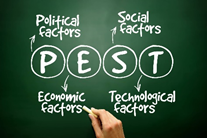
1 pointOther than an organisations resources, process and other internal factors, there are several macro-economic factors that can have a significant impact on its performance. They must be analysed carefully to understand its impact on the organization’s performance. A tool used to evaluate macro-economic factors related to a certain situation is the PEST analysis. PEST stands for Political, Economic, Social and Technological. PEST analysis is a method of assessing the impact of these four macro-economic factors in an organization in a particular situation in the long-term. This tool is used in alliance with other tools such as SWOT analysis to identify and distinguish the impact of internal and external factors. PEST Analysis Factors: Political – Legal factors and government regulations such as political stability, trade regulations, labour laws, government policies, tax guidelines are evaluated. Economic – Inflation rates, interests, growth plans related to economy, employment etc and its impact on the business are evaluated through this factor. Social – Through this factor, lifestyle changes, educational revolutions, customer demographical statistics, area dependent cultural limitations are assessed. Technological – The positive and negative impact of technology in a business’s product and service based on the global rollout of advanced technologies, digitization, etc are assessed through this factor. Example of PEST Analysis: PEST Analysis of a Hospitability Business (House Renting) P Political E Economic S Social T Technological Threat: · Conflicts between local housing laws and regulations and the business model · Fluctuating tax regulations around the globe · Wars and conflicts in certain countries in which the company operates Threat: · Well established hotel chains recognized the threat the company poses to their market share · Competitors copying the business model very easily · Increase in demand for housing locally with low number of service providers offering housing to travellers Threat: · Lifestyle trends decreased amount of travel · Travellers causing bad publicity and jeopardizing the image of the business or irresponsible behaviour hosts · Media highlighting the internal issues of businesses Opportunity: · Slowdown in the economy causing travellers not to opt for expensive hotel chains to save money Opportunity: · Lifestyle trends increased amount of travel Opportunity: · Increasing amounts of internet access by users to shop for hotels and lodging · Access to IT systems allowing more efficient data collection and extensive market research to address other threats / weaknesses
 1 point
 -
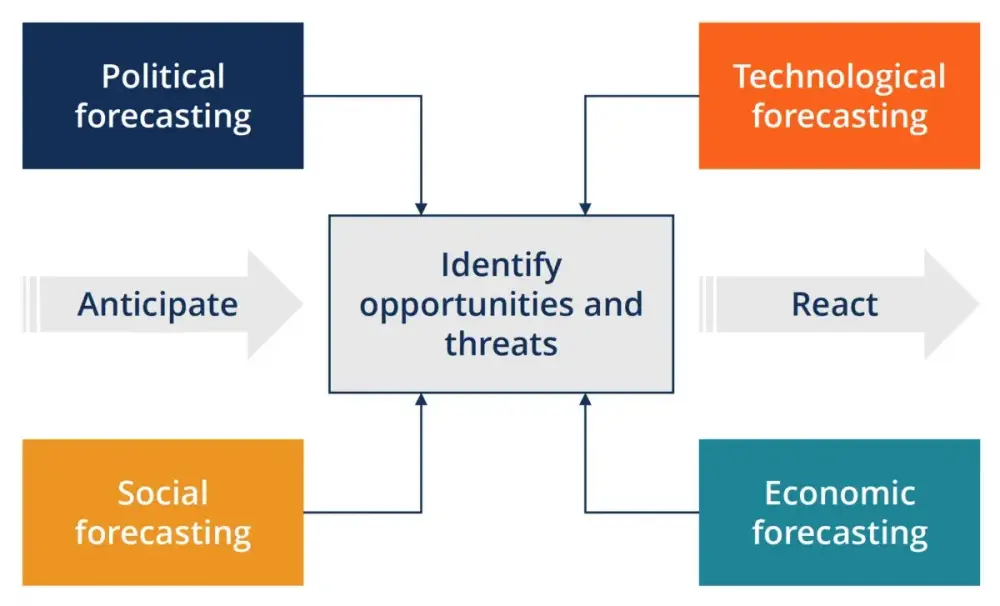
1 pointPEST Analysis (Political, Economic, Social & Technological) is a management method which is used to access the external factor so that organization can take steps in order to take advantage of or mitigate the situation and become more competitive. PEST analysis can be a good method to use in corporate strategic planning. It is to identify pros and cons of a business strategy. A popular variation on the PEST Analysis format, especially in the U.K., is the PESTLE strategic planning approach, which includes the additional aspects of Legal and Environmental. Some of the Example of different facets are given below: POLITICAL : Taxation Policy Environmental Law Labour Acts Subsidies etc. ECONOMIC : Per Capita income growth rate of region or country GDP growth rate Interest Rates Exchange Rates etc. SOCIAL : Culture Population growth rate Age distribution etc. TECHNOLOGICAL : Rate of change in technology R&D initiatives Automations etc. In PEST Analysis, any strategic plan or policy is assessed against these 4 facets. What would be of benefit and what would create an issue so that actions can be planned to mitigate those issue. HOW TO DO A PEST ANALYSIS: To get the most from the PEST technique, gather input from the participants with different perspectives. When you’re working with a large or distributed team, then you can get the most out of this analysis.
 1 point
 -
1 pointPEST: PEST is mainly used to identify the external factors affecting the organizational operations; The acronym of PEST stands for Political, Economical, Social and technological. Some times PESTEL also used to find environmental and legal factors. This tool is mainly used for market analysis and to become more competitive in the market. This tool shall identify all the external factors affecting the organization and the output of this tool shall be used to frame the action plan for improvements. Its mainly used for strategic management / environmental scanning / marketing analysis. Political Factors: The political factors contribute a lot in regulation of businesses, and the spending power of consumers and other businesses. We must consider and deeply analyze the parameters influencing the organization. Economic Factors: Its play a key role to understand country economical scenario, It will define the buyer or seller market. The inflation, GDP, per capita GDP incomes needs to be analyzed thoroughly. Sociocultural Factors: The social and cultural influences on business vary from country to country. It is very important that such factors shall be considered. Mainly on demography (age groups, Male / Female ratio, Health etc), people taste, customs, Technological Factors: The technological factor is vital for competitive advantage, and is a major driver of globalization. As an example today everyone talks about green energy / Green H2. The technology must be updated based on the trend and current requirement of customers, environmental and regulatory requirements. Another example like Motorola was introduced walkie Taki, remote control and mobile phone, due to the technological advancement failure Motorola is not having significant market share in mobile phone market. Thanks1 point
-
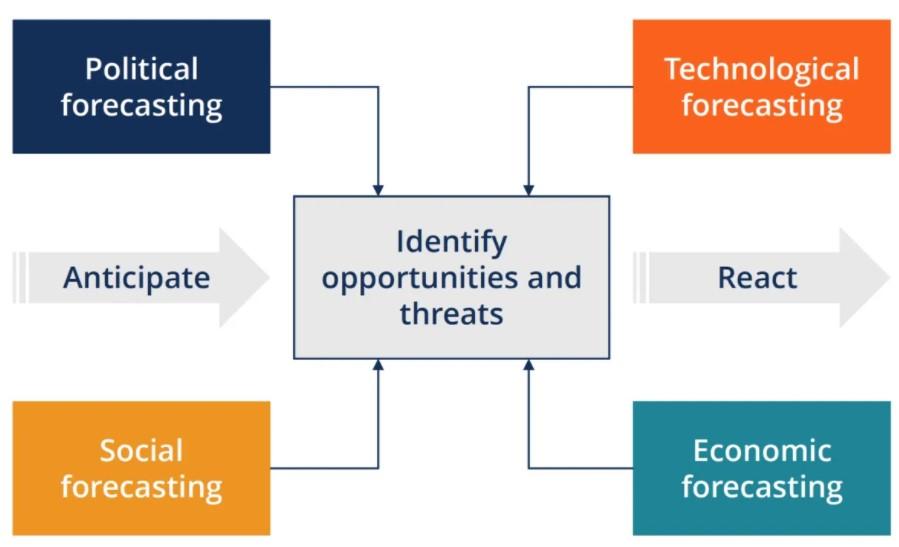
1 pointPEST Analysis is known to be a strategic framework that is used to assess the external environment for a business by drilling down opportunities and threats into Political, Economic, Social, and Technological factors. This analysis has evolved to be an effective framework to utilize in corporate strategy planning, handy in identifying the pros and cons of a business Strategy. Example: COCA COLA 1. Political Factor - FDA tests Coca Cola products. It must follow the rules particular to a country. It should also supply the local stores with the best beverages. Countries can very well prevent it from distributing the products if all rules are not obliged. Rules can relate to accounting, internal marketing, labor or taxes. 2. Economic Factor - Coca Cola has its customers around the world. The company has its production units in various countries. It prioritizes its customers’ tastes and preferences. Revenue comes from the beverage sales. Of late, people have started choosing healthy drinks. Coca Cola has noted it and has been moving in that direction. 3 Social Factor - Urban areas are targeted as major market. There are more than 30 types of flavors in Japan. Same is the case in China. US is more focused on healthy products. Water and teas are also some of the well known products that are under this category. Coca Cola can use the same approach in the countries like Japan and China. 4 Technological Factor - Use of new technologies can make Coca Cola very effective. It can help it in manufacturing a large number of quality products. The technological set up in Britain has helped ensuring that customers get the finest products in a short time. Coca Cola has also social media presence, that helps in increasing its popularity. Its promotion campaigns have been very popular on various social media platforms. 5 Legal Factor - The company has secured all the rights of its business. It has obtained the rights of all the past and future products with a patented process. 6 Environmental Factor - Water accessibility is quite essential to Coca Cola for manufacturing its products. If there is no water accessibility, then they can’t operate. It also need to be ensured that water processing is environment-friendly.
 1 point
 -
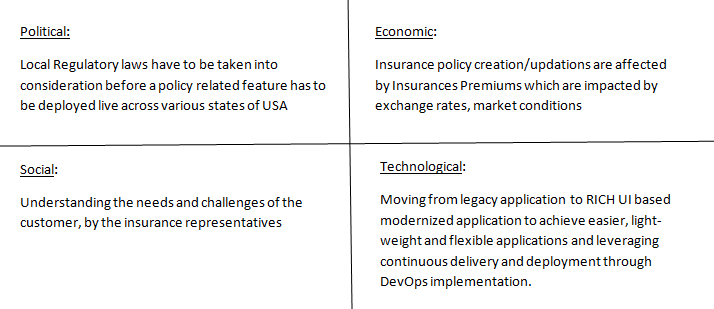
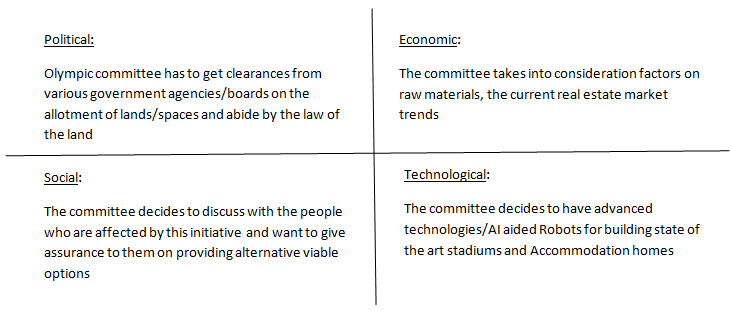
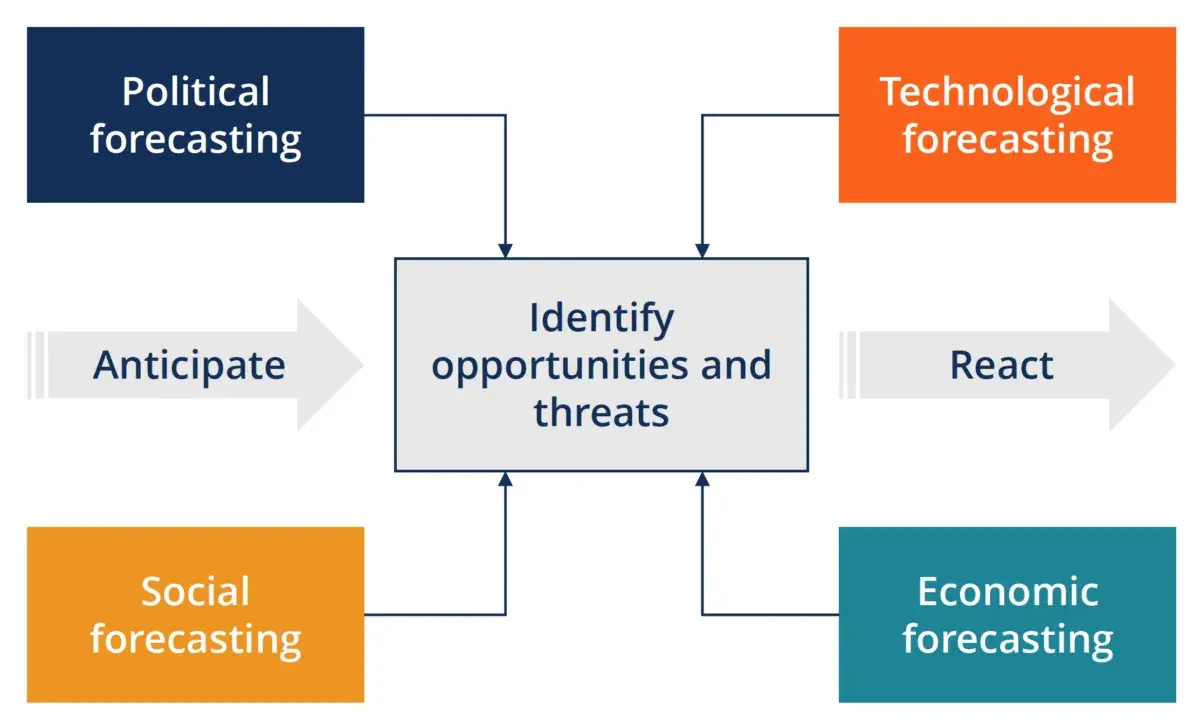
1 pointA PEST analysis brings together four environmental scanning perspectives which serve as useful input into an organization’s strategic planning process: Political: This looks at the political stability, war threats, tax related issues, regulatory issues,labour problems etc.,. Economic: This perspective looks at exchange rates, market conditions, inflation factors… Social: This focuses on health indices(factors), demographics, cultural aspects etc.,. Technological: This provides a view at newer technology developments, rate of technological change, technology cost impact etc.,. Eg1 : An Insurance company in USA makes a PEST analysis for implementing its changes in its product. Eg2: Let us see a hypothetical example. In lieu of the upcoming Olympics, a country’s Olympic committee wants to build an Olympic village which will have accommodations for athletes and several new stadiums for playing various sports / games. Let us see with a PEST analysis as how the committee would strategically plan. Conclusion: PEST analysis can be useful for an organisation, in any industry. It helps in providing a holistic approach to the strategy being devised by the organisation. Source: The CERTIFIED Six Sigma Black Belt Handbook (second edition) by T.M.Kubiak and Donald W.Benbow
 1 point




This leaderboard is set to Kolkata/GMT+05:30