


Mohil mittal
Members
-
Joined
-
Last visited
-
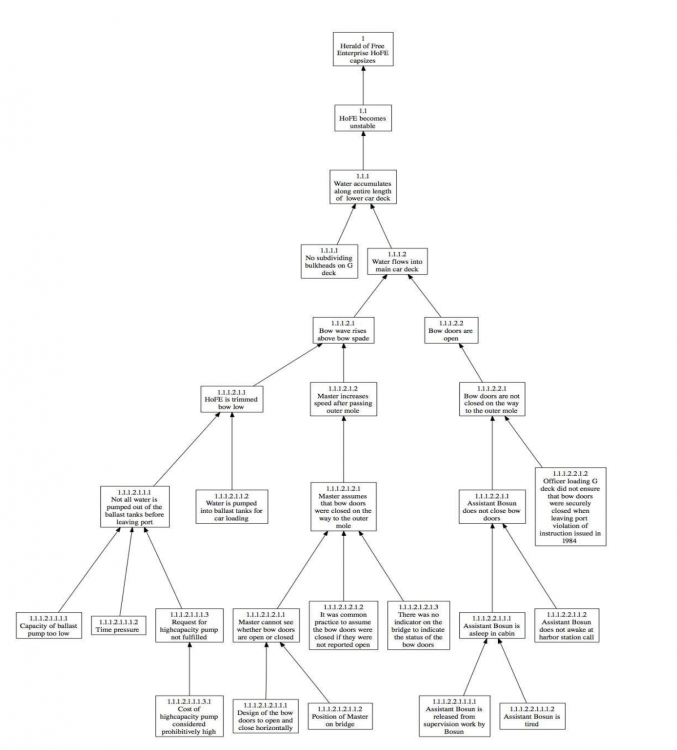
Why because analysis is a method to ascertain the causes for unwanted system behaviour or incidents and is usually represented by a Why Because Graph (WBG). This method is typically used for unexpected system behaviour, mishaps and incidents. The analysis can be made full proof by using Counterfactual Tests which ensures that all the nodes of WBG are rightfully connected. The completeness of the WBG is established through another test, Casual Sufficiency Test (CST) which confirms that "Does the effect necessarily occur, if all listed causes are present?". These tests are not conducted on the entire WBG but is conducted on small sections. It is then extended to the complete WBG. The steps involved in preparing a sound WBG is as under: Information is gathered about the incident and its quality is ascertained The information gathered is further analysed to separate out facts and judgements A list of all the facts is prepared A Why-because list is then prepared which incorporates information about the facts and their relationships A WBG is prepared by listing the unwanted incident/mishap which is normally referred as "top node”. The unwanted incident may not be as easy to define as it seems. It depends upon the purpose for which it is being used. Necessary Casual factors (NCF) acting as child nodes are attached to the facts which are presented in the WBG as nodes. The level of detailing would depend upon the requirement of the exercise being carried out. Further, it is an iterative process and may take time. A Causal Completeness Test is then carried out to ensure that the incident is described sufficiently, and that there are no errors. Note: NCFs are determined either from the facts found in the List of Facts or from the pairs of facts found in the Why-Because List Example- Capsizing of roll-on/roll-off (RoRo) road-vehicle ferry (Herald of Free Enterprise) while crossing English Channel where 189 people died out of 459 people which were on board (Ref:https://rvs-bi.de/research/WBA/TheWBACaseBook.pdf) RoRo road vehicle ferries have bow/stern doors for drive on, drive off loading and carrying vehicles/people over to the other side These doors are closed before the departure to prevent ingress of water. However, the ferry had its door open at the time of departure The bow waver rose over the level of bow spade Water inundated the main deck and went into the lower deck as well The ship became unstable and capsized in shallow water During the investigation following facts emerged The Assistant who was to close the door was asleep in his cabin and did not wake up at harbour call as he was tired The Chief officer who was to examine that the doors are closed before departure thought that he has seen the Assistant going to close the doors The officer who was loading the deck did not check the doors before departure although he was meant to check the doors before departure as per instruction The Captain of the ship always assumed that the doors are locked unless informed otherwise. It was a common practice. The Master assumed that the doors were closed as he went to outer mole (A large solid structure on a shore serving as a pier, breakwater). He could not see the doors closing as they closed vertically and there was no indication on the bridge about their status. The depress the bow to facilitate the loading was not matched with the true level because of time pressure and because of lower capacity pumps. A request for a high-capacity pump had been rejected by management as the cost was considered prohibitive. The WBG of the above incident is as under:
-
PEST an acronym for Political, Economic, Social and Technological is an analysis carried out by companies to scan the market to determine the influence of external factors on its business operations. The Political factors can comprise of regulatory or compliance issues, tax policy, tariffs etc. (e.g. retrospective taxes as applied on companies like Vodafone in India) The Economic factors relate to macroeconomic factors which have a bearing on the businesses like interest rate, GDP growth rate, inflation, and exchange rate. (e.g. devaluation of INR w.r.t USD can boost Indian IT exports) Social factors comprise of demographical aspects, cultural trends, customs prevalent in society which may have a bearing on the consumer behavior and product choices. (e.g. Impact of Covid on cultivating the habit of personal hygiene) Technological factors are linked to innovation in the industry, R&D practices, automation, adoption of IT and other latest trends (e.g. Solar technology has disrupted the power sector and people are now opting for rooftop solar instead of taking electricity from large power generating assets) PEST can be further extended to PESTLE including factors like legal and environmental. These factors and their assessment vary from market to market based on the experience and understanding of the executives. This analysis becomes more prominent when companies are trying to enter new markets in new countries having large geographical distance.

