

Topics
-
Fifty-five women engineering students completed an AI bootcamp focused on rural Karnataka. Participants developed AI-based solutions after visiting villages and conducting field interviews. The She Innovates bootcamp partnered with several organizations to achieve its goals. This initiative aims to boost women's participation in AI and entrepreneurship. It encourages AI applications for rural development and community-focused sectors. View the full article
-
Besi's quarterly orders more than doubled, fueled by AI and hybrid bonding technology. The company saw increased customer adoption of its advanced chip packaging solutions. Demand for AI applications continues to drive growth in data centers. Besi anticipates revenue growth between ten and fifteen percent. This strong performance aligns with other semiconductor sector reports. View the full article



Leaderboard
-
Vinod GC
Lean Six Sigma Black Belt1Points26Posts -
Swarandeep Kaur Juneja
Lean Six Sigma Black Belt1Points21Posts -
RahulGarg
Members1Points28Posts -
Saurabh Gorantiwar
Members1Points10Posts


Popular Content
Showing content with the highest reputation on 08/13/2021 in all areas
-
SWOT stands for – Strengths – Identify current strengths of your Business and reflect on how the current question/problem/decision to be taken, would help in building on those strengths and enhancing your competitive advantage. Weaknesses – It is extremely important to be realistic about the current weaknesses in your business so that during the implementation of a new idea/business decision etc. one can deal with them adequately. Opportunities – Identifying the opportunities external market has to offer is extremely important while analyzing a new idea/business decision, if not this could be detrimental/damaging for the business. SWOT analysis would help the business to seize an existing opportunity in the external market. Threats – Certain external factors can pose threat to existing business or cause problems in the implementation of any new idea/business decision. E.g. new government policies. A SWOT analysis can help you identify threats and ways to counteract them, depending on your strengths and weaknesses. SWOT analysis looks at all the internal and external factors that can affect your business or the decisions that you are taking based on this. For example – For an ongoing Business Excellence Project ABC company has decided to go with the trend and automate some of its processes using RPA (Robotic Process Automation). The objective of the project is to enhance the efficiency of the overall process without any compromises with the quality of the output. Step 1 – Start with a questions in mind – How will RPA help me in achieving my objective? My process would become faster, but with RPA would it also be error free? Are there any particular weaknesses of RPA that we need to ponder on before implementing the solution? Step 2 – To answer the above questions we do SWOT analysis – - Building on Strengths - The value that the current business creates for its customers is that it serves as a one stop solution for all the Small and Medium sized businesses and offer services such as Accounting, Software Development, Marketing, Administration, Medical Billing etc. at the best prizes to help its customers get break through services that only the larger businesses can endow. With RPA current business can build on its strengths as now we could do “more with less”. With limited resources faster and additional work can be done which would give the business a competitive edge and assist it in keeping up with the pace of fast changing market needs. - Minimizing Weaknesses – Employees are used to working in the traditional manner and are not completely exposed to the advancement in technology. Change management would have to be carefully planned out. Trainings could be planned before implementing the final solution to keep the team up to speed with the new technology being implemented. - Seizing Opportunities - Artificial Intelligence, Machine Learning and Robotics, these technologies are widely used in various industries to help humans focus on analytics/decision making rather than regular mundane tasks. Implementing robotics for some of the existing processes in the company would help team focus on analysis and important decision making rather than processing regular documents on a daily basis. This would also help the management get more business with limited resources and would have an overall positive impact on the growth of the company. - Counteracting Threats – The current business model demands data to be move from one country to another. Conflicting data privacy rules between the two nations could cause problems in implanting Robotic Process Automation to the existing processes. Current policies such as GDPR (General Data Protection Regulation) needs to be looked into and concrete analysis is to be drawn in order to proceed with hassle free implementation. Step 3 – Further SWOT analysis can be done on any individual issues highlighted in the high level SWOT analysis, such as the one about GDPR (General Data Protection Regulation) and conclude the final analysis with a list of implementation steps and the control plan.1 point
-
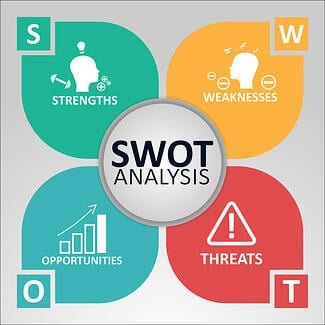
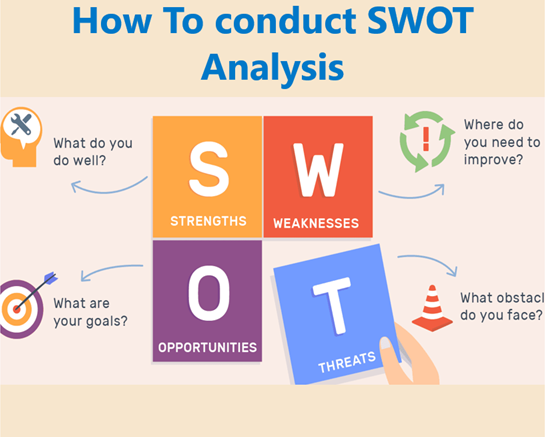
SWOT stands for Strengths, Weakness, Opportunities and Threats. This technique is strategic tools for accessing business in these four aspects. As you access your business in these areas, It support what you have and use for the advantages of the business and you can focus on the reduction of hazards which may create a challenge to your business. As uses by business to analyze the current scenarios and to plan the upcoming strategy . You can identify what is in favors of business, what are not favorable and how to achieve it. To drive all these ares SWOT analysis is perfect tool. To perform SWOT Analysis , It should be done in 2 X 2 Matrix. Each matrix has an area for S , W , O and T. First Matrix is ‘S’ – It stands for Strengths. In this matrix , You should focus on the area where you are doing better. In this area you may be doing better than your competitors. In this area you should always focus on your USP (Unique selling point). When you focus on strength ensure that it is real strength not a mere requirement. You can put example like your process , your quality , Cost etc. Second Matrix is ‘W’ – It stands for Weaknesses. In this matrix, You should focus on the areas you need to improve. In this area Honesty is the best policy. In this area when you compete yourself with your competitor that makes you behind. You can also take view from other stakeholder how they see you as compare to competitors. And then thinks the areas which you could improve or avoid the current practice. Third Matrix is ‘O’ – It stands for Opportunities. Opportunities are the situation which might happen and may give you a positive benefits and you can grasp them. These are usually happens outside your area and you need to focus on it . In this matrix you can collect all these areas. You can focus on new development in market , New Government policy or any major market strategies which may support your business. Fourth Matrix is ‘T’ – It stands for Threats. Threats are the situations happens outside your business which can give negative effects. These are the obstacles that you face for your business to perform. In this matrix you need to collect all the threats and take a suitable action on the same before it arises. Here you can also focuses on your competitors but do not do what they do. Keep your focus on the solving or reducing the impact before it arise. The situation like New technology evolve, Future supply chain problem , Natural calamity affecting the process , Pandemic scenario , Labor challenges. These can be an example for Threats in business. How to you use it in business excellence. The major advantages of SWOT analysis is to provide input to the business excellence team and transform the Business. These are some of the areas where we can use SWOT for business excellence. 1. Business excellence team can structure to their working philosophy with SWOT of overall business. 2. SWOT will give input for business excellence team for driving improvement. 3. It help business excellence team to determine initiative and Project. 4. Team can also use SWOT analysis approach for input generation during start of the project. 5. This can be used inline with VOC-QFD analysis for generation of major Areas for development of Long term plan. 6. Business excellence team can also use SWOT analysis for re-design the process and make the system more Agile to face a future challenge. Conclusion SWOT analysis in one of the best strategic tool use for business as Good business must be competitive. This Analysis help us to visualize the AS IS scenario of the business and support to be work on it. This analysis is not restricted to the business. We can use SWOT analysis for Personal development ,Employee development , Business Process Management. The beauty of this analysis is we can think what stop us to improve and how we can improve in 2 X 2 Matrix.
 1 point
 -
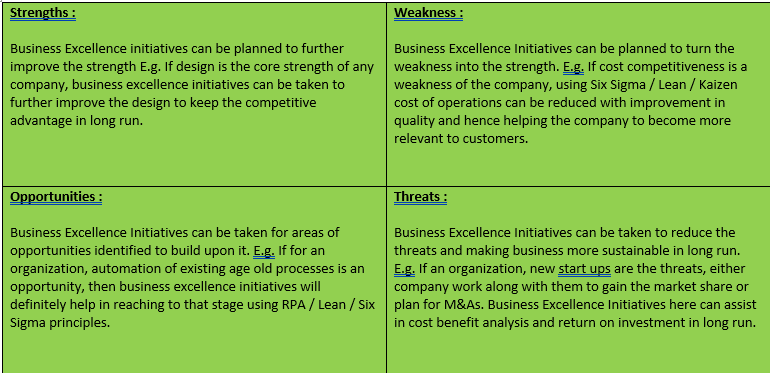
SWOT (Strengths, Weakness, Opportunities & Threats) Analysis is a very important and widely used tool in strategic planning across major multinational companies for doing the high level analysis with their competitors. This tool may help a person, team, organization and at all the levels to analyze on : Strengths : What you do well and give you an advantage over the others Weaknesses : What you don’t do well and put you at weak position compared to competitors Opportunities : Elements available in the environment which you can use to gain competitive advantage over the others Threats : Elements present in the environment which may cause troubles for the company in long run. Pictorial Representation of the Tool : Where this is tool is primarily used ? i) Strategic Planning ii) Corporate Affairs Planning iii) Marketing strategy Planning iv) New Products Launch v) New Mergers and Acquisitions vi) New Campaign Launch vii) New Policy Deployment viii) New Customer Segment Penetration etc. Limitations : i) SWOT Analysis may act as a starting point for strategic building overall, but does not tell us how to gain the competitive advantage. ii) In the rapidly changing environment, it may be challenging to perform and adhere to SWOT analysis with long horizon. iii) Sometimes putting too much focus on one strength may take the focus out from the weakness E.g. Focusing more on cost part may bring the quality down. iv) It may result in generating the too many ideas and put the one in dilemma which one to use v) This method does not prioritize the issues Example of SWOT Analysis in my company (a software major and IT giant) : How SWOT Analysis can be used for Business Excellence Initiatives? SWOT analysis can be used to identify the Strengths, Weaknesses, Opportunities and Threats of a particular business / domain / vertical / segment etc. and accordingly six sigma interventions can be planned in those areas as shown in below grid : Famous Companies used successfully SWOT Analysis to gain competitive advantage or even gained using it : Other popular tools / techniques similar to SWOT : PESTLE Analysis, Porter 5 forces Model, SOAR Analysis, Noise Analysis etc. So we see here SWOT Analysis lays the foundational stone for the Six Sigma initiatives and good and proactive organizations / companies with great vision build upon the areas surfaced out post SWOT analysis by their Business Excellence initiatives to gain the competitive advantage in short as well as in long run !

 1 point
 -
I. Introduction: SWOT analysis is a very simple, yet powerful framework / tool used to evaluate an organizations Strengths, Weakness, Opportunities and Threats. SWOT evaluates, internal / external factors along with current and future potential. This framework was invented by Albert Humphrey a management consultant, in the 1960’s at the Stanford Research Institute. II. SWOT explained: a) Strengths (Internal, Positive): Describes the company’s strengths which separates if from its competition that can be used to maximise the identified opportunities. Examples could be, the brand value, customer base, technology and so on. · Things the company does well · Qualities that separate the company from its competition · Internal resources such as skilled / knowledgeable workforce · Tangible assets like propriety technology, intellectual property etc. b) Weaknesses (Internal, Negative): Any internal factor that prevents an organization from performing at its best which needs improvement to remain competitive. Examples are, bad debt, supply chain issues, lack of funds etc. · Things the organization lacks · Stuff the competitors does better · Limitations on resources · Uncertain USP (unique selling proposition) c) Opportunities (External, Positive): These are external factors that are favourable which could give a competitive advantage. Examples include, tariff cuts, increasing market share, new markets etc. · Underserved markets for certain products · Fewer competition in the area · Emerging need for product / services · Media coverage d) Threats (External, Negative): External factors that have the potential to harm a company. Examples are natural calamities, inflation etc. · Emerging competition · Unstable regulatory policies · Negative media coverage · Changing consumer attitudes III. Steps to conduct a SWOT analysis: IV. A sample SWOT analysis for a restaurant: V. Advantages and Disadvantages of SWOT: Advantages Disadvantages Helps condense large amount of data into manageable chunks Sometimes leads to oversimplification Single tool can describe four critical areas It is not always objective Wide application – can be used by any organization No limits in place (relevance) Simple / low cost Unknown factors may influence outcomes Terms used could be vague, or even meaningless No obligation to verify VI. Application in Business Excellence initiatives: Effective and efficient businesses processes are required for companies to stay competitive. The current digital era is demanding organizations to re-design and improve processes with agility and help achieve the strategic objectives. SWOT analysis framework can be used to understand the AS-IS state by studying the strengths and weaknesses that are internal to any business / process and develop the TO-BE state by developing strategies capitalizing on the opportunities and overcoming threats which are external. When the outcome is combined with other tools, SWOT can help in identifying transactional and transformational improvement projects aligned to goals the organization. SWOT can also help identify the strengths of the people, process, and products relative to the improvement initiative which could be tangible and intangible factors. Likewise, the weakness factors of people, process, and product that prevent from delivering value could be identified. Opportunities can be considered as the targeted improvements which could be internal or external. Threats can be looked upon as the effect or consequences if people, process, or product is not improved.

 1 point


This leaderboard is set to Kolkata/GMT+05:30