

Topics
-
AI News from ET - AMD to invest up to $5 billion in Anthropic; AI startup to buy up to 2 GW of chips
AMD has been seeking to expand its foothold in the fast-growing AI chip market as developers look to diversify beyond Nvidia, while Anthropic has been racing to secure computing capacity to meet growing demand for its AI services. View the full article -
A Meta Platforms lawsuit claims AI tools unfairly targeted employees for layoffs. Workers face difficulties proving AI discrimination due to limited access to internal processes. Arbitration agreements often prevent collective legal action and public scrutiny of workplace disputes. These hurdles explain the scarcity of high-profile AI employment lawsuits. Meta denies using AI for layoff decisions, stating humans made all choices. View the full article



Leaderboard
-
subodh tripathi
Members1Points9Posts -
Vikram Kenjale
Members1Points1Posts


Popular Content
Showing content with the highest reputation on 02/12/2021 in all areas
-
1 pointDiffusion of Innovation (DOI) is a theory popularized in 1962 by Everett Rogers, the American communication theorist and sociologist, which seeks to understand how, why, and the pace at which a product, service, or process spreads through a population or social structure. The diffusion of innovation, in other words, describes the pace at which new ideas and technologies spread. Marketers extensively use the diffusion of innovation theory to consider the pace at which customers are likely to embrace a new product or service. The introduction of a new product, service or concept is not an instantaneous phenomenon; in a social environment, it does not occur equally among all individuals. Consumers who accept an innovation earlier exhibit different characteristics than those who embrace an innovation later, according to studies. Therefore, recognizing the features of each segment that will either assist or impede the acceptance of an innovation is critical for marketers. There are five adopter groups in the diffusion of innovation theory: 1. Innovators: Characterized by those who want creativity to be the first to try it. 2. Early Adopters: Characterized by those that are comfortable with change and new concepts that are embraced. 3. Early Majority: Distinguished before the average citizen by those who embrace fresh technologies. However, there is a need for proof that innovation works before innovation is implemented in this category. 4. Late Majority: Characterized by those who are wary of change and would only embrace an idea after the majority of the population has generally embraced it and adopted it. 5. Laggards: Characterized by those who are very traditional and conservative – they are the last to make the changeover to new technologies. This category is the hardest to appeal to. The distribution of the five adopter groups is given by Rogers as follows: innovators account for the first 2.5 percent of the group to embrace an invention, followed by 13.5 percent as early adopters, 34 percent as early majorities, 34 percent as late majorities, and eventually 16 percent as laggards. Notice that the size of the category of laggards is much greater than that of the category of innovators at the opposite end of the continuum. Let's look at each type and how they vary from one another: 1. Innovators: Those who want to be the first to acquire a new product or service are innovators. They are risk-takers, price-insensitive, and have a high degree of volatility to deal with. For the success of every new product or service, innovators are crucial as they enable it to gain consumer acceptance. For example, innovators are considered to be people who stay overnight outside a movie theatre to be the first to buy the first show for a movie. 2. Early Adopters: Early adopters are those that are not quite as risk-taking as innovators and usually wait before making a purchase for the product or service to receive some feedback. Early adopters are referred to as "influencers" or "leaders of opinion" and are also considered within their social structure as role models. They are important in helping to reach "critical mass" in the spread of a product or service. Consequently, if early adopters of a product or service are limited, it is possible that the total number of people who accept the product or service will also be small. Early adopters are known to be individuals who wait a few days and spend some time reading reviews before going to see a movie. 3. Early Majority: The rest of the market reflects the early majority, 34 percent. The early majority are not risk-taking and usually wait until a trusted peer checks or uses a product or service. These people are cautious and want to buy stuff that is known to work. Early majorities are people who go to a movie after it's been out for weeks and received positive reviews and made money at the box office. 4. Late Majority: A large proportion of the market, 34 percent, also reflects the late majority. The last big group of customers to enter the market is the late majority. When making a purchase, they are considered conservative and are often technologically shy, very cost-sensitive, cynical, and cautious. Furthermore, the late majority is often forced by peers to buy the product or service. People who are waiting to make a movie available online or on Netflix are known to be the late majority. 5. Laggards: The last to accept a new product or service are Laggards. They resent change and may, until they are no longer available, continue to rely on conventional goods or services. In other words, when practically compelled to do so, they usually only accept the latest technology. Laggards may eventually catch a hit movie on network TV when it's shown. The diffusion of the theory of innovation describes the pace at which a new product or service will be accepted by customers. The theory therefore helps advertisers understand how patterns arise, and helps businesses determine the probability of a new introduction's success or failure. Companies can anticipate which categories of customers will buy their product/service and build successful marketing campaigns to drive acceptance into each category by using the propagation of innovation theory.1 point
-
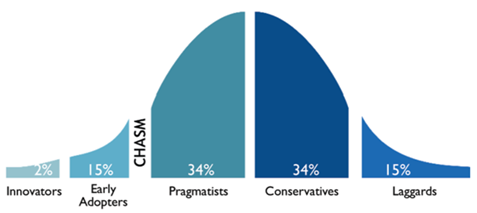
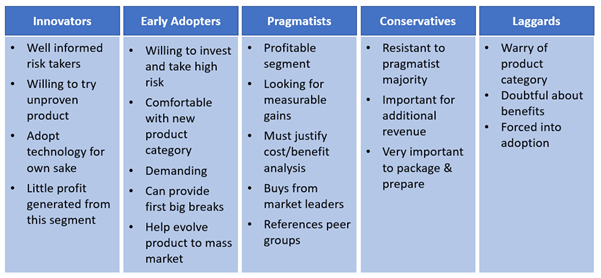
1 pointDiffusion of Innovations This theory by Everett Rogers explains how a new idea, product, technology or behavior gains a momentum and spreads over the time through specific set of population or social system. The end result of this diffusion is that people, as part of a social system, adopt a new idea, product, technology or behavior. Adoption means that a person does something completely different to what they had previously (example buy a new product etc.). The key to adoption is that the person must perceive the new idea, product, technology or behavior as new or innovative. Adoption of a new idea, product, technology or behavior (i.e. innovation) does not happen at the same time in a social set up. Some set of population adopt an innovation early while others take longer time for adoption. The people who adopt early have different characteristics than people who adopt later. There are five adopter categories viz. Innovators, Early Adopters, Pragmatists (Early Majority), Conservatives (Late Majority) and Laggards. The typical spread for these categories is shown in the graph below; The characteristic of different adopter categories as follows; Hence, while promoting an innovation, there are different strategies used to appeal to the different adopter categories. As per Geoffrey A. Moore, in between Early Adopters and Pragmatists lies a chasm. This is mainly because the both these adopter categories represent very different expectations and for crossing the chasm, detailed deliberate efforts are to be made by choosing a target market, understanding the whole product concept, positioning the product, building a marketing strategy, choosing the most appropriate distribution channel and pricing. Sources : a) 280 Group OPP, b) Boston University School of Public Health
 1 point
This leaderboard is set to Kolkata/GMT+05:30