

Topics
-
Fifty-five women engineering students completed an AI bootcamp focused on rural Karnataka. Participants developed AI-based solutions after visiting villages and conducting field interviews. The She Innovates bootcamp partnered with several organizations to achieve its goals. This initiative aims to boost women's participation in AI and entrepreneurship. It encourages AI applications for rural development and community-focused sectors. View the full article
-
Besi's quarterly orders more than doubled, fueled by AI and hybrid bonding technology. The company saw increased customer adoption of its advanced chip packaging solutions. Demand for AI applications continues to drive growth in data centers. Besi anticipates revenue growth between ten and fifteen percent. This strong performance aligns with other semiconductor sector reports. View the full article



Leaderboard
-
Vishwadeep Khatri
Administrators3Points6,722Posts -
Jayaram T
Members1Points17Posts -
Natwar Lal
Members1Points50Posts


Popular Content
Showing content with the highest reputation on 10/23/2019 in all areas
-
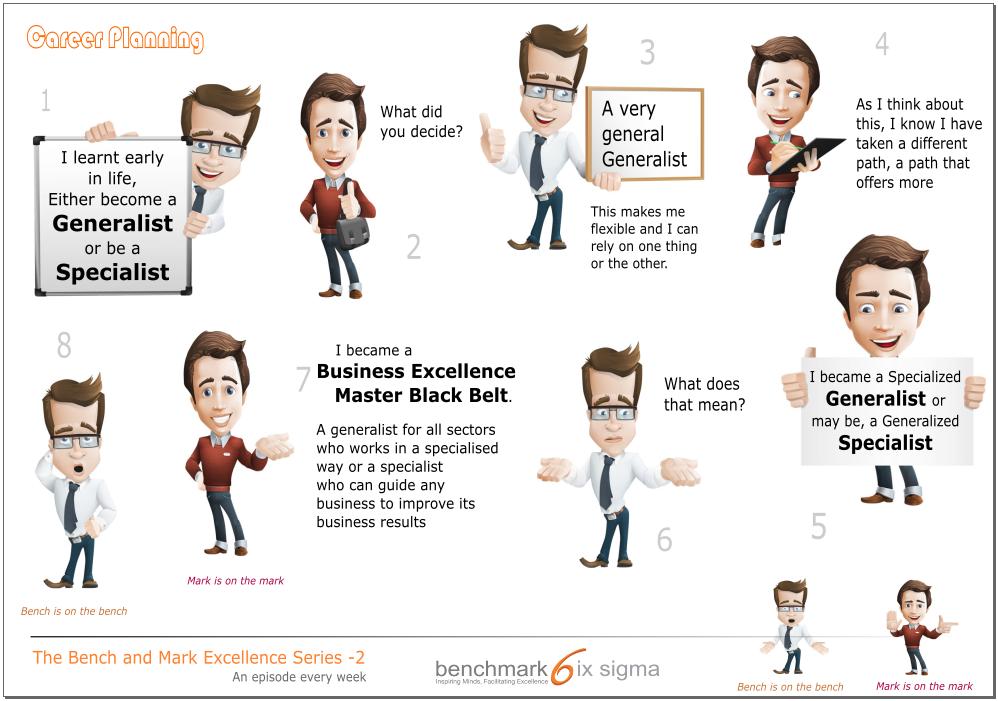
3 pointsDescription - Bench happily highlights that while planning his career, he had considered the choice between being a Generalist or a Specialist early in his life. Mark wants to know about the decision that he took. Bench says that he decided to keep options open for himself and proclaims himself as a "very general Generalist". After listening to Bench, Mark says that he has realized that he has taken a path different from the two options. He considers himself as a "specialized Generalist" or what can be considered as a "generalized Specialist". Bench want to understand what this means. Mark explains that he is a Business Excellence Master Black Belt. He calls himself a generalized Specialist as he specializes in problem solving which he can do in any sector. He further explains that he could be considered a generalist too as he can work with large variety of processes but in a specialized way. This cartoon depicts that Lean Six Sigma and Business Excellence competencies allows one to be specialized without dependence on a specific industry or functional domain.
 3 points
 -
1 pointA Tollgate Review, as the name indicates, is like a checkpoint in a Six Sigma project at which the various team members meet and determine whether the work has been performed as indicated in the project plan and whether the objectives mentioned have been achieved. Here are some of the key factors to be considered while planning a tollgate review to ensure the review is effective and the project moves forward as planned. 1. Tollgate reviews to be planned in advanced and timelines to be adhered as planned, Review cancellation or rescheduling should be avoided 2. Attendance must be made compulsory for the reviews and scheduling should take care of availability of all stake holders 3. Top management should be part of the program right from project selection till closure and they should be part of all reviews 4. The reviews should have a clear agenda and discussion should be confined only to the agenda points 5. Chairperson of the meeting should ensure all participants are given chances to voice their opinion 6. Chairperson should steer the meeting in such a way that the opinions are taken in positive manner by the functional representative. 7. The points need to put forward as support required rather than a complaining mode 8. Every action discussed in the meeting should be aligned to a single owner and time lines (as agreed with the action owner) 9. All actions need to be governed and closed 10. Support required from Senior management should be explicitly discussed and required actions to be taken 11. Meeting has to be minuted and circulated with clear mention of actions / action owner and dead line. 12. The status of previews review meeting has to be discussed first in the next meeting.1 point
-
1 pointOne of the reasons for project failure is 'Lack of Planning' and this not only includes planning for what one is going to do in the project but it also involves planning on how to check that the project is on track. Doing effective tollgates is an excellent mechanism to check the progress and ensure that project is still on the right path. For the tollgates to be effective, one basically has to seek answers to 5W and 1H (What, Why, Where, When, Who and How) Let us look at each element in slightly more detail 1. WHAT - Determine the requirements. What is the purpose of the tollgate? What is the information / artifacts that are required? What questions have to be asked? 2. WHY - Determine the objectives of the tollgate. Why are we doing tollgate? Why is it important to do the tollgate? Is the purpose only to review or also to approve? 3. WHERE - Determine the logistics of the tollgate. Where are we doing the tollgate? 4. WHEN - Determine the frequency, duration of the tollgates. When should the tollgates be set up during the project lifecycle? 5. WHO - Determine the participants in the tollgate. Who should be presenting the progress? Who should be audience during the tollgate? Who should be asking the questions? Who is going to take down the action items and meeting minutes? 6. HOW - Determine the decision criteria for acceptance / rejection of the tollgate. How are we going to judge the success of the tollgate? How many tollgates are required in the project lifecycle? If the team has thought through the above indicative questions, the chances of having an effective tollgate increases manifold. An effective tollgate will have following benefits 1. Keep the project team honest and true to the project objective 2. Ensure that scope, cost and schedule creep DO not happen 3. Effective communication across various levels in the organization (as the sponsor and/or other stakeholders may not be too close to the project) 4. Any issues / challenges are brought to notice at the right time and to the right people so that solutions could be identified1 point
This leaderboard is set to Kolkata/GMT+05:30