Sanju
Members
-
Joined
-
Last visited
Everything posted by Sanju
-
Cherry Picking is not always helpful in Continuous Improvement projects selection, Sometimes you miss the real picture or the issues the organization dealing with. For example, In general Every company focus to reduce the operating cost , means if you take Continuous Improvement projects related to Yield improvement , Energy management & other Variable & fixed cost reduction Projects means DMAIC projects will worked well & good savings will be Achieved this time Cherry Picking works Positive in favor of you if Company is actually dealing with these issues. But sometimes for any Company new Product development or Business expansion will be the first need then Projects mentioned above will not help, Purpose of right kinds of Project selection will get defeated, Actually that organization needs DFSS/DMADV Projects in Priority than DMAIC, So in this case Cherry Picking works Negative against you. So we need to refrain from Cherry Picking & Investigate into the challenges company is facing & then select projects accordingly.
-
Trystorming is a blend of brainstorming merged with rapid prototyping to determine if ideas will work quickly or not. The key process steps includes: · Come up with at least some ideas through brainstorming/sketching · Reduce them down into top three ideas · Go on Simulating them to test their workability & its effectiveness · Morph or combine ideas until you reach a best outcome · Put the concept into your business Process and repeat the process as needed It is used in those areas where Innovation & fast results are needed with low cost solutions. It is based on the Philosophy of Fail fast & Fail Cheap that means Generate some Innovative Idea Develop the Prototype with low cost & test it Quickly to know its Success or Failure. It is widely in used in Manufacturing Industries, where sometimes you need quick & Innovative solutions with low Cost.
-
Competency Mapping is processes of recognizing the key competencies for an organization and/or a job and incorporating those competencies throughout the various processes (i.e., job evaluation, training, recruitment) of the organization. It generally examines two areas emotional intelligence/emotional quotient (EQ) and strongness of the individual in areas like team structure, leadership, and decision-making. Key steps of Competency mapping are : · Identify the department of the Organization for which competency mapping needs to be done · Identify the organizational structure and list down the grades and levels present in the organization · Perform the job analysis and prepare a job and role description · Collect the data about the core competencies of the employee · Classify the obtained data into required skill set and current identified the skill levels · Evaluate and share the identified skill set with immediate supervisors and heads of other departments · Prepare of competency matrix · At last Mapping of competencies to be done
-
Inverted U theory enables you to understand the relationship between pressure and performance. The result will be that you'll get the finest results from a happy and engaged team! When people feels the right amount of pressure, they often perform brilliantly. But, if there's too much or too little pressure, performance can suffer. The Inverted-U Theory gets its name from the curve created when the correlation between pressure and performance is shown on a graph below. The left hand side of the graph, above, shows the situation where people aren't being challenged. Here, they see no motive to work hard at a task, or they're in danger of approaching their work in a "sloppy," unmotivated way. The middle of the graph shows where people work at peak Productiveness. They're Satisfactorily motivated to work hard, but they're not so overloaded that they're starting to struggle. This is where people can experience "flow," the Pleasant and highly productive state in which they can do their best work. The right hand side of the graph shows where they're starting to crumble under pressure. They're engulfed by the volume and scale of competing demands on their attention and feeling a serious lack of control over their situation. They may exhibit signs of hastiness , stress, or out-and-out panic. The Project Leader can use the Inverted-U Theory while allocating tasks to the people in its team and planning his own task/work also. Start by thinking about existing pressures. If you're feel that someone might be at risk of overload, see if you can take some of the pressure off them. This helps them to improve the standard of their tasks/work. And, if anyone is underworked, it may be in everyone's interest to shorten some deadlines, increase key targets, or add extra responsibilities but only with clear communication and agreement. Try to provide team members with tasks and projects of right level of complexity, and work to build confidence in the people who need it. Also, manage any Pessimism in your team, and train your people so that they have the skills they need to do the jobs they're given

-
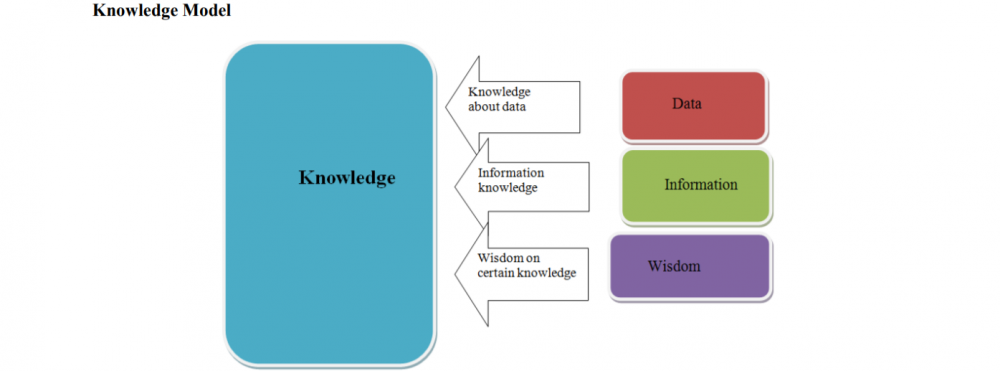
The biggest gap in the journey is to put the Knowledge in the Hierarchy level as per DIKW model. Placing knowledge in a hierarchy reduces its potential and gives the feeling that knowledge is much less to wisdom which results from it not given its full value. Knowledge is more creative, complex and far more disjointed therefore placing it in a form of a hierarchy limits its capabilities. Qualitative Criteria should be considered in knowledge management since knowledge is difficult to define and to measure beyond any dispute. The DIKW model does not take a holistic approach to knowledge management. Solution to this that knowledge cannot be put in a hierarchy as for everything to function there is need for knowledge. Knowledge is found at every stages, Process & Part level . It should be the nerve of organizations as without it organizations will not survive. Knowledge should be considered as per the below Approach.

-
Cellular manufacturing consists of a series of product‐focused work groups called “cells” which contains all operations to manufacture a family of products. The cell is committed to manufacturing those products requiring similar operations. Role of Cellular Manufacturing in Minimizing waste • Cells reduces the distance a part or product has to move. It reduces materials handling costs, enables quicker response on potential quality problems, reduces Work In Process inventories, helps in easier scheduling, and reduces Lead time. • Cells arrange the locating of materials at the point of use. This makes it easy to see the work ahead. • Cell teams have Good Knowledge of the whole process of making parts/assemblies.
-
Grounded theory is an inductive research method, Grounded theory helps to discover or construct theory from data, systematically obtained and analyzed using comparative analysis. While grounded theory is intrinsic flexible, it is a complex methodology. when conducting experimental research, we normally start from a predetermined theory, typically in the form of one or more hypotheses, we then conduct experiments to collect data and use the data to prove the theory. But grounded theory emerges from a set of empirical observations and systematically collected data and we aim to develop a well-grounded theory from these data.
-
Knostner Model is the change management model which is used for managing the Complex change . As per the model the key elements required for the effective change are Vision- Why is change needed? Is the vision shared to the people and are people buying in? Skills- What skills are needed? Do team members have expertise or training in what they are being asked to do? Incentive- How this change will add value? Incentives can be monetary or personal achievement or prestige Resources- A lack of resources make people Annoyed. What resources are readily available? Are they appropriate? Are there in-house people who are resources? Action plan- The action plan for change should be clear and developed by all stakeholders. Key Benefits of the Knostner model are · It gives us a structure to shape our communications to end users and stakeholders to motivate and activate the change we desire · It gives us a way to concentrate where the experience is lacking when we get unexpected or undesirable reactions Missing of the any of the these elements can cause False starts, Frustration, Resistance, Anxiety & Confusion as shown

-
Catchball is the technique for creating & maintaining the open feedback loops across all the levels of the organization by establishing the two –way Communication platform. Under this Top Management set the strategic goals & the proposed strategy and toss to the the lower level like the ball & take the feedback & their Views, After several looped discussion they come to the common Consensus. Similarly Middle level Management tosses the goals to the lower level management (Team leaders, Engineers, Supervisors etc) & repeat the same process until ‘the ball/Goals’ has been reached at the person which is at the bottom. Ultimate Aim is that every person who will be working towards the company Goals should provide their Input & their actions should be aligned in common direction which are fulfilling Company Goals & Priorities. Key Enablers for Catchball Process Every should be a part of the Process , you must not miss any member or skip any level Every Person should be given enough time to Investigate the Plan & to provide feedbacks & data before Passing the ball to the next team member or returning to you Make people Understand that they are one team & their every small suggestion will be respected & encouraged Person holding the ball must take the ownership of their ideas & suggestions, So make sure a s a team they should be executed if accepted by the team Key Benefits of the Catchball Process Increase of information sharing across all the levels of the Company Every Persons actions are aligned as per the goal of the Company It increases the Continuous Improvement culture inside the organization

-
The term "low-hanging fruit" is a commonly used to describe the simplest & easiest work or a quick fix that produces can produce detectable Results. Risk of identifying & addressing the low hanging fruit task in define phase is that Once you done these task some moderate results will come but this can make the team Complacent, Team will not focus well for the other phases in Project And Even Importance of follow the each phase will get dull And Most Important if the Team will not rigorously follow the each phase of DMAIC, their ability to solve Complex Problems we will not develop, So in Complex projects they will fail miserably, Such Complex Projects will be dropped or remain unfinished in any Organization.