


Sundeep Kailwoo
Members
-
Joined
-
Last visited
-
Sundeep Kailwoo replied to Vishwadeep Khatri's topic in We ask and you answer! The best answer wins!AI solutions and the benefits we reap, and measure would depend on various factors as to how an Organization or a functional team would want to measure them , as the results and outcomes should align to the OKRs (Objectives and Key results) of the stakeholders and delivery owners. Speed , Accuracy , Productivity , Efficiency are some of the generic but relevant KPIs that can be measured ant an overall level , but these high level Metrics will have to be broken down to relevant KPIs that define a functions performance and that off an organisation. No if we elaborate on these generic Metrics to an organisation operating in a particular Industry and then a Functional Team operating within the Organization , these Metrics will have to be defined and tracked to establish that AI deployment was an actual Value add vs another fancy tool that everyone wants to flaunt. Case Study – Metric - Speed At an Organisation Level – An employee attendance correction tool, that address specific queries and provides resolution steps, can help speed on organisational Metric targeted towards improving Employee experience on this crucial process as a delay or an error can impact the accurate payout for an employee. With Agentic Bot workflow that can provide and rectify those errors , would help an organisation deliver on their Commitments to their employees with a reduced TAT. That’s where an AI deployment will deliver on Speed measured in TAT (Turn Around Time) KPI. Its easy to track , benchmark vs the pre and post deployment periods and can be communicated objectively to the stakeholders. At a Functional Level – In a CX experience organisation , AI integrated into the case documentation process ( an Essential Non Value Add activity) can speed up the process for experts capturing what was delivered during the transaction, which can speed up process to handle a transaction measured in Terms of AHT( Average Handle Time ) KPI. Speed in terms of Lower AHT, handling a call in less time for customers can help elevate the customer experience with the company and their product support and helping the agents meet their AHT Targets. These KPIs can be measured and tracked for Value over a period of time and can be converted to a $ Value ultimately. Case Study – Metric – Productivity At an Organisation Level – AI Tool integrated into the Staff planning and forecasting processes , highlighting the opportunity areas and gaps from previous runs can help in precise and accurate planning for near future , avoiding unnecessary bench and nonproductive roles in an organisation. Planning for Floating periods and optimizing the hiring windows. With the identified solutions around hiring and staffing , AI tool not only provide value from optimizing the current headcount but also help in avoiding hiring costs , that otherwise may have been difficult to avoid. Hiring Cost Saves resulting into better productivity management can be easily converted to $ Save value for an organisation. At a Functional Level – In a Contact Centre environment from operational delivery enablement , AI Agents deployed to help experts deliver quick , accurate and expert support during a transaction , helps overall operations to deliver an elevated experience to the customers , deliver the organisation on SOW agreed KPIs and even win more Volumes from the Clients basis the capacity they create in this hybrid model with AI and Human in loop processes. Improved productivity creates capacity which in turn either can lead to efficiency gain or more business , all these KPI can be correlated to Value being derived from AI deployment. In conclusion , its essential we identify the right strategic goals while we deploy AI in our processes and define the OKRs that the initiative aims to achieve through measurable KPI which will help in tying back the value delivered through AI.
-
Sundeep Kailwoo replied to Vishwadeep Khatri's topic in We ask and you answer! The best answer wins!AI models and tools gained popular prominence and rapidly became mainstream in short span of time due to their speed in churning out multiple / alternate solutions with a fair degree of accuracy and relevant output for the queries input. With Time and fine tuning the models improved in the information and output accuracy drastically while still maintaining the rate of speed at which they responded to the prompts. While the AI LLMs prime advantage is speed and time save, not all prompts and queries do lead to the desired output when a user is expecting an extremely specific rules based and policy driven response. Not every time these models will have the access to the non-public information and when AI tools are deployed in an organisation to assist and lead processes which are predominantly expert driven, the AI responses initially will have to be carefully evaluated and vetted for before the results can be published to the consumer of the end results, which can be ant any level of an Organization’s hierarchy, from a First line Agent to the CEO of the company. In such situations where AI models are restricted with the information available that they are trained on and general LLMs , and then tasked to model solutions to a unique query with the expectations for a specific result , we may have to model our Solutions where accuracy over speed is preferred and mandated from an output perspective. Taking an Example from the CX experience as a case study, where slowing down an AI may be the optimal strategy and makes a more practical decision than to solely rely on AI for speed. Case study- A Fintech Organization CX experience department servicing the Tax and Payroll queries for its end users. - When an AI agent is deployed to answer some of the most common queries that are based on industry standards and industry protocols and are applicable to the organisation in question , AI models should be able to provide the most latest and accurate information and help the agents to speed up the delivery of the resolution to the customer. The AI Chat bots that can deliver a resolution to a certain degree of freedom and assistance , can only provide limited assistance to the end user or to a human in Loop if the resolution still needs vetting , to avoid repeat queries from the customers - Vs when we are integrating the AI agents into our knowledge base and CRM tools from E2E customer assistance with a Human in loop , the models will have to the based on SLM where the AI model are structured to navigate through the pre-feed Internal Rules , interlinkages, their impact on each other and company policies that may run into complex interpretations when it comes to providing a final output to the customer. In this model , a single prompt response may be disabled to make sure the AI Model interprets the information available to them from the General industry specific information and then map it to the specific product , process , service that a particular organisation is providing to the customer. - AI Models may not be only required to interpret just Policies and rules, but the Pricing, Exemption approvals or denials, the issues/s a customer may be facing before they can churn out a response for the end user. - That’s where the speed will have to compromised for the good of the effective utilization of an AI tool to delivery an experience that Customer called for from a resolution perspective and from a first time right and simple enough for any user to interpret the solution an AI model is providing to them. - There is still an opportunity for AI models to interpret the user query to provide a response that is applicable to a layman. - Navigating through these challenges and effective deployment of integrating AI into a CX experience delivery model ,is where slowing down an AI response across multiple query stages and with Human in loop to review the final output , may serve best for the Client , Delivery partner and the end user.
-
Sundeep Kailwoo replied to Vishwadeep Khatri's topic in We ask and you answer! The best answer wins!When AI Speeds Up Decisions, Do We Risk Making Worse Ones? AI and its applied models built will enable decision-making options and iterations to be easy and accessible to fairly large and non-expert domain stakeholders as well. That also throws up a situation where AI-driven decision-making removes the silos for decision-makers but also drives a question , where a particular unconscious AI-driven bias can lead the decision-maker to align with solutions that may bypass an expert-driven tool gates necessary to safeguard from such biases and irrelevant benchmark KPIs. While AI solutions and processes are lightning-fast vs a Human expert engaged to deliver the same. AI solutions if modelled on unsupervised learning with the base supervised models not authenticated and validated for their accuracy and precision judgement for the data it is handling , the AI output may throw up the below scenarios that, if not identified and made mainstream, can be catastrophic for an organisation's process, certainly in the short term but can have long-term repercussions. Scenario 1: Fear of Missing Out – When committed to make an AI shift and drive the initiatives , stakeholders and decision makers may want to enable most of the processes by AI and not seen to be left behind in the industry and in their functional roles. At times, the promptness to be Deliver AI first leaders , can lead the decision makers to become oblivious to some of the side impact their decisions may have , if not felt immediately but over a period of time. Some recent examples of Tech Giants (FAANG) in a race to roll out the latest GenAI models have faced scrutiny from the experts for either providing biased , inappropriate or hallucinated responses to the most basic queries around historical and world events, landing organisations in a controversial and damage control measures. Scenario 2: First Mover Advantage Syndrome – With AI becoming the most referenced technology shift across industries, every organisation is strategising for the next 3-5 years, keeping AI at the pedestal of future change and outcome. Proven AI agentic models in an industry do provide the initial adopters an advantage to navigate through the change management internal to their organisation and external, to the stakeholders, customers, investors and stock option holders a sense of being Industry first and making the most of the initial hype around the benefits that AI may bring in to their expected outcomes. But executing those changes at speed and not equally paying attention to the impact it may have on allied processes within and outside the operational environment of AI , can give rise to situations which may not be ideal for an organisation. Example – The FAANG group poaching the AI talent across industries and at exorbitant, unheard-of salary packages , at times in the millions, creates an imbalance not just in the value an individual brings to the whole mix but also in the impact it has on lower-strata jobs, where thousands of job losses are being projected and, in fact, people are being laid of in anticipation of the impact that AI deployment may have in future. Hiring of these high profile candidates and then FAANG companies trimming down the same team in a matter of month or weeks , highlight the fact that in order to attain speed , even the most reputed and innovative organisations are failing to make the right decisions.
-
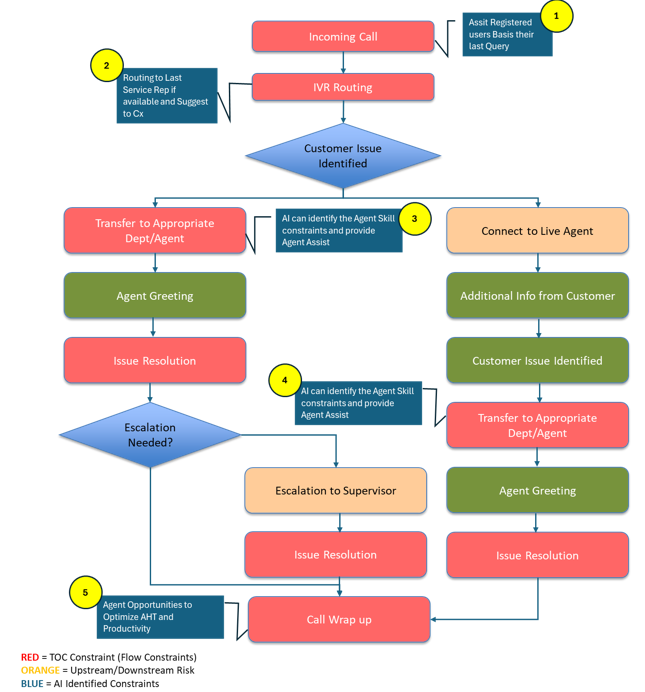
Sundeep Kailwoo replied to Vishwadeep Khatri's topic in We ask and you answer! The best answer wins!When AI Removes One Constraint — Does It Create Another? AI are evolving programming environments, equipped with LLM and scenarios feed into the models and models at times do hallucinate and that’s an area that needs fine tunning and reinforcement. On the same lines when AI removes a constraint and offers solutions that may have not have earlier or ever identified by a Human programmed system. The inter linkages that AI solution may offer as part of its resolution can throw up scenarios that may be ideal from a solutioning standpoint but how practical and real time implementation can still pose a challenge. Taking the Below example from a Customer Service Industry , which we discussed here earlier – Forum Q.No. 831 AI Driven Constraint Identification and Advantages Although the Above scenario, did identify the advantages that an AI may have over Human but the additional constraints that solution may impact the systems and resources involved can be explored through the below outcomes. *Scenarios are highlighted in Yellow Shapes in the flowchart attached. Additional Constraints and Impact Areas Scenario 1: Assist Registered users Basis their last Query Additional Constraints: The new Customer Query may not be related to earlier issue. Impact Areas: Customer Experience – Customer may land in a queue or to a team that may not be able to service their issue/s the first time and may need to handover Customer over to a different department which was not what the customer would have expected and additional information or clarification the helping Expert or customer may have to provide to guide the customer to the correct department. Volume Load – Incorrect routing may lead to additional callback and incoming call volumes to queues that are not staffed to handle such volumes. Scenario 2: Routing to Last Service Rep if available and Suggest to Customer the option of the availability. Additional Constraints: Wait time to for the Customer to reconnect with the last serviced Expert. Impact Areas: Experience Vs Cost – In the effort to customize the Customer experience , the capacity and cost that we need to negotiate between the ideal wait time and the customer expectations and would be hard to measure and evaluate in case the system is either not able to handle the expert tagged routing vs the cost involved to design systems around this process. Scenario 3&4 : AI can identify the Agent Skill constraints and provide Agent Assist capabilities Additional Constraints: Agents will have to cross trained and multiskilled to handle additional transfer volumes Impact Areas: Agent Experience – Agent fatigue and overload can be a metric that is not typically measured but felt during an interaction, which not only impacts the customer experience but also the agent longevity in an organisation and process. Staffing Needs Vs Cost – With the constant leveraging between the expert skills and customer query type , the staffing needs will have to be more dynamic and real time across queues, that may involve additional cost to meet the service level agreements. Scenario 5: Agent Opportunities to Optimize AHT and Productivity Additional Constraints: At times ACW is a value add activity where the case notes needs to be updated with details and inter-case output for an interaction , which if not investigated and captured correctly can lead to incorrect or incomplete documentation Impact Areas: v Query Completeness – AI Driven solution and process may lead to additional human intervention and extended effort and time requirement if critical details are missed to be captured automatically. v Data accuracy – AI driven constraint and any human intervention inaccuracy may lead to data set getting corrupted over a period of time .
-
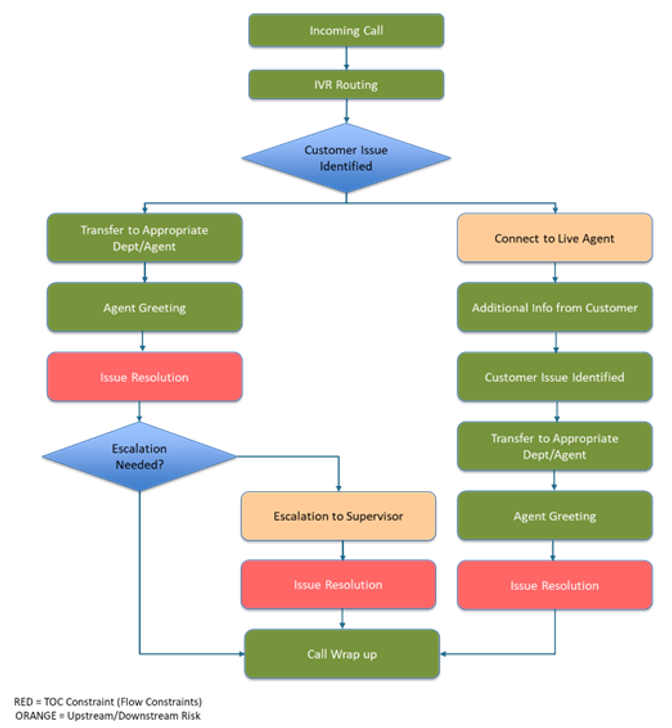
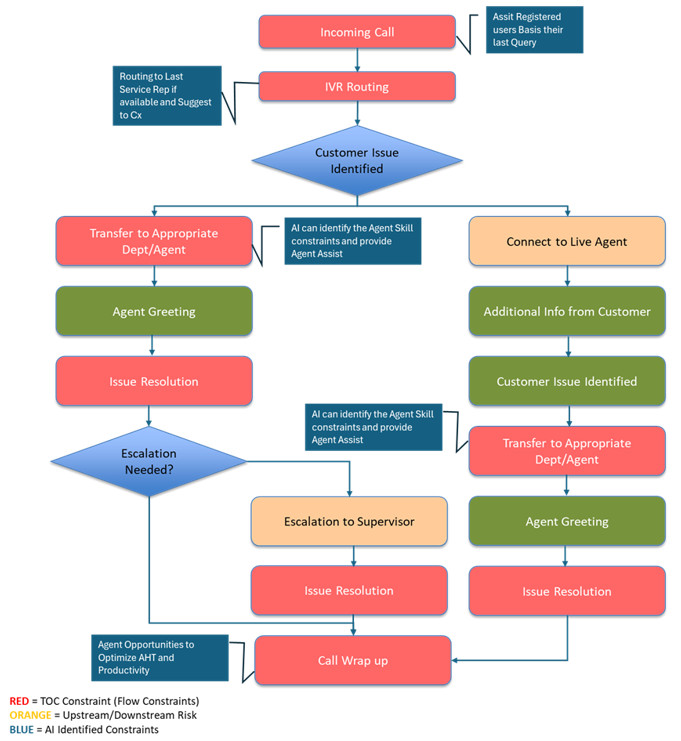
Sundeep Kailwoo replied to Vishwadeep Khatri's topic in We ask and you answer! The best answer wins!Can AI Identify the Real Constraint in a Process Better Than Humans? AI Vs Human, Human in Loop , AI Assistant , Auto AI triggers is here already and no process or policy framework in near future is immune to the impact that AI will bring in. AI will not just Define , assist but consistently dictate how organizations model their processes, where AI is built into every process possible. While we deal with known and validated through the current data sets and data models whether Trends , Predictions , counter-Constraints mechanisms that are currently driven by Metrics that’s measurable and for data systems to identify. Human Intervention to deal with , design , Test & deploy , and rectify constraints. Implementing TOC model to eliminate / reduce the impact of Constraints is limited to a degree to what Humans(Experts) are exposed to in real life and from past experiences. VS AI , once trained on these data models , Real Time and Past Data sets with outcome-based decision making capabilities and programmed to identify all plausible scenarios , operating in isolation or in interconnected environments, can unveil scenarios where the model first fails to deliver or identify incorrect outputs, once fine-tuned can help processes to first discover, relate and then propose solution around the new constraints identified. A Scenario from Customer Service Industry – Human-Designed Transaction Flow - Slide no 1 Typical Constraints identified in process highlighted in Red , mostly centred towards post IVR process and especially focused on Issue resolution But with AI there is possibility to Deploy constraint identification and solution definition at most of the Transaction steps that a typical human-designed process may lack AI-Driven Constraint Identification and Advantages - Slide no 2 In the above scenario, we can visualise the additional opportunities where AI without human effort and time can identify and offer solutions around constraints that we may not have considered extensively and explicitly in the past. With AI becoming an intrinsic part of the organisation’s future course, these changes can be a natural fit into the process solutioning requirements.
-
Sundeep Kailwoo changed their profile photo
-
Sundeep Kailwoo replied to Vishwadeep Khatri's topic in We ask and you answer! The best answer wins!ICUKU (Impact, Control, Known, Unknown, Uncontrollable) is a 9-square Matrix tool that can be deployed for Categorizing the possible solutions on an Impact Vs Implementation grid. On the "X" axis we Impact categories (Low, medium, High) and on the Y-axis we have Controllable ( further subcategorized as Known and Unknown ) and Uncontrollable factors. This Matrix will help us to first categorize and then prioritize the factors/solutions ( Vital "Xs" , independent variables ). The Solutions that have been identified by the teams through various various RCA techniques can then be placed in either of the 9 cells basis the impact that the action may yield on the proposed change and the ease of implementation basis the factors that the team can also attribute the controllable , uncontrollable scope of those known and unknown solutions. Its becomes very critical that while constructing the ICUKU matrix , the team is realistic and exercises pragmatic approach when placing the solutions in the matrix cells, the success or the failure of achieving the desired results will depend upon the solutions we have identified and then categorized then as accurately as possible. Resources are limited and cost optimization along with maximum yield in shortest duration of time is what all want to achieve and this exercise will help to deliver to those expectations to an extent if done correctly. So the Solutions that exist in the HK , MK , HUK, MUK will be our scope of priority in deploying the Actions , to maximize the output. The Example below for an AHT Improvement project showcases the actions that can be deployed ,where ICUKU will be able to help us in planning our actions for best possible results. So the Actions in the cells identified as per the first Matrix , should help us identify the actions that are in our control to implement and will yield immediate results compared to rest of the actions identified.


-
Sundeep Kailwoo replied to Vishwadeep Khatri's topic in We ask and you answer! The best answer wins!Hoshin Kanri is a Strategic planning tool that typically follows a 7-step process in which the organization's strategic goals are designed and communicated across all levels in the organization and then put into action. The Goals are aligned to the Vision of an organization over a period of 3-5 Year horizon and then these goals are broken down to smaller denominations over short team (6 Months - 1 Yr.), medium-term( 1-2 Yrs.), long term(2-3 Yrs. ) and Strategic terms (3-5 Yrs.) and then further bifurcations of the actions and its objectives are planned out for roll out and benchmarking the outcomes. The goals have to reviewed at a monthly basis and the larger goals are evaluated at year end annual reviews. Measurement of performance indicators is also a key factor in the process. Hoshin Kanri is built on a Top-Down approach , where the goals are decided and managed by the management and executed by employees at all levels of the organization. When an initiative is rolled out that level and over a long period of time , it’s important that everyone is aware of the role and responsibilities and how they are the Cog in a system that will enable the process to work as desired, hence it’s important that the system exists where the objectives and the expectations are clearly communicated across hierarchy .That’s where the concept of Catchball is used and becomes effective in seeking and managing the bidirectional communication of Goals , opinions , feedback and other communications channels throughout the organization. Catchball process is developed in Hoshin Kanri , where the communication flow on the goals and objectives are communicated top down but the feedback , negotiation and alignments happen across the hierarchy. The name of this technique is derived from the simple children’s game by the same name and its implementation in Hoshin Kanri follows a simple approach of passing, sharing and discussing the goals across the teams , so that everyone is in agreement and the goals are owned by all. Catchball helps in Increase information sharing across all levels of the organization hierarchy, Align the actions of every person and the goals of your company and Boost the process of continuous improvement. THE ABOVE EXPLAIN FIRST PART OF THE STATEMENT THAT 'It is the set of the sails, not the direction of the wind that determines which way we will go!” , until and unless an organization have not planned out their strategies and the process to achieve the goals , no matter how hard or with dedication the Teams engaged in executing those strategies , will not be able to achieve what the original objective was .That where the 2nd part of the statement , gains relevance that once the teams across the organizations are aligned and tuned to the Goal , Processes and the Measurement successes , the efforts and the actions deployed will bring in the impetus to drive towards the goals. The momentum and the magnitude of the successful implementation will depend upon the synergies between the Set of the sails and the direction of the wind.
-
Sundeep Kailwoo replied to Vishwadeep Khatri's topic in We ask and you answer! The best answer wins!RPA practice has become a very important lever to deliver high-cost savings and reducing the dependency on humans for unskilled and repetitive tasks. RPA is successful when deployed at the appropriate process and scale. In achieving the desired outcome from RPA, Process Mining has gained a lot of relevance and has become an integral part of the RPA. RPA concerns with the automation of business processes, enabling companies to strengthen cost effectiveness and quality improvements. The most critical stages of a RPA project is to pick the intended business process to be automated. However, RPA isn't the means to all or any ends and may be deployed randomly across the processes. The intended automated process must be selected carefully to profit the foremost from RPA. This is often where the critical question must be answered, where and the way do we chose the eligible process for a feasible RPA Deployment. Often the business process that's most eligible for RPA has activities that are repetitive, standardized and transactional. But how do we validate exactly which business process is that or one qualifies the minimum requirement for an RPA. Although most of the business owners and operators would have a good idea how the daily operation works, the important deal is to travel beyond a good understanding to the key stroke level details. This is often where Process Mining comes in. Use Process Mining techniques to construct the AS-IS processes by using event logs, identify and choose the processes that benefit the foremost from automation! Advantage of Process Mining Over the past few years, Business process optimization practitioners constructed the AS-IS process using qualitative methods. With Process Mining's ability to get data and supply insights into the method inputs, flow and output. We now have access to quantitative data points and trends to analyze the simplest fit process. Because the tactic model is made by data its objective and more reliable than as-is process constructed by qualitative methods. The info is extracted from IT-systems that store data and make event logs. The events range from online transactions from an e-commerce website, a business’s offering various discounts and finance schemes to adopt prepaid payment methods over post-delivery methods made through their platform. After the as-is process is made it are often extended with perspectives that are relevant to the business case or the question that possesses to be answered. Process Mining will generate data and help us to identify the frequency of repetitive activities, significance costs or resource use, slowdown time as well as waiting time, process bottlenecks, waste and barriers for a smooth process. Integration of RPA and Process Mining Now that we have recognize what RPA and Process Mining are, the next step it to integrate how RPA-project can leverage Process Mining. Processes and RPA executioners simply don't only need to use Process Mining as an area of a RPA-project, it's also valuable before or after a RPA-project. Here are some examples: Pre RPA Deployment Process Mining was performed before automation to optimize a business process. Process Mining allows for locating the business process where redundancies and process inefficiencies are exposed. This is often beneficial for RPA, as for RPA to be most successful the variation within the business process should be minimized. Before RPA it's better to standardize the processes variation to make high volumes per process variation. This helps in RPA to be used as efficiently as possible. During RPA Deployment Conduct Process Mining as a sub activity of a RPA-project to supply an objective overview of business processes. It help in making the particular process transparent by a data-driven perspective whereby repetitive activities, bottlenecks and process loops are shown. By doing so we'll identify the sole processes to be automated next. Post RPA Deployment The data generated by automation enables continuous improvement in terms of further optimizing the algorithms making the tactic add the backend. Use the info for Process Mining techniques to research the tactic and determining the specified outcome, effectiveness of the automation and subsequent improvements
-
Sundeep Kailwoo replied to Vishwadeep Khatri's topic in We ask and you answer! The best answer wins!4 Eye Principle , Check the Checker Process is a common practice , generally performed on a Sample rather than the whole Lot unless the process mandates and is critical part of delivery , 4 Eye Principle may be a regulatory requirement as well and we will discuss this in further through this write up. At times processes go beyond 4 Eye Principle and deploy 6 Eye process when the scope of making an error is financially and reputational too significant to avoid costs that may be required to set up such a process. Deploying 4 Eye Principle generally attracts the discussions in the Continuous Improvement Teams whether the activity is classified as Value Add , Non Value Add or Essential Non Value Add step in the process. Following the principles of LEAN , reducing Waste and Doing the Things Right the first Time. Rework , Audit , Check the Checker is a Waste or a Non Value Add activity. Deploying the 4 Eye Principle may be justified and required depending upon the Level of maturity of the process. A Process which is newly transitioned or developed by a few experts and needs to be localized across the population , will need deployment of 4 Eye Principle , to make sure no critical error and deviations are passed onto customers and the observations made during the process is used to retrain the task executioners on off repeated errors , In this Scenario , 4 Eye Check can be considered as an Essential Non Value add activity. But a Process which is mature and the process input , Process steps and output generated are standard , 4 Eye Principle may be a redundant activity , which employees resources but provide no feedback into the system , as the process is in Control with natural variations existing . Some Value Add / ( Rather ) Essential Non value Add Examples of deploying 4 Eye Principle: Financial Transactions - The recent Citibank / Wipro $900 Million Error that lead to a transfer of $900 Million transfer to lenders rather than $8 Million transfer happened even despite a Six Eye Protocol. Even after a 4 Eye check was performed at Wipro's end , another 2 Eye Check was performed by Citibank officials before the transfer was approved. In Critical processes like this and many similar cases where the financial implication of bypassing an error may lead to enormous Financial and reputations risks , Companies may choose to go with a 4 Eye Principle no matter at what Maturity level the process is operating at. Cost benefit Analysis will always weigh in favor to deploy a check the checker process. Medical Surgical Process- Nurses assist the surgeons during an operation not only in assisting the main doctor during the procedure but also makes sure they provide the right instrument when asked for and the Doctor can verify that its the right instrument what was required at that point in time . In Life saving situations and processes if 4 Eye Check is deployed , its value can be ascertained from the fact that human life could be saved by making sure no error passed through the process during surgery. Some Non value Add Examples of deploying 4 Eye Principle: Auditing the Whole Population rather than a Sample : In a Process that's matured over a period of time and the Processes are supported by right tools and applications during the processing of a unit , we may not need the 4 Eye Principle in that process at all , and even if we want to make sure that the process owners are able to catch ant special cause variation leading to any deviation in the out , we can deploy a certain % sample output check rather than deploying resources to Audit each and every unit . In this scenario , the 4 Eye Principle is a Pure non Value Add activity . Baggage Scanning Process - In some of the airports we have observed that the Check in and Carry on Baggage are scanned more than once and then physically checked at the security point. Not only does this create a bottle neck in the whole process but impacts the Customer experience as well. If done right the first time and all protocols are followed at the first check point , doing it multiple times in stages ahead a Pure Non Value add task , that not only increase the time to complete one check in cycle time but also involves Cost in Deploying human and machine resources at multiple check points.
-
Sundeep Kailwoo replied to Vishwadeep Khatri's topic in We ask and you answer! The best answer wins!In Business Excellence domain Improvement Kata refers to a Practice of conscious decision making, that's developed over a period of time through consistent practice, deployment, experimentation, and working towards a guided target and not just try storming on a trial and error basis to find a feasible solution. Improvement Kata when applied within the Lean principles aims to deploy continuous improvement for achieving business excellence functional strategic goals. The mindset of deploying Improvement kata is to make sure the practice a daily activity so that habit becomes autonomic in nature. A normal Process Step phase in deploying improvement kata is : Step 1: Understand the Challenge or Direction that we want to address Step 2: Grasp/Analyze the Current condition Step 3: Identify and Establish the next target condition Step 4: Experiment towards the target condition Step 5: Repeat the pattern Coaching Kata refers to how the Improvement kata steps and the process shared by the experts and the mangers to their teams and the cycle of constant learning and feedback that should follow to track the progress and the improvements made during the Improvement Kata stage. Some of the Questions that Coaching kata practice should address are : Apart from the 5 Step process that Improvement kata consists of , Coaching kata will try to know , 1: What did you plan as your last Step? 2: What results did you expect ? 3: What Actually happened? 4: What did you learn? These feedback inputs will feed into the Improvement kata loop. Some of the Improvement Kata and Coaching Kata Industry Application Examples : Aerospace: Companies Like SpaceX, Blue Origin, Virgin Galactic have set their focused target on Outer Space travel. SpaceX already launched its Working prototypes and Production Rockets and is working towards reusable fuel and Payload rockets to make them cost-effective. Even though some of the recent unsuccessful vertical landing attempts continue to address the current challenge, analyze what's going wrong, setting the corrective target conditions, and working to achieve the optimal output, and will keep on repeating until successful. The feedback loop from the experts and the data generated will help to formulate the coaching kata process , where the change and it outcome is shared and tracked with the teams for next steps in Improvement Kata loop. Production/ Manufacturing : Product Manufacturing industries operate in a highly competitive market and the rapid pace to evolvement of the products or its features keep the market leaders and the challengers on tenterhooks all the time. Improvement Kaka is an ideal tool where the competitor moves / enhancements / innovations become the direction to score the change in the product to be market relevant , match or exceed the functionality , set the processes towards the goal and extend the product lifecycle through functional and utility improvements in the products and services . Pharmaceutical Industry : An Industry that is working towards developing medicines for the existing non curable and curable diseases and for un-foresighted scenarios like Covid-19. They are constantly moving towards a shifting goal posts basis the results their experiments and trail results.
-
Sundeep Kailwoo replied to Vishwadeep Khatri's topic in We ask and you answer! The best answer wins!CEDAC is a modification to the Cause and Effect Diagram, with addition of Cards, hence the name Cause and Effect Diagram Adding Cards (CEDAC). As the name suggests the process involves adding Cards to a typical cause and effect diagram construction exercise, these cards are typically 3X5 (cm) in size or post-it notes. This approach elaborates on the original process and involves the inclusion of ideas, opportunities outside the functional team, where many more members from related processes and departments can be asked to participate in the brainstorming exercise to share their ideas while the Fishbone diagram is being constructed. This method was developed by Sumitomo Electric Industries of Japan in 1978. Just like CED, CEDAC also focuses on identifying the major and minor bones (causes leading to an effect) but also incorporates identifying the workflow analysis, creating a countermeasures matrix, identifying the possible multicollinearity factors. This is where the significance of CEDAC gains over CED, but not all situations and projects may need a CEDAC Vs a CED as CEDAC is more time consuming, wants more efforts and involvement, may mislead the original ask with the involvement of too many inputs. One has to be very judicious to apply CEDAC where it demands an application. An Example where deploying CEDAC would provide practical value add inputs, could be an Employee Turnover project, which may be impacting a particular account, where the project is initiated, but when we look at the Upstream and downstream processes, which may impact an employees attrition from an organization, we may not want to operate in a Silo but involve cross functions teams, when we are in analyze phase of the project and start working on root cause identification using CED. This is one such situation where deploying CEDAC would make a valuable impact on the project across accounts and the organization in general. Elaborating on the Example above how inputs from various other functions may be helpful in CEDAC: An Account is facing issues with high Attrition ( employee turnover ) rate, Operations along with the Continuous Improvement team starts with Creating the CED initially to identify the major Bones ( Man, Machine, Method, Measurement, Material, and Mother Nature ) and start growing the minor bones of the CED. But it recognizes that Human Resources Team that is involved in Hiring these resources are required to provide their inputs in terms of the challenges and the opportunities they see in the hiring process for this campaign, Need to involve the Learning and Development team responsible for Training the hired resources and IT Team (Given that most of the Processes are Work From Home now) to also seek their observations during onboarding the candidates for the Campaign. Now expanding the scope of brainstorming exercise and seeking inputs from these teams will be better captured through CEDAC. Why and How the Inputs from these 3 extended functions impact the Overall Employee Retention efforts in long term: HR Function – Talent Acquisition Team – 1. They can help the project in identifying the type of profiles that don’t stick to a particular campaign. 2. The challenges they may face to hire from a particular location, may help the organization to see if there is a possibility to hire virtual employees from a better location with a historically low turnover. 3. TA Team can also help project what can be a better demographic fit for a particular campaign and does it makes more sense to do target hiring than look for a generic hiring practice. 4. TA team can provide their inputs while brainstorming on additional factors that Operations and other functions may not have visibility to. Learning and Development Team – 1. Their inputs during the Brainstorming session can help us to identify if the training process and training duration play any part in employee retention, another factor that we may want to look at in 0-30 Days terms, especially during training and Transition periods of an employee in a process. 2. They can identify that certain employees with certain skills are better suited for a particular type of industry and even though everyone should be trainable on a process unless certain specific skills are mandatory, their inputs can help redefine the job profile, which in turn can help hire employees expected to meet the operational demands of the work and would stick longer with the organization. IT Team – 1. With Technology becoming critical in an environment where more and more jobs will be performed Virtually and away from Brick and Motor set up, Employees being encouraged to work on BYOD ( Bring your own device ), IT team will be able to provide their inputs as to what type of employees ( Tech Savvy Vs not great at Troubleshooting for minor issues) may have an impact on people leaving because technology is impacting their performance and are not able to meet the basis IT Expectations when faced with an outage. 2. They may be able to provide input on what sort of minimum tech. requirements must be mandatory for a BYOD device to make sure we are able to isolate the cases during the Hiring and Interview stage itself if that candidate would qualify to move into a production environment and we don’t see a fall out due to tech issues after onboarding the candidate. There may be other functions and situations that are applicable to similar situations, where an output triggers actions across different functions. This is where CEDAC help in identifying the cross-functional actions across different teams, Data integrations between different sources to build a complete picture for a Situation.
-
Sundeep Kailwoo replied to Vishwadeep Khatri's topic in We ask and you answer! The best answer wins!The expectations to strike a maximum Via policy of Maximum gain with Minimum investment is age-old. The philosophy to optimize the resources and gain maximum profits is always the underlying objective of a profit-making organization or a Function within an organization. The same holds true for a Continuous Improvement Function in an organization where they would want to gain maximum improvement in a process with minimal effort, disruption, and Cost. When we put Investment ( In Money, People, Material, Time, etc.) and Return ( Profits, Better Skilled Employees, Improved Durability, etc.) in a functional Equation to get an ROI ( Return on Investment)= (Net Profit / Investment)*100. The Continuous Improvement team as one of the Objectives is to build a Quality culture from the Bottom Up or Top Down will encourage the teams across all levels to participate and contribute to be part of Quality Culture in an organization. Apart from Training the employees on various Quality Tools and Techniques, familiarizing them with the concepts and theories, actual participation in identifying, Implementing the changes would be the ultimate success rate for the CI function as far as Employee Engagement in Quality Practices is concerned. This brings us to the Topic of the Day whether the ROI gained through improvement projects Via multiple small projects weigh heavy than the number of improvement ideas that engage the Employee to be part of Quality culture and Practices. Employee engagement as part of an Organizational wide Practice is critical to gauge the success rate for a Practice that I rolled out universally, bypassing Functional boundaries. This holds true and Pivots towards the CI Team metrics post-training the population in an organization on Quality practices. Kaizen, not only refers to driving continuous improvements in an organization but it's equally essential to engage all levels of an organization to drive these Improvements. Thus not all Improvement idea , opportunities may lie in a Bing Bang Bucket but small , quick , low hanging fruit can yield a greater ROI over a period of time for a Function. Encouraging and acknowledging the Employees who are motivated to pursue their learning into a practical outcome , will only lead to a culture which is built organically within an organization rather than always engaging few experts to Drive strategic improvements in an Organization. CI team is the Experts that can mentor , guide the Employees to explore Kaizen in their day to day activities and make the change on ground for the team they work in . Finding a fine balance and following the strategic vision of an organization , Driving small Projects with Limited ROI Vs Big Projects with Visible Bottom and Top line Impact, should hold its own merit in an organization. One shouldn’t discount The Impacts and requirement of an ROI driven project vs Employee Engagement to drive small yet work impacting improvement projects .
-
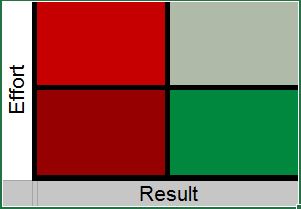
Sundeep Kailwoo replied to Vishwadeep Khatri's topic in We ask and you answer! The best answer wins!Cherry Picking a task or a project may yield quick results but most often taking too narrow a view strategy in a larger scheme of things. Also, the level at which the decision is made to invest, and take up a project in an organization or CI as a function is relatively dependent on the hierarchy at which the decision making is taking place. A cherry-picking exercise done at the higher hierarchy level may not be the same for a decision-maker who lies at a lower level of the hierarchy pyramid. But if we base the decisions to take projects basis the Effort Vs result Matrix as shown in the attached image irrespective of the position the decision-maker is at, invariably the projects, tasks that fall in the 1st Quadrant can be identified as easy pickings, cherry-picking when it comes to selecting a project. Low Effort Low Result (Impact), the projects that lie in this space are invariably replications ( Small Automations eg. Macros, Formulas, etc. driven ), easy process fixes ( E-Bay(Enhancement Bay, Power hours, Cheat Sheets, etc.,) low investment relatively high Return or positive ROI projects. Some of these quick fixes may become redundant when a strategic solution is implemented to address a larger cross-functional, cross-process improvement. Hence it becomes important that the break-even to realize the proposed objectives are monetized in a short span of time. Some of the Pros of Cherry-picking when it comes to selecting Continuous Improvement projects : 1. Low Cost - Most of the issues addressed by such CI projects are the basis to the process where the improvements are being implemented . The change proposed wouldn't need too much tech cost and manpower cost and can be done parallelly to the core functions that if being performed by the Project team currently. Eg.- Developing a VBA Macro by a Team member or an IT resource within the account to automate the file merge process, where the team is supposed to manually merge different files to start working on the actual value add work. The cost to develop and deploy such automation will be very low but the Cost Savings in Man hours saved could be high and also mistake-proofing can be achieved through this change. 2. Less Disruption - Such Projects don't alter the nature of the work too drastically and the improvement can be implemented while doing the process without much disruption / deviating from the current flow. Eg: Team struggling to follow call flow and the basis Troubling shooting process, a Cheat sheet with Call Flow and appropriate probing questions in each Flow Step can be shared with the team for Quick reference. 3. Team Engagement in Process improvements -Not all improvement ideas may come from the CI team but invariably its the people who are doing the job on the floor to identify the improvement opportunities, sometimes big, most often small but significant, that impacts the tasks that they are performing. It's very important that the core team that is carrying out the core operations of the process feel empowered and involved in not just performing their tasks but also feel that their inputs, suggestions, and ideas matter, and Feedback is actioned upon. This is where the Cherry Picking exercise will yield results, where small yet effective improvements can be accepted for implementation and the Employees are recognized for their efforts and innovation. Some of the Cons of Cherry-picking when it comes to selecting Continuous Improvement projects : 1. Fails the Test of Time / Stability - At times the quick fixes achieved through cherry-picking improvement opportunities may become irrelevant in case of a small process change . The improvements deployed today may become useless due to uncontrollable factors like , Client Process Change, Input Change, Output Change, etc. Eg. - A Macro deployed to address a File Compilation process works only when the input is in the form of an Excel file, but of the Input now changes to word or PDF file input, the automation will fail to operate for what it was built for. The same is the case even if the input remains constant, but the output expectations change, the Improvement deployed will be rendered useless. 2. May not integrate with Strategic Direction of the Organization / Function - Some of the Improvements that may be deployed over time may become isolated and ultimately redundant if the function or organization plans to deploy a strategic solution to address overall functional needs. So the investments and time spent to onboard the changes that were selected through cherry-picking will be discarded. Eg.- A team deploys a process change how they are integrating different data sources manually to produce functional Metric Dashboards, that require tech investment and human involvement, this tactical solution for the team will be out of use once the Strategic solution for a Function wise CRM is implemented. 3.Lower ROI - Cherry Picked projects may yield a positive ROI but when compared to other Functions and another ROI impact, the cumulative ROI of such projects may not be as significant as other strategic solutions and Projects. Cherry Picking may result in Quantity of the Improvement projects but will fail in terms of the Bottom Line or Top Line impact of an Organization.
-
Sundeep Kailwoo replied to Vishwadeep Khatri's topic in We ask and you answer! The best answer wins!Hype Cycle was conceptualized by Jackie Fenn in 1995, while working for Gartner as an Analyst and Gartner subsequently after years insisting and lobbying with the industry started with the annual Hype cycle visualization for new and emerging technologies and branded the tool as Hype Cycle. Hype Cycle is technology life cycle stages Graphical demonstration passing through Conception to Maturity to Widespread adoption. There are pre dominantly 5 stages in a Hype cycle but then we can build sub stages as well within those broad stages of a technology lifecycle. Mostly used by marketing and technology business decision making, businesses can choose the level of risk and comfort for each stage in the Hype Cycle and at what stage of the life cycle the product or service is currently at. The hype cycle classifies five overlapping technology lifecycle stages: 1. Technology Trigger: This is the stage where an Idea for a product, service or new technology is envisaged, a prototype may exist but not in functioning state and no market data, study exists as such on these new technologies, products or services but the prospective enhancement / change / innovation that they may cause will impact the how the media and market reacts and this could be supported by the proof of concept demonstrations as well. Technologies / Products are this Hype Cycle Stage: Unsupervised Learning in AI, Supervised learning where Manual Intervention is required and limited data sets can be tagged and mapped and need a lot of effort and time. Unsupervised Learning where the Model / algorithm doesn’t needs manual tagging or Intervention. The Model works independently and learns on its own to tag future data in shape of images and Videos. The technology is still being explored and is conceptualized to be deployed in working environment. 2. Peak of Inflated Expectations: The Tech Life cycle stage in Hype Cycle where the functional prototype / technology is implemented by early adopters , creators , inventors , is called the Peak of Inflated Expectations .At this stage a lot of publicity on successful or unsuccessful implementations may be attached with the outcomes. Technologies / Products are this Hype Cycle Stage: Launch and Stick landings (Vertical landings) for Space Shuttles like SpaceX Starship SN10 rocket. The technology intends to reuse the Payload carrier and the Fueling rocket, thus reducing the cost and timelines for subsequent travels into Space for Mankind and delivering payload. Both SpaceX, Blue origin, Virgin Galactic are some of the pioneering organizations leading the race to Mankind Space Tourism. 3. Trough of Disillusionment: At this stage the shortcomings and not meeting the expected results leading to failures may lead to disappointment in the product/ technology and will see a fall through of some early adopters, inventors and investors. The other may still continue with further refining the functionality and the adaptability of the product / technology while addressing the existing problems successfully. Also new investments and market sentiment will also depend upon the future state of the technology. Technologies / Products are this Hype Cycle Stage: Google was very enthused in its launch of the giant Balloon internet services, “Loon”. The experiment was to delivery low cost wide high speed internet services in tough terrain areas across the world. The Project is being scrapped as it could meet the desired objectives of cost optimization for a long term sustainable business. 4. Slope of Enlightenment: The stage of the Hype cycle where product / technology Beta and early versions start showing potential expected outcomes and are accepted by the industry and gets adopted by the companies, peers OR gets tested in control environment .At this stage the inventors, producers will start working on the next gen version of the products / technologies, where it can be integrated with existing services and platforms. Technologies / Products are this Hype Cycle Stage: Hydrophobic Farming is one such example, when using acres of lands producing food feed on pesticides , Organic or Inorganic will become unsustainable , Urban Farming , utilizing less space , more energy and resource efficient is the answer in Agritech industry . The industry is expected to grow from $9.7 Billion in 2019 to $17 Billion by 2025 with almost 14% CAGR. 5. Plateau of Productivity: The Hype Cycle phase where the successful and effective implementation is adopted on a large scale across industry spectrum, its differentiation yet adaptability becomes widely implemented. Standards are build up around the frame work of the technology for a sustained, standard understanding of the market and market players around this practice / technology. Technologies / Products are this Hype Cycle Stage: Mobile Internet, the technology is past 4G and most of the Developed countries have started rolling out 5G interest services that aim to provide data transfer speed of 20 Gbps at peak and 100Mbps at average. This is almost 100 times faster than 4G, which is the predominant cellular phone broadband network speed.
-
Sundeep Kailwoo joined the community
-
Sundeep Kailwoo replied to Vishwadeep Khatri's topic in We ask and you answer! The best answer wins!Trystorming refers to Brainstorming on steroids and Putting in Practice the idea being discussed in pilot environment and then evaluating the output to continue or exit. It emphasis what can be done right now rather than deliberating and discussing the possible solutions and prioritizing with the larger group over multiple sessions of discussions and finding common ground. Some of the Examples where Trystorming can be successfully implemented : 1. A non-destructive / disruptive process , where the change can happen in parallel to the exiting process . While the core team explores the possible solutions that can be implemented to an existing problem today . Pilot can be rolled out for a sub team , where the impact of the Trystorming solution results can be realized immediately for either accepting the output or rejecting the outcome of the experiment on the pilot. Hiring process in an organization is an ideal place for experimenting and deploying Trystorming , where basis criteria being met the process owners can deviate timelines and the mode of recruiting the candidate. Interviewing and Live assessing the candidate Via Video Communication to eliminate the issue of impersonation specially for Written test / assessment is required . The class for which this process is deployed , then can be measured for Success or not VS previous and old process in terms of the Recruiting metrics , Like Fall Rate , Fill rate , No Call No show % , Through put on the Tests etc. The advantage is if the Trystorming exercise by the Teams succeed , the results can then be made universal for a Blanket Approval at BU, Site , Profit center level . This eliminates the involvement of non-core functions and saves on time and yields quick turnaround time on execution. 2. Trystorming can be employed in operations floors where the experts try an idea in a control environment , monitor the outcome over a period of short duration of time , evaluate the results and make a decision to continue or disengage. Teams can continue to derive at possible solutions without disrupting the core operations and providing the results to the stakeholders to make the process change approved once successful.
