

(1).jpg.c641721157eca5944067f90430715f18.jpg)
Satyajit Das
Lean Six Sigma Black Belt
-
Joined
-
Last visited
-
The term Push-Pull was initially originated in logistics and supply chain management but nowadays it is widely used in sales and marketing also. When the production sequence is scheduled and the material pushed into the production line, it is known as push system, but in the pull system it will follow the “supermarket model” where limited inventory are kept and is replaced as soon as possible it is consumed. Push-Pull System are:- Kanban System Material Requirement System (MRP) System CONstant Work In Progress (CONWIP) System POLCA System K,Y System PAC System There are some advantages and disadvantages in using CONWIP at a production system. Some are given below: Advantages: Kanban works well with high-quantity low-variety parts and it works very efficiently in a continuous process or where there is a continuous demand for the same type of items. In Kanban every part or item is identified by a card number and these numbers are vice versa. A good example is that a company produces a mass production of a particular part and stockpiles it to sell in large quantities. If you have to produce a unique or distinctive item then the Kanban system will face difficulties as it is always assigned a part number. On the other hand CONWIP has no part number earmark by default to the CONWIP card. Hence any part number can be assigned to the CONWIP part, even if the part is produced only once and therefore it is well matched for customized parts. The life cycle of both Kanban and CONWIP are almost similar, so it's easy to combine both of them into a hybrid system. There are at least two types of hybrid systems possible, where both kanban cards with numbers and CONWIP cards without numbers can circle through the system. The only one difference between them is that before production, CONWIP parts get assigned a part number from the backlog sequenced items. Disadvantages: CONWIP needs extra human intervention to reproduce the correct products items as it can be easily messed up the backlog sequence priorities and therefore it needs additional attention or awareness. These human decisions have a higher likelihood for the bullwhip effect, since in CONWIP people decide the priority sequence. On the other hand Kanban can automatically manage the production system sequence. CONWIP and Kanban both use a quantity of parts to prevent overloading at the production line and this system works well, when all parts are consumed at the same time during production. If there is a different production time of the parts then there will be totally different jobs for the production system.
-
The concept of Purple Cow was presented to us by Mr. Seth Godin in his unprecedented book which is known as “Purple Cow-Transform Your Business By Being Remarkable”. Mr. Seth Godin presents a theory with the help of his book that creative advertising nowadays is less effective because people are less attractive towards them as these are far away from the reality of their respective product. He thinks that traditional marketing is no more working, so a company should stop advertising the product and start innovation on the product. The book also supports that companies that produce remarkable products do not need advertisements to sell its products, instead it will target people who will buy the product and spread the goodies of the product from person to person. Successful brands like Apple, IKEA, Google, Starbucks, etc are all built on remarkable products and people talked about them a lot. Some of the key elements of the Purple Cow theory applicable on the Business Excellence field are given below: Find out the detailed consumer wish list about the product. Find out the current product leader of the market and find out what remarkable item can be enhanced from that product. Find out how to build a contagious product. Find out the high fruitful buyers and opinion dominant buyers. Find out the market entrants, who are not trying to sell the customers what they want. Find out what the market figurehead is trying to do, then just simply focus on doing the opposite. Find out the top positive and negative recommendation of the product. Find out the available product design at market and try to create astounding design. Find out how a good product can be transferable into a remarkable product. Find out the unbelievable packing of the product. Find out the big social network and communities in your market and then try to customize the product according to them in a limited special edition. Find out how the product can be more convenient than others. Find out how to make your business card more sensational. Find out the solution of customer complaints and suggestions. Find out how to become the most loyal customer protector. Find out the things that people find striking about the product. Find out the ways to create a new product competitor of your current product with low cost. Find out the customer's recommendation about the product. Find out the limits of your product in comparison with other products. Find out the how much risk it will need to make the product better.
-
Scrum is a framework that helps teams work together and address the complex adaptive problems among themselves for highest productivity and delivering products. Out of many Agile processes, Scrum is a process to focus on delivering the business value in the shortest period of time. It’s main philosophy is “fail fast”, so that you can learn from your failures. Scrum was created by Ken Schwaber and Jeff Sutherland and they wrote its values are Courage, Focus, Commitment, Respect, and Openness. The Scrum Team consists of a Product Owner, the Development Team and a Scrum Master and the Scrum Teams are self-organizing and cross-functional. Planning Poker is an agile estimating and planning technique that is based on consent of all the members and it is also known as Scrum Poker. The main objective to play the game is that every single person should come to the same point of consensus. Planning poker session usually starts after an initial product backlog is written.The Scrum Master acts as the moderator or facilitator of the meeting and the Product Owner may be present as an observer. Planning Poker generally uses the Fibonacci Number to assign a point value to a feature or user story. Planning poker can be a useful estimation technique for any team in any organization, but the approach fits basically well for smaller jobs and smaller teams. The steps of planning poker game are given below: Each estimator or stakeholder will have a deck of Planning Poker cards with values like 0, ½, 1, 2, 3, 5, 8, 13, 20, 40 and 100. The values of the poker card represent the number of story points or other units in which the team estimates.Higher the value of the card means high significance for that particular user story or other units. The members of the group then place the number cards face down on the table rather than utter them loud. Starting a poker planning session, the product owner reads or describes a user story to the estimators or stakeholders. The stakeholders or estimators will then have a discussion on the point and will ask the product owner to clarify any respective query. Then all members of the group will select privately one card to represent their estimate and all cards are then revealed at the same time. If all the people will select the same number then it will become the estimate. If there is a variance between the card numbers then they will further discuss the respective points. The main concern of discussion will be the lowest and highest values given the estimator or stakeholder. After the discussion, again they will select the cards and again all the cards are revealed at the same time. The poker planning game is repeated until concord is achieved or until the estimators or stakeholders decide that estimating and planning of that particular item needs to be postponed until further information is obtained. The Interpretation of the point assigned to a poker card is listed in the table below: Card Value Interpretation 0 Task completed 1/2 Task is very small 1,2,3 These values are generally used for small sized tasks 5,8,13 These values are generally used for medium sized tasks 20,40 These values are generally used for large sized tasks 100 The value is generally used for very large sized tasks ? No idea how much time it will take to complete the task infinity The value is generally used for very very large sized tasks Cup of Coffee I need a break An effective estimation is the toughest challenge that a software developer faces in their jobs. Whatever may be the size of the team, they need to define, estimate, and distribute work throughout a project team. Hereby, planning poker (also known as Scrum poker) is a consensus-based, gamified technique for estimating, mostly used to estimate or develop goals in software development.
-
TRIZ is an efficient and proven innovation and problem solving methodology. In the year of 1940s it was invented and originally structured by a patent examiner for the Russian Navy, Genrich S. Altshuller developed the TRIZ which is an acronym for Teorya Resheniya Izobreatatelskikh Zadatch. The english translation of TRIZ is: “The Theory of Inventive Problem Solving”. Altshuller observed during reviewing thousands of patents that original inventions are very less and majority of the patents are breakthrough inventions.The most important result of the research was that the evolution of technological progress follows a number of expected samples. Contradiction is a combination of statements, ideas, or features which are opposed to one another. The fundamental concept of TRIZ is to eliminate the contradictions which are the root cause of the problem. There are three types of contradiction mentioned in TRIZ: Administrative Contradiction: We have to recognize the need for a change but how the change will occur we don't know. Technical Contradiction: We have to form two different types of contradiction parameters. Physical Contradiction: We have to form two contradicting calls put on the same parameters and it is also known as conflict. Altshuller arrived at 40 inventive principles to solve complex problems in TRIZ. As per the application of TRIZ, each invention till date can be traced back to the 40 principles, it may be one or more of these principles. To arrive at the right application of the 40 inventive principles, it is very important to draw up the right contradiction very specifically with regard to what should be improved and what should not get worse. The 40 inventive principles are given below: 1. Segmentation 2. Extraction 3. Local quality 4. Asymmetry 5. Merging 6. Universality 7. Nested doll 8. Counterweight 9. Preliminary counteraction 10. Preliminary Action 11. Cushion in advance 12. Equipotentiality 13. The other way round 14. Spheroidality 15. Dynamics 16. Partial or excessive actions 17. Transition into another dimension 18. Mechanical vibrations 19. Periodic Action 20. Continuity 21. Rushing through 22. Blessing in disguise 23. Feedback 24. Intermediary 25. Self-service 26. Copying 27. Cheap objects 28. Replace mechanical system 29. Pneumatics and hydraulics 30. Flexible shells 31. Porous materials 32. Colour changes 33. Homogeneity 34. Discarding and recovering 35. Parameter changes 36. Phase transitions 37. Thermal expansion 38. Strong oxidants 39. Inert atmosphere 40. Composite materials The main concept of TRIZ recommends that the abstracted problems and their related solutions can be mapped irrespective of their subject matter. The method of TRIZ can be written in the following four steps: Step 1: Find the specific problem in terms of Technical Contradiction Step 2: Formulate the Problem Step 3: State the Technical Conflict Step 4: Find out Similar Solution The TRIZ method revives innovation and with the help of 40 inventive principles, it could inspire product development. One of the vital steps of TRIZ is a brainstorming session in which people with SMEs are encouraged to give their ideas, so this method is also known as creativity and innovation. TRIZ can be helpful in many industries some of these are mentioned below: It can be useful at any industry or domain where systems tend to be more reliable throughout its life cycle by regular improvement. It can be used to define problems in various industries. It can identify the location of zones of conflict in many domains. It can categorize technical evolution. It can be used in different domains by giving specific solutions to new design and innovation.
-
Hammurabi, the ruler of Babylon, is best known for the development of a collection of laws known as the Code of Hammurabi, which was used to regulate Sumerian society. He collected 282 case laws e.g. prices, tariffs, trade, commerce, marriage and many more including the penalties for the offenders according to the status and situation of the offender and displaying at 12 huge monolithic stone carvings. These laws are to be considered to be the first written legal decisions by the historians. Out of 282 laws one of the laws suggests to have one's own skin in the game thus entrusting a moral obligation for fair play and it refers to the moral duty of citizens to obey the laws of their state. In cases of peace time or in war like situation a citizen should be faithful towards his land and king on willingly. The ways of implementing such moral obligation in an organization: 1. Code of ethics should public to the employees 2. Try to conduct more and transparent dialogue with stakeholders 3. Employees should get the statement of commitments from the management. 4. Assignment of persons or committees to ensure that these ethics or moral obligation are complying with the system 5. Look that employees are adequately performing at the organizational system 6. There should be regular reviews 7. There should be continuous improvement at the organizational system Mechanisms for implementation of such moral obligation are as follows: 1. Publish Code of conduct; 2. Provide training initiatives, 3. Create interest for HRM practices; 4. Leadership modeling, 5. Ethics committees, etc.
-
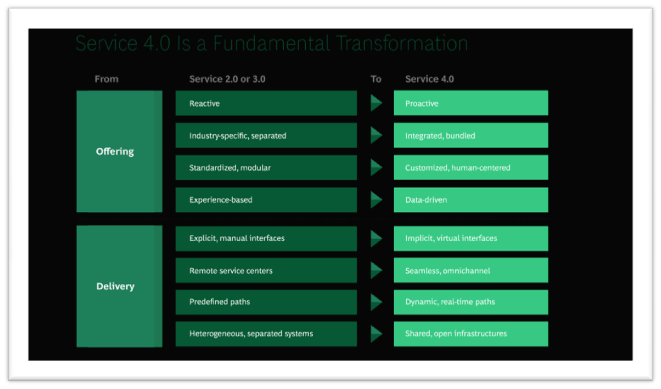
Service 4.0: Transforming Customer Interactions Service 4.0 is a collate term for technologies and idea of service and support function of the organizations; it is based on new disruptive technological concepts, the Internet of Things and the Internet of Services. It is almost similar concept to Industry 4.0 and applied to value chain. The supporters of Service 4.0 profess that it is a vital chance for service companies to make a jump ahead in terms of efficiency and effectiveness, and also an opportunity for service users to discover and benefit from new features, which are impossible to be delivered before. There are two major sectors in the economy: 1. Manufacturing Sector : The goods produced in manufacturing sector includes (i) Agriculture, Forestry and Fishing (ii) Mining (iii) Construction (iv) Manufacturing 2. Service Sector: The service producing sector includes (i) Transportation, Communication and Utilities (ii) Wholesale Trade (iii) Retail Trade (iv) Finance, Insurance and Real Estate (v) Public Administration Service operations are always radically challenged by the invention of new technologies and digital innovations, which have reappraise the standard for customer experience and efficiency and therefore Service 4.0 represents a transformation that helps companies meet consumer needs. Nowadays Customers expect service reciprocity that is simpler or easy, natural and happen in real time. Due to advance technological configuration Service 4.0 makes it possible for the large number of service provider companies across the globe to meet the customer or client demand. Some key benefits of service 4.0 are greater flexibility, faster internet speed, higher productivity and superior quality. The main features that enabled the transformation of service 4.0 and promote greater efficiency: 1. Big Data and Analytics: It will evolve deeper insight of customer or client actions, preferences and passage. 2. Bionic Computing: It will start interact naturally with the virtual agents and services. 3. Ubiquitous connectivity and The Internet of Things: It will create an continuing connection 4. Cloud Computing: It can handle now large volume of data. 5. Cognitive Computing: It can generate computerized models to simulate the human thought process in complex situations. 6. Smart Devices: It can develop apps that can be utilized in high performance devices. 7. Robotic Process Automation: It can use software with artificial intelligence (AI) and machine learning capabilities to handle complex tasks. 8. Virtualization: It can use software that simulates hardware functionality in order to create a virtual system. 9. Augmented Reality: It is a technology that superimposes a computer-generated image on a user's view of the real world, thus providing a composite view.
-
Analysis paralysis is a circumstance in which an individual or group is unable to move forward with a decision as a result of over-scrutinized data or over thinking of a problem. Analysis paralysis can occur with many project decisions, such as accepting or declining projects. The inaction it causes can easily lead to losses in a range of investments or missed chances at larger profits by a person or organization. Everyone in the organization wants to give a perfect solution, but sometimes fear making a decision that could result in error, while on the way to a better solution. Analysis paralysis can occur in both standard and complex situations. It is often depending on the person, who analysis the data or problem that involves an undefined number of alterable. Analysis paralysis may lay in when an individual is unsure of the best practices for identifying an outcome. The situation or problem may also involve an undefined number of variables that result in a random outcome with a low degree of confidence. Thus, in some situations analysis paralysis may be the result of an undefined or unspecific outcome. Extinct by instinct is a situation in which a person or a group making a fatal decision based on hurried or hasty judgment or a gut reaction. Many of the top management sometimes took some decision on their will or gut, without any proper analysis of the data or market survey or not utilizing any SMEs or appropriate tools. The hasty decision sometimes either clicks on target or unfortunate enough to regret. However successful businesses don’t really belong to the world of these two extremes, in fact the role of the successful person is to walk the thin line down the middle. On one side snap decisions based on our own unsound experience on the other the impotence to make a decision caused by over thinking. How to Overcome Analysis Paralysis & Extinct by Instinct 1. Prioritize Your Decisions- Always learn to differentiate between decisions that are vital for your immediate attention and those who you can deal later on the line or track of the organizational goals or objectives. 2. Determine the Goal for Making Each Decision- Sometimes the reason for inability to decide isn’t fear of failure or too much choice; often we just don’t know why we need to make that decision at all. So for this type of particular problems defining goals for making a decision will make it easier to pick from available alternatives. If it’s a low risk decision then keep it lite and if the decision notifies a higher risk means a few more checks are needed. 3. Break Decisions into Smaller Steps- Instead of trying to make a decision in one step, consider breaking it into smaller steps. 4. Forget Perfection- Sometimes, picking a befitting decision is the best decision and ensures that learning from failure should be accepted rather than blame game. 5. Put Healthy Pressure on Yourself and Your Team- If the team is involved in decision making then make them clear before the final session that the decision should be done without any delay during the final meeting. Simultaneously, the team should be empowered to make decisions.
-
The full form of SOP means "Standard Operating Procedure". SOP is a process document and its main purpose is to provide step-by-step instructions on how to perform a particular work/job activity, such as installation of GT, manufacturing of solar panels or record keeping, etc. During initial period of time most SOPs are presented as text documents, but it has been observed that many times the job procedure was not able to understand by certain percentage of technicians or supervisors, as they are the responsible persons those who had to perform the job and therefore, it led to lot of rework and quality issues. So, after thorough investigating, it was found out that the SOPs are either written in very high technical language, lengthy and complicated instructions or sometimes the communication misinterpretation between the working personnel to the supervising personal. Therefore, to avoid such circumstances, the SOPs are written in simple text, small line step content, easy to understand and now they also contain images, small videos and 3D modeling for better understanding and to help clarify the instructions. Instruction creep occurs when instructions from an organization are increased in so much in number and size with time that finally they are uncontrollable. Instruction creep is very common in complex organizations, where rules and guidelines are created by changing groups of people over extended periods of time. The constant state of variability in these groups are often leads them to add or amend instructions, rather than clarifying or integrate the existing ones. This can result in considerable overlap in the message of orders, at the expense of clarity, competence, and communication, or even of stability. Instruction creep can be controlled or avoided in SOPs by keeping policies, procedures and standards transparent and accessible to all employees for most effective outcome. Subsequently additions to policy should not to be considered unless: 1. There should be a real problem that needs solving, not just a hypothetical or recognized problem. 2. If the proposal is implemented is likely to make a real, positive difference or effect. 3. All suggested requirements have a clear concord. 4. All instruction language should be as clear or simple as possible and ensure that addition context are placed in a logical order, and do not obscure the meaning of the surrounding text. 5. It is usually better for the organization that the policy or guideline may to be lenient rather than too strict. As, it will increase the effectiveness / output of the employee and better co-ordination between the employee and employer.
-
Bias is the difference between the measured values against the actual value. Bias can be positive or negative. If the difference between the measured values and the actual value is positive then you have positive bias. If the difference between the measured values and the actual values is negative then you have negative bias. Three types of bias can be distinguished: information bias, selection bias, and confounding Reporting bias means that only a selection of results are included in any analysis, which typically covers only a fraction of relevant evidence. This can lead to inappropriate decisions (for example, prescribing ineffective or harmful drugs), resource waste and misguided future research. Types of Reporting Bias 1. Citation bias: basing your analysis on studies that you find in the citations of other studies. 2. Language bias: ignoring studies not published in your native Language. 3. Location bias: certain reports or studies are harder to find than others. For example, studies that are published in journals might be indexed higher in databases. 4. Duplicate publication bias: studies that are published in more than one place might get more weighting than other studies. 5. Outcome reporting bias: selective reporting of certain outcomes, such as outcomes that paint a company in a good light. 6. Publication bias: studies with positive findings are more likely to be published — and published faster — than studies with negative findings or no significant findings. 7. Time lag bias: some studies take years to be published, especially if they show no effect or have unwanted results. Studies that are positive or newsworthy are published much faster. Reporting Bias can occur in the life cycle of many research and are as follows: Reporting Bias are widespread phenomena in the medical literature. So, the organisations took some preventive measures to safeguard itself from reporting bias. Transparency is the most important action to safeguard health research. Tips to avoid different types of bias during a trial are given below: 1. Clearly define risk and outcome, preferably with validated methods and standardize data collection. 2. Samples should originate from the same general population. 3. Standardize interviewers interaction. 4. Use prospective studies and avoid using historical controls. 5. Use objective data sources whenever possible. 6. Carefully design the plan for lost to follow up. 7. Clearly define exposure prior to study. 8. Validate measures as primary as primary outcome. 9. Consider cluster stratification to minimize variability. 10. Register trial with an accepted trial register. 11. Unknown confounders can only be controlled with randomization.

-
All projects have many issues and these issues or events may have negative impact as well as positive impact to the project. These unknown negative and positive impacts are known as Risks. Every time Risk is always not bad for the project, there are some positive risks also known as opportunity for the project. Moreover, we handle these risks with help of Risk Management Plan. It is a process of identifying risks, analyzing it, response it and implement those responses. So, to analyse the project we have lot of tools and techniques and one such technique is known as Monte Carlo Analysis. When we analyse risk with the available data, we tend to use a model that simulates the combined effects of every single project risks and sources of uncertainty to evaluate their potential impact on achieving the project objectives. Therefore, the simulations are done by using a Monte Carlo Analysis. It is a technique used to understand the impact of risk in forecasting models. Now a days computer software is used to repeat the risk analysis model several thousand times and the output of the analysis can be shown graphically by a histogram or a S-Curve. There are lot more uses of Monte Carlo Simulation beyond the project domain, but for me known a bit application at analysis for schedule risk and cost risk at project except project risk analysis.
(1).thumb.jpg.cf7fa8faabd34aedb58af86f267b3478.jpg)