

Topics
-
AI News from ET - AMD to invest up to $5 billion in Anthropic; AI startup to buy up to 2 GW of chips
AMD has been seeking to expand its foothold in the fast-growing AI chip market as developers look to diversify beyond Nvidia, while Anthropic has been racing to secure computing capacity to meet growing demand for its AI services. View the full article -
A Meta Platforms lawsuit claims AI tools unfairly targeted employees for layoffs. Workers face difficulties proving AI discrimination due to limited access to internal processes. Arbitration agreements often prevent collective legal action and public scrutiny of workplace disputes. These hurdles explain the scarcity of high-profile AI employment lawsuits. Meta denies using AI for layoff decisions, stating humans made all choices. View the full article



Leaderboard
-
Dinesh_Tiwari_WBim
Members1Points5Posts -
Sarvajit_Kadam_vhpT
Members1Points6Posts


Popular Content
Showing content with the highest reputation on 05/07/2026 in all areas
-
View B — Preserve Flexibility I respectfully challenge Bex’s position and support View B — Preserve flexibility. While AI‑enabled standardization brings clear benefits such as consistency, predictability, and scalability, reducing local flexibility can diminish decision quality in complex, human‑centric service environments. The most effective organizations do not replace judgment with AI; rather, they design AI systems to establish a reliable baseline while allowing informed human discretion in contextual situations. In practice, standardization should serve as a foundation—not as a replacement for professional judgment. Why Excessive Standardization Creates Risk AI systems are particularly effective when: Scenarios are repeatable Variables are stable Outcomes are clearly defined However, many large service organizations operate in environments where: Local, cultural, or regulatory contexts differ Customer situations involve emotional or time‑critical elements Exceptions have higher reputational and relational impact than routine cases When local flexibility is significantly reduced, three common challenges arise: Edge cases are managed less effectively AI systems are trained on historical patterns and are less effective in rare or novel situations. Experienced employees feel constrained Skilled professionals may disengage when unable to apply their experience and contextual understanding. Customer trust may decline Rigid responses framed as “system limitations” often lead to customer dissatisfaction, even when decisions are technically correct. Example 1: Healthcare – Clinical Decision Support Systems Many large healthcare providers have implemented AI‑based Clinical Decision Support (CDS) systems to standardize diagnostic and treatment recommendations. Benefits Observed Faster onboarding of junior clinicians Reduction in variation for routine conditions Improved adherence to evidence‑based protocols Challenges Encountered Organizations that enforced strict adherence to AI recommendations encountered: Suboptimal outcomes in patients with multiple or rare conditions Reduced clinician autonomy and increased frustration Resistance to system adoption among experienced practitioners Effective Approach Leading healthcare institutions adopted a human‑in‑the‑loop model, where: AI provides standardized recommendations Clinicians retain authority to override with documented rationale Exception cases are used to improve future models Outcome: Improved patient outcomes, sustained clinician engagement, and continuous system learning. Example 2: Banking – Fraud Detection and Customer Dispute Resolution This example further illustrates the importance of preserving flexibility alongside AI standardization. AI‑Driven Improvements Large banks adopting AI‑based fraud detection systems have achieved: Faster identification of suspicious transactions Reduced fraud‑related losses More consistent application of risk rules across regions Lower operational costs These results clearly demonstrate the value of standardization. Limitations of Over‑Enforcement When AI recommendations are applied without sufficient local discretion: Legitimate customer transactions may be blocked Long‑standing, high‑value customers experience repeated friction Regional spending patterns may be misclassified Frontline teams are unable to resolve cases promptly In such situations, customer dissatisfaction is directed toward the organization rather than the technology. Illustrative Scenario A customer with a long record of international travel makes a high‑value overseas medical payment. The AI system flags the transaction as anomalous and blocks it. Local service staff recognize the transaction as legitimate but are unable to override the decision without escalation. Outcome without flexibility: Delayed resolution, heightened customer stress, and erosion of trust. Institutions That Achieved Better Results Banks that performed well adopted a hybrid decision model: AI identifies and flags risk Experienced analysts can override decisions with appropriate justification Customer history and regional context are considered Overrides are incorporated into ongoing model improvement Result: Strong fraud protection combined with improved customer satisfaction and retention. Contextual Limitations of the Rolls‑Royce Example The Rolls‑Royce example cited by Bex is highly relevant for environments that are: Technically deterministic Heavily regulated Low in contextual variability However, many service operations—such as healthcare, banking, insurance, and customer support—are: Context‑dependent Trust‑based Exception‑driven Influenced by human behavior and emotion As such, a fully standardized approach is less suitable in these domains. Recommended Operating Principle The core question is not whether AI or humans should decide, but rather: Where should variability appropriately reside within the decision system? High‑performing organizations conclude: AI should standardize processes and recommendations Humans should contextualize and finalize decisions Exceptions should be treated as learning opportunities instead of failures Suggested Decision Framework Tiered Decision Authority Model Tier 1 (70–80%) AI fully automates routine, low‑risk cases. Tier 2 (15–25%) AI provides recommendations; humans make final decisions. Tier 3 (~5%) Human‑led decisions for complex or exceptional cases, with AI documentation and learning. This approach balances efficiency, expertise, adaptability, and trust. Final Perspective I support View B — Preserve flexibility. AI should be used to: Improve consistency and efficiency Reduce avoidable errors Support and enhance professional judgment Learn continuously from real‑world exceptions Organizations that remove local discretion may achieve short‑term uniformity, but they risk losing long‑term resilience, employee engagement, and customer trust. Sustainable success lies in intelligent flexibility supported by standardized systems, not in standardization alone.1 point
-
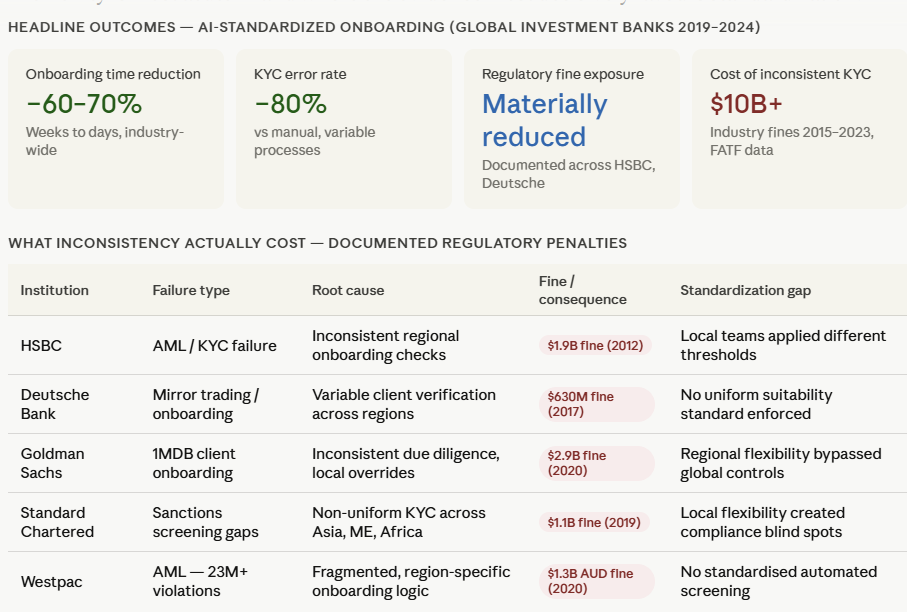
I will go with View A- Embrace standardization. Consistency improves quality, reduces errors, and makes scaling easier. Standardized AI-driven decisions are more reliable than variable human judgment. When a global investment bank onboards a high-net-worth client onto a trading platform, the cost of inconsistency is not only different customer experience, but also a regulatory breach, a compliance failure, or a reputational event. In that environment, standardization is not a constraint. It is the foundation on which trust is built. If I talk about View B, it frames standardization as the enemy of good judgment. But this framing misunderstands what standardization actually does in a complex, regulated, multi-region operation. Standardization does not eliminate judgment, it elevates it. It removes the low-value variability that comes from inconsistent training, individual habit, and regional interpretation of rules, and it creates the headroom for genuine human judgment to operate where it truly matters. Sharing an example of AI-driven client onboarding in wealth management trading platformsThe most compelling evidence for View A comes directly from the client onboarding operations of global investment banks, specifically, the Know Your Customer (KYC), Anti-Money Laundering (AML), suitability assessment, and account activation workflows that govern how high-net-worth and ultra-high-net-worth clients are brought onto trading platforms. Sharing few reasons how standardization wins and creates an impact: Impact: Regulatory and legal. In the five cases documented above — HSBC, Deutsche, Goldman, Standard Chartered, Westpac — the combined regulatory penalty exceeded $7.8 billion. Every single case was rooted in regional inconsistency of onboarding and client verification standards. AI standardization is not just an efficiency measures, it is a legal liability reduction strategy of the first order. Impact: Client experience. The wealthiest clients in the world operate across multiple jurisdictions. They choose banks that deliver the same quality of rigor and speed regardless of where they are being served. When UBS standardized its onboarding, its NPS scores improved — because clients experienced consistency as quality, not as inflexibility. Impact: Operational scalability. A bank expanding wealth management into a new market must currently rebuild institutional knowledge, train local compliance teams, and hope that standards transfer correctly. With AI standardization, the engine carries the standard automatically. Expansion becomes a deployment exercise, not a capability-rebuilding exercise. This is a fundamental shift in how global financial institutions can grow. Impact: Talent and training. When the standard is embedded in AI, new relationship managers learn from a reliable, consistent framework from day one. JPMorgan saw a 40% reduction in onboarding training time. This is not because people learn less, it is because they learn the right things consistently, rather than absorbing the idiosyncratic habits of whoever trained them. Impact: Auditability and governance. In a regulatory environment defined by MiFID II, FATF standards, GDPR, and local central bank requirements, the ability to reconstruct every onboarding decision from a complete, structured audit trail is not optional it is the minimum standard. Manual, flexible processes cannot provide this reliably. AI-standardized processes produce it automatically. The global investment banks that have committed to AI-standardized onboarding are not sacrificing quality for efficiency. They are doing something more important using human intelligence: they are making their best practice available to every client, in every region, on every onboarding, every single time. That is what a premium wealth management institution owes its clients and its regulators. Embrace standardization!
 1 point
This leaderboard is set to Kolkata/GMT+05:30