

Topics
-
OpenAI, which is expected to need about 3,200 megawatts (MW) of power for its new facility, has agreed to provide up to 1,000 MW to the Southern Co subsidiary Georgia Power's systems in times of high demand. View the full article
-
The affected startup, Hugging Face, said it had turned to Zhipu AI's open-source GLM-5.2 model last week to analyze data from the hack after leading US AI models declined the task, unable to distinguish between a defender and an attacker. View the full article


Leaderboard
-
Mike
Members1Points11Posts -
Sachin Tanwar
Members1Points33Posts


Popular Content
Showing content with the highest reputation on 12/17/2024 in all areas
-
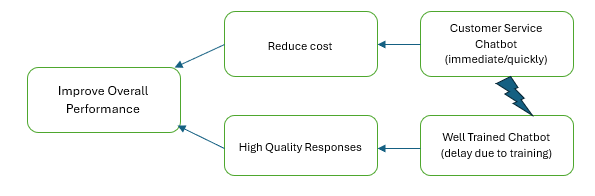
1 pointEvaporating Cloud Technique is a conflict resolution technique that is one of the processes of Theory of Constraints. It was introduced by Dr. Eliyahu Goldratt to solve difficult problems that have no clear solution. It resolves the conflict by stating both sides of the problem and reviewing the underlying assumptions that create the conflict. The EC diagram depicting the current problem statement is shown below., Here the conflict arises from two opposing needs, but the goal is the same to improve overall performance NEED A: To deploy customer service chatbot to reduce cost immediately NEED B: To delay deployment so that a well trained chatbot that gives high quality responses is deployed Let us now state the underlying assumptions., a) Deploying the bot quickly will save cost but stand the risk of low customer experience b) Delayed deployment of bot due to training ensures high quality responses but does not give immediate saving c) Reducing cost and getting high quality responses are mutually exclusive d) If chatbot is deployed it cannot learn quickly and improve on quality We need to a challenge the above assumptions to find a win-win solution. Challenging the above we see that we can build a solution that will address both goals. 1) To mitigate issues caused by delayed deployment and to also ensure high quality response, we can deploy the bot in phased manner to address such simpler queries to start off with and parallelly train the bot on much complex queries as it continuously learns over time. This ensures that quality is not compromised, and immediate savings are also realised 2) We can also do a Pilot testing by deploying the bot for limited section of the customers thereby avoiding potential risks or at least minimizing it. This will help improve quality in the long run before full deployment and save cost immediately 3) We can also use Human in loop to answer complex queries and let the chatbot handle much simpler queries ensuring customer trust 4) We can also use the feedback loop post launch and improve the chatbot performance over a period making it handle simple and complex queries. This ensures continuous or real time learning Hence the company can design a Phased and iterative solution to save reduce costs and sustain acceptable quality. This approach stated above will bring in a win-win situation to the company ensuring benefits in terms of reduced cost in the short run and better customer experience in the long run.
 1 point
 -
1 pointThe evaporating cloud technique enables us to see the unseen. In the case of deployment of AI chatbots, we should cautiously keep in mind the sensitive stability among price performance and most fulfilling consumer service. To use the evaporating cloud technique, we can split down the problem into its fundamental assumptions: Assumption 1: Quick deployment is required to cut costs immediately. Challenge: Can a phased deployment plan strike a compromise between cost reduction and quality assurance? For example, launch a limited version of the chatbot for specific, low-risk requests while training it for more complicated conversations. Assumption 2: To provide high-quality responses, substantial training is required. Challenge: Can machine learning techniques be utilised to speed up the training process? The chatbot could be taught more effectively using massive datasets and new algorithms, thereby lowering the time required to reach high-quality performance. Assumption 3: Cost-cutting and quality are mutually exclusive. Challenge: Can creative solutions be developed to do both; cost cutting and maintain quality? possibly outsourcing certain chatbot duties to a third-party supplier or leveraging open-source tools could save money while also investing in worldly-wise AI techniques to increase quality. By challenging above mentioned assumptions, we are able to open up to new options and doubtlessly obtain a win-win outcome. In this scenario, a balanced method that mixes speedy deployment and non-stop development can be the great choice. This could permit the corporation to make short price discounts even as keeping long-time period purchaser happiness. The evaporating cloud approach is more than a problem-fixing tool; it is an attitude that believes that disputes are regularly because of tunnel vision, and that with the aid of testing our assumptions, we are able to find out solutions we in no way considered ever before.1 point
This leaderboard is set to Kolkata/GMT+05:30