

Topics
-
AI News from ET - AMD to invest up to $5 billion in Anthropic; AI startup to buy up to 2 GW of chips
AMD has been seeking to expand its foothold in the fast-growing AI chip market as developers look to diversify beyond Nvidia, while Anthropic has been racing to secure computing capacity to meet growing demand for its AI services. View the full article -
A Meta Platforms lawsuit claims AI tools unfairly targeted employees for layoffs. Workers face difficulties proving AI discrimination due to limited access to internal processes. Arbitration agreements often prevent collective legal action and public scrutiny of workplace disputes. These hurdles explain the scarcity of high-profile AI employment lawsuits. Meta denies using AI for layoff decisions, stating humans made all choices. View the full article



Leaderboard
-
Chandra Shekhar Chauhan
Members1Points11Posts

Popular Content
Showing content with the highest reputation on 08/12/2022 in all areas
-
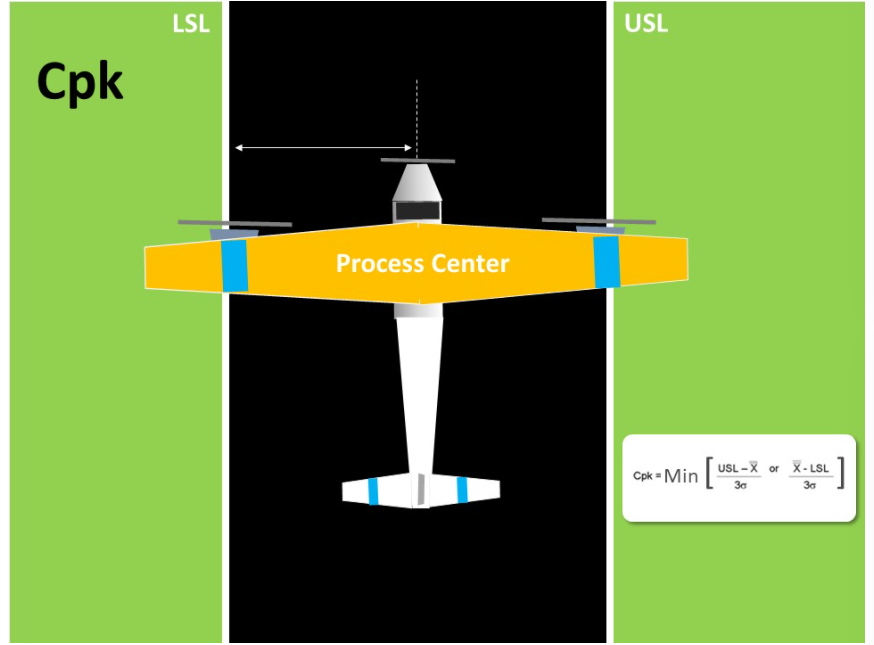
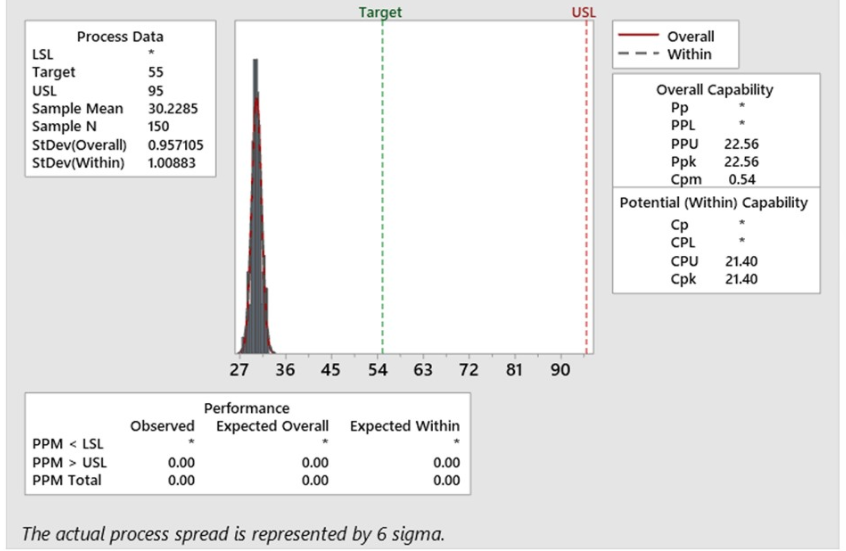
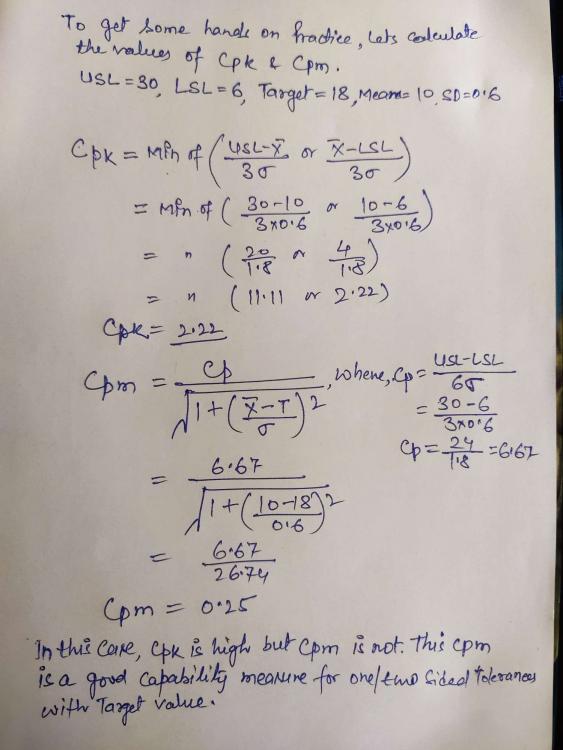
1 pointYes, it is true that Capability Matrices (Cp & Cpk) are more relevant for manufacturing Industries where it is common to get 2 sided specification limits. These indices do not adequately address the issue of process centering. Foe addressing this issue, an alternative definition of Cp advocated by Taguchi. Taguchi introduced the name Cpm for the Taguchi Index and examined statistical properties of an inefficient estimator under the assumption that the process mean coincides with the target value. Cpm is now another interesting process capability metric that is not very popular. In fact it is more robust than Cpk. Cpm is an advanced measure and it corrects some deficiencies in Cpk. It is also called as Taguchi Capability Measure. We can easily understood the difference between Cpk and Cpm with this below Illustration and formula; Cpk Cpk is considered as a measure of the process centering for any process. If we closely observe the Cpk formula, it does not require the actual target value. target value is the center value obtained from the customer Given or design specification. However it takes the LSL, USL & Process mean. In this way, we can say that this is an indirect method of assessing if the process centered to the tolerance. In the above picture, in order to know if the plane is landing exactly on the middle of the landing strip, we look at the distance of the plane's nose from either edge of the strip. That is good but it's only an indirect way of assessing the process center. Cpm If we look at the above picture and formula of Cpm, it contains the target value. Thus in addition to obtaining the USL and LSL from the customer or Design, we also obtain the Target Value. This means, Cpm is a true process capability index, because it compares the difference between process mean and target Value. To draw an image for plane landing, we are comparing the plane's nose to the median line of the strip. Lets take an example, where there is only a specification on one side. In most business processes, service levels have only an upper or lower specification. In some cases, Cpk losses its significance. However, in all service scenarios, there is a target value. For example, Customers are told that payment will be updated in 4 hours but the internal target is to get it done in 2 hours. Process is designed for 2 hours. In such scenarios, Cpm will be a relevant centering metric. In this scenario, Cpk is high, but Cpm 0.54 is very less value as comparison to Cpk 21.40. Here Cpm is very sensitive and good capability measure while Cpk is not. To get some hands on experience, lets calculate the value of Cpk and Cpm for another service industry; Below are the few examples of use of Cpm (Taguchi Capability Measure) in Service Industry, where we generally have one sided specification with Target Value; - Resolution time less than X hours - Call time less than X minutes - Payment update in less than X hours - Number of min order places per hours - Number of max. calls in waiting and so on .........

 1 point

This leaderboard is set to Kolkata/GMT+05:30