

Topics
-
The latest setback has fueled worries that Google was losing momentum just as OpenAI and Anthropic and a host of Chinese rivals have accelerated the pace of model releases. On the call on Wednesday, Pichai struck an unusually defensive tone as analysts pressed him on the state of Google's frontier models and whether they could still compete at the cutting edge of AI development. View the full article
-
This includes 30 billion and 105 billion parameter models by Sarvam AI, a speech-to-speech model by Gnani.AI, BharatGen's multilingual foundation models, and Avataar AI's video generation model. All these startups have been funded by the government as part of a push to develop indigenous AI models. Of the 20 models, five have been released so far. View the full article



Leaderboard
-
Vishwadeep Khatri
Administrators3Points6,717Posts -
Kaviraj
Members1Points10Posts

Popular Content
Showing content with the highest reputation on 07/12/2022 in all areas
-
2 pointsQ 485. Cobots are extensively being used in Manufacturing industries. What are cobots? How are they different from traditional robots? Do cobots have any utility in service industry? Note for website visitors - Two questions are asked every week on this platform. One on Tuesday and the other on Friday. All questions so far can be seen here - https://www.benchmarksixsigma.com/forum/lean-six-sigma-business-excellence-questions/ Please visit the forum home page at https://www.benchmarksixsigma.com/forum/ to respond to the latest question open till the next Tuesday/ Friday evening 5 PM as per Indian Standard Time. Questions launched on Tuesdays are open till Friday and questions launched on Friday are open till Tuesday. When you respond to this question, your answer will not be visible till it is reviewed. Only non-plagiarised (plagiarism below 5-10%) responses will be approved. If you have doubts about plagiarism, please check your answer with a plagiarism checker tool like https://smallseotools.com/plagiarism-checker/ before submitting. The best answer is always shown at the top among responses and the author finds honorable mention in our Business Excellence dictionary at https://www.benchmarksixsigma.com/forum/business-excellence-dictionary-glossary/ along with the related term2 points
-
1 pointQ 482. Explain the KT Analysis method of problem solving using an example. Does it provide any advantage over other problem solving approaches? Note for website visitors - Two questions are asked every week on this platform. One on Tuesday and the other on Friday. All questions so far can be seen here - https://www.benchmarksixsigma.com/forum/lean-six-sigma-business-excellence-questions/ Please visit the forum home page at https://www.benchmarksixsigma.com/forum/ to respond to the latest question open till the next Tuesday/ Friday evening 5 PM as per Indian Standard Time. Questions launched on Tuesdays are open till Friday and questions launched on Friday are open till Tuesday. When you respond to this question, your answer will not be visible till it is reviewed. Only non-plagiarised (plagiarism below 5-10%) responses will be approved. If you have doubts about plagiarism, please check your answer with a plagiarism checker tool like https://smallseotools.com/plagiarism-checker/ before submitting. The best answer is always shown at the top among responses and the author finds honorable mention in our Business Excellence dictionary at https://www.benchmarksixsigma.com/forum/business-excellence-dictionary-glossary/ along with the related term1 point
-
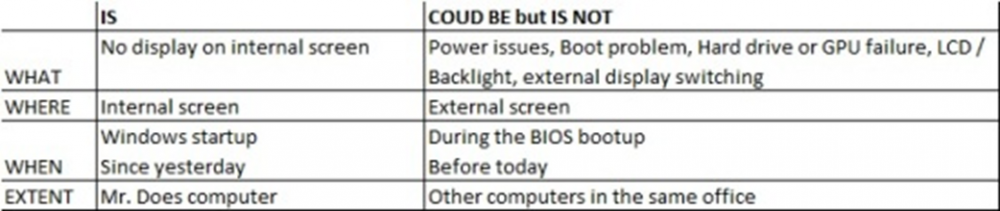
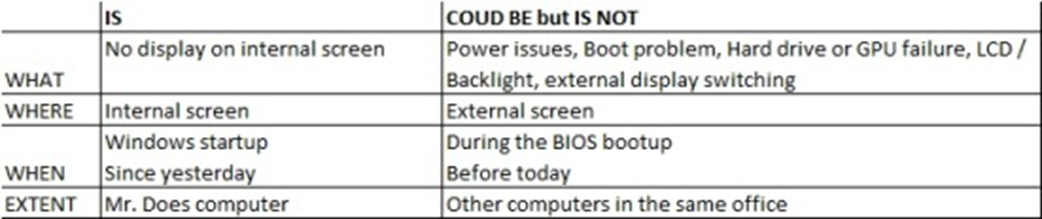
1 pointK-T method or the Kepner – Tregoe method is a systematic method to analyse the problems and understand their root causes, without making any assumptions or jumping to the conclusions. Usually, 5 steps are there in Kepner-Tregoe Problem Analysis, (1) Define the Problem, (2) Describe the Problem, (3) Establish possible causes, (4) Test the most probable cause, (5) Verify the true root cause 1. Define the Problem, This is the first step in this process and the most crucial one too, many people tend to skip this step thinking they know the problem already, such conclusions may lead to a wrong diagnosis and waste of time. For example, if an employee reports “My computer screen is blank” to an IT person. K-T method guides us to ask a few basic questions that can expose far more information about the nature of the problem and helps us to define the possible causes effectively. Let’s expand this further with a few basic questions, Let’s assume these answers to expand the problem definition from “My computer screen is blank” 1. Who - Mr. Moorthy 2. Why - Needs to see his screen so he can perform his duties, 3. What – The computer screen went blank when booting up and nothing appears on the screen and the start-up sound was heard. 4. When - Morning when he came for work, it was working fine till the previous evening. 5. Where - Mr. Moorthy’s computer. Let’s restate the problem definition. “Mr. Moorthy is unable to perform his duties because his screen goes blank during boot it worked well till he shut it down yesterday” The above statement is a much better problem description, which allows us to understand exactly what the problem is and allows us to narrow down the questions that will help us to understand the impact as well. A brief simulation before the problem statement will also help, Example. why would the screen be blank? The reasons could be, a) The graphics card could have failed? · Ans, no the computer wouldn’t boot, it would give 3 loud beeps then stops. b) The screen could be faulty? · Ans, no the manufacturer’s logo appears at first then the screen goes blank. c) Hard Drive could be faulty and the computer doesn’t boot? · Ans, no we hear the windows start-up music. d) The backlight might have failed and the screen is dark? · Ans, no the logo appears perfectly visible. e) The display could be switching over to an external screen? · Ans, no we can see everything on external display but when we switch to internal it’s still blank. Let’s restate the problem definition now, “Mr. Moorthy is unable to perform his duties because his internal screen goes blank when Windows is starting since he shut it down yesterday” 2. Describe the Problem, Let’s describe 4 aspects of any problem, 1. What the problem is, 2. Where the problem occurs, 3. When it occurred, and 4. The extent to which it occurred. We, already have the answers for these questions when we fine-tuning our Problem Definition, but the IS and IS NOT method is allowing us to explore these even further. For the above-mentioned aspects, let’s describe what the problem IS, and also what the problem COULD BE but IS NOT. Let’s fill out the table for the problem we have taken, 1. Identify possible causes The arrived comparison of “what the problem IS and IS NOT” will help us to sensibly inspect what changes could have affected the items in the 1st column but not the items in the 2nd. Our own experience will tell us the majority of the problems are because of the recent change, let’s add 2 more columns to the worksheet, the ‘Differences’ column will list the differences between the IS and IS NOT, and the ‘Changes’ column will list the changes to where the problem IS that could account for the differences. Another important aspect is that the effects don’t always follow the action immediately, most recent changes could have uncovered the fundamental problems that were always there, so when considering the list of changes we should not limit ourselves only to recent ones. 1. Test most probable causes The list of changes identified in the previous step will become a list of possible causes and a Subject Matter Expert ranks the possible causes by asking “If THIS is the root cause of this problem, does it explain everything the problem IS and what the problem COULD BE but IS NOT?” In our example, 1. Verify true cause In this step we need to compare the probable causes against the Problem Description and check does it satisfy all the conditions of the problem or not? When we find a cause that explains all these conditions, we must test it to confirm whether it is correct with the procedure in the ‘True if’ column starting with the most probable cause. When we are confident that all the identified root causes of the problem, then we need to develop a solution and check if we are satisfied this would prevent any reoccurrence of the problem. If we agree that we are satisfied then implement the solution, and test the problem again under the same conditions, does the issue still occur? In our example, we have determined the problem with the display is due to a recent driver update which was installed but did not take effect until Mr. Moorthy had restarted his computer. As a corrective action we may attach an external screen and uninstall the driver update and restart the computer, issue is resolved, but has the root cause been addressed? It is not appropriate to ask all the employees not to update the drivers, hence as an immediate action we can ensure Mr. Moorthy does not install this driver again. and as a preventive step we may notify all the employees who has similar type of computer that they should not install this driver until further notice. Conclusion, The purpose of this method is to bring situational awareness to the solution/opportunity. This method advocates a balanced and systematic approach to analyse the problem without jumping to conclusions or making assumptions based on experience. Compared to other methods one of the biggest advantages is the IS and COULD BE but IS NOT procedure which provides an intuitive approach to identify the possible causes of a problem. This process may be faster than the other methods on the other hand it may be harder if not impossible to detect delicate variations in a process, hence this method needs to be implied sensibly.


 1 point



This leaderboard is set to Kolkata/GMT+05:30