

Topics
-
AI News from ET - AMD to invest up to $5 billion in Anthropic; AI startup to buy up to 2 GW of chips
AMD has been seeking to expand its foothold in the fast-growing AI chip market as developers look to diversify beyond Nvidia, while Anthropic has been racing to secure computing capacity to meet growing demand for its AI services. View the full article -
A Meta Platforms lawsuit claims AI tools unfairly targeted employees for layoffs. Workers face difficulties proving AI discrimination due to limited access to internal processes. Arbitration agreements often prevent collective legal action and public scrutiny of workplace disputes. These hurdles explain the scarcity of high-profile AI employment lawsuits. Meta denies using AI for layoff decisions, stating humans made all choices. View the full article



Leaderboard
-
RahulGarg
Members2Points28Posts -
Sai Kotari
Lean Six Sigma Black Belt1Points11Posts -
Vishwanath Oleti
Lean Six Sigma Black Belt1Points10Posts



Popular Content
Showing content with the highest reputation on 07/27/2021 in all areas
-
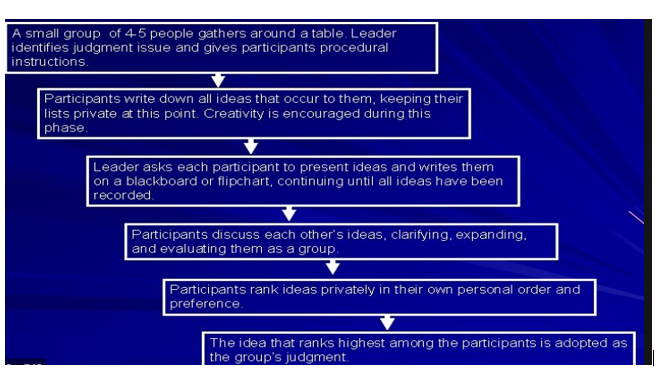
2 pointsDelphi method was initially conceived in 1950s by Olaf Helmer and Norman Dalkey of RAND (Research and Development) Corporation. This name came from Oracle of Delphi, a priestess at a temple of Apollo in ancient Greece known for her prophecies. Delphi method allows experts to work towards a mutual agreement by series of questionnaires rounds and providing related feedback to further progress the discussion with each round. The experts' responses may change as rounds are completed based on the information put forward by other experts participating in the analysis. Flow of the Delphi method is as depicted hereunder : Key Steps in Delphi method: i) Facilitator selects the team of experts based on the topic being covered ii) Once all participants are confirmed, each participant is sent a questionnaire with instructions iii) Participants / Experts comment on each topic based on their personal opinions, experience, or previous research. iv) The questionnaires are returned to the facilitator who groups the comments and prepares copies of the information. v) Collected comments are sent to each participant and they can comment further on the same vi) At the end of each comment session, all questionnaires are returned to the facilitator vii) Facilitator decides if another round is necessary or if the results are ready for publishing viii) The questionnaire rounds may be repeated any number of times as necessary to achieve a general consensus. ix) Conclude the final result / outcome of the process In contrary to Delphi method, Nominal group technique (NGT) is a structured method for group brainstorming that encourages contributions from everyone and facilitates quick agreement on the relative importance of issues, problems, or solutions. Here the team members start by writing down their ideas, then selecting which idea they judge is the best. Once team members are ready, everyone shares their favorite idea, and the suggestions are discussed and prioritized by group using a point system. NGT consolidates the importance ratings of individual group members into the final weighted priorities of the group. When NGT is used ? · Some group members are much more vocal than other group members · Some group members has the tendency to think better in silence · There is concern about some members not participating in discussion · The group does not generate quantities of ideas comfortably · Some of the group members or all members are new · The issue is controversial or there is heated conflict or disagreement Steps in NGT : When Delphi Technique is preferred over Nominal Group Technique (NGT) : i) When the decision to be taken are strategic in nature and lot of scenarios and subjectivity is involved before reaching to the final consensus. E.g. Mergers and Acquisitions of companies, New Product Development, Foraying into new Geographies and segments for Existing Product Penetration. ii) Complex Problem which needs opinions from the experts from the different fields. E.g. Staring a new company, Choosing a career option, Doing a large investment in any company / sector. iii) When its not possible to interact face to face and experts are located across the different parts of the world. E.g. Building the vaccine during the Corona-virus pandemic, Organisation of any big event such as Olympics, Commonwealth games. iv) When there are severe consequences of the decision going wrong and there is no room of error. You want it right first time anyhow. E.g. Final of any big event like Olympics, World Cup, treatment of the patient in ICU / at last stage etc. v) When an innovative / new product to be launched within the shorter time period / timelines. E.g. Adoption of New technology – Mahindra moving to Electric Vehicle Segment, Amazon moving to E Commerce Sector / Cloud Segment with AWS etc.

 2 points
 -
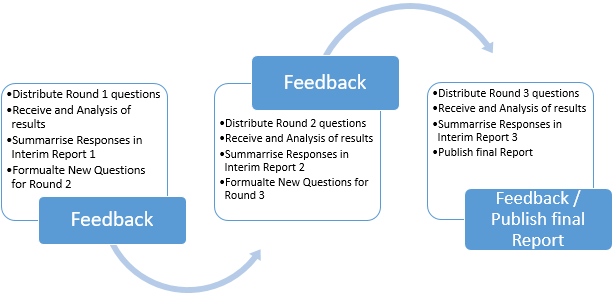
1 pointIn a competitive business environment today, business always seek to the expertise advice and appropriate solution to identify and mitigate the business risk. Delphi Technique is a qualitative research technique or also termed as Risk identification tool, originally conceived by Olaf Helmer and Norman Dalkey. It is a participation technique involving iterative process where we try to seek advice and try to incorporate others point of views with the aim of getting subject matter experts to reach consensus. Thus it’s a survey method where we ask the experts series of questions and these experts (may or may not be the project team members) have to share their opinions anonymously. We can evaluate their opinions with the project team. Thus Delphi Technique is a method that allows experts to respond to questions to reach other until reaching agreement on an issue. However, to drive such discussions with the experts, there are 2 key challenges; 1. Experts difficult to have physical meeting 2. Experts might affect by dominant individuals Hence to overcome these challenges, a series of questions delivered to participants via email. This also provides anonymity to participants, thereby encouraging idea generation and reduce dominance by a particular individual. Implementation of Delphi Technique; Although there can be variations on how the method can be applied, there are always certain common distinct characteristics 1. Choose a facilitator 2. Identify and select a group of experts ü The selected participants must be experts in that field and must have great interest. Besides the technique required to form a group of multilateral, they are responsible for giving, collecting, analyzing and summarizing information. 3. Create a list of questions to a problem you trying to solve ü Moderators will need to set questions related to the risks which needs to be identified and these questions are sent to the participants. 4. Send the questions to the experts anonymously. 5. Collect feedback, analyze and compile information. Create another set of questions that will bring all the experts to one point of view. ü The process of Delphi Technique goes through 2 or more sequential rounds. The moderators will monitor, manage, and analyze the feedback along the process. o Round 1. Participants answer the open end questions and submit to the moderators in the specific time given. Moderators need to convert the collected information into well structure questionnaire. o Round 2. Participants receive the questions modified in the first round. In this stage participants required to make a rating of 1 to 10 according to priorities among items. Moderators collect the response, analyze it and make a summary. o Round 3/4. Participants receive the rating summary along with a summary chart. Participants identity the area of agreement and disagreement. Participants are also asked to revise their judgment and specify the reasons for remaining outside the consensus. The responses are analyzed and summarized and feedback to participants for reactions until participants reach an agreement. While Delphi Technique is suitable for small group discussions, discourages domination in decision making process, ranking methods are utilized and enables virtual meetings, the below differences would help us understand and decide when to prefer Delphi Technique over Nominal Group Technique; Delphi Technique Nominal Group Technique The participants of group discussions must have certain level of knowledge towards discussions topic to ensure the quality of idea generated Anyone can be the participants as long as they are involved in the discussions Can be quite slow and time consuming process. Not only slower than face to face meetings but also the time taken to reach consensus takes a longer time as compared to Nominal Group Technique as iterations need to undergo to ensure the best quality of the questionnaire to obtain the best result in identifying risk Time taken to reach consensus is short in order to identify the risk as soon as possible in the discussion after considering everyone’s opinion. There is passive communication as the decision making is on questionnaire results. Anonymity is present to encourage cooperation of the participants in answering questionnaire and to avoid replications among individual panelist Decision making is based on face to face communication. The anonymity does not exist as the identity of the participants is exposed during the discussion.
 1 point
 -
1 pointDelphi Technique is a systematic consensus building method for a problem or future event by generating opinions and forecasts which involves structured interaction with a group of experts. Uses a highly engaged communication process in allowing a group of experts to participate in problem solving. This is used in combination or by itself for decision making mostly in organisations that are geographically diverse. RAND corporation invented this technique to forecast the impact of technology on warfare. Advantages: · This technique generates number of independent judgements without face to face meeting · It leverages resources across geographies and departments · Investment of time and cost related to face to face meetings is avoided · Experts can adjust their answer each round based on group response · Addressing three main problems with Focus groups and/or brainstorming – o dominant personalities, o Group pressure, ideas are overrun and subverted by the group, o noise as it’s difficult to keep focus group on topic o Sometimes conclusions and ideas deviate from the objective Disadvantages: · As this process is time consuming, it cannot be used for situations that require speedy decision. · Expert opinion is a belief that may or may not be true · Does not develop the rich array of alternatives · Consensus does not always mean the correct answer, Common ‘everybody agrees’ so may be this is right. Even if everybody agrees, the solution is wrong · Internal validity or reliability is largely unknown · Lacks the advantages of live discussion – understanding and assessing each view point Planning and considerations of Delphi Study Due to lack of single methodology and lack of guidance, proper planning is critical. Following needs to be planned: · Understanding the need – What problem it solves and why do we need it · Design of the survey tool – as communication is survey based, selecting a proper tool that is easy and reliable is important. Followed by pilot test of the tool for its reliability and validity · Size of expert panel · Implication on lack of anonymity · Level of consensus – Definition and rules on how consensus will be arrived based on data/information from the survey. · Timeline – Usually takes 2 weeks between rounds, so consider a larger timeline for entire process Delphi Workflow: Following steps involved in the process: 1. Problem indications - A precise and comprehensive definition of the problem 2. Select facilitator - A neutral person, familiar with subject, knows process of data collection and analysis 3. Select experts - 15-20 experts who have knowledge and experience, capacity and willingness, sufficient time to participate 4. Round 1 - Questionnaire - Open ended questions (4-5) for idea generation. Can be replaced with focus groups or face to face interview 5. Qualitative analysis - Ideas collated, summarised, and grouped based on similar viewpoints 6. Round 2 - Questionnaire - Closed ended questions created based on information from round 1. Ranked based on importance and agreement, and sent back to experts for feedback 7. Consensus? Else, repeat round - Rules of consensus is prerequisite to initiative DT. Continue rounds till consensus is obtained. 70% response rate preferred. 8. Conclusion & Inference - Rank statements reached consensus from high to low. Use descriptive techniques such as plots for Inference. Before we look at uses of Delphi and Nominal Techniques, lets understand Nominal Group Technique in Brief: This is a group brainstorming process that encourages participation from everyone. Effective way of pooled judgement or decisions in a group that meets face to face. This technique can generate many creative ideas. It allows every member of the group to express their ideas while minimising the influence of the other participants. A common challenge of Nominal group technique is managing discussions. Discussion if not balanced, conversation may turn into argument. Facilitator should remember that the primary purpose is clarification and not to resolve difference of opinions Advantages of Nominal Technique: · Decision-making process is shorter · Participants know each other, they get opportunity for equal participation · Distractions avoided · Ideas are visible to all Steps involved in Nominal Technique: · Generate: Objective shared and discussed to generate as many ideas as possible · Record: Members record their ideas and share · Discussion: Each recorded idea discussed to determine clarity and importance · Voting: Participants vote on ideas, and help prioritise When do we use these techniques: Use of Delphi Technique Use of Nominal Technique Recap of Delphi Technique: Expert ideas taken anonymously and passed around the group until a consensus is met. Participants are physically distant, no interaction between the experts, individual response is recorded, and consensus is arrived. · To get consensus in a large group where difference of opinion may not resolve through discussions · To shortlist priorities, usually for future events · Develop policy - When there is no clear-cut resolution of a given policy issue · To avoid investment of time and cost related to face to face meetings · If decision making involves people from all geographies, various departments · To build consensus for a particular group · Should only be used on absence of Analytical technique · When we have longer duration for decision making as this technique takes time Recap of Nominal Technique: Allows each member to write down and present the idea to the group, ideas made visible to all. Participants get to know each other as they meet face to face. Ideas are ranked and consensus made. · To generate lot of ideas · To allow group thinking specially for introverts and extroverts - some groups are vocal, some think in silence · Where members do not participate in surveys · If group does not generate ideas (normally) · If some team members are new to the group · When you want to identify priorities and select few alternatives · When time available for consensus is short and needs immediate implementation Conclusion: As a lean six sigma consultant, we are always faced with problems that needs out of the box thinking, fresh perspective, innovative solutions. It’s important to use “Divergent” and “Convergent” thinking to do this. Divergent thinking allows generation of lot of potential ideas, solutions and possibilities which is commonly known as brainstorming. While convergent thinking involves evaluating those options and choosing more relevant one. We must consider using combination of these two methods to develop new ideas and solutions. As using just one-way thinking could lead to unbalanced or biased decision. Hence combination of Delphi with Nominal technique would be ideal by leveraging its strengths, which also includes brainstorming to allow maximum innovative ideas with deeper understanding of its capabilities.1 point

This leaderboard is set to Kolkata/GMT+05:30