

Topics
-
Fifty-five women engineering students completed an AI bootcamp focused on rural Karnataka. Participants developed AI-based solutions after visiting villages and conducting field interviews. The She Innovates bootcamp partnered with several organizations to achieve its goals. This initiative aims to boost women's participation in AI and entrepreneurship. It encourages AI applications for rural development and community-focused sectors. View the full article
-
Besi's quarterly orders more than doubled, fueled by AI and hybrid bonding technology. The company saw increased customer adoption of its advanced chip packaging solutions. Demand for AI applications continues to drive growth in data centers. Besi anticipates revenue growth between ten and fifteen percent. This strong performance aligns with other semiconductor sector reports. View the full article



Leaderboard
-
subodh tripathi
Members1Points9Posts

Popular Content
Showing content with the highest reputation on 01/29/2021 in all areas
-
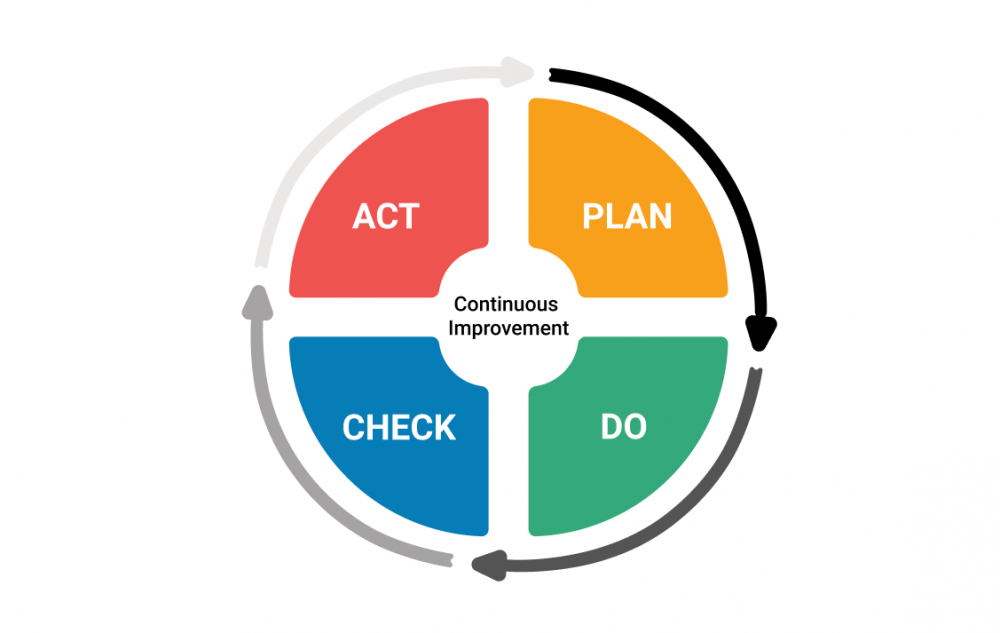
1 pointThe PDCA cycle or loop is mainly an empirical technique that can be used in a fully internal way with great success where there is largely a full data set. To make the PDCA loop work, one does not have to consult the external environment or adapt to unfolding circumstances. With the knowledge that is available, PDCA can be used with great success on the factory or laboratory floor. Analysis in PDCA requires the use of a more or less comprehensive collection of data to draw efficient conclusions. To confirm or deny the hypothesis that our research has led us to, we use the data to make a decision about how to proceed, then we verify and act. This supports Continuous Improvement's structure and criteria. You can solve problems and execute solutions in a systematic, methodical way using the PDCA loop. Let's look in turn at each of the four stages: 1. Plan: Identify the problem or opportunity first. Perhaps the quality of a finished product is not high enough, or better outcomes should be an aspect of the marketing process. Explore in detail the available information. Generate ideas and screen them and establish a detailed implementation plan. Be sure to mention and make the success criteria as observable as possible. Later in the Check Point, you can return to them. 2. Do: Test it safely with a small-scale pilot project until you've found a possible solution. This will illustrate whether your planned changes produce the desired result, or they did not, with minimal disruption to the rest of your service. For instance, within a department, in a small geographical region, or with a specific population, you might arrange a trial. Gather details as you run the pilot project to demonstrate whether or not the change succeeded. In the next step, you'll use this… 3. Check: Next, review the outcomes of your pilot project against the goals you established in Phase 1, to determine whether your concept was a success. If not, go back to Stage 1. If so, move on to Step 4. You may decide to try more changes and repeat the phases of Do and Check. But if your original idea obviously does not succeed, you're going to need to go back to Phase 1. 4. Act: This is where you get your solution applied. But note that PDCA/PDSA is a loop, not a beginning-and-end process. The new baseline becomes your improved method or product, but you continue to search for ways to make it even better. OODA loop is more concerned with synthesizing an action from a data set that is incomplete. Since we are required to deal with all the variables in any environment such as COVID-19 that cannot be recognized, we must therefore be able to make a decision that we think will give us the highest likelihood of success and therefore reduce and eliminate any possible operational risk. The following are the steps of OODA loop: 1. Observe: The first step is to recognize the issue or threat and to develop an overall awareness of the internal and external environment. This can be equated with data collection in the business sector, where all the information is gathered about the existing organizational state, any rivals and the market. Recognizing that the world is dynamic is the main point in the observation process. In time, all information is a snapshot and must be viewed as such. Therefore, in order to be prepared to make decisions based on it, organizations must obtain whatever information is available as soon as possible. 2. Orient: The orientation stage includes reflecting on what was observed during observations and taking into account what should be done next. In order to make a conscious decision, it needs a substantial degree of situational consciousness and awareness. Since some decisions are unconscious or instinctual, prior to choosing a course of action, this step includes understanding what and why decisions are made. The orientation phase can be accomplished when applied to an individual level by developing mental models or mental rehearsal drills to put knowledge into narratives that influence judgment. With machine learning (ML) software, situational models can be generated in organizational applications to classify possible effects while eliminating any bias. 3. Decide: The decision process makes recommendations for an action or response plan, taking all possible consequences into account. This can be done by meetings or conversations that concentrate on developing a roadmap for the company as a whole. 4. Act: The action relates to the implementation of the decision and the associated improvements which need to be made in response to the decision. This phase may also involve any checks, such as compatibility or A/B testing, that are required before an action is officially carried out. Comparison and Contrast: People sometimes fall into the trap of seeing the OODA loop as a part of, or vice versa, the PDCA loop. The PDCA is primarily involved in analyzing, perhaps using some synthesis, while OODA is primarily involved in synthesizing using all possible empirical data points, but realizing that the data set would still be mostly incomplete. The unpredictable environment in which we find ourselves these days. is increasingly demanding greater tenacity and dynamism in terms of how we behave proactively and also the growing importance of being able to fluidly alter plans and responses based on the emerging changes we see around us (which are frequently outside of our control).
 1 point


This leaderboard is set to Kolkata/GMT+05:30