

Topics
-
Fifty-five women engineering students completed an AI bootcamp focused on rural Karnataka. Participants developed AI-based solutions after visiting villages and conducting field interviews. The She Innovates bootcamp partnered with several organizations to achieve its goals. This initiative aims to boost women's participation in AI and entrepreneurship. It encourages AI applications for rural development and community-focused sectors. View the full article
-
Besi's quarterly orders more than doubled, fueled by AI and hybrid bonding technology. The company saw increased customer adoption of its advanced chip packaging solutions. Demand for AI applications continues to drive growth in data centers. Besi anticipates revenue growth between ten and fifteen percent. This strong performance aligns with other semiconductor sector reports. View the full article



Leaderboard
-
premkumar thirunavukkarasu
Members1Points10Posts -
Sanat Kumar
Members1Points12Posts


Popular Content
Showing content with the highest reputation on 11/03/2020 in all areas
-
Business Process - set of sequential steps followed to obtain a desired result. Whereas Business Process Re-engineering - steps taken to de-design the current process in order to meet Organization’s goal and objective (cost, quality, service, speed so on). This concept is adopted in early 1990. BPR is a 4 step methodology: Step 1 is to identify process One of the toughest questions is to identify the process. There are several processes in an organization which can be categorized as “Core and Support process”. BPR concepts should be applied on Core process for the better results. Core processes are those which are related to vision of the organization. Core process (es) provides organization competitive advantage, creates value for customer and are aligned to organization vision Eg- In Banks core process is providing financial services. For a food processing company any process related to production, packaging and shipment of food are core processes. For a back office completing the transaction on time and with minimal error are the core processes. All the other process could be termed as Support process Step 2 Review and Analyze In step 2 “As-is” core processes is reviewed and if required perform some process improvement and see if the output is improving. Even after the changes if the output (desired result) is not impacted much analyze the reason for the low output. Use tool like 5Why analysis to analyze the root cause of the As is processs Step 3-Design To be As part of this step “Design To be process” which might require changes in People/Processes/Technologies. Tools used here to design new process as “Benchmarking” the process which best in class within same industry or different industries Step 4 -Test and Implement Once “To be” process is defined, next step is pilot testing (the new concept is tested on a very small area or in controlled environment). Once the pilot testing is successful, implement the “To-be process in one go (if process identified is small) or in phased manner (if the process is lengthy). Post successful implementation start from Step 1 for the new process re-engineering. In case of failure of pilot test (means that either analysis or the “To-be” process is not right, hence it is re-commended to start from the beginning) DMADV-(Define, Measure, Analyze, Design and Validate) Since BPR focuses on re-think and re-design the process hence traditional Six Sigma DMADV would be on line with the concept. Integration DMADV will enhance the BPR study as Six Sigma focus on the variation reduction and is a customer/business centric approach. Once the core process is identified in Step 1 of BPR its advantageous to introduce DMADV which will help in: 1) Introduction of DMADV will help business to view the process end-to-end from business and customer value point. Hence focus will be more than cost reduction 2) DMADV is a structure approach and is a robust methodology, which also emphasize on cross –functional groups and better stake holder management 3) DMADV will be more focused towards the area where the solution are unknown 4) It’s a metric driven approach hence post improvement using Six Sigma concepts will help in analyzing the actual benefit in terms of metric movement 5) Apart from the as a practice in Six Sigma – it also focuses on sustenance of the improvement Hence DMADV will complement BPR and will result in better yield to the vision of the Organization.
 1 point
 -
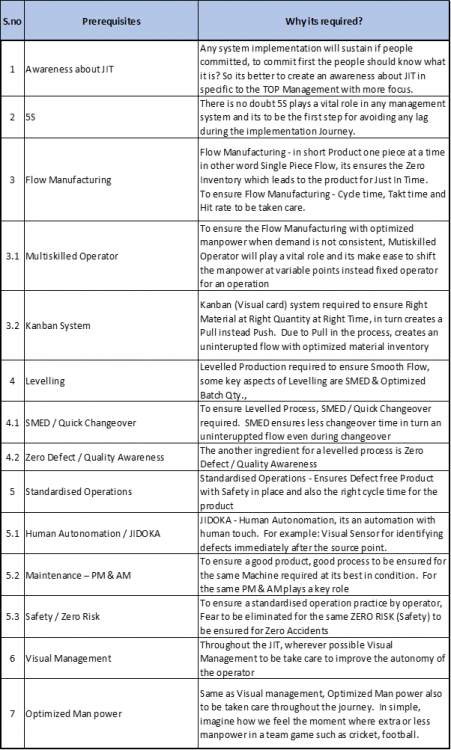
1 pointJIT – Just in Time is a part of Toyota Production System, yes its originated in Japan. In an overall it looks like more focusing on Inventory Management, but in practical the approach will make other issues visible and also towards solving the same. Any approach or a concept needs a foundation, same way JIT also requires following Pre requisites to make it efficient. Pre requisites: 1) Awareness about JIT 2) 5S 3) Flow Manufacturing 4) Levelling 5) Standardized Operations In another view all above are Primary Prerequisites and to support the primary prerequisites, secondary prerequisites are as follows: 1) Visual Management 2) Optimized Man power 3) Multiskilled Operator 4) Kanban System 5) SMED / Quick Changeover 6) Zero Defect / Quality Awareness 7) Human Autonomation / JIDOKA 8) Maintenance – PM & AM 9) Safety / Zero Risk For ease understanding, summarized as below: In Brief, take care all the anomalies related to "reducing the phase of process flow and also the reverse flow".


 1 point

This leaderboard is set to Kolkata/GMT+05:30