

Topics
-
Fifty-five women engineering students completed an AI bootcamp focused on rural Karnataka. Participants developed AI-based solutions after visiting villages and conducting field interviews. The She Innovates bootcamp partnered with several organizations to achieve its goals. This initiative aims to boost women's participation in AI and entrepreneurship. It encourages AI applications for rural development and community-focused sectors. View the full article
-
Besi's quarterly orders more than doubled, fueled by AI and hybrid bonding technology. The company saw increased customer adoption of its advanced chip packaging solutions. Demand for AI applications continues to drive growth in data centers. Besi anticipates revenue growth between ten and fifteen percent. This strong performance aligns with other semiconductor sector reports. View the full article



Leaderboard
-
Vishwadeep Khatri
Administrators1Points6,722Posts -
Natwar Lal
Members1Points50Posts

Popular Content
Showing content with the highest reputation on 10/25/2019 in all areas
-
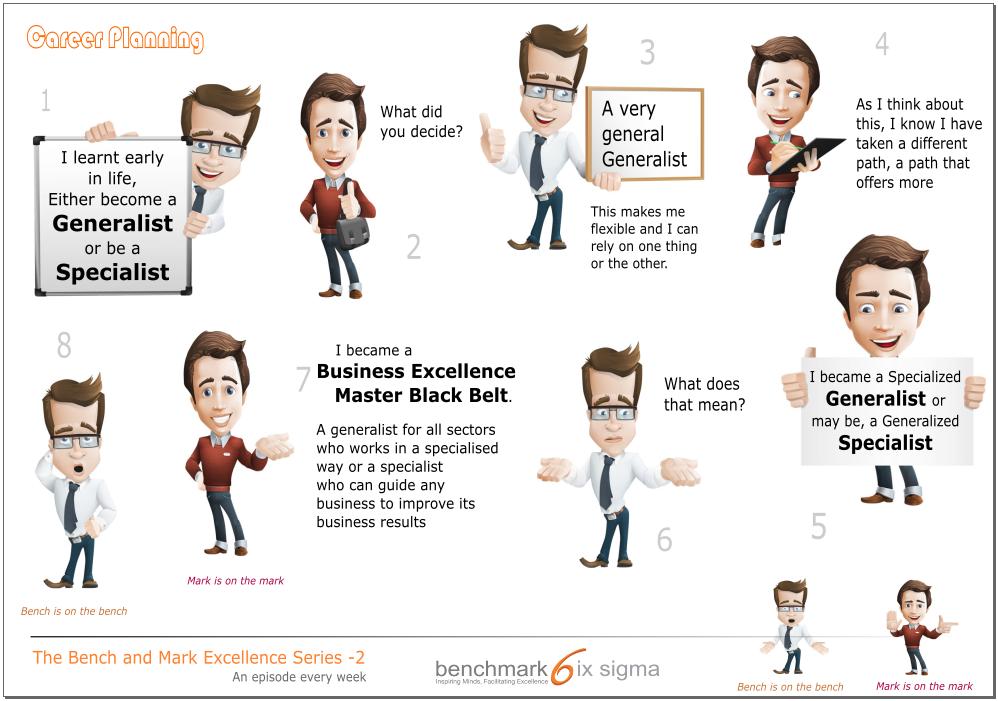
1 pointDescription - Bench happily highlights that while planning his career, he had considered the choice between being a Generalist or a Specialist early in his life. Mark wants to know about the decision that he took. Bench says that he decided to keep options open for himself and proclaims himself as a "very general Generalist". After listening to Bench, Mark says that he has realized that he has taken a path different from the two options. He considers himself as a "specialized Generalist" or what can be considered as a "generalized Specialist". Bench want to understand what this means. Mark explains that he is a Business Excellence Master Black Belt. He calls himself a generalized Specialist as he specializes in problem solving which he can do in any sector. He further explains that he could be considered a generalist too as he can work with large variety of processes but in a specialized way. This cartoon depicts that Lean Six Sigma and Business Excellence competencies allows one to be specialized without dependence on a specific industry or functional domain.
 1 point
 -
1 pointSampling Errors are of two types (as already mentioned in the question) - Biased and Unbiased. Biased Sampling Error - is one which results in a bias in the sample. The effect of this bias is that the result of the sample will not reflect the true nature of the population. There are three sources of such bias 1. Survey Bias: where the survey questionnaire or the process of collecting data is biased 2. Researcher Bias: bias introduced by the researcher of the study 3. Respondent Bias: bias in the responses if the respondent chooses not to give the correct answer Unbiased Sampling Error - is one which is the resultant of chance. The sample will never reflect the population simply because the observations will vary from each other. Selecting a large sample size is one way in which both these biases could be avoided. However, since our analyst has decided to choose a smaller sample size, he should take care of the following things 1. Sampling method: choose the one which gives a random representative sample 2. If there is a questionnaire involved, then ensure that there are no leading questions or questions for which the respondents might have a tendency to not give the right response. Make the survey anonymous so that respondents could give correct responses 3. Determine which is more important - alpha or beta error? Since sample size is fixed, he could then determine either the significance level or Power of the Test that he is going to get and whether it is ok or not1 point
This leaderboard is set to Kolkata/GMT+05:30