Topics
-
OpenAI, which is expected to need about 3,200 megawatts (MW) of power for its new facility, has agreed to provide up to 1,000 MW to the Southern Co subsidiary Georgia Power's systems in times of high demand. View the full article
-
The affected startup, Hugging Face, said it had turned to Zhipu AI's open-source GLM-5.2 model last week to analyze data from the hack after leading US AI models declined the task, unable to distinguish between a defender and an attacker. View the full article



Leaderboard
-
Vastupal Vashisth
Members1Points130Posts -
Manjula Pujar
Lean Six Sigma Green Belt1Points13Posts -
Arunesh Ramalingam
Members1Points53Posts



Popular Content
Showing content with the highest reputation on 07/31/2019 in Posts
-
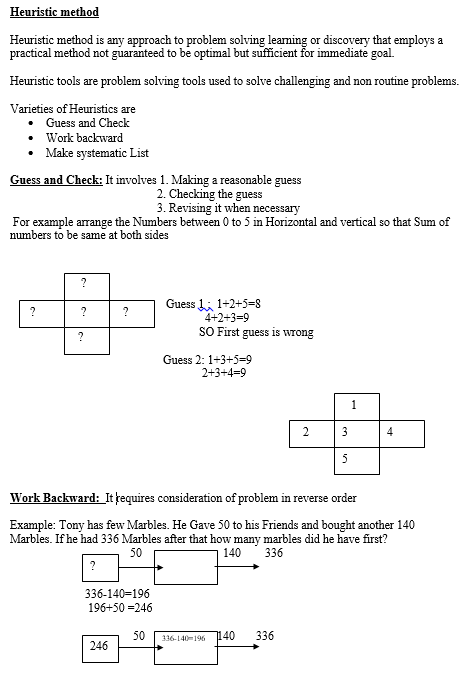
1 pointProblem Solving: in today's world, there is very highly complex environment for businesses and a huge competition between each other to sustain in the market and companies are searching various ways to gain the market by improving their products or services quality, increasing their speed of work, improving efficiency. while achieving these goals companies are facing various problems which can be in-house or in supply chain or problems in searching for a new business/opportunities or any decision making. There are basic four principles for solving any problem which are given below: 1. First, Thoroughly understand the problem 2. Second: make a plan to solve this 3. Third: work out on that plan 4. Fourth: do evaluation and then adapt it for future There are various methods to solve any problem and Heuristic Method is one of them. Further we are explaining more about Heuristic Method; Heuristic Method: Heuristic methods are not formal methods but are practical and mathematical approach which is used to find a solution of any problem. While applying these methods we consider Quick Fix to solve any problem and to speed up the solution process we use our previous experience considering that solutions which are developed does not necessarily need to be optimal or perfect solution for the required problem. Previous experience with same kind of problem or same kind of business is also used to take decision but sometimes it may lead to wrong direction also. This can be treated as Quick fix but it can introduce error, bias in the solution. For example, any Fast-food company wants to grow their business in other countries and found that India is a very big market for the same and decided to invest, but after sometime they found that losses are their after initial set-up. Because they took decision on the basis of heuristic method by their experience and intuition. Later on they found that they did not researched properly about the taste of Indian and food of their interest. Heuristic Techniques: there are various heuristic techniques used while solving a problem which are given below: 1. Dividing Technique or decomposition: break down the main problem into small segment and start attacking on them one by one and combine all solution in the end conditionally all sub problems should be linked to linked to each other. 2. Inductive Technique: in this we refer our previous learning of the same kind of problem 3. Reduction Technique or Limitation: usually problems deals with different different causes and factors and comes out a big one than considered. in this technique we set our limits for that problem which makes it easier to solve. 4. Constructive or serial Technique: in this we approach by step by step and we consider small solution in every step as our victory and then proceed further to catch another one. 5. Multiple Mind Technique: in this we give preference to include other people while solving any problem for their input and use them as available resources. Advantage of Heuristic Methods over Classical Methods: Heuristic methods have various advantage over classical methods. Some of them are given below: these methods are quick fixer and give solution very quickly limits the problem solving and focus on immediately doable things. these concepts are simple and very efficient to use Promotes an individual as a problem solver by focusing on immediately doable. can solve a problem very rapidly Achieve immediate goals can speed up the process after finding a satisfactory solution works very well with complex data provides timely solution or decisions Provides Practical solutions which are easy to understand and implement Provides short-term solutions Disadvantage of Heuristic Methods: Heuristic methods have many disadvantages with its advantages. Some of them are given below: unable to provide a optimal solution solutions are for very short-term not able to give power to the solution which can be used for long term for greater productivity or any profitability have error and bias in the judgement Data selection might be insufficient which leads to inaccurate decision Preference of Heuristic Methods; there are various situation where we can prefer Heuristic methods to solve any problem. Some of them are given below: The situation where we found that the processing speed is important as much as the final solution, we prefer Heuristic methods. Heuristic methods are preferable because they provide good solution very quick and other methods are time consuming to solve any problem. where we can go with small term goals and are satisfied with small wins with satisfactory results we can prefer heuristic methods where we can use following heuristics: thumb rule any experience or educational guess common sense any intuitive judgement Where we want to achieve small goals where we are focusing on immediate doables where we want temporary solution where we aim for only to implement known or readily accessible solutions where it is impossible or impractical to find an optimal solution , we prefer heuristic methods where we want to increase the speed to find a satisfactory solution Let's have a one example of Heuristic method: There is lot of 1000 parts produced by a sheet metal department in an automobile industry. Before delivery, during quality check, inspector found that these parts are defective and have thinning in all parts.The concerned department can not hold the parts because it leads to stoppage of Main Line of next department and the department can not reject these defective parts as the part cost is very high.People tried to think about the solution how to deliver these parts and followed heuristic technique of multiple mind with following heuristics: Common sense: Someone suggested that this part is of C rank and will not be assemble in critical area in final assembly and have very less importance which is not directly visible also, so we can deliver these parts but still thinning is there. Thumb Rule: Someone else suggested about the thumb rule of 25% thinning which is allowable , they applied the same and checked all parts and found thinning within 25% and deliver all the parts So by following heuristic , they have saved rejection and supplied parts to next department so that there was no loss on main line. So they are satisfied with this solution. later on they can find out the reason of thinning in their process and can take C/M accordingly.1 point
-
1 point1 pointProcess Stability refers to the consistency of the process to stay within Upper Control Limit (UCL) and Lower Control Limit (LCL). The outputs of any process will have a mean value. Then the control Limits for the process are defined as follows: Upper Control Limit (UCL) = Mean + 3 sigma Lower Control Limit (LCL) = Mean - 3 sigma If the process behaves consistently over time, i.e. the outputs fall within the range UCL to LCL called process width, then the process is said to be stable or in control. If the Outputs are spread across outside the limits, then the process is Unstable or Out of Control. Process Capability is a measure of the ability of the process to meet customer specifications. The measure tells how good each individual output is. An estimation of the ppm (defective parts per million) is a method to measure process capability. Capability Indices (Cp, Cpk) are metrics used to measure the process capability. It indicates how capable the process is in terms of meeting customer requirements. Customers provide Upper Specification Limit (USL) and Lower Specification Limit (LSL) within which they want the product value to exist. This is called the tolerance or Allowed variation. (E.g. A customer of a Building Management system may want his air conditioning such that room temperature is 20 +/- 2 (deg C) i.e. with USL =24 deg C and LSL = 18 deg C) The air-conditioning process may have its own Mean/Average temperature say, 21 deg. C Cp = Tolerance/ Process Width = (USL-LSL) / (UCL-LCL) Cpk = min(Cpu,Cpl) where Cpu measures the closeness between process mean and USL; Cpl measures the closeness between process mean and LSL. Cpk accounts for change is process mean. A simplistic example: In an exam if the passing mark is 40 (USL = not specified; LSL = 40) and a student if 5 continuous attempts get 30,30.5,31,32,30 then we can say he is Stable(consistent) but not Capable. Is Process Stability supposed to be a pre-requisite for all type of processes? Any manufacturing /production process should be stable before being released to the production environment. Many customers request that their suppliers submit process capability data to qualify the supplier process. Any estimate of process capability depends entirely on where the process happens to be when the data is collected. For an unstable process, the mean shifts about over time. So, stability would be prerequisite for such process, as the process capability can only be estimated for stables processes. But, I believe, processes involved in Research and Development, Innovation would be inherently unstable. These process may not need a Capability estimation , so stability will not be a prerequisite.1 pointThis leaderboard is set to Kolkata/GMT+05:30