

Topics
-
The latest setback has fueled worries that Google was losing momentum just as OpenAI and Anthropic and a host of Chinese rivals have accelerated the pace of model releases. On the call on Wednesday, Pichai struck an unusually defensive tone as analysts pressed him on the state of Google's frontier models and whether they could still compete at the cutting edge of AI development. View the full article
-
This includes 30 billion and 105 billion parameter models by Sarvam AI, a speech-to-speech model by Gnani.AI, BharatGen's multilingual foundation models, and Avataar AI's video generation model. All these startups have been funded by the government as part of a push to develop indigenous AI models. Of the 20 models, five have been released so far. View the full article


Leaderboard
-
Suresh Jayaram
Members2Points179Posts -
SuriBabu
Lean Six Sigma Black Belt1Points9Posts -
R Rajesh
Members1Points160Posts -
Mathi
Members1Points5Posts




Popular Content
Showing content with the highest reputation on 02/19/2019 in all areas
-
1 pointLean Six Sigma is a powerful methodology that can be used to improve business processes. It is a structured approach to problem-solving that can be applied to any process - manufacturing, sales, marketing, IT, BPO, accounting, purchasing, you name it. All processes have variation. Variation is the cause of all evil - it leads to defects and customer dissatisfaction. Lean Six Sigma methodology can be used to reduce variation from any source and thus improve costs, quality, and hence customer satisfaction. The standard methodology that is used to improve existing processes is called DMAIC. The acronym DMAIC stands for Define - Measure - Analyze - Improve - Control. If you think about it - this methodology is common sense. Before we start working on a problem, we need to have a good definition of what is the problem, why we are working on it, where is the pain area, what is in the scope of the project etc. All of these are accomplished in the Define phase. Secondly, in the Measure phase, we are interested in ensuring that the data used for further analysis is free of measurement errors. Lean Six Sigma is about making decisions based on facts & data. If the data is inaccurate, we would end up making the wrong decisions. Hence, the measured phase ensures good data. Before making any improvements, it is also important to establish a baseline so that we can clearly communicate the benefits obtained from our project to other key stakeholders. The next phase, Analyze, is all about making the hypothesis and using data to either prove or disprove our hypothesis. We make the hypothesis about what is causing the problem and then establish the real root causes. The fourth phase, Improve, focus on getting the best possible solution to solve the root cause of the problem. The solution is optimized and any potential failure modes are resolved before the solution is deployed in the real world. The last phase, Control, is all about ensuring that the solution is sustainable in the long run. Any financial benefits obtained from the project are also quantified. Finally, the improved process is transitioned over to the process owner. As we can see from this paragraph, any problem can be addressed using this structured approach. Here are some things that should come to your mind when people talk about Lean Six Sigma: Business Process Improvement Methodology 3.4 defects per million opportunities Customer focused Uses facts & data Quantify financial benefits Structured improvement approach1 point
-
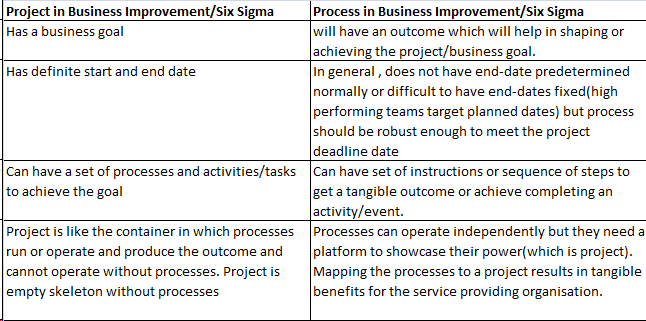
Let me start with my assumption of what it takes to qualify as a Project in Project Management realm , a Project and a Process in Business Improvement or Six Sigma world. Project in Project Management Realm: In a one-liner , we can say a project will have an objective with a definite start date and a definite end date. Eg:1 Converting a meter-gauge rail(track) to a broad-gauge rail can be a project, for Railway engineers. Eg:2 Creating a software product can be a project, for an IT team. Eg:3 Constructing a shopping mall could be a project, for a builder Project in Business Improvement of Six Sigma context: A project will have a goal with a definite start and end dates. That will be accompanied by a strong business case explaining an explicit reason as why this project is needed in the first place and it will highlight the end dates for the various phases that a project might have. Process: In generic terms , we can say that it is a set of instructions/sequence of steps to achieve a particular activity/complete an event. Essentially , every process would have certain parameters which act upon as inputs and then there could be a set of actions or a sequence flow which would be necessary so that there is a tangible outcome which serves our need. That outcome becomes the output which will/can be consumed by other actors(could be another process /events/users/activities..) Eg:1 Setting up Continuous Integration(CI) is a key process as part of Continuous Delivery and Deployment(for delivering your IT delivery rapidly). CI includes multiple steps : 1. Check-out the latest code from the Code Repository (say GIT) and put that into local workspace(Developer's workstation). 2. Do your code changes on the local machine and unit test it thoroughly 3. Post a peer review (and after fixing comments, if any - unit test it again) 4. If everything ok, get the latest code from Code Repository, 5. If no difference found in the version of the code, then push the code to the code repository with proper comments 5. Automatically Build should be triggered (When a change is pushed). 6. If build succeeds, then ensure that your change is successfully working in the Integration box. Now as we see multiple steps are there. The sequence is important to get a successful testing of your functionality which is the outcome from this process. Eg:2 Code Review is a process - Steps involved: 1. Review the code. 2. Check if the code adheres to coding standards and guidelines. 3. Whererever the stds/guideline not followed, provide proper feedback comments. 4. Ensure the developer fixes the comments.5.Ensure functional misses are not there. 6.Ensure same mistakes are not repeated. 7. Ensure all comments are fixed. Now let us first compare and contrast a project in Project Management(PM) realm and a project in Business Improvement(BI)/Six Sigma world. We have compared and contrasted project in PM realm and in BI/Six Sigma realm. Let us now contrast a project and a Process in BI/Six Sigma context. Let me explain these difference with an example. Imagine an improvement project. An IT team's delivery quality is poor. They are getting multiple escalations and they are unable to meet their SLA of <5% defects in a critical application. This is happening for the past 6 months. Now team is doing an improvement project. It is trying to zero in the problem. It needs to fix the issue in 4 months time. Goal is to have <5% defects by 17th June 2019. Now it starts to check its flow from where it has to correct itself. It reviews the AS-IS process. It finds (after doing Value Add activity process) that it needs to improve upon Design Patterns(for Coding), Code Review, Automatate Unit and Functional Testing. These are processes which have their own steps which need to be done so that quality of the deliverable meets the defined SLA as per the goal statement. Now without the processes, the project goal cannot be achieved. At the same time, the processes can be independently achieved but if not tagged to a project, the chance of systematically finding the deficiencies in a process or a need for a new process(if old process is too bad to be modified) would be missed out. Conclusion: From the differences that we saw now, it is clear that process and project in a business improvement/six sigma world or different entities. Having said that there is always a bit of these two words conveniently interchanged especially in Business Process Outsourcing(BPO) industries. Many teams use process to represent what could be possibly called as a project. For instance, those teams might call HR Payroll system as a process, whereas an IT team might call that as a project. One reason it could be because of the fact that BPO bretherens could construe each of the steps in the system happening in a sequential flow. But in general, by and large as the definition says and based on the differences that i articulated above, my conclusion is process and project are two different entities.

 1 point
 -
1 pointThe following Japanese words related to “handling of manpower” in production process according to the organizational requirements; Shojinka: This is the Japanese word that originated from the lean manufacturing principles of Toyota. When we translate from Japanese to English, it gives direct meaning of “Various people”, shortly it can be “Vary people". i,e Flexible manpower lines maintain productivity with fluctuating demand. Shoninka: It means “Manpower saving”, by providing machines / equipment in order to free one or two operators: Shoryokuka: It means “ labour savings” partial removal or combining two operations by automation to support the process Productivity = outputs/ inputs i.e it is a measure of efficiency of production line. More often the Shojinka is defined as having to main categories; first, the workers are multi skilled and they can perform in multiple workstations at a time in a production line. The second is, the line should be designed in a way to accommodate or vary people based on the fluctuating customer demand. In simple words; Shojinka can be defined as “ability of a production line can be balanced when the production volume goes up or down" Demand Vs Supply: Shojinka techniques developed based on the Demand Vs Supply and no excess production as they considered as an inventory by deploying flexible machines and man powers. Capacity planning is the process of determining the production capacity needed by an organization to meet changing demands for its products. The capacity is normally developed based on takt time: Takt time: Available production hours per day / customer demand per day (Generally it is calculated on annual basis with full speed of line capacity). When the demand fluctuates, the organizations have some broad questions; · How to absorb the fluctuations in demand that will occur over next 12 months? · To what extent should inventory be used for this purpose · Can demand fluctuations be met by varying size of workforce (Shojinka?) · Why not absorb the fluctuations by changing activity rates and varying work hours( overtime) · Why not outsource to maintain a stable work force and let suppliers change activity rates to absorb demand fluctuations? · Will the organization lose orders if doesn’t meet all demands? Should the organization adopt this policy? Each of these choices determine the moves of the organizations. The organizations will adopt basically three strategies of planning to managing supply · Chase strategy: - when demand fluctuates, the organizations should adjust the capacity to match the demand as close as possible. E.g seasonal business demand like sale of apparels during festivals · Level strategy: - a firm maintain constant capacity over a period of time, irrespective of fluctuations in demand; e.g When more investment or skilled labour required, this strategy will apply · Mixed Strategy: Individual firms devise infinite combinations of the above strategies based on the situation. Shojinka is suitable to apply when organization adopts chase strategy. Flexible manpower line: The production line is designed in such way to meet the changing production requirements: Before designing of any production capacity, the following parameters to be considered; Takt time : Net production time / Customer demand Cycle time : Net production time / No.of Units produced No. of stations / Operators: Cycle time ( Work content) /Takt time In the competitive market, the organization has to prepare some strategy to prevent the business loss and shojinka is a solution for the flexible manufacturing; Calculating Manpower / machines: The following formula will help us to determine the manpower / machine requirements to meet the demand; Overall cycletime / Takt time = Manpower / machines Cycle time is the sum of the processing time to complete one unit of assembly Examples: Case: 1 Overall cycle time: 240 secs Takt time: 80 secs No of manpower = 3 So, we can use the manpower formula and assign no. of operators based on the demand Case: 2 When demand goes down, we can remove the manpower and he can be used in other machines/ assembly lines; Overall cycle time : 240 secs Takt time : 120 secs No of manpower : 2 When the demand low, we reduce 30% manpower and two manpower will produce the output to meet the low demand. Shojinka demands employee training, multiskilling to manage / operate different machines / practical standard operating procedure in place for flexible manpower line. Advantages of Flexible manpower line: · Avoid overproduction · Better usage of capacity · Smooth material movement · Kaizen culture Disadvantages of Flexible manpower line: · Design of production process is complicated as the forecast are not realistic · Require high skilled operator · Not suitable for small, medium size industries Conclusion in my purview: At the present time, most of the industries look for outsourcing when the demand peaked up. The peak demand may not be long-lasting, as the demand lows they withdrawn the order from the supplier. This will affect the supplier relationship in long term. However, organization should design flexible manpower line to the peak volume and if the demand is lower, the assigned manpower can be used in another production area, provided if they are competent. But practically it is complex in real time production situation. Industries, normally extend their work hours to meet the peak demand and cut off the extra hours if the demand goes down. If the forecast is realistic, the cell design is flexible to manpower, Shojinka is a best tool to apply.1 point
-
1 pointDear Sandeep, Robotic Process Automation (RPA) is there in the industry for quite sometime now but more popularized in last 3 or 4 years. Considering the competition in every industry, every organization is trying to keep their operating cost low and provide the right product or service with right quality to the customers. It has become mandatory to every organization to search and implement new methods of production to improve the margins and quality at same time. RPA is becoming new buzz word or new method to talk and implement as every customer, organization, Industry are looking for change and a quick change. As a Lean Six Sigma Practitioner, our role has become more significant during initial stages of RPA implementations. In a simple way, A LSS Practitioner can identify and suggest the right opportunity to implement RPA by following structured method. Few debates are there saying that there is no involvement required from LSS Practitioners in RPA implementations as these would be pure technology driven. At the same time, I have observed that many projects are not able reach their end objective on time (Please read the line again... NOT ABLE TO REACH THEIR END OBJECTIVE ON TIME) due to lack of structured methodology during initial phases. A Lean Six Sigma Practitioner can support/add value to make the RPA projects success as below. 1) Understanding the objectives and preparing the business case for improvement 2) Establishing right metrics to measure the improvement 3) Preparing detailed VSM to identify highly manual repetitive time consuming process steps. 4) Estimating the benefits by performing cost vs. benefit analysis (All the processes may not yield greater ROI but many qualitative aspects to consider) 4) Design/Re-design the process to make it suitable for RPA (Please note that automating the process As-Is may not give desired results) 5) Standardize the input and handoffs 6) Support the RPA developers with suitable functional guidance 7) Tracking and Monitoring the projects with robust governance models (Depending on PMO structure in the organization) 8) Evaluating the outcomes (Metrics, Benefits) post implementation Depending on organization's project management structure, LSS Practitioner can have greater role to play in implementing RPA projects. Few organizations have started RPA consultant roles to manage all the activities mentioned above and few are managing with existing LSS teams. Fundamental method would be the same irrespective of organization structure however, LSS practitioners will have additional edge of LSS methods and concepts to get quick results. Hope this helps.1 point
-
1 pointThere are two primary methodologies in Lean Six Sigma: DMAIC DFSS or DMADV The Lean Six Sigma DMAIC methodology described in the post earlier is for making improvements to existing processes. The second methodology DFSS stands for Design for Lean Six Sigma. This methodology is used for new products and services or when the improvements that can be made with DMAIC is not sufficient. There are several approaches to DFSS: DMADV, IDOV, etc. The most popular approach to implementing DFSS is using DMADV (Define - Measure - Analyze - Design - Validate). More than 70% of the DFSS implementations use the DMADV approach. DMAIC can be considered to be reactive in nature, in the sense that a process already exists and is making defects. DMAIC approach is used to identify the root cause of the problems and then fix it. On the other hand, DFSS is mostly a proactive approach. A process does not exist yet and DFSS is used to truly understand customer requirements and then develop a process that provides exceptional levels of quality and process performance.1 point
This leaderboard is set to Kolkata/GMT+05:30