

Topics
-
Fifty-five women engineering students completed an AI bootcamp focused on rural Karnataka. Participants developed AI-based solutions after visiting villages and conducting field interviews. The She Innovates bootcamp partnered with several organizations to achieve its goals. This initiative aims to boost women's participation in AI and entrepreneurship. It encourages AI applications for rural development and community-focused sectors. View the full article
-
Besi's quarterly orders more than doubled, fueled by AI and hybrid bonding technology. The company saw increased customer adoption of its advanced chip packaging solutions. Demand for AI applications continues to drive growth in data centers. Besi anticipates revenue growth between ten and fifteen percent. This strong performance aligns with other semiconductor sector reports. View the full article



Leaderboard
-
Dhatry
Members1Points12Posts -
Mr. Abhijeet
Members1Points12Posts -
R Rajesh
Members1Points160Posts -
Venugopal R
Members1Points238Posts




Popular Content
Showing content with the highest reputation on 09/11/2017 in Posts
-
1 pointA process takes input(s) and perform a set of activities to produce an outcome or result. Innovation: The process of creating a product or service solution that delivers significant new customer value. The process begins with the selection of the customer and market, includes the identification and prioritization of opportunities, and ends with the creation of an innovative product or service. Lean Six sigma is a collaborative team effort to improve performance by systematically removing waste, reducing variation and increase predictability. Six Sigma and Innovation are complementary yet opposite. Refer table below for how they complement and contrast and how they can work together. Six Sigma Innovation Contrast · Reduce variation · Optimize processes and product trade-offs · Be precise and data driven · Make money now · Encourage diverse thinking · Break the mold so trade-offs are unnecessary · Create “emotional” experiences · Create opportunities to make money by taking risks How they complement Helps create customer loyalty through stable & capable processes Frees up resources by eliminating costs Making execution of a new idea more predictable --> creates foundation for innovation --> can be reinvested in innovation --> helps mitigate risks What’s common Both aim to meet customer expectations in cost effective manner How does it help if they come together Lean brings structure and predictability to innovation and sharpens the distinction between idea generation and development process. Lean can help bring discipline needed to develop and profit from new product and service offerings. Lean encourages focus on - listen to the voice of the customer, business and employee which will help innovate a profitable winning idea. Lean can help reduce risk. Caution Excessive adherence to Lean may kill innovation as people will not deviate from norm and thus no innovation. Reason / Necessity for them to come together Increasing competition, need to be more profitable and sustainable, pressure for cost cuts Case Study for co-existence Pixar is a live example of lean and innovation coexistence. Pixar believes in a method to the madness. Pixar has created a set of processes that emphasizes team based collaboration and continuous feedback loops to help overcome creative blocks and track deliverables. Pixar has setup structure that believes individual is as important to the team as team is to individual – this helps create structures that helps resolve roadblocks faster and encourages individuals to discuss problems and collaborate. They have practice of discussing daily progress and bottleneck / risks. Ideas that are likely to be doomed are therefore terminated early on. They nurture creative freedoms and yet reduce waste. Techniques that can be used Root cause analysis (RCA) Voice of customer (VOC) Quality function deployment (QFD) House of Quality (HOQ) Failure mode effects and analysis (FMEA) Value engineering analysis (VEA) XY Matrix, TRIZ method (Theory of Inventive Problem Solving) PUGH Matrix Design of Experiments (DOE) Mistake Proofing DMAIC and application of above tools at relevant phases. Conclusion: Not everyone is an advocate of Six Sigma. While the well thought-out process and constant benchmarking may seem to be restrictive however Six Sigma does not suppress free thinking. They complement each other and when used creatively and effectively can result in true benefits.1 point
-
1 pointThere is always a process involved in any kind work ,right from drinking water from a bottle to designing a rocket. It is the process which makes any work simple and easy to understand. However as the innovation and creativity is concerned, sometimes to implement a newly generated idea one has to go against the process. Yes the process sometime adds barrier to some innovative ideas. Many creative ideas and new innovation occurs accidentally. Defying a process to implement a new idea leads to betterment or may be a lessont learnt. As it can be understand that Six sigma is a methodolgy it is not a process. Implementing six sigma ease up the way towards innovation.it helps to render unknown and unknowable facts about the idea. It gives a positive approach towrds the new process. We can use six sigma methodology in every aspects, but what, where, whom, and how touse it depends on the user.1 point
-
1 pointWhenever we think/speak of Lean Six Sigma, the first and foremost thing that comes to our mind is eliminate waste and reduce variation!! Though there is nothing wrong about that mindset as so many six sigma projects in the world, do focus on that, there is another sibling of that which can do some interesting things as well.Will talk about that now. In General, Six Sigma can be broadly classified into two DMAIC and DMADV. While DMAIC is to improve an existing process, DMADV is to go for a new process for providing the service or product , because the old process cannot be improved at all or revamping the product/service itself with a new design. The concept is so powerful that there are few variations in DMADV and is there is a separate branch called "DFSS" (Design for Six Sigma). The major variations of DMADV are DMADOV(Define, Measure, Analyse, Design, Optimize, Verify) and IDDOV (Identify, Define, Develop/Design, Optimize, Verify). So much so has been done using these concepts that the modern definition of Lean Six Sigma can be rephrased as a methodology used for business improvement that enriches the shareholder values by providing high-quality product/service at affordable cost with considerable speed on a consistent basis, thereby maximising customer satisfaction I very strongly believe that use of Lean Six Sigma helps us to innovate a product/service or make it supreme. Let me provide an example. Explaining this concept with two imaginary companies. In reality, this happens across in Insurance or for that matter in any other domains. Background: Consider two insurance companies, 'StandIns' and 'TotalIns'. TotalIns was acquired by StandIns. Both the companies had a Policy Claims product, but both were written in different technologies. StandIns used a legacy system (mainframe) for its product 'SIPC' and TotalIns used its own proprietary system for its product 'TIPC'. After acquiring TotalIns , StandIns decided to migrate the 'TIPC' into its product 'SIPC' after some time of acquiring, so that it can provide continuous support to the existing TotalIns customers.Both the products were handling 3 variations/types namely individuals, corporates and other business entities. DFSS, the remedy: Now they decided to add the existing users' data from 'TIPC' product to the 'SIPC' product. This was not easy to migrate the data. Migrating the data from proprietary one to legacy system became cubersome and error-prone. Halfway through that migration project was abadoned. So it was decided that the existing users of 'TIPC' would continue with that product only . The stakeholders were at their wit's end as what could be done. The 'TIPC' product had some good features which 'SIPC' product did not have and the stakeholders at StandIns wanted to utilise them for getting better business growth. The stakeholders of 'SIPC' product felt that with a proper ground work on the needed functionalities and with a strong desgin base, they would be able to provide a high quality product which can bring profitable business, great customer satisfaction, in the longer run. One of the stakeholders who was in the quality department convinced the others stakeholders of doing a Lean Six Sigma project using DMADV(DFSS) to create a new top-notch product which can cater to both 'SIPC' and 'TIPC' customers. It was overwhelmingly approved. Problem Statement : StandIns insurance company has been struggling to migrate all the data of 'TIPC' product into its 'SIPC' product since the Oct 1 2016. All these days 'SIPC' unable to produce customer reports/data properly resulting in extremme customer dissatisfaction and also in a loss of 1 million US $ Goal Statement : Create a high quality product,'SSPC', which caters to both the existing customers of 'SIPC' and 'TIPC'. The new product will also cater to the new customers and the product should be crated by by 17,Aug 2017. How was it done: Following are the steps/activities that were done: 1. Voice of the Customer(VOC) : The stakeholders of the new product thought that focus should be given to the key customers who use 'TIPC' product and that their opinions should be heard. They believed that those customers needs/requirements should be satisfied. Those were captured. 2. The requirements data collected from VOC, was added to the existing list of requirements already available for those two products('SIPC' and 'TIPC') 3. Those captured needs were categorized/affinitized , for brevity so that none of the functionalities are missed out during the product development. For instance, all requirements/needs related to administrative activies, were put under the group "Administation". Needs related to an individual customer were put under "Personal", needs related to a corporate were put under "Corporate" and needs related to other business entities were put under "Business" and so on. 4. All the needs were prioritized with the help of a Kano model. All the must functionalities were highlighted , then satisfactory functionalities were listed out and then the delighting functionalities were drawn out. The objective was to ensure that a minimum viable product (MVP) was achieved at the earliest so that customer dissatisfaction is eliminated right at the outset. 5. Next thing was to find the characteristic through which the success output could be measured. For such a complex sytem which requires two different products to be merged , how could the critical-to-quality(CTQ) be measured ? After much deliberation ,it was decided that CTQ would be a factor called , 'SuccessCode'. A combination of certain parameters decided the fate of the CTQ. They included various fields from the existing 2 products - a).PolicyNumber (for both the products), b).location Code(for existing users of 'TIPC' -needed because both companies were in different regions), c). policystatus, d).isActivepolicy, e). response time (to user's query). 'PolicyNumber' should adhere to the validation rules specified for it. 'Location Code' should be unique and should not be a NAN. 'PolicyStatus' should be either new/renewal and ' isActivePolicy' should be true. 'Response time' should be <=5 seconds.If anyone of this had a discrepancy or throw an error, then 'SuccessCode' would fail with a '0' code , else it will pass with a '1' code. 6. Now the product team/stakeholders decided to have a brainstorming session what are the grey areas where they need to improve their design/technology so that they do not go into the same issues which is why in the first place, this project was started. How to achieve the key parameters/vital X factors which can help to achieve a better product. That was decided 7. The product team decided to go for a Pugh matrix, (named after the person who introduced it - Pugh) which can evaluate multiple options (as a solution to the problem) with various criteria against a baseline option and then allow us to pick the best one. With multiple options, they picked the combination of a web-based system with SpringBatch system, Oracle DB , j2EE . This became the selected option Below was the Pugh matrix used. Baseline Option : Mainframe System – PL/1 Criteria Option1 Option 2 Option 3 Response Time + - - Batch Processing speed + - + Concurrent Processing + S + Effective handling of all CTQ parameters + + - Total 4 -1 0 Option 1 : Uses Java EE with Object Relational Mapping database and SpringBatch Option 2: Uses Jave EE with Relational Database Management Option 3: Uses Mainframe Systems (COBOL) with legacy Database 8. Now the product team developed the product using the selected option (from Pugh), for 'Personal' type (1st variation of the product). 9. The product team loaded all the data for existing users of 'SIPC' and 'TIPC' and got amazed at the speed they were able to see the data for both the users of 'SIPC' and 'TIPC'. The team was able to add new users, seamlessly. Months of pain seemed to be gone in a trance. 10. The product team replicated the development for the remaining two variations for Corporate and Other Business Entities and loaded with data and successfully tested. 11. Product Team had a deployment flowchart and also a checklist that clearly provided how things should be done. There were great celebrations and all the stakeholders and senior management celebrated with great fanfare. 12. A full-fledged Implementation plan was created and on 17th Aug 2017, as scheduled, the product was deployed and it went into live. All the stakeholders were extremely happy. 13. The product team created a list of metrics with which the management can measure the progress of the product's success post its deployment. 14. The product team created a transition plan to the operational team and created a documentation of what was done and how they were done. 15. Three months into the production, because of the product, the StandIns company marginalised its loss that occured earlier and by the end of sixth month, the company had a surplus revenue of 1 million US $. New customers got added and there was so much customer satisfaction and the company's business grew three times. This improvement was possible only because there were tools and techniques which captured data systematically and stastically and using which the team was able to work out with a complete and proper solution. By having well organized and scientifically proven techniques/tools , the team was able to achieve its target in style. There are many other tools and techniques which can be of real use to developing a new product or designing a new product/service. For instance, its worth mentioning about the Quality Function deployment tool which helps your requirements to be converted into design. It essentially converts "What do yo want" to "how do you want" .A sound design will result in a solid product. For instance, you want to create a cage for an animal say Tiger. What would be your requirements. You would want a iron bar with a comfortable space for the tiger just walk a few steps and also ensuring enough height to accomate it. You would want strong doors. How do you convert this into a design requirement. So you would think of Iron bar or rods and you would specify the length and width of the cage (say, in feet). Then you would talk about thickness of the cage, followed by door quality(in which material, its strength ) . Now your design also has to consider the material used for the cage should not be too light. If its too light, then chances are that the Tiger could break it. So while doing design, all factors should be thought about and ensure that a balance is found out. We should know which factor is affecting which other factor and in what way whether in a positive or negative way. Instead of putting an iron cage, what if i put a wooden cage. It may be light weight(thats one factor) but would it be a safety one(Safety is another factor). These kind of analysis can be obtained through QFD which will help us to decide the design considerations which can help us in creating a best product/service. Hence i conclue that with the advent of Lean Six Sigma, product innovation has taken gargantuan proportions1 point
-
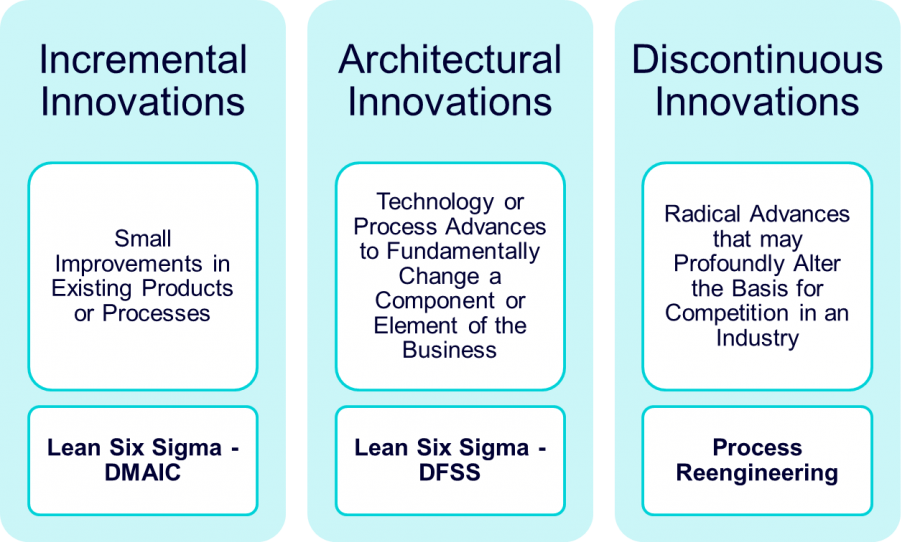
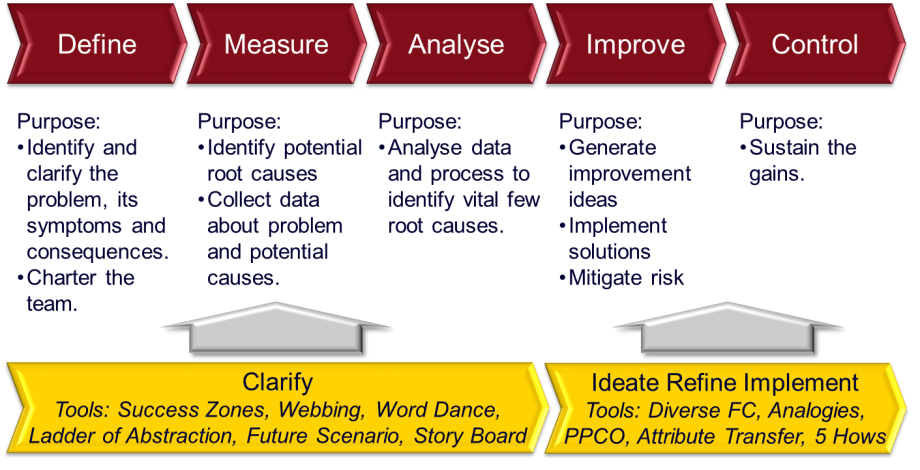
1 pointIn my view both lean six sigma and innovation are necessary for sustained business success. Several Six Sigma tools including the Cause and Effect diagram and the Failure Mode and Effects Analysis (FMEA) promote innovative thinking and team brainstorming. After identifying an inventive solution, Six Sigma can be integrated to make the most of the solution’s effectiveness. The O’Reilly-Tushman Innovation Continuum provides a better insight on approaches to innovation and how lean six sigma is a part of innovation: Also the below representation gives a fair bit of idea on how DMAIC and innovation are integrated in product development: Since most of the techniques of the innovation process is engaged more in to creative thinking and does not require much of statistical analysis, most of the solutions generated provide short term effects. Using statistical analysis and technique of lean Six Sigma, the creative thinking of innovation can be paired with the thorough analysis of lean Six Sigma. With constant practice, innovation skills will be developed. Referred websites to frame this answer: 1) Innovation excellence 2) isixsigma
 1 point
 -
1 pointThere are many experts who consider the presence of a process as a significant roadblock in the effort towards creative design work. It is also understood that there are many innovations that happened purely by accident. Is there any value in the use of Lean Six Sigma in the world of product innovation? Why/ Why not? Any innovation with respect to a product has to transform itself through a design process and then the design expectations have to be fulfilled by a process. The process will actually create the product with repetitive consistency. It is true that innovative ideas do come up suddenly, we may even say accidentally. However, it is the result of the thinking process of an individual brain or collective brains of a team. Most innovations invent path breaking solution to some need for people. Invention of aircraft provided solution of very fast travel, and invention of internet provided communications at a speed one had never dreamed of. Not all innovations are accidental, and there are several which are a result of focused effort by groups of talented people, led by a visionary leader. Such planned innovation efforts can be systematically driven as a structured approach using certain Six Sigma tools and methods.For instance if a particular innovative effort is aiming for providing a specific solution to human, it would be important to gather baseline data on the current situation and also apply measurement methodologies for assessing the results of the innovation. It is agreeable that striking upon the actual innovative idea, (the eureka) is unpredictable brain power and is difficult to represent it as a process outcome. However a process approach can help to facilitate the thinking process that led to the innovation. Even as part of our usual Six Sigma DMAIC cycle, it is possible that during the improve phase, innovative 'eureka' could emerge as part of the solutions. Now, coming to the developments that need to take place subsequent to the innovation, a design and development process, verification and validation processes, production deployment... all these are familiar to experienced professionals in this forum and it is needless to explain how the DFSS kicks in! I do not see a need to go beyond that!1 point
-
1 pointTrue. There are many product innovation happened in the past with accident. I would like to add the point that innovative ideas happens with accident; but the innovative ideas are followed by various tools and methodologies of Lean Six Sigma to convert that into innovative product (Feasibility and Scalability). It has to undergo intense checks in these processes. So the Lean Six Sigma is equally much of importance and value for the product innovation. The following example is the best way to understand it. In the year 2004, two scientist and reknowned professors of Manchester University,UK named Andre Geim and Konstantin Novoselov discovered the the material called Graphene accidently while researching on Graphite in their chemical laboratory. Graphite is 3D structured carbon material, the commonly used as main ingredient in making of pencil which whole mankind known. The Graphene is a single layer of Graphite which was invented through mechanical clevage of cellotape. Graphene has tremendous unique properties It is a one atom thick carbon material. It is 2D material (means it has length and width but has no mass). It is Electronically, Electrically and Thermally conductive Material(The only material in the world). It is thinnest material known to mankind (1000 times thinner than single sheet papaer and human hair). It is flexible. The important to mention that it is thiker than Diamond(200 times) and stronger than furness steel (300 times). To make use of these unique propertiesof Graphene in various product /industry application, there was need for innovative product design, where the DMADV, QFD are used and brings the value of Lean Six Sigma in picture. One of the best application of Graphene is Flexible Electronics. No wonder, in the age of technology revolution(4th revolution) every phone user want their mobile phones ro be more smarter than ever. Some of the common expectations of 21st century's consumer are going tobe fulfilled by use of Graphene(also called wonder material) in near future. This material is used by many companies like Samsung, Sony, Lenovo, Nokia and every electronics manufacturing giant for designing the flexible display of mobile phones. This is also being use in making of Graphene mobile batteries which will charge your phone in 30 sec to 1 min. in future. With the help of Graphene being used by companies like Intel, creating processors which will run thousand times faster. (the list of application is long and long.) To innovate all these products like Flexible Mobile Displays, Thinner Batteries, Faster Processors, Supercapacitors and so on, it has to undergo various Lean Six Sigma tools and methodologies which going to create value for their consumer(end user) in future. So, to conclude, processes invovled in innovative ideas to creating a finished product which creates value for Lean Six Sigma in Designing the Product, Designing the Quality Parameters, Designing the Manufacturing Processes and so on. These processes will be followed with the valueable feedback of the customers and improving product with Kaizen, Poka-Yoke, DFSS, Mistake Proofing with better versions. The other industry applications of Graphene are Paint and Anti Corresive Paints Print and Packaging Construction Industry Palstic and Plastic Composites Automative industry Aerospace and Spaceship Building ... Not but the least, Graphene is accidently innovated "Wonder Material" which is then creatively used with the help of Lean Six Sigma1 point


This leaderboard is set to Kolkata/GMT+05:30