Tushar Ghosh
Members
-
Joined
-
Last visited
Everything posted by Tushar Ghosh
-
Objective: I want to build and maintain an online Mutual Fund tracking system for my client. Since 2023 there has been many changes and to keep us with the changes. I have found the following areas which are critical and every changing. Thanks to AI many things can be managed. Please find some of the area: 1. Real-Time Fund Performance Tracking Use of AI-driven to track NAV & volatility monitoring: ML models analyse historical NAV trends, macroeconomic indicators, and sentiment from news/social media to predict short-term risks. Build Dynamic dashboards & alerts: AI can trigger alerts for sudden NAV drops, liquidity stress, or regulatory breaches. 2. Real time Personalized Investment Recommendations Hyper-personalization beyond KYC: AI Can uses behavioural data, transaction history, and life goals to recommend funds (e.g., SIP vs lump sum, ESG vs sectoral). Predictive portfolio optimization: Using AI one can simulates market scenarios to suggest rebalancing strategies. Compliance-aware suggestions: One can use AI agents to ensure recommendations adhere to SEBI suitability norms and avoid mis-selling by in-corpora ting the change very fast. 3. Automated Reporting & Communication Natural Language Generation (NLG): AI converts complex fund data into simple, jargon-free investor reports. Which can be seen in real time. Chatbots & voice assistants: AI-powered bots handle investor queries real time in multiple languages, improving accessibility. 4. Customised Fund Screener & Comparison Tools Customised AI-powered screeners: Filter thousands of funds by custom metrics (e.g., ESG score, volatility, expense ratio, SEBI risk-o-meter). one can look at their portfolio break up into small, medium and large including funds invested in international stocks. Sentiment & performance scoring: Through NLP models can analyse analyst reports, news, and social chatter to rank funds dynamically. 5. Cost Optimization for my Fund Houses I can do Real time Automated KYC & onboarding: AI reduces onboarding time by 40% and lowers operational costs. This can be done 24/7 and any changes can be implemented real time. Process automation: AI agents handle repetitive tasks like NAV validation, reconciliation, and investor communication.
-
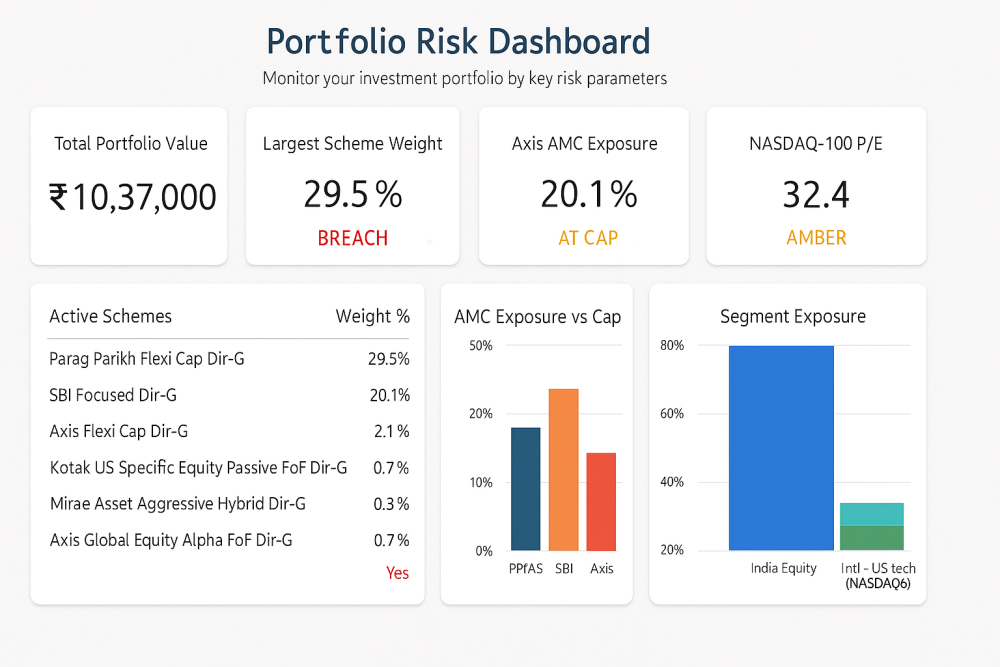
We can use AI in everyday life to manage and highlight any red flags in our stock and mutual fund portfolio. One can spend just 5 minutes every month, quarter to just “Analyse his / her portfolio using the combined principles of Philip Fisher, Howard Marks, Warren Buffett, and Pulak Prasad. For each holding, my model will evaluate business quality, financial strength, downside risk, and valuation & highlight any red flags that could become future crises.” You can change your parameters based on your risk types, core investment philosophy and amend the Risk-Prevention Checklist. Please find below my suggested 3 steps: Step 1: The Core Investment Philosophies Philip A. Fisher (Growth & Quality Focus) This Look for companies with long-term growth potential and strong R&D. This Assess management quality, integrity, and depth. Identify Favor businesses with high profit margins and strong cost controls. Please Avoid over-diversification; concentrate on a few outstanding businesses. Howard Marks (Risk Awareness & Cycles) Use this principle of Risk ≠ volatility; risk is the probability of permanent capital loss. Please Focus on downside protection and asymmetric opportunities (more upside than downside). Check and Understand market cycles: where are we in the cycle? Just Accept that risk cannot be precisely quantified; use judgment and scenario analysis. Please Avoid leverage and prepare for the unexpected real investment advice Warren Buffett (Value & Moat) Just Invest in simple, understandable businesses with durable competitive advantages. Identify Favor companies with consistent operating history and high ROE with low debt. Deep research on Management so that it should be rational and candid. Do a deep Reaser each at historic price Buy at a significant discount to intrinsic value (margin of safety). Think like an owner: Would you buy the whole business? Pulak Prasad (Nalanda Capital – Darwinian Investing) Just Avoid big risks first: survival is priority #1. Always Buy high-quality businesses at fair prices; avoid fads and moonshots. We Prefer boring, predictable industries with clear rules of the game. I like to be extremely patient: hold for decades, not years. Always Minimize Type 1 errors (bad investments) even if it means missing some opportunities. Step 2: Unified Risk-Prevention Checklist Here’s a periodic checklist to run on your portfolio: A. Business Quality & Growth (Fisher + Buffett) Does the company have long-term growth potential (products/services with future demand)? Is the business model simple and understandable? Does it have a durable competitive advantage (moat)? Are profit margins strong and improving? Is management competent, ethical, and shareholder-friendly? B. Financial Strength Check if ROE > 15% and consistent over 5–10 years? Identify Low debt-to-equity ratio (avoid leverage risk)? How is the Free cash flow positive and growing? Identify No equity dilution risk (avoid frequent capital raising)? C. Risk & Downside Protection (Howard Marks + Pulak Prasad) Run a simulation to find the worst-case scenario for this business? Check the margin of safety Is the valuation reasonable? Does the company operate in a stable, predictable industry? Identify any hidden risks (regulatory, currency, governance)? Validate if it is exposed to any market cycles? D. Behavioral & Portfolio Risks for Mutual fund portfolio Am I over-diversified or under-diversified? Am I chasing short-term trends or sticking to fundamentals? Can it be liquidated. Do I have liquidity needs that could force selling in downturns? Step 3: Risk Metrics for Mutual Funds Alpha: Is the fund adding value over its benchmark? Beta: Is volatility aligned with your risk tolerance? Sharpe Ratio: Are returns justified by the risk taken? Expense Ratio: Is cost eating into returns? Portfolio Concentration: Too many overlapping holdings? Step 4: How to Automate & Periodically Run This Create a spreadsheet or dashboard with these checklist items as columns and your holdings as rows. Assign scores (1–5) for each criterion. Set alerts for red flags (e.g., debt rising, margins falling, valuation stretched). Review quarterly for stocks and semi-annually for mutual funds. Based on this parameter I am sharing my mutual fund portfolio Risk Dashboard build suing AI: Top ribbon of KPI cards: Total Portfolio Value, Largest Scheme Weight, Axis AMC Exposure %, NASDAQ-100 Sleeve %, NASDAQ-100 P/E. Left column: Bar chart – AMC Exposure (conditional color: red if > 20% cap). Pie/Bar – Segment Exposure (India vs Intl vs Hybrid). Right column: Schemes table – Fund, AMC, Category, Weight %, Breach flag (red/amber/green). Slicers – AMC and Category. Footer panel: Triggers table (Threshold → Action). In my scenario I must take the following action: 1. Rebalance Concentration Risks Parag Parikh Flexi Cap (~29.5%) → Above the 25% cap. Action: Trim gradually on strength or redirect new flows to hybrid or global value funds. Note: Since I was not monitoring this, it has already crossed the threshold but If I was monitoring all parameters I could have taken a decision before it became red. Hence, we can conclude that we can build dashboard to proactively identify risk using AI.
-
That quote attributed to Jack Ma—"You should learn from your competitor but never copy"—is a powerful reminder that innovation comes from adaptation, not imitation. For banks aiming to make every customer interaction feel personal, the key lies in learning from other industries and customizing those insights to fit the unique context of financial services. Here’s how a bank can apply this principle using AI: 1. Retail: Hyper-Personalized Recommendations Netflix & Amazon uses deep learning to adapt recommendations based on user viewing behaviour, time of day, and device used. Starbucks customizes offers using AI based on historical order, time of the year, and location. Sephora and Derma co (In India) uses AI for skin tone matching and personalized skincare routines. Banking Application: Bank can learn from Netflix, Starbuck and Use AI to recommend financial products based on transaction history, life events (e.g., marriage, home purchase), and seasonal behaviour. They can also Offer dynamic, context-aware promotions (e.g., travel insurance before holidays). 2. Healthcare: Empathetic Personalization AI is used to deliver personalized chronic care support and preventive nudges. Patients expect seamless, relevant, and empowering experiences. Banking Application: Banks can Provide empathetic financial nudges (e.g., reminders for bill payments, savings habits, budgeting tips). Banks can learn to be emotional intelligence through Use of AI to support vulnerable customers with tailored financial wellness programs. 3. Hospitality & Travel: Integrated Journeys There are many Brands which integrate flights, hotels, dining, and experiences into a single personalized journey. AI-driven “next-best-action” engines guide users through seamless experiences. Banking Application: Banks can Create integrated financial journeys/ bundle service (e.g., mortgage + home insurance + renovation loan). Based on above context banks can follow following Recommendations: Build a “Digital twin” for every Customer Integrate data across silos to understand customer behaviour holistically. Invest in (Customer Brain) Real-Time Personalization Engines Banks can Use AI to deliver dynamic, context-aware interactions across channels and communication strategy. End-to-End Workflows using AI Banks can Learn from retail and marketing leaders who rearchitected workflows to scale personalization. The experience must be seamless across touch points. Human Touch Ensure AI complements—not replaces—human empathy and trust. AI can draft and use data to build context. Which can help Personalize not just based on data, but on timing, channel, and customer mood. Ethical AI Use Banks must be careful and transparent about data usage by avoiding over-personalization and mitigate bias.
-
Do you know how banks are getting smarter? It is by turning Knowledge as a Competitive Edge : The real game-changer is how they're using everything they know by decoding the customer brain through data by studying their patter 24/7/ 365 days. 1. They are ditching the old for the new Simplify and streamline operations: They are replacing legacy systems with modular, cloud-native architectures which was un-thinkable just a few years ago. Use continuous integration and delivery tools are used to reduce development time and improve agility. In action: Bank of America using Cloud Provider: Private cloud infrastructure. Saved approximately $2 billion 2. Investing big in data and AI They are Building a solid foundation: Banks are building unified data views from their scattered data sources. To connect all the dots which was their biggest pain. Use AI and Gen AI to generate insights, automate decision-making, and to give a personalize customer experiences. Example: Several Autonomous Decision Intelligence Platform is developed by banks to turn fragmented data into strategic assets for fraud detection, risk assessment, and marketing. 3. Shifting focus from maintenance to innovation: Redirecting funds: Tech budgets are being redirected from simple maintenance to things that where it is creating new value. Customer-first focus: The focus has shifted to improving the customer experience, personalizing everything, and getting to market faster. 4. Nurturing the right talent and culture Build a tech-savvy board and leadership team. Gen AI training are provided to the leaders along with it’s application. There is a significant Increase in the proportion of in-house engineers and reduce overhead roles. Foster a technology-first mindset across the organization. Example: Another US Bank Capital One, with it’s 12,000-strong tech team transitioned to a cloud-first model and began selling its own software products. 5. Use AI to Enhance Relationship Management AI isn't just for behind-the-scenes—it's also a powerful tool for customer-facing teams. Smarter advisors: Relationship managers are being armed with AI-generated client summaries, risk profiles, and insights. More meaningful conversations: They are spending more time on strategic, high-value conversations because gen AI solution is providing them with the necessary inputs. The payoff: This is leading to a stronger, more profitable customer relationships and faster decision-making.
-
In Banking service, AI might be used to reply to customer cases based on urgency, value, or predicted outcomes. There is a possibility that the training data is based on historical biases (e.g., favouring certain ethnicity, creed, age or regions). Following are the suggested Steps to Minimize Bias in Design, Testing & Monitoring 1. Design Phase Define fairness criteria: one should define “fairness criteria” Source Diverse data : one should Ensure training data includes a wide range of date that includes representation of all types of variation that exist in real world / population of that universe. 2. Testing Phase Testing for bias: Introduce Use fairness metrics for example disparate impact analysis to test the model Observe scenarios: one should run test cases with all kinds of customer profiles. Human-in-the-loop: Include manual review for flagged decisions. 3. Monitoring Phase Metrics for dashboards: Track prioritization patterns by different customer segment. Continuous Feedback loops: Build a culture where employees and customers can report unfairness. Continuous train the Model: There is still a possibility that some biases infiltrate despite all checks and balance hence it is suggested that one should Periodically retrain models to identify noise and biases.
-
-
-
To my mind Carrot should be introduced in the improvement phase. This will work as a catalyst for change and should be continued so that the result is sustained.