NishaNathG
Members
-
Joined
-
Last visited
Everything posted by NishaNathG
-
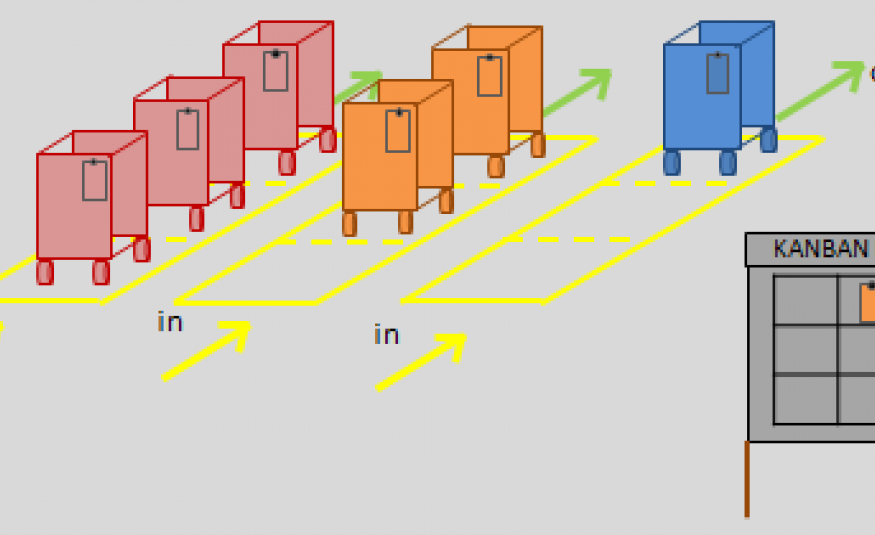
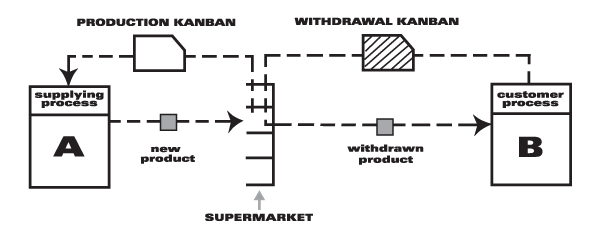
As a part of value stream mapping , when we start designing the future state process Supermarket is one of the strategies used. It is one of the pull strategies that is used when we create Future State Value Stream Map. It is an effective method to manage your inventory or what order the parts will be used from the inventory. It is actually placed in the process of the supply chain or workflow to support the need and the requirements. In the supermarket materials in the flow will provide the materials if there is a demand in the downstream processes. A visual management tool like kanban board with different colors can be used to signal this. IT was Toyota who first installed this supermarket in 1953 in one of the main plant in Toyota city. Taiichi Ohno who was behind got inspired by the American supermarkets where the goods are arranged in shelves and the customer will selected based on the demand and it is refilled. Benefits of Lean Supermarket Helps in signaling if there is a lack of inventory Its visual management tool to track the inventory It works in FIFO principle Effective way in tracking the quality of the deliverable Eliminating the non value added activities in the whole flow
-
Obeya room is the room which is assigned to run large projects or initiatives and to support the teams in decision making, improve cross functional and stakeholder interactions. Its also called as War room. It was used very Frequently and its very relevant part of the Toyota production system. The importance or the focus of the obeya room is inculcate the culture of social networking and reduce the thinking only limited to a function. Inside the obeya rooms you will showcase charts, graphs, milestones and progress update . Current risks/mitigation steps including the technical/schedule /cost related issues also will be listed. IN TPS its often told as a visual technique to reach the objectives faster as its helps the stakeholders to come under one room and discuss all the problems and identify solutions and put into actions. Benefits of obeya rooms in crossfunctional projects Eliminates the problem-solving barriers- time, interaction with stakeholders GO into the depth of the problem when all the team members are present in the same room. Clarify the questions and enhances understanding the of the problem Add different perspectives of same problem which helps to come up with innovative solutions and make the whole process a lean activity Encourages team work and cross functional communication


-
Yes it is important to have sponsor and champion as part of a successful six sigma program. Sponsor - In all the projects we need decision making it will be done by senior management. A person from leadership or from the senior management is always identified as the sponsor as he need to play the role of approving budget, resources and matters which are sensitive . Sponsor should give clarity to the problem by defining goals the team need to achieve and validating the charter and provide sign off at each DMAIC toll gates. Its very critical for the sponsors to be liaison with the team for the success of the project. eg: For a project if we need to identify the best fit solution for digitization , we will have 3 options ( Bot, workflow and desktop bot) Based on the benefits the sponsor can approve the budget for the digitization and it will be a major milestone in improvement phase of DMAIC. Champion: A person who is driving the continuous improvement initiatives throughout their organization is the champion of that project. Champion will drive the project based on each year vision and goals and provide metrics and plan to the leadership. Identify resources and remove roadblocks. He will provide training and mentoring to the black belt candidates and ensure the resources availability throughout the project. He will ensure that the project is going according to the six sigma standards and all the tools and processes are followed. he will mentor the team on how to use the six sigma tools and resolves the cross functional teams. eg: A team has a target of 4000 hours and champion will create pipeline after talking to the business and identifying the projects from each portfolio that this target by the organization is met. He/she will ensure that the projects are done rightly and the benefits are calculated without any manipulation.

-
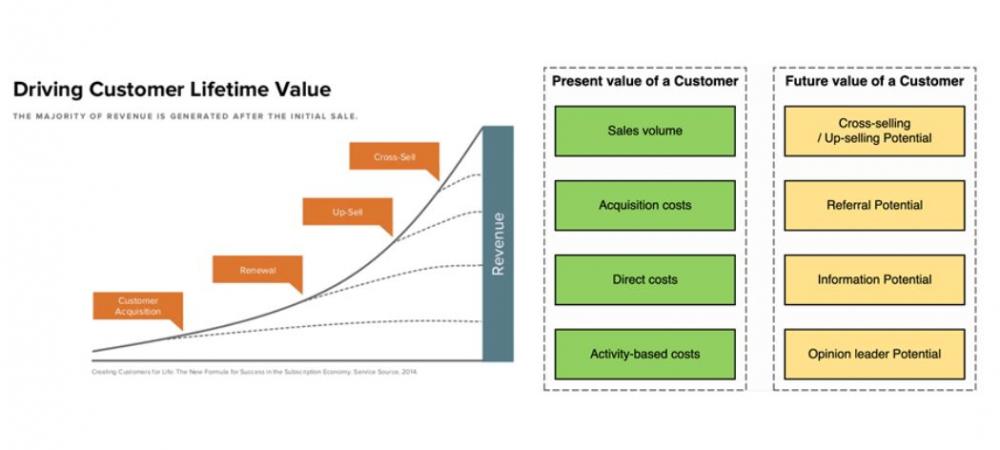
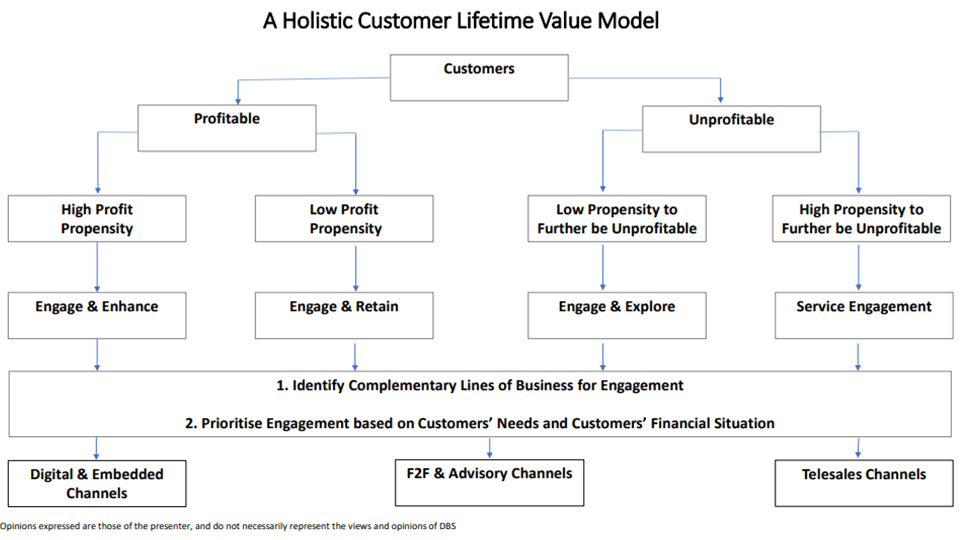
Customer lifetime value is the an important quantitative metric which is tracked as a part of the voice of the customer program. This is a measurement to understand how much importance a customer is to the company and this also helps to understand the cost per acquisition. CLV is very different from the net promoter score while CSAT measures satisfaction. So we can generally talk about it as the sum of the revenue /value from business of a customer and how much time period the customer was with the company.Through this approach we will be able to find that how the current customers are affecting or contributing to the business and is wiser to keep them. Through this a company can increase value and drive growth. The first account of CLV was measured in the 1988 book Database Marketing and the early adoptors of this was in 1990 which is by Edge Consulting and BrandScience. We can use the following approach to measure CLV: Identify the flow and understand where all the value is generated Map the end to end customer journey Profit /revenue we are getting at each of this touch Sum it with the duration of the journey (Take the mean/average of the customer revenue * Profit per customer) ÷ Monthly Attrition/Retention of the customes For example: $100 avg monthly spend by a customer in an IT development company * 25% margin ÷ 5% retention rate = $500 LTV
-
MoSCoW is a tool for prioritization of your projects to make the business understand the products requirements. IT will be very much crucial for the stakeholders when they need to understand the features in a specific release. MoSCoW has four different categories: must-haves should-haves could-haves will not have. “W” in MoSCoW is used to stand for “wish/delighters” instead of “will not have right now.” Dai Clegg, software development expert,, created the MoSCoW method when he was working in orace and was later added to Dynamic Systems Development Method (DSDM). For example: MoSCoW can be applied to any product development - for example a food app like Swiggy Must have - user should be able to order and restaurants should be added to add their food options Should have - Multiple options to add different locations and different orders at sametime COuld Have - recommend the restaurants with lower price wil not have - option to auto order breakfast & lunch scheduler based on scheduling for a month

-
Change Effectiveness Equation is a famous equation Q x A = E is the one which belongs a GE Milestone which is called CAP (Change acceleration Process). It came as a forerunner to the six sigma methodology which was also by GE. Jack welch launched the CAP around 1992 due to accommodate the fast changes and transformation in the world due to the Gulf war. Q is the quality /strategy of the organization, A is acceptation – people skills, team, E is the Effectiveness of the change. After implementing a Work Out a model from Japanese quality circles welch understood the adoption rate is very less by the business . The reason of many projects to be derailed is lack of the time team spent on the cultural values. The point of this model was if there is a zero in the acceptance of the business however effective the technical strategy is the effectiveness will be zero. Project leader quantify these components to maximize the effectiveness: Project leader can be committed to lead the change till the end of the project Changing the mindset of the employees Measure the progress of the initiative continuously Bring changes in the system and organization structure to accommodate large scale changes in project.

-
EMO Index is an indicator to quantify the emotions of stakeholders and it is a registered trademark of EMO Insights International. A company in spain introduced and did a wide range of study to test the Emotional Management in Spanish Retail Banking Market. The sample was taken of 1,968 interviews which were all retail banking customers, both male and female, aged 18 and were spanish. They used neuro linguistic techniquest also to analyse the past of the customers association with the bank to understand their current behaviour. Customer Satisfaction or voice of customer is an important thing when it comes to any business. This customer satisfaction survey aggregates the information and tells us all the details about each of the customer and groups. The result they got was the Net emotional state and Net Intensity Balance and they used that to measure values from -100% to +100%. 7 broad stakeholder/banking customers were arrived: Fans (+100 to +80) Believers (+80 to +55) Followers (+55 to +30) Stand By (+30 to +15) Lost Souls (+15 to -5) Burned Out (-5 to -30) Opponents (-100 to -30) This clustering model actually is an opponent for traditional methods which are used to predict behavior of different classes. EMO Index is a more dependable and consistent indicator than Net Promoter Score.
-
Decisional Balance kit is one of the continuous improvement toolkit. It’s a simple and effective decision making practice followed. The objective of the decision balance sheet is to take more confident and balanced decisions. It is a window which shows the advantages and disadvantages of the a challenge/idea /situation. There may be various situations it can be either due to a problem or a condition which needs to be solved. It improves the currently knowledge about the situation. It will avoid decision making blocks or hindrances. It always encourages the team members and increases the speed of decision-making process. It captures the advantages and disadvantages and the different options available. It can be very well useful when you plan to decide individual or related organization. Benjamin Franklin is the one who used Decision balance sheet when he wrote a letter Joseph priestly in 1772. So it is often called as franklin method. Plus Minus Work from home · Manage work and home effectively · Manage household things · More care to children · Work can be also done in a relaxed manner in the home premises · Work will not be limited to hours · It will extend from day till night. · Teaming not happening · Social interaction less
-
Product Portfolio Matrix/ BCG Matrix or Growth-Share Matrix Product Portfolio matrix is also know as BCG or Growth – Share Matrix. Each organization needs to understand and regularly asses if the products they offer to the market is profitable or not. This helps in driving efficiency and they can use the resources efficiently. BCG Matrix is developed of Boston Consulting Group will help you to understand the value of the products and growth share. It is also called as growth share matrix and it’s a portfolio planning model and analyse the products. BCG Matrix is classified as: Cash cows, Stars, Question Marks and Dogs Each category represents each kind of product in the portfolio. Stars: Products with High Growth and High Market Share. These products will have a higher market share and they will bring more profit to the business and high growth potential. As the business gets matured it will become cash cows and they will hold a big market share but growth wil be less. SO as a remedy we need to find innovative products to develop new stars to the market. Cash Cows: Product with Low Growth and High Market Share. These are the products with significant return of investment but they will lack innovation and growth. They will be the source of profit for the organization. They will provide the capital for Stars and question marks. Dogs: Products with Low Growth and Low Market Share. These are the products which will not have any cashflow or they wont be required any investment too. It wont be advisable to invest in them they will neither generate cash nor market share. Question Marks: Products with High Growth and Low Market Share. For question marks we will have high growth potential and low market so it will be possible to increase the growth with right strategies and investments Positives · Easy to comprehend · Monitor the opportunities available to prioritize it · Identify sources of profit and to increase it · Resource optimization Negatives · Only two factors are identified and analyzed which is market share and growth rate. · Doesn’t tap the sources with low market · Small competitors are not considered Dmaic - Question mark and cash cows as there is an opportunity for improvement DMADV - Dogs as there is no growth and no profit. we can re-design this projects
-
Standardized Work is one of the fundamentals of the lean methodology. Standard Work is defined by Toyota as a detailed definition of the current best practices for performing a process. In the lean principles we have Standardized work as one of the key elements. It aims to the objective of continuous improvement of the process. It also includes the time taken to do each task in the process. Standardized work enables in reducing variation and there by improves the process.“Where there is no standard, there can be no kaizen.”- Taiichi Ohno The objective of the Standardized work is having fool proof solutions and continuously improve them and benefits in identifying and eliminating previously unseen wastes. It focuses at the customer demand, efficient process steps, cycle time, audits to minimize defects and effort required. 1. Takt Time is the rate at which we need to complete the product in order to meet the customer expectations / demand. Takt is calculated by dividing the available production time by customer demand. Through the takt time we will be able to understand the bottlenecks in process and non-value added activities and it will help us to identify the wastes in the system. Eg: Monitoring the Turn Around time of tickets resolution. 2. Work Sequence is the step by step detailed operating procedure which need to be performed / completed by operators within TAKT time to meet the customer demand. It helps in knowledge transfer and make the whole process standardised and helps in streamlining. It helps to forecast the resource crunch in advance which helps to maintain at least minimum resources to operate the business. Eg: Process documentation, escalation matrix 3. Standard Inventory aims to understand the inventory and focus on at least minimum quantity of parts, raw materials, resources to run the smooth operations. Example : Resourcing for tickets resolution is done using the volume handled and the resolution time