
Pradeepan Sekar
Members
-
Joined
-
Last visited
-
Pradeepan Sekar replied to Vishwadeep Khatri's topic in We ask and you answer! The best answer wins!Queuing Theory: 1. Queuing Theory is mathematical study of waiting time or queues in a model. 2. Queuing theory is used to predict the queue length and waiting time in the simulation for the better business decisions such as planning of resources, space allocation, charges for the premium etc. 3. Queuing is not only applicable to the customers, but also to the product, raw materials, Services, or projects which are lined up. How queuing works? An entity will be arriving to the queuing node, where the entity will be treated by service. But it needs to wait before getting treated and then it will take some duration while it been serviced and then leaves the node. Some applications of Queuing theory: 1. Raw materials are stored and then consumed as per requirement. (Queue length – Inventory | Waiting Time - Capital of WIP/ shelf life) 2. Ships waiting for the clearance. (Waiting time and Service time -Demur-rage) 3. Car parking in the mall (Queue/ service length – Number of Parking slots) Scheduling policies: There are different ways to assign or schedule the next entity to the server which are called as scheduling policies. 1. First in, First out: a. This policy states that the first come will be served at first, which means the entity with longest waiting time will be treated first. b. It is considered as an ethical way to schedule the service for the customers. Token system in Bank or Hospital c. In Manufacturing, First in First out have been considered to keep track on the shelf life of the product. Raw material consumption. 2. Last in, First out: a. This policy states that the last come will be served at first, which means the entity with Shortest waiting time will be treated first. b. It is also stated as stack, It is applicable in most of the cases where you have constraint in such a way that you need to treat the last item first c. In Drive in Racking, We need to pick the last item placed as first. 3. Processor sharing: a. In Processor sharing, more entities will be served at the same time. In this case it can be multiple or as many as possible b. In a mall/ theater, it can accommodate more customers. 4. Shortest Job First: a. Shortest job will be scheduled first , which helps to reduce the queue length. b. In super markets, there will be separate queue for less than 5 billing items, they will treat other customers only after treating the shortest job. 5. Longest Job first: a. Longest Job will be scheduled first. b. In case of Project funding (Project funding as server), Longest job can be allocated with funding to start first. 6. Priority: a. Customers with high priority are treated first. b. It can be primitive (Where customer in service will be interrupted) or non- Primitive. c. Priority can be given in the form of premium queue or even emergency d. Patients at life risk will be treated immediately in hospitals. e. High paid premium queue in the amusement parks. 7. Shortest remaining processing time: a. Customers who have been treated already and having shortest remaining processing time. b. In Banks, after filling the forms, priority will be given to the submission of forms. Key Points: 1. Types of Service facility: Single server, Multiple server with single queue, Multiple server with Multiple queue 2. Queue length, waiting time and service time are the key parameters. 3. Customer Behavior: a. Balking: Customer not joining the queue, because of queue length b. Jockeying: Switching between the queue, considering other queue will be treated faster c. Reneging: Leaving the queue ( which is also called as drop outs)
-
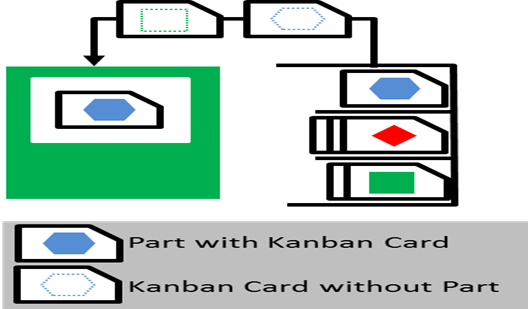
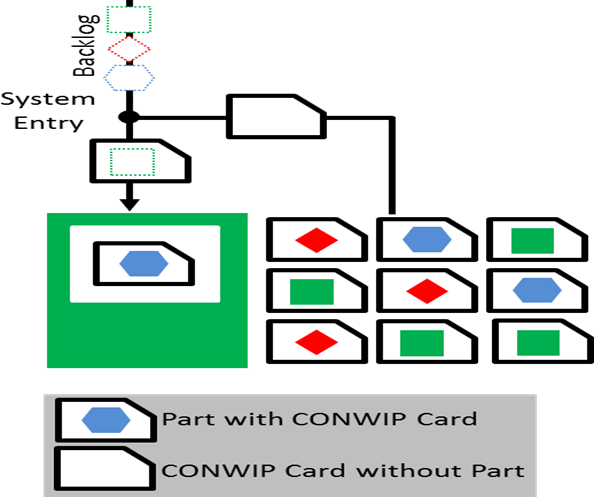
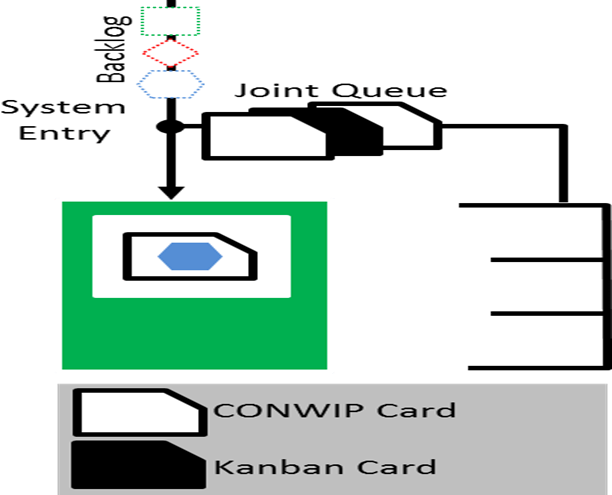
Pradeepan Sekar replied to Vishwadeep Khatri's topic in We ask and you answer! The best answer wins!CONWIP Production system and Inventory control: Production system and inventory control is often classified as two system 1. Push System and 2. Pull System. In Push System, Planning involves forecasting of the customer demands and inventory needs to be maintained to meet the demand. The system will produce the enough product as per requirement based on scheduling and it will be pushed to the customers or the next phase of manufacturing. In Pull System, Production begins with customer order. A trigger is required from the customer. The main advantage of push system is to reduce inventory levels and cost of carrying and holding goods, as the system allows to manufacture enough goods only to meet order. Unlike the Push System, pull system will not allow excess storage of material to push the supply towards customer. The most effective way of implementing Pull system is Via Kanban Cards. The concept of Kanban is so much associated with Pull system, as sometimes even used synonymously. However, some of the other Pull systems are JIT (Just In Time), CONWIP (CONstant Work In Progress). Kanban: Kanban is a lean method aiming towards reducing the inventory and to manage the work by balancing the demands with available capacity. This method was originated in Toyota production system. Kanban refers to Billboard in Japanese. Kanban is both a type of card (Billboard or signboard) and Production or Manufacturing system in Lean Manufacturing. In traditional method of Kanban, a card is used to identify the demand of the particular product. But often with the development of lean concepts in various sectors, Kanban is replaced with any form , even in digital form as per the application. How Kanban Works? In Kanban methodology, there will be a limited number of Kanban (signals) either in form of card or any other form and each signal represents certain product type and a certain quantity. Every product will be attached with Kanban (card) and Once the product is consumed and then the card will come back to the initial loop to schedule the production. Now the new product will be attached to the Kanban and the stock will be replenished, once after it is consumed. As the number of Kanban cards are limited, System will not allow to stock more than a particular quantity. The number of kanbans, way of prioritizing production in the queue, FIFO requirements will be defined in the system. Kanban makes a simplest form of Pull system. CONWIP: CONWIP (CONstant Work In Progress) system is very similar to Kanban. CONWIP also associated with signal or card to trigger the manufacturing, processing or servicing of the product, but unlike the Kanban , it is not associated with a particular product. In CONWIP system, if a part leaves the system, CONWIP card will go to initial stage and the card is not associated with any product. If the card is returned from inventory location, next part with backlog and most urgent will be next in line for the production. In CONWIP, it gives signal about capacity available. But the production will be scheduled as per the forecasted demand. Hence CONWIP is a kind of single stage Kanban system, except the product type will be assigned only when it way backs to production floor; Product is assigned only after reviewing the backlogs, urgency or priority base, sometimes even by the forecast of demand. Advantages of CONWIP: When Variants and Product Varieties are high Kanban works very well with High quantity low variant product. Kanban replenish the stock of the part number which is having continuous demand. Kanban works well with made-to-stock parts (Fast Moving Consumer Goods or the items sold in larger quantity with continuous demand). CONWIP overcomes the difficulties faced by Kanban when the every product we produce is unique or customized and when the variants are very high. Here any part can be assigned to any CONWIP card as there is no product assigned to CONWIP as default. 1. CONWIP works very well when the product variants is high and the capacity of storage is maintained. 2. When all the products are unique or customized, CONWIP overcome the Kanban challenges. 3. Since any product can be assigned to CONWIP, Product which we produced only once can be assigned to CONWIP. Lesser WIP than Kanban: As we don’t need to create a WIP space for the product which is of low volume, So the space can be give n to the higher volume products. Flexibility of not having product associated with the signal cards helps to reduce the number of cards comparatively. If less number of cards, that means lesser WIP. It is also a pull system: As Like any Pull system, CONWIP is also having all the advantages of the pull system to make the production process efficient and smooth, such as 1. Reducing and maintaining Inventory 2. Lean Manufacturing Application 3. Prevents overproduction 4. Reduces inventory holding and carrying cost Hybrid is possible (Kanban and CONWIP) While Kanban maintains the tighter control on system WIP through individual card allocated for each product and will not allow any flexibility. Some system can be hybrid with Both Kanban and CONWIP by assigning Kanban to some stages in the production or to some parts in the production. CONWIP is also described as hybrid push-pull system. The Hybrid system will have Kanban for higher run products and CONWIP for lower volume products. Whenever card returns , both the cards will follow the same queue and the product will be assigned to CONWIP card only before the production based on priority and Backlog. It is quite a good system to have the benefits of Kanban and CONWIP cards. Disadvantages of CONWIP: Need Human Inputs to schedule production: Unlike Kanban, CONWIP can’t Produce the parts automatically. If Kanban cards comes without product, system will reproduce that product automatically. But in CONWIP, Human input based on some prioritization or forecasting model is required. There is an assumption that people organizing backlog or prioritizing the requirements knows what they are doing. If prioritization is done for non-moving products in large quantity it will occupy your inventory space and you will not be able to produce another product which is on demand until we sold out those product we have produced. Extra Effort: CONWIP needs Extra effort as we need to sort the backlogs , prioritize the demand and assign the product to CONWIP Before production.It is not automatic as like Kanban Bullwhip effect: The effect of human decision certainly leads to Bullwhip effect. This effect is described as tendency of increasing the quantity swing. As the human involved in production scheduling overreacts to the demand signal leads to WIP quantity swing in the system. Overloading the production system: Here time is not considered to schedule the production, only the quantity of stock is considered. In a balanced system, if we have products of different Throughput rate. Utilization of the resources will not be constant in CONWIP as we need to maintain the CONWIP quantity. It will leads to overloading or underutilization of the resources. It is important to have balanced workload among products and balanced system to overcome this particular limitations of CONWIP
-
Pradeepan Sekar replied to Vishwadeep Khatri's topic in We ask and you answer! The best answer wins!Planning Poker: Planning poker which is also called as ‘scrum poker’ was first coined by James Grenning and later popularized by Mike Cohn in his book “Agile Estimation and planning”. Planning Poker is a fun way and secured method used mostly in estimating effort, relative size of the team or duration, size of the goals in software development. It is a gamified technique to guide the team on planning and to have an consensus based, accurate and unbiased estimate. Planning poker is a variant of wideband Delphi Technique. Planning poker combines three estimation technique which are 1. Wideband Delphi Technique 2. Analogous estimating Technique and 3. Estimation using WBS (Work Breakdown Structure). Planning poker avoids the influence of participants. If a number is called out, it may sound suggesting, recommending, or influencing other participants. It provides space to thin k people independently. Wideband Delphi Technique: Wideband Delphi Technique involves greater interaction and more communication among the experts who are participating. Coordinator calls a group of experts to discuss the estimation issues and coordinator presents each expert with an estimation form and experts fill out the estimation anonymously. Then coordinator prepares and distributes a summary of the estimates and the experts are again called for the meeting focusing on discussing the points which are varied widely. This iteration of meeting continues until it arrives an appropriate estimation. Analogous Estimating Technique: Analogous estimation is the technique which use the experience of the similar former projects to estimate the effort or time or cost involved to it. For analogous estimation, more the data available will better the estimate. Estimation Using WBS: The entire work to be carried out in a project will be identified and well defined which is call as Work Breakdown Structure. Hence by reviewing the WBS with project stakeholders, you will be less likely to leave any work since we had spent time on defining the WBS. Estimation using WBS will be more accurate and precise. Procedure to play Planning Poker: 1. A Moderator will chair the planning poker. 2. The Product Owner provides an overview on the user story (Requirements from the client in software development) 3. Team will be provided to ask questions to clarify on assumptions and risks. 4. During discussion, members should not mention numbers. 5. Summary might be recorded by moderator. 6. Everyone who are playing will choose a card and keep it face down. The number in the card will represent the unit of his/her estimation. 7. Everyone turns the card simultaneously. 8. People with high and low estimates are allowed to justify their estimation, proceeding with that discussion will continued to the team. 9. Repeat the estimation process by choosing cards until the consensus is achieved. 10. In software development, developer might like to hold high value of estimates and project manager wants it to be minimum. However,moderators will contribute to arrive to a consensus. 11. To ensure the discussion in structured manner, Moderator or product owner can handle timeclock. After timeout, another round of poker will be played. Benefits of Planning Poker: Expert opinion: Expert opinion provides an estimate relying on his own experience, intuition, or gut feel. Expert opinion doesn’t take much time comparing to some other analytical methods. Analogy: Analogy provides accurate results as the user story in the given case is compared with similar user stories which are implemented. It provides experience as base for the estimation. Dis-aggregation: Dis-aggregation is done by splitting a user story in to smaller and easy to understand user stories. Then the estimation will be done for each and every individual smaller stories. It is also providing a base for analogy as smaller stories are comparable with many of the similar stories in the past.
-
Pradeepan Sekar replied to Vishwadeep Khatri's topic in We ask and you answer! The best answer wins!TRIZ (Theory of Inventive Problem Solving): TRIZ is a problem-solving approach derived from the study of global invention patterns which was carried out by author Generic Altshuler in 1946. TRIZ is an acronym of ‘Teoriya Resheniya Izobretatelskikh Zadatch’ which is rendered as “Theory of Inventive Problem Solving” and often called as TIPS. TRIZ is a systematic approach for generating solutions in Problem solving even in finance, product, services, and manufacturing fields. Altshuther screened over 200,000 patenst and observed that the most of the patents have very straight forward solution, only few had somewhat inventive solutions. Altshuter had extracted 40 inventive principles and those principles will serve as a hint to find the highly innovative solution to the business. Concept of contradictions: Problem lies in contradictions between two or more elements of interest. Increasing the quotient of desirable elements or reducing the quotient of Undesirable elements will lead to reduce the quotient of another one or more desirable elements or increase the quotient of undesirable elements. Sometimes we need the maximum and minimum quotient of the same element. Some examples of contradictions: Contradictions More of Undesirable Less of Desirable More of Desirable Increasing the strength of material , increases the weight Increasing the capacity of the car, reduces mileage Less of Undesirable Reducing Variation in process, needs more effort and investment Reducing the expense on material, leads to poor characteristics More and less Height of Rack in supermarket should be maximum to store more materials and also should be minimum for easy access of customers While applying TRIZ to find inventive solution for the business problems, first and foremost things to do is to identify the contradicting statements as stated above. These are called as Technical contradictions. Inventive principles: Solutions are often straightforward by compromising one of the contradictions. But TRIZ provide us an ability to think to improve on both contradictions. By applying the inventive ideas, it has been proved that Ideality i.e more of desirable and less of undesirable can be achieved at the same time. TRIZ principles are used in the many leading companies like Samsung, Xerox, IBM, LG, intel and so on. Altshuter has developed a set of 40 inventive principles and later he also framed a matrix in which he indicated 39 features ( which is also called as Engineering Parameters)in rows of desirable and columns of undesirable and the matrix is called as matrix of contradictions. Each cell points in the matrix points to the list of inventive principles which is more commonly used in order to resolve both contradictions and to achieve ideality. Example: For instance, now a days, all the Governments are facing challenge between economical crisis and pandemic risks due to the spread of COVID-19. If Lockdown is lifted, country will be in a good position to handle the economy, but will result in increasing the COVID-19 cases. They are looking for a solution to handle both and to strike a balance. But in some fields or organization, they were able to overcome the spread and also helps in increasing the efficiency, cutting down some overheads such as travel allowance, Electricity bills, administration charges with the innovative ideas of working from Home, which was supported by lot of visual meeting medium, e-forms, e-signatures, remote access, Virtual machines etc. By which, the continuity of working for an organization or customer or on a project is carried out without the physical presence to generate more revenue than before and at the same time reducing the risk of pandemic in their organization. How I used TRIZ in my domain? Background: TRIZ has been used in the purchase of packaging machine which is one of its kind for our food product. I have morphed and simplified the terms for the better understanding and to maintain confidentiality. We are into manufacturing of a food product which is available in different sizes (1x,2x,3x…..6x). Manufacturing of the products with varied size can be done by a single processing line with the set up-time of 8 hours from one size to another and the packaging machine needs to be changed from smaller ( which can pack 1x, 2x and 3x) to bigger (4x, 5x and 6x) which is followed so far As we are interested in buying a new packaging machine with more advanced features and accommodating HMI , A. we need to buy two machines to cover all range of products, but it will increase the investment by double or B. we can buy universal machine which can pack all range of products, but the speed will get reduced for smaller products due to the design for maximum and investment also will be 1.7 times of budget of single machine or C. We can buy a standard machine which can pack the product sizes of 1x,2x and 3x. so we should drop plan of producing other bigger sizes. Contradiction Statement: To increase the packaging capability of wide range of products to meet demand of market with lesser set up time, we should increase our investment and/or reduce the packaging speed. Desirable: Packaging capability, Packaging speed Undesirable: Investment Options Packaging Capability Investment Packaging Speed A Wide (1x,2x,3x,4x,5x,6x) High ( 2 times) Standard B Wide (1x,2x,3x,4x,5x,6x) Moderate (1.6 times) Lesser than standard (for 1x,2x and 3x) C Limited (1x,2x,3x) Low (as per budget) Standard (for 1x, 2x and 3x), Not feasible (4x,5x and 6x) Ideality of Innovative idea, Our interest is to pack wide range of products, with less investment and without compromising on speed. Inventive principles applied: Principle 1 : Segmentation. (Divide an object into independent parts) Principle 16: If 100% of an object is hard to achieve by slightly less or slightly more, we can achieve it with same method which is considerably easier. By combining above 2 principles, by dividing the standard machine with considerably spares for mechanical parts alone (which increases the cost by 3%), we will be able to cover a wide range from (1x to 5x), the solution was considered and accepted by machine maker and order is placed for the same . The machine going to be supplied is unique for the supplier and they have never adapted such flexibility before.
-
Pradeepan Sekar replied to Vishwadeep Khatri's topic in We ask and you answer! The best answer wins!HAMMURABI CODE: Hammurabi is the king who ruled from 1792 to 1750 BC in the middle east. The king, Hammuarbi enacted the code in 7.5 Feet Stele stone. It consists of 282 laws describing scaled punishments such as “an eye for an eye, a tooth for a tooth” based on the social groups and consequences of the committed mistakes. This code was found in 1901 and translation in to publication happened in 1902. Hammurabi code is described as “the first code of conduct” which was passed about 4000 years ago. Being the King, who is leader of civilians, he was concerned about the welfare of people which is clearly depicted through his laws. Hammurabi had taught few lessons through his code to the modern business leaders. It has featured some progressive precepts such as minimum wage’s law, innocent until proven guilty, fairness about graded punishment (Famous saying “an eye for an eye, a tooth for a tooth”). His codes of conduct are considered impossibly harsh and authoritative, but most leaders describe his concern as motivation towards the wellbeing of the society and his own civilians. Hammurabi Code – skin in the game. Mainlining the accountability According to law number 232, if a Babylonian builder built a house with under quality materials which will apparently result in collapsing of the house will leads to death of owner, then builder will be put to death too. Builders build the Babylonian houses with high quality, because builders knew the consequences as default. Risk Evaluation: The King, Hammurabi encourage the builders to build the houses with more margin of safety to make the structure rigid not only during the predictable situations such as wind, storm, and rain but also in unpredictable situations like earthquake. Incentive Management: Builders are incented to build with better margin of safety but not cut the corners to pocket more money to the owners. His code which is suggesting to have “one’s own skin in the game” thus entrusting a moral obligation for fair play, addresses the Business leaders of today to mainline the individual accountability, communicating the standards, Incentive management, Risk Management. The issues concerned by the King Hammurabi are often the issues of modern business leaders. Now a days, Organizations are engaging the leaders to find the way of 1. How to maintain employee accountability, 2. Improving the Quality of execution, 3. How to drive incentive system, 4. Defining performance measure with clear KPI, 5. Rewarding and Reprimanding – its not about punishment, about improvement, 6. Employee fairness – Sustaining the employee’s morality. Ways of Implanting the idea of having one’s own skin in an organization: 1. Clear roles & Individual Accountability: a. When the roles and responsibility of the employees are ambiguous, people struggle to be accountable. Clear definition of the role through work instructions and SOP become a necessity. b. Measurable KPI with fair quotient of weightage. c. Assigning responsibility to the individuals with clear definition of his role. d. Removing confusions such as who is doing what, when, and how makes the person accountable for the successful execution and paves a way for success 2. Team formation and owning the process: a. Form, Norm, Storm and perform as four stages of team formation. Leaders play an important responsibility to achieve the fourth stage of team formation. b. When team feels truly accountable, they will storm on the gaps, learn new roles and processes, teach to each other, find a way, bring synergy and makes more efficient team. c. Each member of the team will become responsible to seek information, give feedback and receive feedback and point out mistakes when it is needed. 3. Autonomous and independent decision making: a. Listen to the multiple solutions and brainstorm, most of the problems will have multiple solution. b. Improve upon the team’s ideas, rather than imposing your own thoughts. c. Give them the freedom and support. d. By providing them the rights to take decision, team will increase their skills, confidence, and ownership. 4. Communicating the standards: Standard Operating Procedures: SOPs are the documents which describes the actions to be taken under several circumstances, it also lays who, what, when and where for the important actions. It provides clear and concise guidelines. SOP should be the document which is serving at higher level and the detailed instruction should be described in work instructions. The SOPs should be clear, simple, concise and continuously updated. Otherwise it results in instruction creep. 5. Risk evaluation: a. Encourage people in assessing the possible failures of the process, get suggested on solutions to overcome the worst-case scenario. b. Engage the operational excellence or Business analyst in identifying the areas of risk and scope of improvement. 6. Incentive Management: a. Incentive should not drive the process to fulfil what had been described. b. Fairness of evaluation is more important to keep employee’s morality high. c. Employee should be incented for their additional inputs, their creative and innovative initiatives.
-
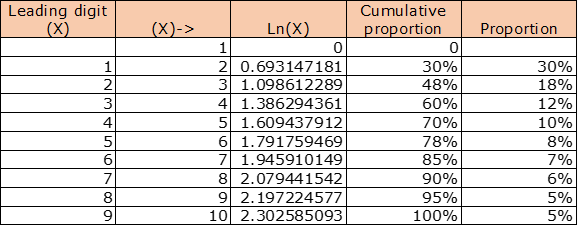
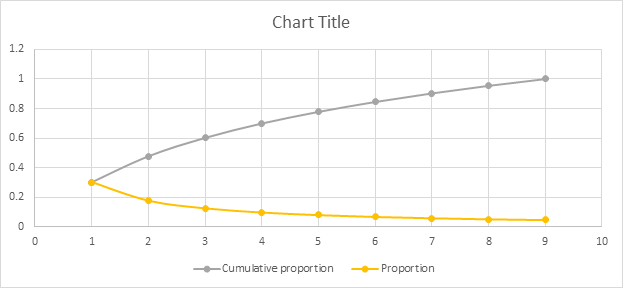
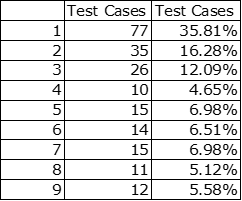
Pradeepan Sekar replied to Vishwadeep Khatri's topic in We ask and you answer! The best answer wins!Benford’s Law: Benford’s law is also called as the law of anamoulous number, law of first digit. This law is named after the physicist, Frank Branford who stated in 1938 and it describes the observation on the probability distribution of leading digits in many real time data sets. According to Benford, leading digit in any set of data most likely to be small. I.e the number of datum which starts with the digit 1 will be having the highest probability of around 30% , followed it the digit 2 will be having the second highest probability of 175 and so on, the probability of having 9 as the leading digit is the lowest as 5%. Benford’s law applies to the set of data if the logarithms of the number applies to the normal or uniform distribution, but not the number themselves. If a number x constrained to be between 1 and 9, set of data starts with digit 1 will be between 1 and 2, in similar way, x starts with digit 1 will be in the interval of [ Log 1, Log 2], and digit 2 will be in the interval [Log 2, Log 3] and so on Picking a random number in a uniform manner on this line results 30% of time with leading digit 1. Benford’s law application: This law applies to the large number of data with multiple orders of magnitude. Most of the data such as population of country, Account Balance, Bills, Tax, data of tallest building heights in the world, COVID-19 spread. Of course , it will not apply to the set of data that has been divided and each data will be between 300 - 900 and are uniformly or normally distributed then the benfords law will not be applied there. In Business application, Benford’s law can be widely used in auditing the set of data. Based on the human plausible assumption , they will try to fabricate the figure and distribute them uniformly. When it applied to the large set of data of multiple orders of magnitude, by simpliy finding the frequency of first digit, the data can be audited. References: A movie released in 2016, The Accountant, a detective uses benford’s law to find the theft of funds. In US, criminal cases had been admitted with the evidence of benford’s law. Benford’s law tested on COVID-19 affected cases: The distribution of COVID-19 as on today (19-May-2020) follows Benford’s law which is shown below. Source: https://www.worldometers.info/coronavirus/#countries

-
Pradeepan Sekar replied to Vishwadeep Khatri's topic in We ask and you answer! The best answer wins!Industry 4.0: Industry 4.0 comprises of many concepts of current digital trends that can be broadly summarized as Cyber physical system, Internet of things, Artificial intelligence, Cognitive computing and cloud based computing. Industry 4.0 is often called as the digitalization or digital transformation of manufacturing process. Industry 4.0 enables new way of production, reduces repetitive monotonous human intervention, value creation and real time decision making. Service 4.0: Service 4.0 is similar concept to ‘Industry 4.0’ or ‘Fourth industrial revolution’ which is applied in a value chain process. Service 4.0 is described as the collection of recent technological concepts such as Big data Analytics, Internet of things, Machine Learning, Artificial intelligence which helps the service or support functions. Service 4.0 is applied in Financial, transactional, insurance, real estate, trade, communications, supporting functions, administration to provide greater experience to the customers who are provided with the service by the recent technological applications The goal of Service 4.0 is to improve the service efficiency and effectiveness, and to benefit the service users. Service 4.0 can transform impossible to possible. Dynamic Customer expectation: Customers expectation can never be same and its keep changing. Especially in service industries, customers requirement in terms of service are dynamic expectation and it evolves over the time and keep changing. In Banking, early stages of 90s, customer didn’t want the waiting time, if the transaction happens without any waiting time in the bank, then it was called as good service, then evolution of ATM cards, net banking, Mobile banking happened and resulted in situation that one need not require to visit bank anymore to make any transactions. Money has been digitalized and real time transaction is in place. Even in digitalization of transaction, OTP has been replaced with QR codes and so many must come. To tackle that dynamic expectations of the customer and to survive in the competitive world, it become particularly important to provide unparalleled customer experience in service industry and then the journey towards service 4.0 begun. Features of Service 4.0: 1. Shorter Lead time: Prioritization and completion of tasks without having much wait time and the decision or fulfillment of the service with lesser time. 2. Real time Optimization: Decision will be taken immediately with the help of machine learning and Artificial intelligence. 3. Autonomous and decentralized decision making: Reduces the human intervention to the greater extent 4. Information transparency: Any information / service status can be tracked at real time 5. Eliminates monotonous repetitive tasks and mistakes, errors and/or slips. 6. Improves customer experience 7. Large source of data will be monitored and can be make use of it in future decisions. 8. IoS: Internet of services maintain all the requirements in software application in the cloud which automates the process, requirement such as software, platform, UI path and database in a single cloud and they communicate to each other.
-
Pradeepan Sekar replied to Vishwadeep Khatri's topic in We ask and you answer! The best answer wins!Analysis Paralysis: Analysis Paralysis describes when the group of people/ orgainisation or individual spend their time on overthinking or overacting upon the situation the cause paralysis in decision making, that means due to the act of overthinking on the problem instead of looking for the solution, the result will be too complicated or the decision is never taken or there is no solution. Analysis paralysis may be result of the fear of mistakes, looking for the super extreme solution, or overweighing the possible realistic solutions. A person/ team or organization will take much time in the decision making, which is due to the fear of making wrong decision or looking for the best solution. Few Highlights: 1. Waterfall model in the software development will not allow any changes in the development as they had spent their enough time in planning and executing.In some cases, waterfall model allows analysis paralysis to exist and the desired outcome will not be achieved. 2. Most of the organization loses their opportunity while delaying their decision due to highly competitive environment. 3. In typical decision making while they have multiple criteria, due to the lack of skill in multi criteria decision making, organization find difficulty and beats around all criteria instead of making decision which leads to no results. Extinct by instinct: ‘Extinct by instinct’ is described when the group of people/ orgainisation or individual did not spend their time on analysing, which results in fatal decisions due to hasty decision-making skill. Extinct by instinct may be result of Gut feel, Instinct, Instant way of decision making, lethargic approach. Few Highlights: 1. Some decision has been made without consulting with the key members and leads to failure 2. Enough amount of value should be analyses before making any decision. When the decision involves financial investment, some structured way of Financial investment analysis (methods like ROI, NPV, Breakeven etc) should be done. Extinct by instinct is opposite extreme to the Analysis paralysis, but in the organization or in decision making in any sector or by individual, both the extremes of decision making should be avoided as both will result in unreliable or fatal solution and even sometimes without solution. Ways/tips to overcome: 1. Remember nothing is perfect. During worl war II, when the team spend most of their time on design changes on landing craft, Winston had mentioned ‘ Nothing avails but perfection’ can be spelt shorter as ‘ paralysis’. 2. In terms of investment analysis, use of structured approach of financial investment analysis such as ROI, NPV, Breakeven. 3. Collect more information. 4. Make your objectives very clear. Clarify your priorities. 5. Improve the communication. Talk about it and discuss as much as possible. 6. Limit the number of solution and also set limit to the time “set a deadline , hold yourself and your team as responsible” 7. In case of multicriteria decision making, use systematic ways such as AHP. 8. Make the best decision
-
Pradeepan Sekar replied to Vishwadeep Khatri's topic in We ask and you answer! The best answer wins!Standard Operating Procedures: SOPs are the documents which describes the actions to be taken under several circumstances, it also lays who, what, when and where for the important actions. It provides clear and concise guidelines. SOP should be the document which is serving at higher level and the detailed instruction should be described only in work instructions and only the reference of those work instructions will be provided at SOP. So that the SOPs will be clear, simple and concise. Otherwise it results in instruction creep. Instruction Creep: Instruction creep occurs when the procedures are increasing in a system with more details in such a way that it causes severe damage to the progress of the organization. Instructions are made to retain or continuously improve the success of the organization, but in turn when they go complex or abundant, causes the failure. Instruction creep occurs in most of the organization. Usually it happens when the procedures are framed without questioning them, by change in thoughts of the people who create it or by changes in the set of people who make use of it. If the instruction creep persists in the Standard operating Procedures of the system, it will often result in addition, substitution, or modification of the procedures. It often results in the overlapping of the communication and in lack of clarity, efficiency, communication, and consistency. Believing that the people will read all the instructions in SOP with the attention, irrespective of their volume or complexity of the instruction is the most common reason for the instruction creep. Sometimes the procedures are made with deliberate intent to control the people without reviewing them with the concerned people or without collaborating with the users. . Ways to overcome the instruction creep: Best Practices: 1. SOP should be clear and concise. 2. Easy to understand. 3. Possible pictorial representation to avoid reading of volumes. 4. Segmentation on the instructions. So required document can be accessed at the time when it is needed. 5. Introducing more Poka yoke rather than procedures or instructions. 6. Routine training on the procedures Checklist: SOP can comprise of checklist. Set of instruction should be comprised into checklists with which we can ensure that all the instructions have been followed. Checklist should be made in such a way that the users find it easy and helps them to follow procedures without missing any steps.
-
Pradeepan Sekar replied to Vishwadeep Khatri's topic in We ask and you answer! The best answer wins!Filter Bubble: The term “Filter Bubble” was first coined by Eli Pariser, who is an activist and entrepreneur focused on technology to serve democracy. Filter bubble means an algorithm which does selective isolation of the information based on the interest of the user, supposedly that can result from Personalized search, web pages visited, Location, Search history and their personal posts in social media. Filter bubble leads to bias in the information. When a society or group of people allege about something, based on the preconceived information about that allegation, search engines in the web provides results which agrees with the people’s mind. Because of the algorithm in the search engine, it isolates the disagreeing information and indirectly creates “duplication and Publication bias” for the corresponding user. Usually this algorithm comprises the search history, language, personal information, web page visited, Location, etc. Two schools of thought: We can say that the filter bubble misleads the user and make user continue to rely on their preconceived mindset, by excluding the conflicting information. On the other side, Filter bubble helps us in streamlining on our interest. In OTT, We will be suggested with movies you may like at the top and you will continue to watch the same journal of movies which can be considered that the filter bubble is streamlining our options or it direct us only in particular journal limiting our chances to explore the other journals. In one of the search engine, when I am searching about Keto diet, my search results are influenced by my search input. This is one example where the influence (search input) and the impact(search results) are clearly visible. Why is keto good Why is keto bad Even if the motivation behind designing this search is to improve and speed up the retrieval of information, it may not always result in what was intended. Few ‘Filter Bubble’ applications in Business world: 1. Marketing: Identifying the potential customers based on their search history. Influencing them through one click e-commerce advertisements for the products which might tempt them in to buying it. Marketing of the information or ideology is also feasible by increasing the visibility of the target ideology to the relevant group of people, even to the extent of choosing leader or fall of economy. Marketing can also be done by making an information invisible to the user. 2. Survey: It helps in pooling the people of same interest or people belonging to the same location or people of same profession which helps to categorize the target group. 3. Business Intelligence: In Most of the cases, Business Intelligence Technology handles a large amount of structured or unstructured data gathered respective to particular filter bubble in order to identify, create or develop the new business opportunities.
-
Pradeepan Sekar changed their profile photo
-
Pradeepan Sekar replied to Vishwadeep Khatri's topic in We ask and you answer! The best answer wins!Reporting Bias: Reporting bias means “distortion in the dissemination of details in dissertation” i.e misinterpretation or suppression of information or findings in the research/publication due to the influence of nature, location, time frame, Cultural background, conflicts or by detailing only one part of the research. Reporting Bias in Research/ Academics: In academics/ research, Researcher tends to hide the undesirable results and always tries to undercover the unlikely results with errors. Unlikely results are even suppressed believing that the desirable results are most trustworthy by forgetting the fact that all possible outcomes have their own probability. Reporting Bias in Survey: When we are taking up a survey on the brand preference among the customer, The sample customers are taken from the zone where they glorify the Particular brand or the surveyor questions may lead to promote the particular brand due to the direction of the desired result. Reporting bias is either intentional or unintentional, either natural or driven by the preferred results. However, it is important to address and avoid the reporting bias with concern of future interpretation. Most of the political and marketing surveys have some biases which seems to be obvious, but it will not be always obvious and tends to occur. Reporting Bias leads to incorrect data analysis: Data Analysis, Data driven decision making and empirical or Analytical research depends on the facts of the data been reported or the outcome of research. Most of the organization are facing these challenges while making decision due to data bias (as an outcome of reporting bias). Bias in data challenges the decision making and makes any organization to fail in their decision. Even with most of the best intentions, reporting bias likely to be presenting and pervasive. Considering that decision makers and data analytics should be aware and put their best effort in order to eliminate or diminish the effect of Bias in their analysis Some types of Reporting Bias: 1. Publication Bias: Researcher fail to submit or document their reporting which makes distortion in prediction. Most of the researcher’s work in finding the vaccination of COVID-19 is not published due to failure or null finding. Because of that reason, progress of the research will be overestimated. 2. Time Lag Bias: Delay in reporting due to constraints in publication or an article published after a year from experimentation may bring out totally different scenario. Due to intervention of new things, research results with time lag may not be valid. Research conducted on street foods preference become obsolete because of intervention of COVID-19. 3. Duplication Bias: Multiple publication of the same desired results by the same author or different author will make the analyst to overestimate the effect on the results. Due to multiple publication of the effect of Hydroxychloroquine on COVID-19, Many people started believing HCQ is proven vaccination (the failures are not in open source – Citation bias). 4. Location Bias: Research findings published in one location may not be applicable for the other location due to the difference in characteristics or behavior. Deceased rate of COVID-19 in Italy will not be same as UK. 5. Citation Bias: Researches prefer positive results to publish than the null or negative results. Success of HCQ is published more than the failure of same. It results in opinion of HCQ as a better vaccine for COVID-19 6. Language Bias: Studies published in different languages are neglected in the systematic review. Most of the time researchers don’t know that language bias is existing in their process. It has to be taken care on locating and assessing the relevant non-english publications. Role of organization to safeguard itself from reporting bias/ data bias: Business leaders /Organization should be aware of the impact of Reporting bias in their future goals. Since we have various forms of bias in our research or data collection process, there should be complete transparency and should be even addressed to the researcher/ surveyor on possible shortcomings in the process. We should ensure that we have the quality information without bias, so the organizational system should know the source of data. It is very important to decide on few things which are mentioned below for the data collection. a. Where the data collected b. When the data collected c. How the data collected d. From whom and by whom the data collected e. How long the data will be valid f. What criteria should be given Considering all those factors, data collection should be as generic as possible inorder to minimize the effect of influencing factors and should have open mindset on all possible outcomes which will ensure that there is no misleading decisions and safeguard the organization from the risks of reporting bias.
-
Pradeepan Sekar joined the community
-
Pradeepan Sekar replied to Vishwadeep Khatri's topic in We ask and you answer! The best answer wins!Monte Carlo simulation is a simplified powerful mathematical computation on distribution of the possible outcomes with probability where the inputs are having inherent uncertainty. How it works? In order to explore the possible outcomes of any process/ model which is having uncertain inputs, we need to derive a mathematical model which computes the effect of input in the output. As a general practice, we use mean or average as an input in order to compute the outcome, but it is more unrealistic as we know average is not going to happen again and again and the variation from an average is having a big impact on the outcome. In Monte carlo simulation, Based on the distribution we are fitting to the inputs, it generates a random value ( as per the parameters of the distribution) for each input and compute the outcome and this computation will be repeated for 1000, 10000 or million times with the help of software support. Then we will have a wide range of outcome which will give us a result of the probability distribution of the outcome. 1. It is very important to build a perfect mathematical model which can be done by simple mathematical equation with inputs or regression equation based on experimental data (or Historical data if history represents the future) and 2. it is also important to fit the range of input data in the adequate distribution with proper estimation of the parameters. Monte Carlo Simulation in Risk Management: Risk is always an outcome of uncertainty. In other words, certain inputs will bring out expected results, but it is rare to have certain inputs and which leads to risk in each and every day -day activity we are carrying out. For an instance, risk of India losing the final match in cricket is depend on so many uncertain inputs, starting from tossing the coin to choose first team to bat, whether, Players in the team, their batting order, bowlers performance. In that case if we are able to build a mathematical model of runs scored in a ball for a batsman ( who is left only with last over ) based only on the bowling speed and bowling style keeping all other factors as constant and we have fit the bowling speed in to distribution for the bowler who bowls, we will able to get the distribution of runs scored in last over as an outcome. Average score of the batsman or strike rate will not support as much as the probable score taken in last over, to find the probability of winning the match. So Monte carlo simulation can be applied in all aspects where you are able to build a mathematical model for an outcome as a function of uncertain inputs to get probability distribution of outcome which in turns helps you to identify the risk involved in the process.