

Topics
-
Fifty-five women engineering students completed an AI bootcamp focused on rural Karnataka. Participants developed AI-based solutions after visiting villages and conducting field interviews. The She Innovates bootcamp partnered with several organizations to achieve its goals. This initiative aims to boost women's participation in AI and entrepreneurship. It encourages AI applications for rural development and community-focused sectors. View the full article
-
Besi's quarterly orders more than doubled, fueled by AI and hybrid bonding technology. The company saw increased customer adoption of its advanced chip packaging solutions. Demand for AI applications continues to drive growth in data centers. Besi anticipates revenue growth between ten and fifteen percent. This strong performance aligns with other semiconductor sector reports. View the full article



Leaderboard
-
Mohamed Asif Abdul Hameed
Fraternity Members1Points78Posts -
Moushmi Kandori
Members1Points11Posts


Popular Content
Showing content with the highest reputation on 04/11/2023 in Posts
-
DPU is measure of average number of defects per unit. DPMO is the measure of number of defects per million opportunities. Yield % is the measure of proportion of products that pass the assessment or QC stage. DPMO or DPU are used when the defects are discrete in nature and when it can be counted on a unit basis. Yield% is used when defects are assessed on a pass/failure, true/false basis, mostly in quality control or during quality inspection. Appropriate metric depends on the specific context, specific goals and the requirements of the processes in the organization and can differ from case to case basis. Minor, major and critical defects may be weighted differently in terms of their impact on the overall quality of the prod or service. So, it is recommended to use weighted metrics that accounts the severity of each defect. Software development example: When we are tracking number of defects in the code and when we identify 100 defects out of 10000 lines of code. DPMO would be: DPMO = (100 / (10,000 * 1,000)) * 1,000,000 = 10,000 For DPU, when we have identified 50 defects in the user interface and when the mobile application has been downloaded and installed on 1000 devices. The DPU would be: DPU = 50 / 1,000 = 0.05, meaning on average there are 0.05 defects per mobile device. Yield %, during QC, when we run tests on 100 instances with 90 passing the test. The Yield% would be: Yield % = (90 / 100) * 100 = 90% To conclude, when we track both defects and defectives, we can use DPU or DPMO to measure the number of defects per unit or per opportunity and over an above use yield% to measure the proportion of defect free units. So, choice of metric depends on: Specific context / goals Type of defect and Impact on overall quality1 point
-
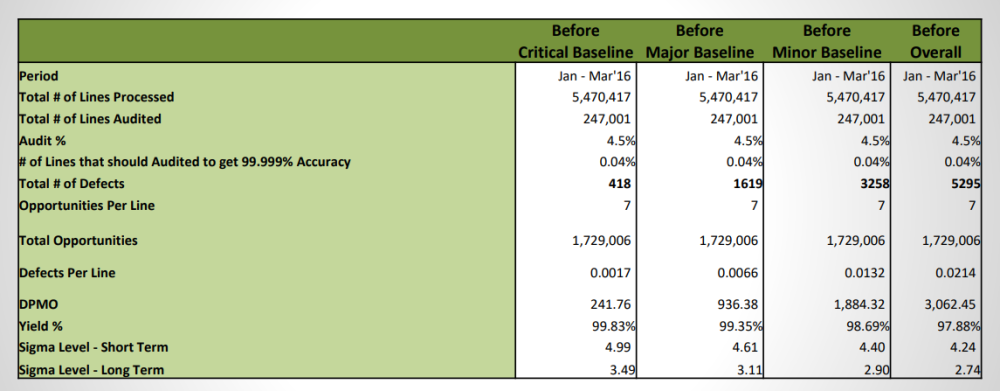
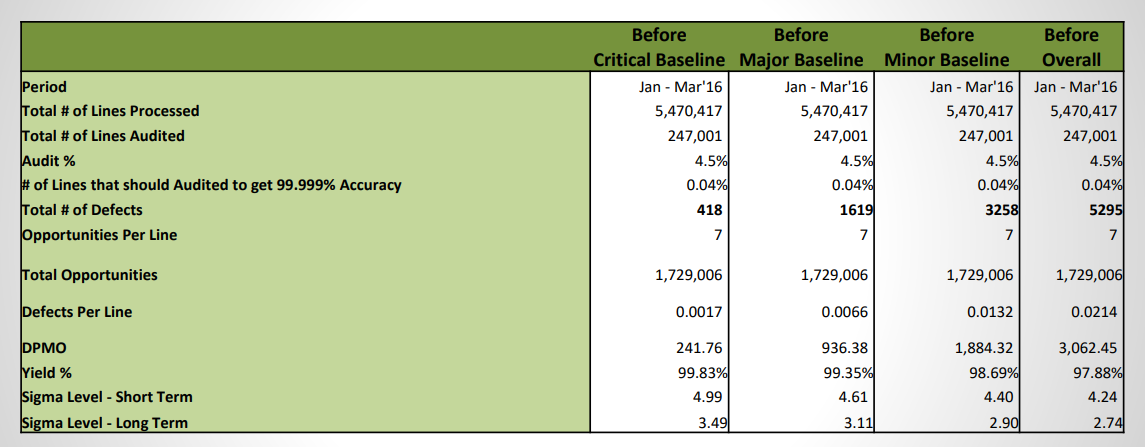
DPMO is the best metric to use, though we can also check the yield %. Below is one of the project example that I initiated.
 1 point
This leaderboard is set to Kolkata/GMT+05:30