

Topics
-
Humanoid, a UK robotics firm, secured $152 million in Series A funding. This investment fuels the development of next-generation platforms and proprietary AI software. The company plans beta robot deployments at customer sites later this year. Humanoid has established partnerships with major technology and manufacturing companies. Bosch will serve as the contract-manufacturing partner for the new robots. View the full article
-
German authorities warned Tuesday of the "growing influence" of AI and digital technology on the sexual abuse of children, saying in a report that criminal abusers are increasingly using those tools. Sexual abuse of minors is "increasingly shifting to the digital realm," driving overall statistics "upward", said Holger Muench, the head of Germany's Federal Criminal Police Office (BKA). View the full article



Leaderboard
-
m.v.elango79
Lean Six Sigma Black Belt1Points14Posts -
Jpiyush
Members1Points14Posts -
Rahul.Arora2
Members1Points44Posts


Popular Content
Showing content with the highest reputation on 09/20/2022 in Posts
-
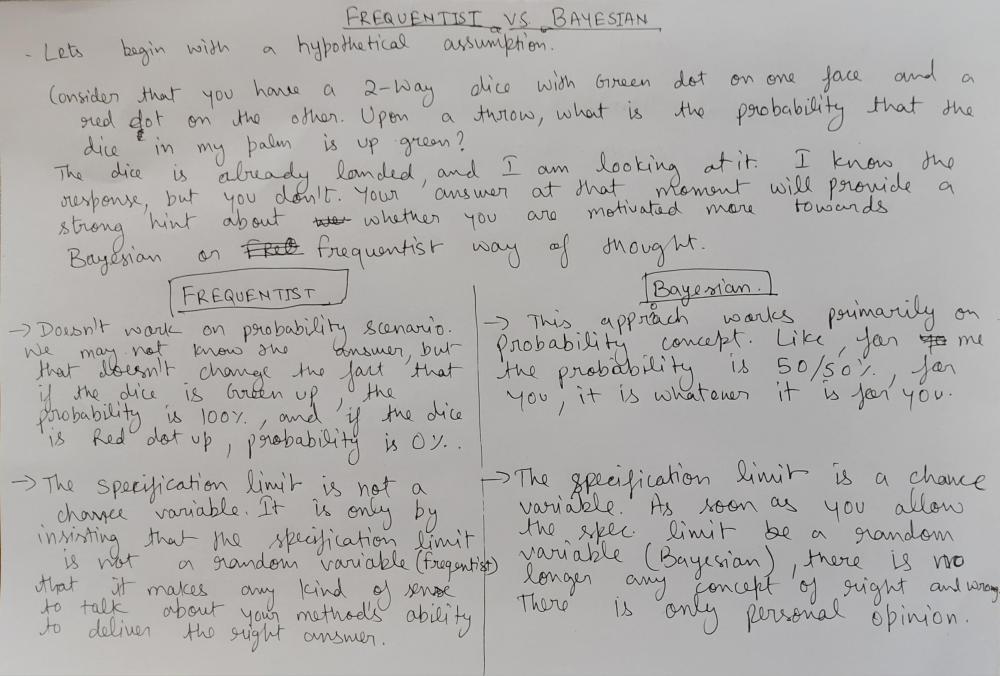
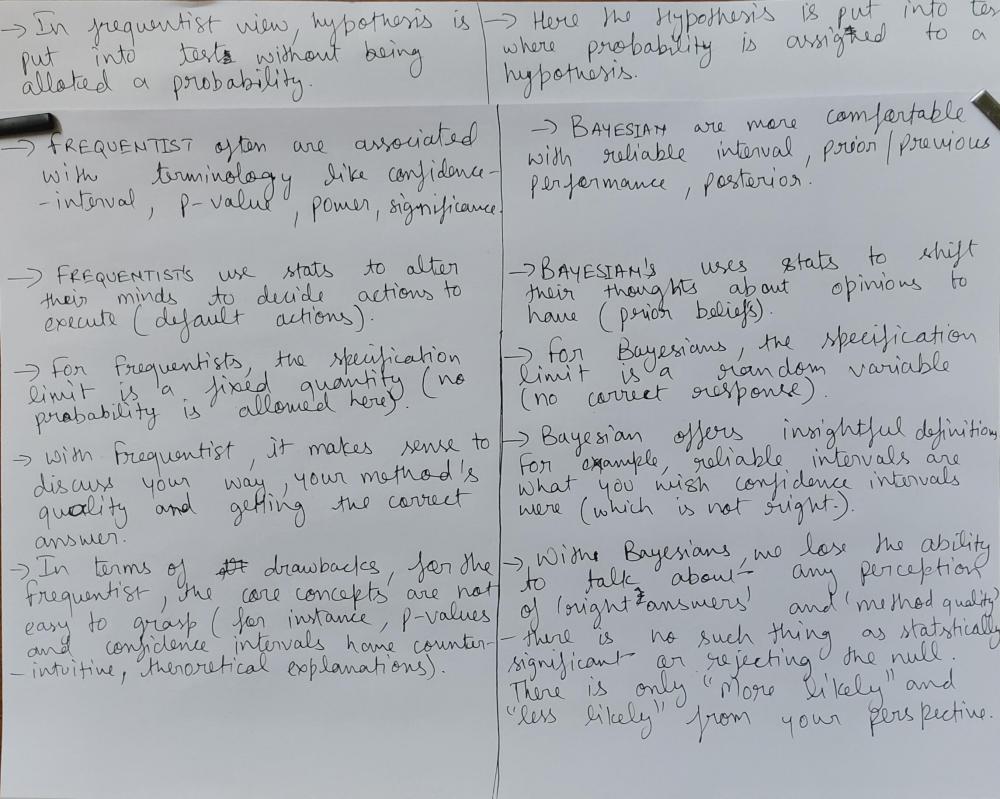
1 pointBayesian Vs Frequentist main difference of both thought process is reasoning of probability Bayesian Frequentist Bayesian thinking see the probability based on their certainty and uncertainty of trail. It’s based on belief of an event based on prior information Frequentist thinking see the probability based on frequencies of the repeated trail P Value based on the probability of the hypothesis. Which is inverse of Frequentist P value is probability of more extreme data with the assumption that null hypothesis is true Hypothesis is based on no variation in the data but the variation in the Model/Parameter Hypothesis is based on Variation of the data and their derived quality based on the repeated measurement with fixed Model/parameter Assuming 95% of true value of a model lies with in credibility region 95% of cases confident interval will have true value of the model Varying True value and Fixed credible region Varying confidence interval and fixed true value Process to understand possibility that Hypothesis it true based on observed result Process to understand how extreme the observed result under the Hypothesis Example: Playing Card with friend which has 52 card and Friend drawn a card and seeing card in hand asking possibility of card in his hand is Diamond card, On Bayesian way of thinking possibility of getting Diamond is out 13 out of 52 cards which is 25% its Diamond Example: Since the card has been drawn and the result is known its either Diamond or others, so this can be either 0 or 1 Bayesian way of thinking is preferred in term of clinical trails based which take more result change based on prior data and new state. Also, current AI model use more Bayesian theorem to learn based on prior data and change the result. Which allow to correct Bais and Noise level based on prior data to correct make it more accurate. But in uncertain case when there is no prior data (non-informative prior) consider all data are equally likely which create a Bias hypothesis in given data will not be always correct.1 point
-
1 pointThere are two common statistical approaches that are being followed when it comes to statistical testing i.e. The Frequentist Approach, which is based on the observation of data at a given moment or instance & The Bayesian Approach, which is basically a forecasting approach & it involves analyzing prior information. The frequentist approach is also described as experimental or inductive as it relies on observations while the bayesian approach is theoretical or deductive as it enables to combine the information provided by data with a priori knowledge from previous studies or expert opinions. Let us take a very simple example to understand both the concepts:- Let us toss a coin 10 times, now when it comes to frequentist approach, the probability of getting either a head or a tail is 0.5, now let’s say we get heads on 7 out of 10 tosses, then the probability of getting the heads will be 7/10 i.e. 0.7. Now let’s say we have a prior information through previous experiments of expert experience that heads will come 6 out of 10 times thus we have a prior probability of 0.6, now we will compare the outcome of the experiments with this prior probability. Thus we can say that the objective of the frequentist approach is to explore the data collected in order to identify a significant effect that could only be explained through by the hypothesis of the experiment & for the bayesian approach the focus is on comparing two hypothesis by comparing the data collected at the time of the experiment with the prior information available therefore assessing the chances that one was true comparison to other. As an organization performing experiments & relying on statistical analysis for analyzing the results of these experiments, it is thus important to understand the difference between the above two approaches on the basis of different parameters which are as shown below:- In terms of analyzing the test data :- Frequentist approach requires the experiment to be completed first by collecting sufficient samples before analyzing the data, this limits the test to be an offline experiment. Bayesian approach analysis can be performed during the experiment while collecting the data. Also it is an online experiment as the analysis results get updated when new batch of data gets ingested. Sample Size :- Frequentist approach requires calculating the sample size prior to conducting the test, also the number of samples among test groups needs to be balanced. Bayesian approach does not require a pre-defined sample size & also there is no need to have same number of samples amongst the test groups thus allowing an imbalanced sample size. Test results explanation :- For the frequentist approach, conclusions can be made like “We reject/ fail to reject the hypothesis that group A is better then group B. This conclusion is based on the observation of the historical data collected during the test. This approach uses p-value in order to quantify the confidence of the business conclusions. For the bayesian approach, we introduce the element of probability while making an interpretation of results such as “ There is a 98% probability that group A is better than group B”. Thus this probabilistic result quantifies the confidence of the business conclusions. Leveraging Test Results :- Frequentist approach gives summary statistics of the samples collected during the experiment period, thus cannot be used for making any conclusions about the future unseen data. Bayesian approach leverages the parameters of the distribution from the data & gives the posterior predictive distribution for unobserved, future values on the observed data. Duration of the Test :- In the frequentist approach, the duration of the experiment can be estimated basis the designed sample size as it is easy to estimate how long an experiment will be conducted. In the bayesian approach, the duration of the experiment cannot be estimated as more samples coming every day helps to get more confidence conclusions, but cannot estimate how long a specific experiment would take. Granularity of input data :- In the frequentist approach, the level of granularity of the input data is at the very base level for eg: data collected basis each user / ID & also it depends on the duration for which the test is conducted. In the bayesian approach, the level of granularity of the data depends on the frequency of the updating the test results, for eg : in case you are testing the Click through rate & the results are updated every 24 hours, one needs to calculate the number of total seen events & number of click events every day in order to arrive at the daily click through rate. Performing Multiple Comparison :- Frequentist approach leverages bonferonni adjustment in case when multiple variants are required to be tested at the same time. Bayesian approach uses hierarchical bayesian methods for cases involving multiple variants. Testing Approach :- The frequentist approach recommends different tests based on the distribution(s) that a variable of variable(s) follows. The bayesian approach leverages conjugate families for variables following different distributions for eg : Click through rate would leverage the beta distribution conjugate wherein prior parameters need to be set for the beta distribution, collected data is updated basis the baye’s rules in order to get the posterior of the parameters, then samples are taken from the posterior distribution & inferences are made on the test results accordingly.1 point
-
1 pointFrequentist statistics, which could also be described as experimental or inductive, rely on the law of observations. In a frequentist model, probability is the limit of the relative frequency of an event after numerous trials. In other words, this system calculates the probability that the trial would have the same issues if you were to replicate the same conditions again. This model only uses data from the current trial when assessing issues. When applying frequentist statistics or using a tool that uses a frequentist model, you'll presumably hear the term p- value. A p- value is the advised probability of carrying an effect at least as extreme as the one in your sample data, assuming the verity of the null thesis. For illustration, a small p- value means that there's a small chance that your results could be fully arbitrary. A large p- value means that your results have a high probability of being arbitrary and not due to anything you did in the trial. In short, flash reverse that the lower the p- value, the more statistically significant your results. Unfortunately, people constantly misinterpret what p- value represents. P- value is basically the probability of a false positive rested on the data in the trial. It doesn't tell you the probability of a specific event actually passing and it doesn't tell you the probability that a variant is better than the control. P- values are probability statements about the data sample not about the thesis itself. So if you ran an A/ B test where the conversion rate of the variant was 10 advanced than the conversion rate of the control, and this trial had a p- value of0.01 it would mean that the observed result is statistically significant. Bayesian statistics, which is theoretical/deductive, enables us to combine the information provided by data with a priori knowledge from previous studies or expert opinions Bayesian statistics are named after champion Thomas Bayes who believed that “probability is orderly opinion, and that conclusion from data is nothing other than the modification of similar opinion in the light of applicable new information. With Bayesian statistics, probability indicates a degree of belief in an event. This system is different from the frequentist methodology in several ways. One of the big differences is that probability expresses the chance of an event end. Although the computation can be extremely complex, this system seems to be a simpler and further intuitive approach for A/ B testing. fairly simply, a Bayesian methodology will tell you the probability that a variant is better than an original or vice versa. The Bayesian generality of probability is also further conditional. It uses former and posterior knowledge as well as current trial data to prognosticate issues. Since life doesn’t be in a vacuum, we constantly must make hypotheticals when running trials. But the Bayesian approach attempts to regard former knowledge and data that could impact the end results.
 1 point


This leaderboard is set to Kolkata/GMT+05:30