

Topics
-
Fifty-five women engineering students completed an AI bootcamp focused on rural Karnataka. Participants developed AI-based solutions after visiting villages and conducting field interviews. The She Innovates bootcamp partnered with several organizations to achieve its goals. This initiative aims to boost women's participation in AI and entrepreneurship. It encourages AI applications for rural development and community-focused sectors. View the full article
-
Besi's quarterly orders more than doubled, fueled by AI and hybrid bonding technology. The company saw increased customer adoption of its advanced chip packaging solutions. Demand for AI applications continues to drive growth in data centers. Besi anticipates revenue growth between ten and fifteen percent. This strong performance aligns with other semiconductor sector reports. View the full article



Leaderboard
-
Vishwadeep Khatri
Administrators1Points6,722Posts -
Mokshesh
Members1Points10Posts -
AmitKumar
Lean Six Sigma Black Belt1Points11Posts -
RahulGarg
Members1Points28Posts



Popular Content
Showing content with the highest reputation on 10/12/2021 in Posts
-
1 pointQ 409. What is the Shingo Model for operational excellence and how can it be used to build a sustainable continuous improvement culture? Note for website visitors - Two questions are asked every week on this platform. One on Tuesday and the other on Friday. All questions so far can be seen here - https://www.benchmarksixsigma.com/forum/lean-six-sigma-business-excellence-questions/ Please visit the forum home page at https://www.benchmarksixsigma.com/forum/ to respond to the latest question open till the next Tuesday/ Friday evening 5 PM as per Indian Standard Time. Questions launched on Tuesdays are open till Friday and questions launched on Friday are open till Tuesday. When you respond to this question, your answer will not be visible till it is reviewed. Only non-plagiarised (plagiarism below 5-10%) responses will be approved. If you have doubts about plagiarism, please check your answer with a plagiarism checker tool like https://smallseotools.com/plagiarism-checker/ before submitting. The best answer is always shown at the top among responses and the author finds honorable mention in our Business Excellence dictionary at https://www.benchmarksixsigma.com/forum/business-excellence-dictionary-glossary/ along with the related term1 point
-
What is Single-Minute Exchange of Dies? SMED is used to address MURI, Change Over Time Reduction’ (COTR) and ‘Single Minute Exchange of Die’ (SMED) are the concepts used to reduce downtime caused by changeover between jobs, machines or personnel It reduce setup (changeover) time to less than 10 minutes Techniques include: • External setup • Simplify internal setup • Eliminate non-essential operations • Create Standardized Work instructions The set up time is expected to be counted in single digit of minutes and hence the name, SMED SMED aims at speeding up the transition Example a) Transition of an experienced personnel to an incoming person can be termed as a Change Over b) Production Support Shift Changes How does Single-Minute Exchange of Dies help? Iterative development in smaller lots Potential Implementation: Software/Hardware update Periodic replacement of parts Handover / Takeover between the team Migration (Data) One touch Exchange of Dies(OTED): Less than 100 second for change over OTED requires the following actions: – No adjustments – No fastenings – More precision – LCM Single motion change Examples of usage of OTED a) Complete automation of the process in any industry(manufacturing) b) Telecom industry Resource: https://www.leansixsigmadefinition.com/glossary/oted/ Reference: https://elssc.eu/dictionary/oted
 1 point
 -
One Touch Exchange Die (OTED) One Touch Exchange Die (OTED) indicates to setup or change over accomplished by the operator in one quick handling of the dies or tooling usually in 10-15 seconds. OTED, which is closely associated to SMED but more difficult concept in implement and high involvement of cost and effort. In Lean Manufacturing, Setup times are non-value-adding activities and reduced to zero or near zero. OTED is an outgrowth of SMED but is far more aggressive and complicated to implement, where SMED is generally considered to be done in less than 10 minutes. Actually SMED is a single-digit minute exchange of die, where OTED indicating with continuous improvement and die change are nearly instant with a single motion rather than multiple steps. SMED >> Applying ingenious methods to bring setup time to less than 10 minutes. OTED >> Advanced and challenging tool to bring changeovers less than 100 seconds Fig: Typical setup activities (Source Internet) What is set up (Change over reduction)? Set-up definition is the time amount taken to change over a piece of equipment from the last piece of a production lot to the first good piece of the next production lot. Set – up (Change overs) reduction is a process of systematic approach to reduce stop time of any machine or a process during a model or product change. Fig: Definition of Set-up (Source Internet) OTED requires the following actions: – Adjustments of Eliminations – Freedom from screw fastenings – Moving towards strength and precision – Precision and close fits – Die material and die function separations – Methods of insertion – Using of Least Common Multiple (LCM) method Fig: Example of OTED (Source: Internet) Benefits and outcomes of OTED: i) Less adjustment less errors ii) Improved customer service levels iii) Fewer shortages and stock outs iv) Improved machine efficiency & Level out production v) Labour utilized effectively vi) Reduced overall cost of quality vii) Increased Manufacturing process flexibility and capacity viii) On hand inventory reduction ix) Improved cash flow x) Increased scheduling flexibility and capacity xi) Operating conditions prepared in advance which help to stabilize product quality xii) Trial processing eliminate & material waste reduced. Set – up time reduction process: 1. Video tape the set-up 2. Separate external and internal activities 3. Shift internal activities to external activities 4. All work methods of the operation improving 5. Standardize what we been done. Fig: Set-up Reduction – Zero Limitations & Complication of OTED: If speed not up in the system, is not really an improvement: Firstly, we have to make sure that there is a need to drive down changeover and have to look for where to spend our improvement efforts in the system. The journey of OTED may not be a need for a part if other parts of the system are slower. OTED journey is also very complicated for reducing setup time on a high-volume machine. Even lot sizes to single piece with near-instant changeover, is there a way to get parts to the point of use one at a time? Sometimes, OTED may use in Localized improvements as part of a bigger plan. An improvement may happen on its own but not speed up throughput of the system. But it may be a necessary to change for others. Complication in attempting to implement flow with OTED in Lean Manufacturing: Secondly, in Lean manufacturing usually uses smaller and dedicated machines at the point of use. But this contradicts the need for one-touch exchange of die. A product-oriented work cell might remove more waste by a new, dedicated, low tech machine rather than a larger and centrally located machine capable of OTED. Also, the small machines mostly have lower maintenance costs than big and complicated machines. At the end, like all continuous improvement efforts, there is always a cost involvement to reduce changeover times. OTED is an advanced and challenging tool to make a great company to world-class or best-in-class status. With OTED, we have to understand the flow of the system clearly and gain a deep knowledge of the processes before attempting to use this sophisticated tool. Though most of the companies have a lot of room to grow before diving into graduate-level Lean work of OTED.


 1 point
 -
OTED as defined in the portal termwiki.com is “a setup reduction goal that reduces the process to a single step or one touch.” OTED is defined in the Encyclopaedia of Production and Manufacturing Management as “Setup times are non-value-adding activities. Lean manufacturing attacks setup times until they are reduced to zero or near zero. OTED refers to setup or changeover accomplished by the operator in one quick handling of the dies or tooling, usually in 10-15 seconds.” OTED, as defined in the portal leansixsigmadefnition.com, is “an exchange done with a single motion, rather than multiple steps and a changeover that takes less than 100 seconds and other references mention it is as being less than one minute.” The principle behind OTED and SMED is the idea that the set-up time in a process is a Non-Value-Added step and leads to waste. It is based on the principle in the Economic Order Quantity and Economic Production Run models. In the Economic Ordering Quantity model, the Ordering Cost and the Inventory Holding Cost are balanced, whereas, in the Economic Production Run Model, the Set-up Costs and the Inventory Holding Cost are balanced. The main idea that comes out from both these models, is the smaller the Ordering Cost/Set-up Cost the lower will the Order size/ Production Run. An important principle in Lean is the concept of moving from Batch Flow to Continuous Flow with the idea that moving from batch flow to single part flow to continuous flow reduces waste. Gradually reducing set-up times would gradually lead to smaller production runs which naturally lead to moving to smaller batch sizes and finally to a continuous flow. Once this principle has been identified, it is the endeavor to reduce the set-up times in a process. At times continuous improvement kaizen steps are taken to reduce the set-up time and at times, entire DMAIC projects are dedicated to the reduction of the set-up time. This technique is used in conjunction with Theory of Constraints and Value Stream Mapping with the identification of the bottleneck in the process, reducing the set-up time in the process till the time its cycle-time is less than the takt-time and moving on to the next bottleneck. In this iterative process, at first, there will be a need to use the SMED principles to release the bottleneck, however, after a few iterations further improvement of the process will only be possible through the application of OTED principles. The Single Minute Exchange of Die is a changeover in a single digit, i.e less than 10 minutes, however, the One Touch Exchange of Die is a near-instantaneous changeover. This one-touch implies that the change can be done with a single motion rather than multiple steps. Implementing OTED is challenging and takes a process to the best-in-class process. It is however important to realize making just one step in the process as OTED may not necessarily optimize the entire process. At times a balance between a single machine with OTED capability and high operating and maintaining cost need to be considered as against dedicated, low-tech machines in a work cell layout. References https://www.velaction.com/one-touch-exchange-of-die-oted/ https://en.termwiki.com/EN/one-touch_exchange_of_die_(OTED) (2000) ONE TOUCH EXCHANGE OF DIES (OTED). In: Swamidass P.M. (eds) Encyclopedia of Production and Manufacturing Management. Springer, Boston, MA . https://doi.org/10.1007/1-4020-0612-8_644 https://www.leansixsigmadefinition.com/glossary/oted/1 point
-
OTED (One-Touch Exchange of Die) is closely related to SMED (Single Minute Exchange of Dies) where the term " Single Minute" refers to the objective of reducing the start-ups and changeovers to single digit minutes (less than 10 minutes) whereas OTED states that changeovers can and should take less than 100 seconds. OTED needs the following actions: 1)Elimination of adjustments since the time available for replacement is very less. 2)Freedom from screw fastenings-Since turning of screws for locking and unlocking takes more time one should avoid screw fastenings. 3)Moving towards strength and precision for the best fit. It should be precise and close fits. 4)Functional burdens of die Vs machines i.e. adaptability of dies for various variants of same category of machines. 5)Reduced usage of complex mold separating systems. 6)Reduced insertions in the system. In One-Touch concept the exchange should be done with a single motion, rather than the multiple steps. Examples: 1)Usage of Push Butten switches for the phase changes in an electric panel. 2)Usage of level 3 automation in tooling. 3)Using one touch fixing of fasteners. That is using simple and quick (one touch) fastening mechanisms rather than screwing. 4)Single touch assembly and dis assembly of electronic gadgets. 5)Emergency push button stations in the manufacturing plants for the sudden power isolations.1 point
-
One Touch Exchange of Die which is OTED – This is one of the techniques of Single Minute Exchange of Dies (SMED) that helps in reducing the tool exchange process and machine set-up process to a single step only. Generally OTED is advanced way of SMED that occurs only after many easy Set-up reducing activities has been performed. OTED needs below actions mainly- A. Reduction or Elimination of process adjustments B. Get rid of from screw fastenings C. going towards More strength and D. going towards More precision E. Separating die material & die function from each other F. LCM -The Least Common Multiple method1 point
-
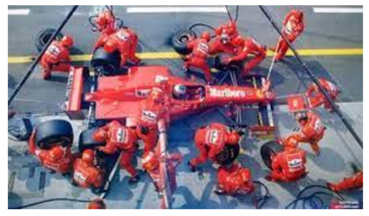
What is OTED? Continuous improvement professionals have constantly strived to reduce the time taken for changeover. Single-minute exchange of die (SMED), is a technique to figure out how changeover can be accomplished in lesser time with less motion. One-touch exchange of dies (OTED) is an aggressive version of SMED. While SMED is usually termed to any changeover done in less than 10 minutes, OTED advocates that changeover must happen almost instantly with just one touch or in single step or in less than a minute. Why is OTED difficult to implement? 1. It takes more and more effort to improve any process. Every effort to improve a process comes with an additional cost. It becomes important for an organization to decide if there is any value addition happening by improving changeover time from SMED to OTED. Many companies may not be willing to improve changeover process from less than 10 min to a 30 sec process unless they see a substantial value add in doing so. 2. OTED is advanced and challenging. Most of the time, to implement OTED, a complete change of process, machine design and human skill sets are required. The cost required to make these complex changes and cost to sustain them may outweigh the final benefits expected. The cost to benefit ratio shall be much higher making such improvement propositions unviable. 3. OTED becomes really valuable if the changeover time across the process (including the upstream and downstream process) follows OTED approach. If this is not the case then benefit of OTED will not be realized. Suppose a situation where a changeover at more than one point is required in a production assembly. Having one step changeover (OTED) at one point and multiple step changeover (SMED) at other point will not speed up the overall changeover. 4. OTED is also more important for big/complex machines. However, in a lean setup the usual practice is to keep multiple simpler machines throughout the assembly line. These simpler machines usually have lower upkeep costs and designs are relatively simpler. This negates the requirement of OTED approach. 5. The take away with OTED as a lean tool is that it should not be used for the sake of using it. CI professionals must make sure to understand the flow of the process and system and overall cost benefit of expected improvement idea before attempting to use a sophisticated tool like OTED. An example where OTED is achieved The popular example where changeover time is truly less than 30 secs is the process of tyre change for F1 racing cars. Here changeover is done at the pit stop with a single motion instead of multiple steps. The need to implement OTED arises as a time difference between a winning and losing team can be in fractions of seconds. Implementing OTED here clearly explains that benefits outweigh the cost/effort of implementing it. Below modifications in entire process are done to achieve OTED in F1 racing cars. 1. Steps requiring adjustments are eliminated 2. Machine is redesigned to achieve freedom from time consuming steps like screw fastenings 3. Focus on precision is utmost and parts are designed to fit in almost instantly without errors 4. Highly skilled pit stop crew with hundreds of hours of practice 5. Process is redesigned to ensure multiple tasks can be done simultaneously and in same amount of set time 6. Strong 5S is implemented as a pillar to support the entire lean approach of OTED References https://www.velaction.com/one-touch-exchange-of-die-oted/ https://www.leansixsigmadefinition.com/glossary/oted/
 1 point
 -
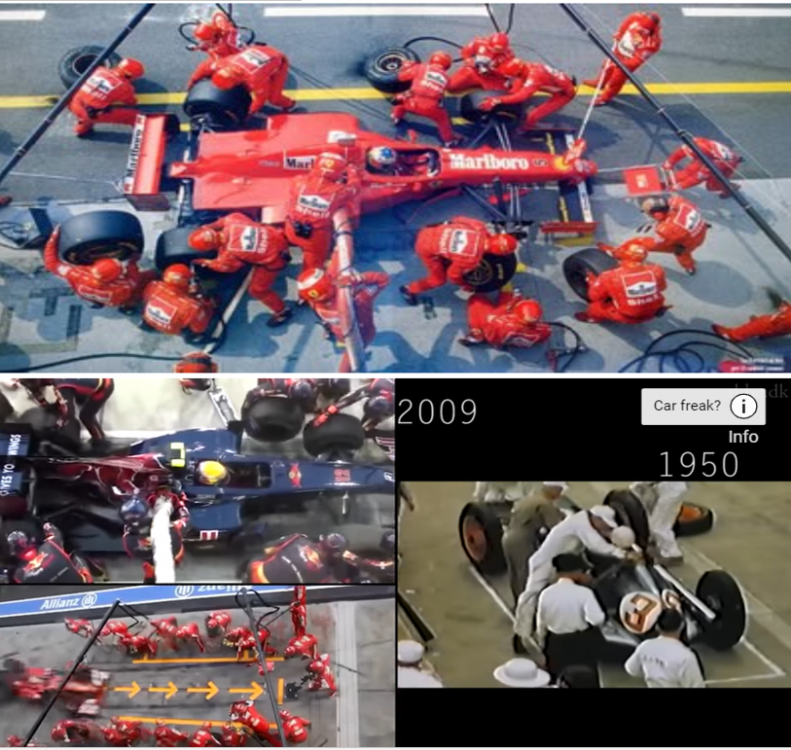
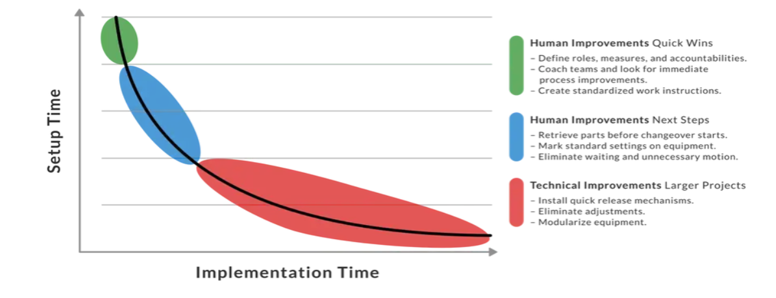
OTED – An Abbreviation for One touch Exchange of Dies and it is closely related to SMED (Single Minute Exchange of Dies) but OTED is much more difficult to implement than SMED. OTED is one of the more advanced and efficient methods of SMED concept that only occurs after many simpler Set-up reducing activities. Example – Pit Crew team’s Operations Improvement Over a Period of Time and Moving towards OTED from SMED Concept Image Source : https://www.leansixsigmadefinition.com/glossary/smed/ Ideally changeovers shall take < 100 secs OR even less than one minute. OTED Needs the following actions to take place : · Elimination of the adjustments · Freedom from screw fastenings · Moving towards strength and precision · Precise and close fits · The functional burdens of dies as compared to machines · The separation of die material and die function · Advanced Insertion methods The one-touch target simply means that an Exchange can be done with just a single motion, rather than following the multiple steps. An OTED aims to achieve the setup time of 15-20 secs against the set up time of single digit minutes in SMED. To achieve the SMED / OTED , typically below set of steps / operations are focused upon : 1. Develop and complete the external set-up checklist. 2. Develop and complete set-up reduction observation forms – Classify the activities into 4 buckets i.e. P- Preparation Activities, R – Replacement Activities, L – Locating Activities and A - Adjusting Activities. And also categorise the operations into internal / external. Internal Activities – Activities / Operations those can be performed when the Machine is shut down External Activities – Activities / Operations that can be performed even if the Machine is running 3. Convert the Internal Activities to External Activities – Most Important and Brainy Step 4. Bring Standardisation concept into the process operations 5. Use Clamps and One Touch Fasteners 6. Use Intermediate Jigs 7. Adopt Parallel Operations 8. Eliminate the Adjustment Activities 9. Use Mechanisation as last resort Set Up Time Reduction Benefits as Evident in below graph : Companies Using / Aim to use the OTED Concept in Automobile Sector : Some of the Examples of Evident OTED Concept in day to day Operations in Services and Manufacturing Sector : Services : Ø Reduction of Employee Onboarding Time from Month of Sigle Day / Few Hrs Ø Reduction of New system / laptop configuration time from earlier in days to few hrs Ø Account Opening process in banks earlier in days to now in with in hrs Ø Credit Card Issuance earlier in Weeks to now in 1-2 days Ø Shift in Entertainment Sector from earlier CD Writing / DVD methods to watch the movie / shows now to OTT platforms (Amazon Prime / Spotify etc.) Ø Notes Making in Educations Sector – Earlier Manually by students to now instant as instructor / teacher is speaking Ø Medical – Waiting for a specialised doctor for a complex surgery now to done locally by videoconferencing / telephony techniques Ø Concept of Agile in Software Development Manufacturing : 1. Reduction in Machine Set up Time in Toyota to Single Digit Minute or a minute with SMED / OTED 2. Reduction in Plastic Moulding Set up Operations time 3. F1 Pit Stops 4. Computerised Colours Mixing as per Shade Card against the manual earlier 5. Designing of shapes / building as per 3D Printing than earlier manually in designing softwares
 1 point


This leaderboard is set to Kolkata/GMT+05:30