

Topics
-
Jeff Bezos is pushing Prime Video's overhaul to highlight Amazon's AI. The project, known as Lighthouse, aims to showcase AI for millions of users. This initiative seeks to elevate Amazon's standing in the competitive AI landscape. New features will improve content recommendations and respond to spoken requests. Bezos' personal involvement underscores the strategic importance of this AI integration. View the full article
-
Advanced Micro Devices is launching new artificial intelligence hardware on Thursday. This new hardware aims to compete directly with Nvidia's offerings. AMD is targeting the growing data center inference computing market. The company also announced significant deals with AI labs Anthropic and OpenAI. These agreements position AMD for substantial future revenue in the chip sector. View the full article



Leaderboard
-
Mayank Gupta
Members2Points679Posts -
Shrikant Angre
Members2Points20Posts -
Johanan Collins
Members2Points72Posts -
RahulGarg
Members1Points28Posts


Popular Content
Showing content with the highest reputation on 07/23/2021 in Posts
-
2 pointsA lot of brilliant examples have been quoted by the participants. Answers by Shrikant and Rahul are a must read to get a perspective of the widespread application of this simple tool. However, one answer explains ECRS along with simple yet apt examples is from Johanan. Therefore, his answer has been selected as the winner!2 points
-
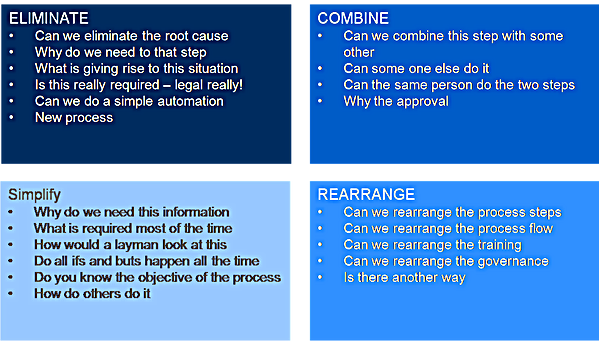
2 pointsECRS stands for Eliminate, Combine, Rearrange and Simplify. It is one of the lean method used in problem solving, in order to reduce or eliminate waste. When is this method used? ECRS is used when - Business requires immediate improvement from the problem state - Team is planning to implement lean methodology to achieve continuous improvement Steps to implement ECRS? Following is an example of Work Analysis Sheet that can be used - This method is implemented along with doers - First step is to draw the process map/process steps - Process map is to be drawn till the last level L1 .... Ln, in order to get minute details regarding the process or the work analysis - Capture all the relevant information related to the process like: Quality, Cycle Time, On Time, etc. - Once the above steps are done, then we should ask questions in following order 1. Eliminate - Can we eliminate this step? - What is the value this step adds to the process? - Can we automate this step? 2. Combine - Can we combine this step with other steps? - Can someone else do this step? 3. Rearrange - Is this sequence correct? - Can we re-arrange the step and thus get a better process flow? 4. Simplify - Why do we do this step? - Is this the best way to execute this step? - Can we completely/partially automate this? - Implement the best practices followed in the industry? How else it can be used? - This can complement PDCA method to achieve faster results - This can be combined with 5 whys and 1 H in following way Examples where ECRS is used: Example 1: Manufacturing companies use this in Single Minute Exchange of Dies (SMED) while doing change-over to ensure less production time is wasted or there is very minimal downtime. Example 2: Banking system has used ECRS very effectively in all the day to day transactions that a customer does with the bank.. Money withdrawal, transfer, deposit, cheque request, loan request, loan disbursal and every verification is done nowadays online Example 3: Insurance sector is using ECRS very effectively in rolling out insurance policies in shortest possible time.. They have automated, simplified, rearranged and eliminated a lot of redundant steps. Now we are able to take a life insurance policy sitting at home at click of few buttons.. Same is the case with claim intimation or hospitalization request. It is done with the use of apps and all the parties get relevant information from time to time Example 4: Airline industry is US and other leading countries are already using ECRS effectively.. Now in India as well it has started to a great extent. 1. Seat Selection 2. Getting boarding pass 3. Adding baggage and getting baggage tag. All this is done via self check-in Kiosks Example 5: Ecommerce Industry has been using ECRS very effectively.. 1. Product selection and Quantity 2. Product order 3. Address selection 4. Payment 5. Feedback capturing All these are simplified or done it such a way that customer is able to do these steps at any point of the day and at ease using easy to use apps and their features


 2 points
 -
2 pointsECRS or Eliminate, Combine, Rearrange and Simplify is a Lean technique. ECRS is used to reduce or eliminate wasteful steps from any business processes, be they a process in manufacturing or a process in the office. ECRS is a method that can be used for fast improvements. Eliminate: In a process which currently takes a certain number of steps, if we were to eliminate a step it would shorten the process. For funny example would be Tom Smykowski in the 1999 Cult comedy Office space, Tom’s job was to take “the specifications from the customer and bring them down to the software engineers”. The consultants eliminated his job as they had the customers directly send the specifications to the software engineers. A funny example from a cult classic but it does the job of explaining elimination. Combine: When elimination is not possible, the next step is to see if any of the steps in the process can be combined. A classic example would be the use of macros in Microsoft Excel. By creating a macro of multiple steps when working on a excel file you are combining all those steps together. The analyst does not have to do those steps again as the macro does it for him. Rearrange: When elimination or combining is not possible, rearrangement of steps is done to make the process safer, easier, or faster. A classic example of rearrangement of steps is Henry Ford’s assembly line for the production of cars. One of the main benefits was the reduction in the assembly of a car from half a day to under an hour. Simplify: When faced with a complicated process, simplifying steps is undertaken. This done to ensure that the process is easy to understand by the operators. Visual aids are an easy low-cost method of simplification. Sources: https://www.creativesafetysupply.com/glossary/ecrs/#:~:text=ECRS%20stands%20for%20Eliminate%2C%20Combine,processes%20or%20even%20office%20procedures. https://www.lean.org/LeanPost/Posting.cfm?LeanPostId=12452 points
-
1 pointECRS is a lean method / approach for process activity optimization, and if use this by keeping 7 types of waste in mind and combination with other efforts such SMED, 5WHY´s or 5S it will be a wonderful tool to implement. For clear understanding we can use the other lean manufacturing tools such as VSM (Value stream mapping) to identify the steps which can be filtered for ECRS scope. ECRS, stands for : · Eliminate · Combine · Rearrange · Simplify 1. Eliminate – Here, it’s important to identify the steps that can be quickly eliminated or not adding any value to the end output or kind of Non Value added in nature. Usually elimination is done for the steps that results in a cost. Overheads, reworks, material costs, etc. are possible targets for elimination. The critical requirement of elimination is to obtain same process performance with an improved efficiency. Questions asked in elimination step : · What is the possibility to eliminate root cause/ basic cause? · What is the importance of this step? 2. Combine - When work cannot be completely eliminated, then try to combine them. Here, see if two steps can be merged together and made as one step in place of two OR if any one person can do both the steps in place of 2 persons doing 2 different steps. Though it is efficient to break down a process into the simple operations; excessive handling of documented information, materials, tools and equipment may add to more time to be spent in maintaining the same. Such situations can be identified and improved by simply combining two or more steps. So when analyzing ECRS, team must evaluate possibilities to combine process steps as relevant. Questions used in Combine step : · Is there any possibility to combining this step with other steps? · Can someone else can do this step ? · Can the same person/ same machine do several steps in operations ? 3. Rearrange – Here, see if we can change the order of the steps to make the overall process more efficient. Rearrange is the least feasible option in real world scenarios of applying ECRS to process improvements, due to initial process flow design analysis in PDCA cycle designing stage. Questions used in rearrange step : · What is the possibility to re-arrange this step in the process ? · What is the possibility to re-arrange process flow from the current state ? 4. Simplify – The Golden rule here regardless of the situation is to simplify the flow anyhow. Usually, we want to Eliminate first but, if not, then Combine, Rearrange, and Simplify will be really helpful. After the steps of Elimination, Combining, Rearranging are done, the step Simplify is taken up. Here, the over-all process level issues are examined first and then the detail of the operation is studied. Questions used in simplify step : · What is the possibility to make this step simple ? · What is the requirement of collected information from this step? · How do others do this step? · How will a layman look at this step ? Lets see a real life examples of ECRS : How these 4 steps are covered in Telecom Revolution (Landline to Basic Mobiles to Android Mobiles) : Eliminate : Mobile phones have eliminated several old items from our day to day life e.g. Camera, Wrist watches, Alarm Clocks, Calendar, Diary etc. Combine : In mobile phones, there are lot of places where in several activities which are combined under 1 utility e.g. Clock Utility. Here, Alarm, Stopwatch, Timer and Clock functions are combined under this particular app. Rearrange : In earlier cell phones, when you were changing your phone you have to manually transfer your data / contacts but now there are apps available which can copy data as is from your current phone to new phone and create a mirror image of your data . So this step of data transfer is rearranged / redesigned. Also in earlier phones there was no favorites / option to add frequently used apps on home page and with the passage of time those things have been re imagined and rearranged. Simplify : Usage of dictionary and Auto-suggest of words has made the typing activity more simpler than it was before. Few Examples from Different Sectors / Companies using this approach :

 1 point
 -
1 pointECRS method for Process Improvement ECRS stands for Eliminate, Combine, Rearrange, and Simplify. This is a Lean technique used for removing wasteful steps in manufacturing processes or even office procedures. This can be better put together with a value stream map as well to identify necessary and complex steps within production lines. While first implementing ECRS, complex and time-consuming tasks are reviewed with the goal of successfully applying any one or all of the ECRS Strategies acronym. The end result is always aimed to streamline any process for workers and create a more efficient business as a whole. The four methods are: Eliminate – Identify the steps in a process that can be eliminated without decreasing production value. Ask questions such as: Can we eliminate the root cause? What is the problem with this situation currently? Do we need a new process? Combine – If nothing can be eliminated, see if any steps can be combined. Ask questions such as: Can the same person do both steps? Can we merge this step with another? Rearrange – Rearranging steps may help in making the process work faster, easier, or safer. Ask questions such as: Is this the best sequence of progression? Can we rearrange the process steps, process flow, or training? Simplify – Simplifying steps can make complicated tasks much easier to understand. For example, by providing visual aid or better equipment, process can be simplified. Simplifying a process helps in improving completion times and improve accuracy. Ask questions such as: Why do we need this detail? What is the objective of the process? How do others do it? The ECRS Lean technique helps in faster implementing application of new ideas after conducting brainstorming meetings for potential improvement opportunities with those who perform the task. This happens most of the time, newly designed or newly processes set don’t require money to be spent, it just requires restructuring and making improvements upon old procedures. The major advantage of ECRS is implementation, if something is not working in a planned manner it can be changed without overspending of money and resources on an unproven solution. When to use ECRS Technique o When we need Immediate Improvements o To produce quick practical ideas to make the process lean Variations o Supports PDCA (Plan-Do-Check-Act) o Can be done in templated form way, combining with 5W, 1H o Easiest way for Process Map Analysis How to do ECRS · Do it with the "doers" , it’s a lean technique · Draw the process map and write the every process steps · the steps should be mentioned in detail till the end - lower level ( should be "go to the printer" "get print out" and NOT just print) · Write any known information/data on the process steps Example, o no of errors o Amount of time to the activity o Show hand offs o Elapsed time : Difference between the amount of time elapsed between hand over and take over o mark rework loops o An optional or Alternate step should also be mentioned After the above steps, we should start asking questions · Eliminate - what if we don't do this step in an intended manner, does this step add any value . Example, instead of mentioning the printing and scanning step, can we directly turn it to PDF · Combine - which steps can be combined to be identified · Rearrange – which way the work to be performed in the best sequence · Simplify - why do we need this detail, is this best way to do it Example, can we create a macro , a calculator , can we automate this · Once we are done with the above exercise mentioned – we should go out on the floor and start implementing it

 1 point

This leaderboard is set to Kolkata/GMT+05:30