

Topics
-
Fifty-five women engineering students completed an AI bootcamp focused on rural Karnataka. Participants developed AI-based solutions after visiting villages and conducting field interviews. The She Innovates bootcamp partnered with several organizations to achieve its goals. This initiative aims to boost women's participation in AI and entrepreneurship. It encourages AI applications for rural development and community-focused sectors. View the full article
-
Besi's quarterly orders more than doubled, fueled by AI and hybrid bonding technology. The company saw increased customer adoption of its advanced chip packaging solutions. Demand for AI applications continues to drive growth in data centers. Besi anticipates revenue growth between ten and fifteen percent. This strong performance aligns with other semiconductor sector reports. View the full article



Leaderboard
-
Rajesh Chakrabarty
Members1Points87Posts -
Sundeep Kailwoo
Members1Points15Posts -
Titus Mehta
Members1Points1Posts


Popular Content
Showing content with the highest reputation on 03/09/2021 in Posts
-
1 pointAs Humans, we like to avoid pain- a propensity. The common notion is that people without the instinct to avoid risks or things that might hurt tends to die early. This is the core reason that you will see the habit/compulsion of cherry picking. “Cherry Picking” as the term suggests is based on the perceived process of harvesting Cherries, wherein the picker/Plücker, Picks the fruits which are “lowest hanging” ripe and easiest to pick and fill the basket. The acceptable or positive definition of “Cherry Picking” is the action or practice of choosing and taking only the most beneficial or profitable items, opportunities, etc., from what is available to meet immediate requirement. The negative connotation of the same can be that the easiest task/ project is done first and ignoring the other tasks in hand. Similarly, in any organization, selection of a continuous improvement project is a task which has the scope for Cherry picking in both the perspectives- positive and negative!! Ideally the criteria for selecting any project for process improvement are: - Customer Impact - Process Stability - Data Availability - Defect Definition - Impact on service quality There is no right or wrong order to prioritize the above criteria and most of the times the projects that suit the immediate need is selected. It is always most apt to keep in mind that the internal and external stakeholders are the people who will be effected the most by the process improvement project. Hence a well-planned project, with analysis of all the above mentioned criteria and impact is recommended at every opportunity to choose any project. Cherry Picking can be done both intentionally and unintentionally Advantages Of Cherry Picking in Continuous Improvement Programme - Most impactful projects are selected and thereby creates a sense of confidence in the top management- Investment in Sales improvement projects which brings in immediate cash flow - Sometimes projects which can be done based on similar successful projects, done earlier, with available insights and learnings are best suited to meet time constraints – Life improvement of sellable products which are nearing expiry date - Some of the projects that benefits the later projects / operations can be cherry picked – Training projects that will help in proposed operations in a new start up can begin, even before the operations is implemented. Disadvantages Of Cherry Picking in Continuous Improvement Programme - There is a chance of ignoring the better project options, with better impact – The Online marketing may be an easier and more cost effective methods to reach out to customers- This is so more obvious in these times of pandemic- But customer engagement is a continuous improvement project and Online marketing may be missed out by the customer as it is far too overwhelming in these times… maybe a telephone call would be a better option. - Sometimes the output of cherry picked projects are not permanent or sustainable and can defeat the whole purpose- Sourcing easily available Imported ingredients in a product can be a risk and continuous production may be difficult if there are any issues in importing. A local sourcing or local development of the ingredient is a better option. - It is not a good idea to cherry pick in a new project, which has no previous benchmark or simulation to compare with- The risks of choosing inappropriately is high.- Example in teh improvement project for some life saving medicine As deemed from above, it is obvious that the cons of the practice is more damaging for an continuous improvement programme as it is a practice that neglects, overlooks or directly suppresses scope of researched action that could lead to better improvement to any process. Hence “Cherry Picking” is not what I would recommend unless the required criteria and output is analyzed and/verified.1 point
-
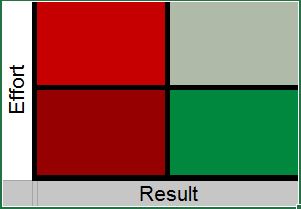
1 pointCherry Picking a task or a project may yield quick results but most often taking too narrow a view strategy in a larger scheme of things. Also, the level at which the decision is made to invest, and take up a project in an organization or CI as a function is relatively dependent on the hierarchy at which the decision making is taking place. A cherry-picking exercise done at the higher hierarchy level may not be the same for a decision-maker who lies at a lower level of the hierarchy pyramid. But if we base the decisions to take projects basis the Effort Vs result Matrix as shown in the attached image irrespective of the position the decision-maker is at, invariably the projects, tasks that fall in the 1st Quadrant can be identified as easy pickings, cherry-picking when it comes to selecting a project. Low Effort Low Result (Impact), the projects that lie in this space are invariably replications ( Small Automations eg. Macros, Formulas, etc. driven ), easy process fixes ( E-Bay(Enhancement Bay, Power hours, Cheat Sheets, etc.,) low investment relatively high Return or positive ROI projects. Some of these quick fixes may become redundant when a strategic solution is implemented to address a larger cross-functional, cross-process improvement. Hence it becomes important that the break-even to realize the proposed objectives are monetized in a short span of time. Some of the Pros of Cherry-picking when it comes to selecting Continuous Improvement projects : 1. Low Cost - Most of the issues addressed by such CI projects are the basis to the process where the improvements are being implemented . The change proposed wouldn't need too much tech cost and manpower cost and can be done parallelly to the core functions that if being performed by the Project team currently. Eg.- Developing a VBA Macro by a Team member or an IT resource within the account to automate the file merge process, where the team is supposed to manually merge different files to start working on the actual value add work. The cost to develop and deploy such automation will be very low but the Cost Savings in Man hours saved could be high and also mistake-proofing can be achieved through this change. 2. Less Disruption - Such Projects don't alter the nature of the work too drastically and the improvement can be implemented while doing the process without much disruption / deviating from the current flow. Eg: Team struggling to follow call flow and the basis Troubling shooting process, a Cheat sheet with Call Flow and appropriate probing questions in each Flow Step can be shared with the team for Quick reference. 3. Team Engagement in Process improvements -Not all improvement ideas may come from the CI team but invariably its the people who are doing the job on the floor to identify the improvement opportunities, sometimes big, most often small but significant, that impacts the tasks that they are performing. It's very important that the core team that is carrying out the core operations of the process feel empowered and involved in not just performing their tasks but also feel that their inputs, suggestions, and ideas matter, and Feedback is actioned upon. This is where the Cherry Picking exercise will yield results, where small yet effective improvements can be accepted for implementation and the Employees are recognized for their efforts and innovation. Some of the Cons of Cherry-picking when it comes to selecting Continuous Improvement projects : 1. Fails the Test of Time / Stability - At times the quick fixes achieved through cherry-picking improvement opportunities may become irrelevant in case of a small process change . The improvements deployed today may become useless due to uncontrollable factors like , Client Process Change, Input Change, Output Change, etc. Eg. - A Macro deployed to address a File Compilation process works only when the input is in the form of an Excel file, but of the Input now changes to word or PDF file input, the automation will fail to operate for what it was built for. The same is the case even if the input remains constant, but the output expectations change, the Improvement deployed will be rendered useless. 2. May not integrate with Strategic Direction of the Organization / Function - Some of the Improvements that may be deployed over time may become isolated and ultimately redundant if the function or organization plans to deploy a strategic solution to address overall functional needs. So the investments and time spent to onboard the changes that were selected through cherry-picking will be discarded. Eg.- A team deploys a process change how they are integrating different data sources manually to produce functional Metric Dashboards, that require tech investment and human involvement, this tactical solution for the team will be out of use once the Strategic solution for a Function wise CRM is implemented. 3.Lower ROI - Cherry Picked projects may yield a positive ROI but when compared to other Functions and another ROI impact, the cumulative ROI of such projects may not be as significant as other strategic solutions and Projects. Cherry Picking may result in Quantity of the Improvement projects but will fail in terms of the Bottom Line or Top Line impact of an Organization.
 1 point
 -
1 pointOne must firstly understand the term "Cherry Picking" and its origins completely to assess its pro's and cons. I believe that Peter Suber in his book "One-Sidedness Fallacy" who's title rightly mentions too, cherry picking can be a one sided approach to selecting something, It does not mean that your argument or premise is false or wrong it only means that it is incomplete or not fully sound. Take for example the literal interpretation of the term, to pick cherries - as a visitor to a farm, if I were to pluck the good looking and shiniest cherries from the tree confidently believing that they will be the best or tastiest, I may be in for a surprise. For in the eyes of the farmer it isn't about the outer appearance only but also the ripeness of what is happening inside the fruit also the consistency in texture, shape, etc could tell us which fruits are the tastiest of the lot. As we put this same logic to our work - life situations, we many times realize that perspectives of various viewpoints play an impact in the things we do, invest or participate in. This can also crucially decide the fate of your decision to be a success of a fail, a profit or a loss. Therefore, let us further understand how this selection process can affect or be beneficial for our project. This shows us that 2 or more arguments will help us achieve a reasonable amount of information making our decision one that has a strong structure of key points that will create a stronger and effective impact. Cherry picking, may not be the best approach. However it may be essential on certain aspects and in certain areas to an extent. It may also help in the elimination of creating waste. For example in selecting a quick lean project at the workplace during a brainstorming session individuals may bring to the table a varied number of problem areas to work on. Engineering on some engineering issues, customer service with some customer related problems, admin with some administrative processing problems, etc. though each area is crucial and important you as a manager can look at the future interest of the companies goals which might not be in the light yet and cherry pick on a particular departments issue to work on. This may not go down well with the other departments but explaining to them how a future goal which could cause damages to the organization can be averted by giving priority to this project might justify your choice over the groups. This could also play out on a flip side where a bias manager who leans more toward marketing goals and sales targets or HR practices and other such roles could cherry pick a situation based on benefiting his or her personal achievement of respect among his subordinates or teams, also to benefit the teams by achieving their targets and making life at work easier for them first, etc. This can have a detrimental effect on the organizations critical areas that need to be addressed first. Ironically, I too have faced this recently where in I led a meeting cherry picking areas I enjoy working on such a creative solution areas for a companies improvement strategy for the future. My passion being creative innovation and brand identity management and all things creative from a user interface and experience point of view, I completely missed the boat and luckily a close friend on the clients team pointed that maybe we need to also focus on some backend as it has been causing some concern. I had to apologize and found out that an innovative change in the ERP system and CRM system was actually the only innovative solution they required, having completed these two tasks we saw massive growth and true value creation was achieved. Therefore, it is very important, when selecting continuous improvement projects we need to assess the idea from various perspectives not just ours and see if we are in any way cherry picking where it is not the right approach. We must also always remember the quote that was made famous by Edwin Rolfe and Lester Fuller in 1946 “You can never tell a book by its cover.”1 point
This leaderboard is set to Kolkata/GMT+05:30