

Topics
-
Fifty-five women engineering students completed an AI bootcamp focused on rural Karnataka. Participants developed AI-based solutions after visiting villages and conducting field interviews. The She Innovates bootcamp partnered with several organizations to achieve its goals. This initiative aims to boost women's participation in AI and entrepreneurship. It encourages AI applications for rural development and community-focused sectors. View the full article
-
Besi's quarterly orders more than doubled, fueled by AI and hybrid bonding technology. The company saw increased customer adoption of its advanced chip packaging solutions. Demand for AI applications continues to drive growth in data centers. Besi anticipates revenue growth between ten and fifteen percent. This strong performance aligns with other semiconductor sector reports. View the full article



Leaderboard
-
Mohamed Asif Abdul Hameed
Fraternity Members1Points78Posts

Popular Content
Showing content with the highest reputation on 08/02/2019 in Posts
-
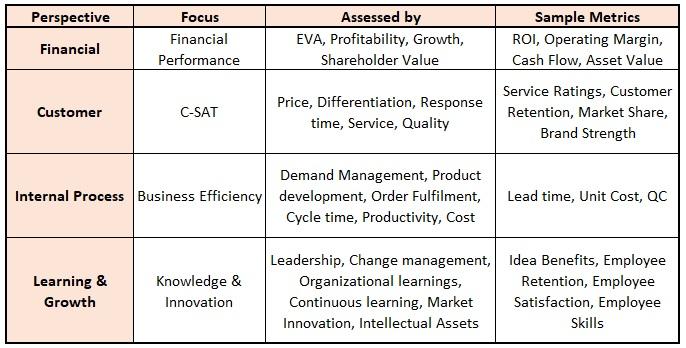
1 pointKaplan and Norton’s Balanced Scorecard helped in measuring the performance of the business in terms of both Financial and Non-Financial metrics. It was developed based on four perspectives viz. Financial, Customer, Internal Process and Learning and growth perspective. It is a powerful tool and the Objective of Balanced Scorecard is to create Cause and Effect logic for Organizations strategy goal. Below is the representation of the Balanced Scorecard framework: Each perspective would have objective, measure, target and initiatives for goal conversion. For instance, Objective: “Cut Rework cost” Metric: “Annual Savings”, “Cost of Poor Quality” Target: By 80% Initiatives: Replacing manual inspection with Automation; Implementing Mistake proofing in Operations Principles to remember when mapping goals into perspectives • Follow Cause and Effect Logic Between perspectives • Mapping business goals • Align KPI’s with Goals Balanced Scorecard is mostly compared with the Performance Pyramid model as both are methods of strategically driven performance management systems. Some of the Advantages of Balanced Scorecard includes: • This tool helps organization to create breakthrough performance • It helps in making strategy operational • It acts as a vital component in device integration • It drills down organization level measures to functional measures Balanced Scorecard becomes ineffective under below scenario’s • When there are too many performance Indicators • When everyone in the organization is not involved • When the metrics are poorly defined • When KPI’s are insufficient • Lack of Planning • Lack of Communication • When there is no balance between the four perspectives • When Leadership is just focusing on Financial metrics / Performance • It does not have Infinite Shelf life When Balanced scorecard is not updated in regular frequency (Sustainability would be an issue) • When using the tool for Strategy Formulation (It is a tool for strategy implementation) • Not capturing voice from external stakeholders apart from customers such as from Suppliers and public authorities • It doesn’t include environmental factors and metrics that can influence overall performance of the organization • When it takes time for Implementation/deployment, this is mainly because of the below reasons No proper understanding of Balanced Scorecard Lack of Management Support for implementation No proper training Inadequate Information Technology support Other cautious elements/disadvantages of Balanced Scorecard would include • High implementation cost for deploying balanced scorecard (number of employees trained * training hours * Cost per hour for FTE) • Objectives to be defined clearly (SMART) • Four perspectives do not provide holistic end to end picture • It doesn’t provide recommendations as output • It takes time to measure the output and its time-consuming process • Translation strategy into objectives needs to be accurate • When Cause and Effect relationship is inaccurate it can lead to inappropriate performance indicators • Lack of validation: It doesn’t provide mechanism for maintaining the relevance of the defined measures. • When there is lack of integration between strategy level and operation level metrics (It is not bi-way process) • Competitor analysis is not a part of the framework To overcome these limitations, companies should focus on the below parameters, Emphasis: Instead of considering all the available metrics and taking it to balanced score card, take only the metrics which matters, “Vital Few” and focusing on the metrics would give tremendous results Validation: Validate metrics, KPIs, objectives, strategy link. Ensure cause and effect logic is validated Clarity: Organization should have clear communication plan to clarity its strategy @ all levels – factory, mid management, senior management. Strategy should flow from top management and cascading goals should be done with utmost attention Integration: it is significant and essential for an organization to ensure balanced scorecard is successful. Integrating performance measure with the development practices would ensure the initiative is effective. When setting up Balanced Scorecard, we will have to focus on below points: Define / Evaluate: Vision & Mission, values, communication and change management plan Set Strategy: Aligning Organizations strategy with themes, results and perspectives Set Objective: Strategic objective categorized and drilled by perspectives and aligning cause and effect linkages Strategy Map: Extend the map organization wide, thus creating Enterprise wide Strategy Map Performance measures: Objectives, measures, target and initiatives are set and measured Accountability: Involving everyone in organization and assigning responsibility and ownership of the performance measures Assessment: Assessing the performance and monitoring the progress to ensure strategic objectives are aligned Alignments: Alignment / Realignment is done carefully for successful deployment Evaluation: Evaluate result for sustenance
 1 point
This leaderboard is set to Kolkata/GMT+05:30