


Setu Bhardwaj
Members
-
Joined
-
Last visited
-
Setu Bhardwaj changed their profile photo
-
Q 384. What is the ECRS method for process improvement? Explain with examples. Answer : What is ECRS: ECRS is one of the easiest problem solving skill or approach which supports to PDCA. It is one of the lean improvement methods too. ECRS stands for Eliminate, Combine, Rearrange and Simplify. Intention behind using the ECRS is to lean the process by identifying the waste reduction opportunities by asking right ECRS questions. When to use ECRS: Need immediate improvements To get quick practical ideas to lean the process Opportunity to combine this approach with others like PDCA & 5W for improvement ideas How to use ECRS: 1. Define the right project team 2. Include doers and SMEs as it’s a lean technique 3. Draw the process map on white board 4. Process steps at minute level 5. Make the process data centric like # of errors / defects # of people involved Time in minutes or hours at each step Time between hand over and take over Specific mark the process loops 6. Ask specific relevant questions on ECRS approach like Eliminate – if we don’t do this step than what will be the positive and negative impact Combine – what all steps we can combine together Rearrange – The current sequence of processing steps is right or can be changed Simplify – find out any other alternate or easiest way of doing it by using any macro, tool, tracker or streamlining the process 7. Once all the opportunities are identified than validate and implement the solutions Most of the companies follow the ECRS worksheet template and it is useful as well. Following is the snapshot for same. Also there are few basic questions those can be asked while working ECRS exercise under each component:


-
Question. What is Parkinson's Law of time management? List down bullet points on how it can be used to improve productivity of a team? Answer. What is Parkinson’s Law of Time Management? Parkinson’s Law in simple words that “the amount of work required adjusts to the time available for its completion”. Parkinson’s Law says that people in an organization often spend unnecessary time and give attention to small matters. There’s also social loafing, in a group projects “people tend to put ¼ efforts than they would put on their own solo project.” Parkinson’s Law benefits to increase the productivity? This law says that whenever there is kick off meet to initiate the project, it becomes successful when we have cleared out the expectations with everyone on how the team will approach on project asks. Here are the few basic and important asks those should be well considered during kick off meetings: 1. Well defined the project vision and problem statement – it is always important for a project success to define the clear importance or impact associated with the project or task to entire team 2. Well defined roles and responsibilities by using DACI framework D = Driver. The one person who is responsible for collating all the important information to share with stakeholders, leaders and connecting with them continuously to give status updates and getting their thoughts or visions as per the agreed timeliness. This person may or may not be the project’s full-time owner. A = Approver. The one person who makes the decision. C = Contributors. They have knowledge or expertise that may influence the decision (i.e., they have a voice, but no vote). I = Informed. They are informed of the final decision. 3. Well defined project in and out of scope – Project team and owner should agree upfront about what is in and out of scope for the project. 4. Well defined project tasks or trade-offs - like project timing, scope, and budget are the most common areas to be considered and prioritized 5. Well defined and agreed timelines – agreement on project milestones and deadlines for various project tasks and sprints
-
The BLINDSPOT analysis is a strong decision making tool which is primarily used as a solution for strategic decisions and has the long term impact on entire organization. This analysis is actually uncovers dangerous, incomplete and outdated assumptions that can prevent organization from wrong decisions. Even though every organization do very well pre framework to make company level decisions but still decisions found wrong or can say not in favor or company / employees / clients. Some important and basic factors have been missed or we can say “blind spots” were missed while making the correct decisions. Blindspot analysis can expose inadequacies and make it easier to highlight all old ideas. Blind spot can patent in below 3 ways: Management ignores the strategic important issues. Management know the important issues but interpret them incorrectly Management knows the critical issues and interpret correctly but discovers it late and as results also acts as late. Identifying the important and crucial factors before making important decisions is a very vital exercise. Following are the 3 Ways to identify the blind spots in an organization: History Data: Find out the history data which lead to reach out the decisions has been taken. All the arguments need to be read thoroughly with the intention / context behind it. External perspective: Organizational decisions need to be overlooked from an external perspective. It should be done by using public information, social media to understand how organization has outlined itself. It gives understanding how outsiders think on the decisions made. Comparison: Results of Step 2 and Step 1 are compared and whatever gaps / contradictions are seen are potential blind spots Blind Spot Analysis benefit the business in: To identify flaws in decision making To improve strategic thinking It involves third eye from external party (similar industry kind of) to know what others think on the decisions
-
Q. LIFO and FIFO are two commonly used methods for inventory management. Explain the differences between the two methods and provide examples where these are used. Answer: LIFO and FIFO are the terms those are used in inventory management or cost of goods sold. Abbreviation for these two is “Last in First Out – LIFO” and “First in First Out - FIFO”. FIFO – means the first item of the row / bucket will be sold out first from the inventory. In FIFO it is assumed that inventory items are sold in the order which they are manufactured or purchased. Means oldest inventory is sold first. FIFO method is generally adopted by most of the organizations which shows the actual flow of goods are manufactured. For example: A grocery store buy the 10 cans of fresh juice every day. Owner will ensure to keep the juice in a manner that older one is in front of the shelf so that older one is picked first by customer. It will not let the older one wasted. FIFO is mostly recommended for businesses that deal in consumable products. Why FIFO? 1. It is easy to use and follows the physical flow of inventory goods 2. It has less wastage of goods, which shows the effective utilization of inventory. LIFO – means the last item or more recent item purchased or manufactured in inventory to be sold out first. When the good’s price is increased, cost of goods sold is also higher in LIFO which reduces the inventory balance on lower side. For example: The electronics dealer sells out the Air Conditioner in off season around 30K rupees but in summer season same AC will be sold out at 35K-38K. Using LIFO causes a firm’s cost of goods sold to increase and the net income to decrease. LIFO is preferred in product-based companies which does not deal in consumable items. Why LIFO? 1. It complies with the matching principles as it charges costs with the revenue of a similar period 2. Reduces the possibility of write-downs of inventory if their fair market value has decreased LIFO generally leads to separate calculations which goes for extra manpower or extra efforts.
-
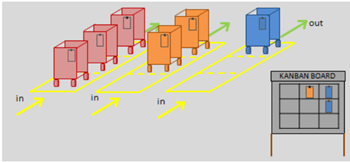
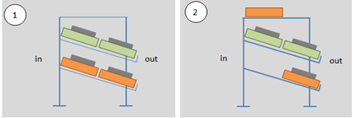
Question : What is a supermarket in lean six sigma? What are the characteristics of a good supermarket? Answer : Supermarket in Lean is a location where all the predefined / predetermined inventory is kept to supply the downstream processes. Supermarkets are designed in a way that helps to fulfil the customer requirements quickly. Supermarket carries the necessary “supplies” for a work area that is close by. When a customer needs an item so they can visit any nearby supermarket and retrieve the items from there. In supermarkets its easy to identify what item a customer needs due to the well-defined KANBAN boards and Bin System. Supermarket staffs keep a check in their systems and dedicated places / bins to replenish the material as per the downstream demand. These supermarkets prevent overstocking and help lower inventory levels. Supermarkets are basically a group of centrally located Kanban: The central location is to allow ‘customers’ the time saving benefit of one stop shopping and supplier consolidation In Lean thinking This central location should be located as close as possible to the customer(s) and not confused with a buffer stock that may be held within the production chain. Characteristics of Supermarket: Strong tracking mechanism of process / store inventory Fulfils the customer requirements / needs quickly Customer is need not to struggle in finding the items / parts as it is displayed in well defined KANBANs and placed in proper BINs / boxes centrally Pull system Prevention of overstocking and over processing Supplies as per demand Cost benefits to the organization Time savings for the employees and customers Easy to reach for the customers Visuals on Kanban and Bin system:
-
Question : What is an "Obeya Room"? Why is it necessary to have one for large cross functional projects? Answer: Obeya is a Japanese word which means a “Big Room” or “War Room”. This room is used in workplace to get employees out of their workstations, offices to a central location where they all meet and discuss the key information and identify the solutions for business problems. This room helps employees to come out of daily ongoing deliverables which helps them to think out of box on the ongoing problems / challenges with fresh mindset as a team. The purpose of these rooms to improve collaboration, alignment and speed of problem solving. Employees in this room communicate face to face with each other and collaborate on the work and post information about the work on the walls with colorful stickies which is visible and understood to everyone. Obeya rooms are very much important if we have to run a large project where we have multiple teams or departments included because : by using Obeya room we have all the people in one room and they can openly share their dependencies, challenges and opportunities in one go which gives clear understanding to the entire group on the road blocks and possible improvements. For example of a Warehouse, XYZ company is looking to boost warehouse safety and will include people from various departments like: Engineers to discuss new equipment Safety managers to review ongoing safety concerns Warehouse workers to discuss challenges on the working floor Human resources representatives to analyze and communicate new policies. This obeya might host charts, images, maps, and more to convey the concerns, along with whiteboards and other collaborative materials that allow employees to find solutions together. What we need to run Obeya Room? Every company has their own different work culture and different work hence we cant expect the all Obeya rooms will be similar or 2 Obeyas will be similar in one organization. But still there are few core and important elements those in obeyas to include : Charts, graphs, and drawings (to depict a project’s progress, milestones, timing, schedules and other timely data) Desks / tables for project leaders Anything else to facilitate strategic problem-solving like any tool for real-time displays, computer systems, any pole system or more
-
Question : Is it necessary to have both a sponsor and a champion for a successful lean six sigma program? Explain with examples in support of your response ? Answer : Yes, Project Sponsor and Project Champion both are important for a Lean Six Sigma program. In some of the organizations these roles are played by one person only. These roles are important to keep our stakeholders up to date on the project status and to move the project towards success. There are lot of communication needed between the project team and stakeholders towards project success, roadblocks, project tracking, project mission and vision, project outcomes, business requirements and change management. All these responsibilities are very well managed by sponsor and champion. Some of the core responsibilities are mentioned below which shows the importance of these roles : Project Sponsor: sponsors a specific lean six sigma project and understands the lean six sigma advantages and is primarily supporting on financials of a project followed by the project objectives and goals. Project sponsor approve the project goals, objectives, project scope and project metrics as per the organizational strategies or should say the (Approves the project charter) Project Sponsor obtain the budgets to align the technical and non-technical resources LSS project Project sponsor to take critical decisions at times of project completion as needed Project sponsor is authorized to approve the project toll gates on each DMAIC phase. Project sponsor has sufficient knowledge on the financials of the project and can review the progress of the Project without any difficulty. Project Champion: promotes the continuous improvement initiatives throughout their organization. Project champion secures training and mentorship for Black Belt candidates and makes sure the resource availability conflicts. Project champion resolves any cross-functional team issues that may occur. Project Champion plays a pivotal role to remove the roadblocks that may impact the project success. Project Champion is responsible to track the project success and keep the Leadership informed Project Champion set the direction of process improvements in the organization. They link the benefits of the project to organizational priorities. Project Champion can create a portfolio of projects which could range from projects in Customer Satisfaction, Service, Cost and Quality. It provides the Champions the visibility in the process and also showcases his abilities to top-management to manage varied portfolio of projects. Project Champion is also authorized to approve the project toll gates on each DMAIC phase. Thus, both the roles has crucial responsibilities to play for a LSS project success for an organization.
-
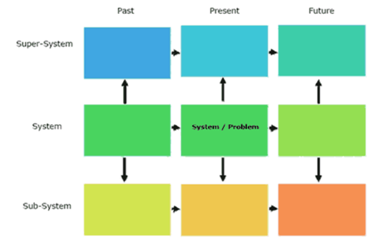
The NINE windows technique is a method for exploring issues and its impact by examining the past, present and future areas. This technique is often used to ensure that companies change and evolve without realizing the past tactics might not work in present or future. Process is always meant to change, and we should have change acceptance. This technique is basically is Idea creation tool to ensure that companies, teams and individuals do not stop ideate, innovate or developing new ideas to improve the existing process, service, system and products. This technique helps us to segregate the problem in space and time standpoint. This technique has following 8 routine which challenge the status quo : 1. To have a model of the solution or the root cause. 2. False assumptions (trusting the data). 3. Specific terminology in a language that is a strong carrier of psychological inertia. 4. Experience, expertise, and reliance upon previous results. 5. Limited knowledge, hidden resources, or mechanisms. 6. Inflexibility (model worship), trying to prove a specific theory, stubbornness. 7. Reusing the same strategy. 8. Rushing to a solution, incomplete thinking. All of the above routines / causes can be improved by nine windows. This technique helps organizations and teams to explore a problem in past at both the super and sub system level. How to use NINE windows. Below is the sample image to use the Nine window technique. Explore the problem at all 3 levels. 1. System: The problem or system that was created 2. Subsystem (or Micro system): A component or parts of the problem or system 3. Super-system (or Macro system): External environment and components that the problem or system interacts or may interact with Example – Digital image. What is the direction for future?

-
In Manufacturing unit Lean is a strong methodology to follow and “Standardized Work” is one of LEAN principles to be used rigorously. Standardized work is used to make products in the safest, easiest and most effective way based on current technologies. This lean principle is based on three elements: 1. Takt Time – Takt is a German word and being used for pulse or beat in music. However, in manufacturing unit TAKT stand for the important measure of output against demand. TAKT time is the rate at which we need to complete the product in order to meet the customer expectations / demand. Takt is calculated by dividing the available production time by customer demand. Example : Working in a customer care call handling time always monitored in terms of AHT, ATT etc. Benefits of Takt Time · Bottlenecks are quickly identified · Non-Value-added activities or process / product waste can be identified quickly · Quicker to identify underperformers 2. Work Sequence – is the step by step detailed operating procedure which need to be performed / completed by operators within TAKT time to meet the customer demand. Example : The entire process, scripts, product details, escalation points are documented in a document which can be follow by Agents on each step. Benefits of Work Sequence · Standardized and streamlined processing / product manufacturing steps · Easy to identify the kaizens at each step level and do improvements accordingly 3. Standard Inventory – is the tracking mechanism to keep the focus on at least minimum quantity of parts, raw materials, resources to run the smooth operations. Example : Basis on the call volume the average handling time helps to decide how many resources we would need or can say we need people to work for how many hours. Basis on that the required agents calculation is done and accordingly forecasting is performed for future requirement. Benefit of Inventory – It helps to forecast the resource crunch in advance which helps to maintain at least minimum resources to operate the business.

